
Parenting ADHD Kids: Dr. Amy Shares Myths, Tips, and Advice About Online Advice
About this Episode
Are you parenting ADHD kids and wondering how to filter through all the ADHD advice out there? Absorbing information online during ADHD Awareness Month can feel like drinking from a firehose. Everyone has a tip, a reel, and a strong opinion leaving parents asking a real question: who should we trust and what actually helps a child with ADHD in daily life?
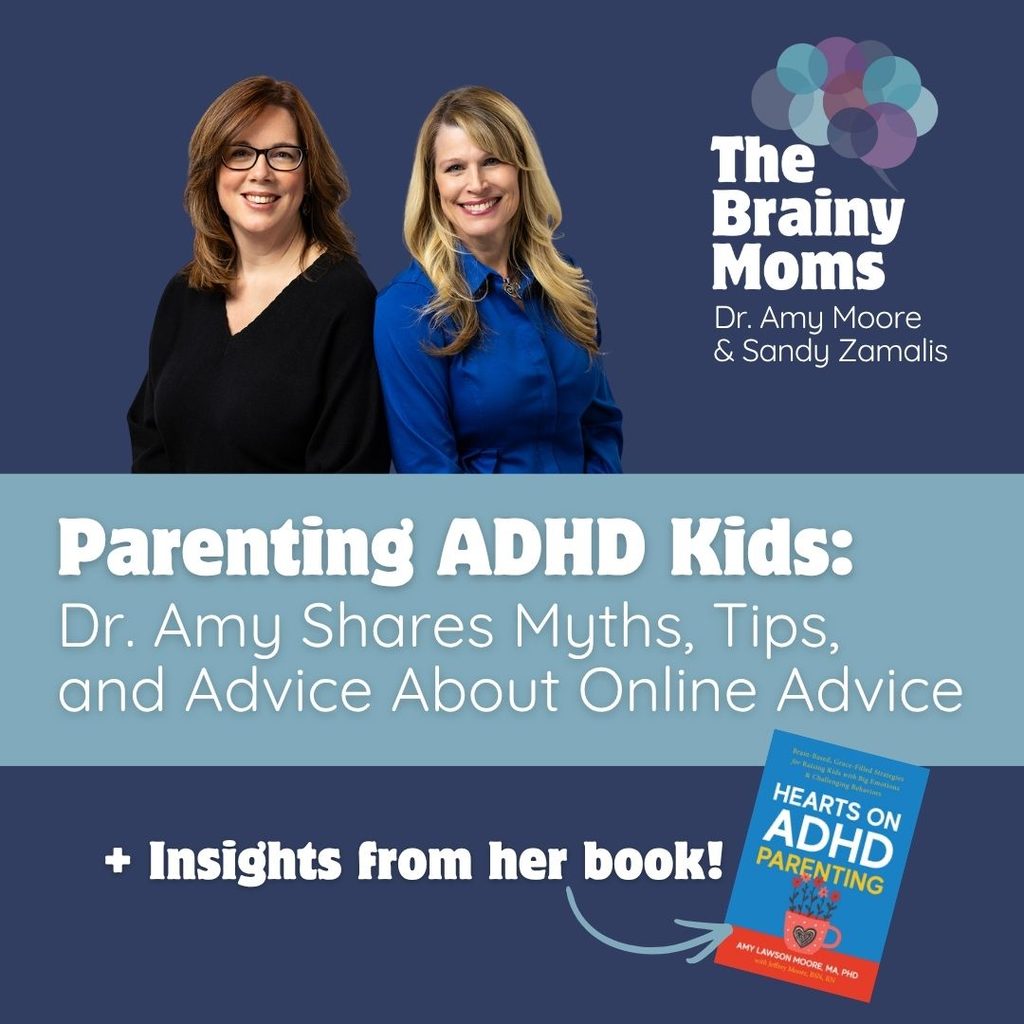
On this episode of The Brainy Moms Podcast, we celebrate the launch of Dr. Amy’s new book, Hearts on ADHD Parenting: Brain-based, Grace-filled Strategies for Raising Kids with Big Emotions and Challenging Behaviors.
Cognitive Psychologist Dr. Amy Moore describes how her book is a little different than most ADHD parenting guides: it comes from decades in the trenches with neurodivergent kids and their families, her counseling and research experience, her faith-informed lens of grace, and her lived experience as an ADHD mom and a mom with ADHD. (Plus her husband adds humourous but vulnerable commentary throughout the book.) The core reframe is simple but hard: ADHD parenting is not about “fixing” our chid’s behavior. It’s about reading behavior as communication, looking for unmet needs, and building our own emotion regulation so we can access grace and lead with curiosity and flexibility.
Because it’s ADHD Awareness Month, Dr. Amy and Sandy have some fun with a rapid-fire myth game that tackles what parents hear every day: “ADHD isn’t real,” “it’s just a focus problem,” “video games prove they don’t have ADHD,” “kids outgrow it,” “smart kids can’t have it,” “everyone’s a little ADHD,” and “ADHD is a superpower.” We dig into hyperfocus, time blindness, co-occurring anxiety or autism, and why structure, routines, timers, movement, and outside reminders can be game-changing supports. We also talk ADHD nutrition and brain health, including omega-3 fatty acids, artificial food dyes, sugar, pesticides, and why exercise and even martial arts can support executive function.
If you want solid advice from a true ADHD expert with clearer next steps, hit play. Subscribe, share this with an ADHD parent who needs it, and leave a review so more families can find the show.
About Dr. Amy Moore
Dr. Amy is a quirky and klutsy cognitive psychologist, Christian counselor, clinical researcher, child development specialist, podcast host, parent educator, and author. She’s the Director of Psychology & Research at LearningRx World Headquarters in Colorado Springs, CO where she specializes in neuroplasticity research for neurodevelopmental disorders like ADHD along with brain injury and learning disabilities. Her brain training research has been published in peer-reviewed medical and psychology journals and presented at conferences around the country.
She has a PhD in psychology and a master’s degree in early childhood education, and has worked with neurodivergent kids and their families for over 30 years. Dr. Amy has worked in private, public, non-profit, and military organizations supporting kids and parents her entire career. She’s an ADHD mom and a mom with ADHD…so she gets the struggle from multiple perspectives. Her brain is neurodivergent, and she has a hard time with sensory processing, emotion regulation, and large motor coordination. And she makes fun of herself about it all!
Dr. Amy is married to the amazing Jeff Moore, a retired Air Force fighter pilot now working as a surgical nurse. (He’s a classic overachiever like she is!) Their book, Hearts On ADHD Parenting: Brain-Based, Grace-Filled Strategies for Raising Kids with Big Emotions and Challenging Behaviors, is available now! They have three incredible adult sons (ages 21, 25, and 27) and a very mischievous but super soft Siberian cat. Originally from South Carolina, Dr. Amy has called Colorado home since 2006.
Website: www.AmyMoorePhD.com
Find Dr. Amy’s book, Hearts on ADHD Parenting: Brain-based, Grace-filled Strategies for Raising Kids with Big Emotions and Challenging Behaviors, at all major booksellers or here:https://a.co/d/01IkKZEN
Watch her TEDx talk, Lessons Learned from Training 101,000 Brains
Read her research: https://www.learningrx.com/brain-training-research/
Free Downloads from our Sponsor, LearningRx
Download the free ebook, Unlock the Einstein Inside: Wake Up the Smart in Your Child
Download the Brain Training Game Pack
Link to our sponsor’s website: www.LearningRx.com
Listen or Subscribe to our Podcast
 Apple Podcasts
 Google Podcasts
 Pandora
 Spotify
 iHeartRadio
 TuneIn
 Stitcher
 YouTube
Watch this episode on YouTube
Read the transcript for this episode:
Welcome And Book Celebration
Dr. Amy Moore 0:00
Hi, smart moms and dads. Welcome to this very special episode of the Brainy Moms Podcast brought to you today by Learning R X Brain Training Centers. I’m Dr. Amy Moore here with Sandy Zamalis. And this is our kickoff to ADHD Awareness Month because it’s ADHD Awareness Month. And you have a book. And I have a book. Yes. For those of you who are watching us right now, you can see it in my background that my book, Hearts On ADHD Parenting, Brain-Based Grace-Filled Strategies for Raising Kids with Big Emotions and Challenging Behaviors, launched on September 29th. Yay! Yay! There should be like an applause button. Right. Or one of those uh confetti cannons.
Sandy Zamalis 0:47
That would be awesome. That would be awesome.
Dr. Amy Moore 0:52
Well, we’re super excited about your book. I’m super excited about my book. It’s been um a long uh time coming. And so I’m really happy um to finally have 30 years worth of work um put into something that parents can uh hold and take away and um have advice about.
Sandy Zamalis 1:20
It’s always fun like to watch uh authors get their book for the first time because it’s just so pretty. You just want to like, it’s like you’ve given birth, right? Now here’s your baby for the world. And it’s just such it’s just so pretty. And I’m sure like the pages are fun to feel and it’s just got everything about your personality included in it. So I hope you’re enjoying it over there.
Dr. Amy Moore 1:46
Absolutely. And you can see that uh book box opening on my Instagram account. Um, I cry a little bit uh because it it was a really emotional moment, yeah, for sure.
Who Should You Trust On ADHD
Sandy Zamalis 1:58
Well, because it is ADHD Awareness Month, um, there seems to be so much ADHD advice everywhere on social media, books, webinars, summits on the news. What can we help parents with today? How do how do they know who to listen to or whose advice is credible?
Dr. Amy Moore 2:19
Yeah, I think that’s a really great question because I’ve noticed as an ADHD expert, Instagram has uh curated my feed uh to be mostly ADHD and nothing but ADHD as well. Um, and so I’m seeing it from um psychologists, neuropsychologists, psychiatrists, pediatricians, coaches, moms with ADHD, you know, adults with ADHD who were late diagnosed, right? You see it from lots of different perspectives. And so I think that’s important to take into account when you’re um following an influencer or reading advice about ADHD, is to consider the source. Um, because everyone is gonna have their own lens through which they share information. So, for example, a pediatrician is a medical doctor. And so their lens is typically going to be a medical intervention lens for the most part. Um, so a psychiatrist would be a medication lens normally, whereas a psychologist is going to look at behavioral interventions or a more holistic approach sometimes. A functional medicine physician or um someone who um maybe is chiropractic neurology, they’re going to have a more holistic approach. A special ed teacher is gonna be saying advice that’s a little bit different, right? Because that’s gonna be from an educational standpoint rather than a medical standpoint. So I just think as we read information, as we listen to people talk about ADHD, we just take into account the lens through which they are speaking or sharing. Because we we know then that we can say, oh, that aligns with my worldview or my view on um holistic health that I want to adopt for my family, or hey, I trust traditional medicine. So I’m gonna listen to those influencers instead. So just uh look at the source and say, does this align with what my worldview is? But that being said, I always encourage people to look at advice from people who don’t align necessarily with what you think your worldview is in in terms of healthcare, because there may be advice from someone that you haven’t considered yet. I think it’s really important to make sure that advice is research-based, that when we talk about, hey, maybe you should consider omega-3 fatty acids, because that is the most researched nutritional supplement for ADHD, for example. I think that type of advice is important, right? Is there research to support that? When we’re looking at behavioral-based interventions, right? Is there research to support something like what we do, cognitive training? Yes, there’s research to support that. So that makes the advice more credible when we know that it’s been subjected to peer review, published in a medical or psychology journal. Um, that’s a scientific piece of advice. That being said, sometimes Great Aunt Trudy has okay advice too, right? So, you know, she may say, hey, mom, maybe you could consider offering a couple of choices rather than giving a command, right? Great Aunt Trudy might be onto something because she has three ADHD kids of her own and that worked for her. So don’t discount friendly advice simply because it didn’t have a research study uh behind it, too, right? It’s totally okay to say, hey, that sounds like an interesting idea. I might try it, as long as it doesn’t compromise health or safety.
The Lens Behind Hearts On ADHD
Dr. Amy Moore 6:36
Right.
Sandy Zamalis 6:36
Well, because your book is titled Hearts on ADHD Parenting, let’s kind of talk about your lens because you’re coming at this from your own unique lens. And talk about what makes your book different from what other parents might find in the bookstore when they’re looking for something to help them.
Dr. Amy Moore 6:58
Yeah. I actually think I list six different ways that my book is different than other books out there. One of them is, you know, that I have been working with ADHD kids and their families for um more than 30 years. So it comes from an in-the-trenches approach as a child development specialist, as a former educator, and now as a cognitive psychologist. I’m a clinical researcher. Um, I’ve published research on ADHD. So I look at it from that perspective as well. But I’m also a Christian counselor. So I come at it from a spiritual perspective, right? Like what role does uh God’s grace play in our parenting? Um, but I’m also an ADHD mom and a mom with ADHD and a wife with ADHD. And so I have that type of perspective as well. So I think we combine, you know, my formal education with my experience, with who I am and my own diagnoses and my children’s diagnoses and um just, you know, my 30 years of experience. Um, and that’s sort of all converged on creating this science-based, grace-based uh combination of advice for ADHD parenting.
Sandy Zamalis 8:21
And the thing I love about your book is that you included your husband in that process. Because you’re it’s it is all of your research and expertise, um, but it’s a parenting book. So you’re coming at it also from mom’s perspective and dad’s perspective. Share a little bit more about that.
Jeff’s Notes From The Dad Seat
Dr. Amy Moore 8:42
Yeah. Um, that was not my original plan. I wrote the book by myself and then said, you know what? Um, years ago when we used to write traditional Christmas letters, like that you mailed and put a stamp on and stuck them in the mail, um, I would write the letter. And then my husband Jeff would add funny comments throughout the letter. And everybody always loved getting it uh, because his comments were always just fun. And so I thought, what if Jeff went through this book and gave color commentary? Um, that would make it unique. And so I handed it to him and said, All right, here, I want you to do what you used to do with our Christmas letters. And what came back to me was not just a book with some funny comments. It was a book that showed some serious reflection on his part, some vulnerability about his experience uh having been married to someone with ADHD and raised three neurodivergent kids. It was beautiful. It was a stunning kind of realization for me that he had been so self-reflective. Um, and I think it makes the book so much better because we get his reflections on, yeah, I messed that up too. You know, and and then my editor came back. Uh, every time Jeff makes a comment, his there’s an avatar of his face next to his comments. Um, she took one of his photographs off my Facebook page and said, Well, what do you think about this? And it’s the coolest edition. So yeah.
Sandy Zamalis 10:30
Well, like we mentioned, with all the noise that’s coming through on ADHD Awareness Month, what would be one piece of advice or tip that you would want to leave parents with today?
Behavior As Communication Not Defiance
Dr. Amy Moore 10:44
Yeah. You know, I think um, you know, one of the messages that, you know, I felt like I wanted to drive home with this book is um parenting a child or more than one child with ADHD isn’t about fixing our child’s behavior. It’s about looking at our child’s behavior and saying, what is that communicating to us? And what do I need to do differently as a parent to help my child? So it’s being aware of, hey, the ADHD brain is different, and here’s how. It’s being aware of what do I value as a parent and how do my parenting decisions align with those values? And we actually teach you how to, you know, do that in the book. Um, you know, how do we identify unmet needs in our child, right? Like what is that behavior telling us about an unmet need that then we get to meet? And that starts with us and our own emotion regulation, um, our own nervous system, and our own ability to be flexible. And so flexibility is the name of the game. And I would love to read a couple paragraphs from the book where I talk about flexibility.
Flexibility And The Curiosity Mindset
Dr. Amy Moore 12:05
Oh, I’d love that. Okay. Flexibility in parenting means we are open to all possibilities. It means bringing humility into our interactions. Not that we think less of ourselves, but that we’re open to the possibility that we might not always be right. It isn’t saying that we aren’t right, it’s leaving room for the possibility that we might not be. Often we become entrenched in our beliefs and expectations about what it means to be a parent. We think in terms of should and have to rather than I wonder if, and maybe it could be. We adopt a curiosity mindset about parenting. We walk into every decision wondering about possibilities rather than absolutes. The problem with absolutes is the fallout when things go a different way. When we think what should happen doesn’t happen, we can feel frustrated, angry, rejected, betrayed, disrespected, and unheard. When a should is violated, we think we need to act on it, impose a consequence or punishment, engage in lecturing, knock over the dominoes, and watch helplessly as we lose control over all of it. Sound familiar? I’d like to propose a different way. What if we adopted a mindset of curiosity where we were open to all possibilities? A mindset that turns worry into wonder, a mindset that recognizes discipling as teaching and nurturing rather than commanding and punishing. We’ve talked about our child’s behaviors as communicating unmet needs. When you face a challenging behavior, remember to put on your detective hat and ask yourself, what unmet need is my child’s behavior communicating to me right now? We don’t punish unmet needs. We meet unmet needs. That’s how we stay flexible in parenting, always wondering, always open to possibilities. It removes the absolutes and thus lowers the temperature on our emotional responses to violations of those absolutes.
Sandy Zamalis 14:09
I love that. I just always think of that love in the open hand. That was a great verbal, I think, image of that. Well, you just read. That was beautiful. Thank you.
Dr. Amy Moore 14:21
Yeah, I think um I think what it helps us do is become a little bit more resilient to the stress that comes with parenting ADHD kids, especially if we have it ourselves, right? I mean, having ADHD is a source of stress. And then being a parent to a child with ADHD is stressful. And there isn’t not really such a thing as managing stress, right? That’s an elusive goal, but we can become more resilient to it. And I think that having that mindset of curiosity and staying flexible and open to all possibilities, um I think builds our own resilience to stress and it makes us show up in a way that um is open-hearted uh with grace in mind. Um again, it’s called Hearts on ADHD parenting, and we will put a link to it um in our show notes because I’m really excited uh to have it out there and available to parents, you know, who could benefit from it, I hope. Um Okay, thanks for letting me share that today. That was really
Rapid-Fire Myths Game Setup
Dr. Amy Moore 15:39
cool. We have something fun for you guys now, though, um, in honor of uh ADHD Awareness Month. Sandy and I recorded a quick rapid fire. Um, hey, on a scale of one to ten, how do you feel about these things related to ADHD? And so we are going to share that um with you guys now. Enjoy.
Sponsor Spotlight LearningRx Story
Sandy Zamalis 16:07
And now a word from our sponsor, Learning RX. In middle school, Kevin had given up on learning because of his reading struggles. His parents had tried everything and they were losing hope until they enrolled him in the cognitive training and reading programs at Learning RX. It was hard, but he gained confidence as he strengthened his memory, attention, processing speed, visualization, reasoning, and auditory processing skills. Years later, his mother wrote to us that Kevin has graduated from college and is beginning his master’s degree. He’s a military officer and is married with his own children. He’s thriving in life, in learning, and in his career. We can’t promise your child will have the same results as Kevin, but we’d love to talk to you about our brain training programs. If your child is struggling with reading or learning, talk to the team at Learning RX to see if we might be the right fit for your child. Visit Learningrx.com slash the Brainy Moms to learn more and receive a cognitive skills assessment with a consultation for just $99. That’s LearningRx.com slash the Brainy Moms.
ADHD Is Real And Not Just Focus
Sandy Zamalis 17:15
We thought we would make it fun for you guys by doing sort of a rapid fire where we talk about myths and misconceptions about ADHD because there’s a lot of talk that happens in social media and you know, out in education spaces that um some can be helpful and some are total myths and need to be debunked and really drive Amy crazy. So we thought this would be fun to give her a rapid fire. So the meters on a scale of one to ten. Um, ten, meaning that the statement is spot on. Um love it. One total nothing. Throw this away. Don’t support it. Um, so that’s your scale.
Dr. Amy Moore 18:02
Are you ready? Okay, so one, I don’t support it, don’t do it. 10, highly recommend. Yes, yes, and then whatever I find in between.
Sandy Zamalis 18:10
Okay, and no sevens. Too safe. So you gotta pick. Six or eight is fine. No sevens. All right, here we go. Um ADHD isn’t a real condition, it’s just an excuse for bad behavior, rate. One.
Dr. Amy Moore 18:27
Why? Um we have a wealth of research, especially neuroimaging research, that says ADHD is a real condition. Um, if you look at MRI scans, spec scans, QEG studies, PET scans, um, you will see there are differences between the ADHD brain and the non-ADHD brain that correlate to the symptoms of ADHD that we see. It has been in the DSM, which is the uh diagnostic bible, um, for decades. It is a real disorder. And uh so I give that a one uh if you say that it’s not.
Sandy Zamalis 19:09
All right, you ready for the next one? Yes. ADHD is basically just a focus problem.
Dr. Amy Moore 19:15
For so focus can be a problem in ADHD. In fact, the inability uh to concentrate or focus on the most relevant thing in our environment or the task that we need to be working on is a real thing. But we also know from research that working memory, long-term memory, and processing speed are real problems with many people with ADHD. So it’s so much bigger than just focus.
Sandy Zamalis 19:42
All right, that leads me to the next one. Okay. We hear this all the time. If a kid can play video games for hours, then they can’t really have ADHD. One.
Dr. Amy Moore 19:54
Okay, there is something amazing called hyperfocus. So ADHD is interest-driven. And so video games are highly interesting and actually contribute to that ability to um engage in something for a very long time without getting pulled away from it. Um, but when we are engaged in something that we really like, that uh produces dopamine, and dopamine is the do-it-again button where it just keeps us wanting more and more and more. So it’s sort of self-perpetuating, right? We’re engaged in the video game, it releases dopamine, which says keep going, keep going, keep going. So uh hyperfocus is a real thing in ADHD, and that’s why you can see kids uh play video games for hours at a time.
Sandy Zamalis 20:45
Okay, how about this one? ADHD is only for little boys that can’t sit still.
Dr. Amy Moore 20:52
Hmm. Well, back in the 1970s and early 80s, that is exactly what we thought. But now I will give that statement a one. Um, we know that there are almost as many girls diagnosed with ADHD as boys are now. And so it’s about a 60-40 split. Um, so it can be diagnosed in uh both sexes, not a thing to say it’s just little boys. Yeah. And what about the hyperactivity part? Yeah, so uh the behaviors that we see with hyperactivity tend to be more disruptive. And so that rough and tumble play, that running around, that loudness might seem more obvious in boys, but girls can also be diagnosed with hyperactivity. Um, so there are three types of ADHD there’s the inattentive type, the hyperactive type, and the combined type. And we see all three types in boys and girls. All right. How about this one?
Sandy Zamalis 21:54
Kids can outgrow ADHD.
Dr. Amy Moore 21:57
I wish that were true. Uh, so that’s a Two. The reality is that symptoms of ADHD do change over time. And so we will see more in the hyperactive type, we will see more of those hyperactive disruptive behaviors when kids are younger. And so that tends to fall off a little bit as we hit puberty and begin getting older. But the ADHD itself doesn’t go away. The symptoms just show up differently as our brain matures, as we develop coping skills, but the disorder does not go away.
Sandy Zamalis 22:35
This is probably your favorite one. That’s going to be my guess.
Hyperfocus And Growing Out Of ADHD
Sandy Zamalis 22:39
Diet and nutrition can play a real supporting role for kids with ADHD. 10.
Dr. Amy Moore 22:46
I’ll probably get some pushback for calling it a 10 because the research is constantly evolving. So I will say that, right? That we there’s nothing definitive that says, hey, this diet cures ADHD. So let me just say that is not what I’m saying at all. But our nutrition can impact ADHD symptoms. Our nutrition can impact things that we think might be ADHD symptoms. And our nutrition can exacerbate our ADHD symptoms. So when we optimize our nutrition, we can lower the temperature on many of those symptoms that are from ADHD or look like they’re from ADHD. You want some examples? Yeah, give us some examples. Okay, let’s talk first about artificial food dyes. So 83% of studies since 1990 show an association between artificial food dyes and ADHD symptoms. That’s not a randomized control trial, that’s correlational research, but 83% of studies does show a pattern of association. So when we see patterns as researchers, we say something might be happening here. And should we do something about it? Next, let’s talk about pesticides. So they’ve done some really interesting research that’s alarming. There was this one study with more than a thousand kids, and those who had higher levels of pesticides in their urine were twice as likely to have ADHD. And children who’ve been exposed to organophosphate pesticides were two to three times more likely to be diagnosed with ADHD. And there are lots of other studies related to that as well, which is why I always encourage families to choose organic whenever possible. There’s also some research that shows an association between sugar and ADHD symptoms. Again, there’s research that does not show a correlation, but we look at patterns over time as scientists and researchers. And so when there is enough evidence to suggest a pattern or an association, then it’s enough to say there might be something happening here. So by reducing our exposure to artificial food dyes, pesticides, and sugar, we may be able to impact the ADHD symptoms that we’re seeing, or we may be able to have an impact on symptoms that we think look like ADHD.
Nutrition Levers Dyes Sugar Omega-3s
Sandy Zamalis 25:17
Okay. So with that in mind, let’s kind of think through a proactive approach. That’s one thing. Take some things away, but what could we add to the nutritional layer for kids with ADHD to help support them?
Dr. Amy Moore 25:32
Yeah, I actually love that question. Because when I do ADHD workshops and I talk about all of these things that we should do to optimize brain health and ADHD, where I talk about optimizing sleep, getting enough physical activity, working on nutrition, working on emotion regulation and connection and meeting all of those unmet needs. Sometimes it can be overwhelming for families to hear, you know, seven, eight, nine different things that they could be working on to optimize the ADHD brain. So I like to end those talks by saying if you only choose one thing to start this week, if you choose nothing else, choose omega-3 fatty acids. So omega-3 fatty acids are notoriously deficient in people with ADHD. And we need omega-3 fatty acids for our neurons to communicate effectively. The omega-3s are responsible for the myelin sheath, which is that fatty coating on our neurons. And so if we have low omega-3 fatty acid levels, then our neurons aren’t able to communicate as effectively as they could. And what research says to us is that children with the lowest levels of omega-3 fatty acids benefit the most from omega-3 fatty acid supplementation.
Sandy Zamalis 26:59
Okay. Here’s your next one
Exercise Time Blindness And Comorbidity
Sandy Zamalis 27:01
to rate. Are you ready? Regular movement and exercise can meaningfully improve ADHD symptoms.
Dr. Amy Moore 27:09
Absolutely. So we know that aerobic activity increases BDNF. That is a protein called brain-derived neurotropic factor. And that’s like throwing miracle grow on the brain. So aerobic activity is the best way to make that happen. And we know from ADHD research that martial arts actually has the strongest evidence in helping reduce ADHD symptoms in kids. Okay. Especially taekwondo. Want to know why? So taekwondo is a sparring art. So you have to have constant threat awareness. And that really helps develop those executive function skills that are deficient in ADHD.
Sandy Zamalis 27:55
Okay. All right. Here’s your next one to score. Smart kids who are doing well in school can’t have ADHD. Two.
Dr. Amy Moore 28:04
The reality is that intelligence is not correlated with ADHD. So there are many, many children and adults with ADHD who have high levels of intelligence. So what that says to us is that child has some strong cognitive skills, has had some strong instruction, and probably has a structured home environment to help externalize those executive function skills that they don’t necessarily have naturally. So it might not actually impact learning, but it could have a huge impact on things like emotional regulation and social skills.
Sandy Zamalis 28:55
Okay.
Dr. Amy Moore 28:56
How about this one? I hear this a lot.
Sandy Zamalis 29:00
A diagnosis is just a label and it will limit my child.
Dr. Amy Moore 29:05
Two. So a diagnosis is a label. And the reality is in some areas of life, ADHD can limit your child. But having a diagnosis also gives you a roadmap. It gives you an explanation for a lot of the struggles that you might already be seeing. And it allows you a starting place to say, okay, now I know what’s happening. Let’s plan what we need to do about that now. Okay. How about this one? Everyone’s a little bit ADHD anymore. If I could give that a zero, I would. As someone who struggles with ADHD, I’m offended when I hear that or see that, especially on social media, that everybody’s a little bit ADHD. So absolutely everyone can struggle with paying attention to something that is not interesting to them. Everyone can be a little bit forgetful at times. Everyone can have trouble focusing once in a while. And there are people who have lots of exuberance and abounding energy, right? That might look like hyperactivity. But the reality is not everyone has a neurodevelopmental disorder. And when we make comments like that, we minimize the struggle of the people who actually had it. Okay.
Sandy Zamalis 30:28
That is a really great point. Let’s jump into our next one, which is people with ADHD genuinely experience time differently. 10.
Dr. Amy Moore 30:40
So it’s really interesting when you look at time blindness in ADHD. Um, and I love how uh Dr. Ned Hallowell describes it. So this is how the clock works in the ADHD brain. Now and not now. So the ADHD brain works on this is what’s happening in the moment. This is what I have to do in the moment. This is what is motivating me in the moment. That’s the now. The not now is some other time, right? It could be an hour from now, tomorrow, or next year. Um, and the ADHD brain has a really difficult time estimating when that not now is. And because we need that um sense of urgency to accomplish something, it’s very easy to say, well, that’s not now. And so we don’t get it done yet. And it looks like procrastination, but it’s really our inability to estimate um when something needs to be done and how long it’s going to take us to do it. That’s a real thing. That’s a real thing.
Sandy Zamalis 31:50
How about this? You can’t have ADHD and anxiety or autism at the same time.
Dr. Amy Moore 31:58
One. Really a zero. Absolutely. You can have ADHD, anxiety, and autism all at the same time. So about 70% of people with ADHD have a co-occurring mental health diagnosis. Therefore, it’s super common. We see it all the time, and that’s a fallacy to think that it isn’t.
Sandy Zamalis 32:19
Adults can’t suddenly be diagnosed with ADHD. What’s your score?
Dr. Amy Moore 32:26
One. So adults can be diagnosed with ADHD if they meet the criteria for having had ADHD symptoms since childhood. So ADHD does not suddenly arise in adulthood, but the diagnosis can occur in adulthood.
Sandy Zamalis 32:46
All right, I’ve got a couple more and we’ll wrap us up. Are you ready? These have been fun. All right.
Routines Timers And Helpful Fidgets
Sandy Zamalis 32:53
Structure, routines, and outside reminders make a difference for kids with ADHD.
Dr. Amy Moore 32:59
- Absolutely. What that’s called is externalizing supports or externalizing executive functions. So when we’re able to say, um, hey, here is a visual schedule for what your day is going to look like. We are reducing the cognitive load that trying to remember what comes next and the next and the next is causing for a child or adult with ADHD. We just talked about the now and not now. So being able to visualize what that schedule looks like is a fantastic support. Using timers is a great way to help people with ADHD keep track of how much time has passed and how much time they still have left in order to accomplish a task. So those external supports can be very helpful to day-to-day functioning. They don’t get to the root cause of the issue, but they’re great supports, yes.
Sandy Zamalis 33:57
Okay. How about? We talked about exercising, but what about movement and fitgeting? Does movement and fidgeting actually help a kid focus?
Dr. Amy Moore 34:09
Sometimes. So many kids with ADHD also have uh sensory processing issues. And so they might need to move more, especially those kids who you see run around the living room and throw themselves into the couch cushions. Uh, those are sensory-seeking behaviors. And so allowing a child with ADHD to have that additional input from the environment or additional movement can actually help them focus more.
Sandy Zamalis 34:37
Okay. And our last one um ADHD is a superpower and the struggles are minimal.
Why The Superpower Label Hurts
Dr. Amy Moore 34:47
One, that is one of my pet peeves. ADHD is not a superpower. And when we call it a superpower, um, again, we’re minimizing the struggle. And not only are we minimizing the struggle by calling it a superpower, but we’re setting this expectation that, well, if if it’s a superpower, then I should be able to do everything perfectly. And then we’re disappointed when we can’t. And so, from a child’s perspective, that’s setting them up for disappointment. And so I think it’s important to note that we can achieve successes despite having ADHD. So we could say we have superpowers in spite of having ADHD. We can get really good at things and call those our superpowers, but ADHD itself is not a superpower, and we need to stop saying that.
unknown 35:38
Yeah.
Sandy Zamalis 35:39
This was really fun. Well, thank you so much for doing my little run-through today with our top ADHD myths we hear out in the world. Um, that’s all we have for our listeners today, and I’ll let you wrap us up.
Resources And Where To Find Us
Dr. Amy Moore 35:53
Yeah. Um, well, thank you, Sandy. That was a fun game to play. We wanted to do that in honor of ADHD Awareness Month. And so every episode this month uh will be about ADHD. So we’re interviewing several other ADHD experts. Um, and so we will link those uh in the show notes at the end of the month as well. Um, so look, if you want more from us, you can find us at thebrainy moms.com, you can find us on social media at the Brainy Moms, and you can find Sandy on TikTok at TheBrain Trainer Lady. If you go to my website, amymoreph.com, there are lots of free resources that you can download um related to like lots of different topics that are already in the book. Um, so some beautiful color uh handouts and worksheets, and you can also sign up for some other resources. Um, free things from learning rx. Um, you can sign up for the Brady Mom’s newsletter. Uh, we love to give things away. So yeah, that is all the smart stuff that we have for you this week. We are gonna catch you next time.