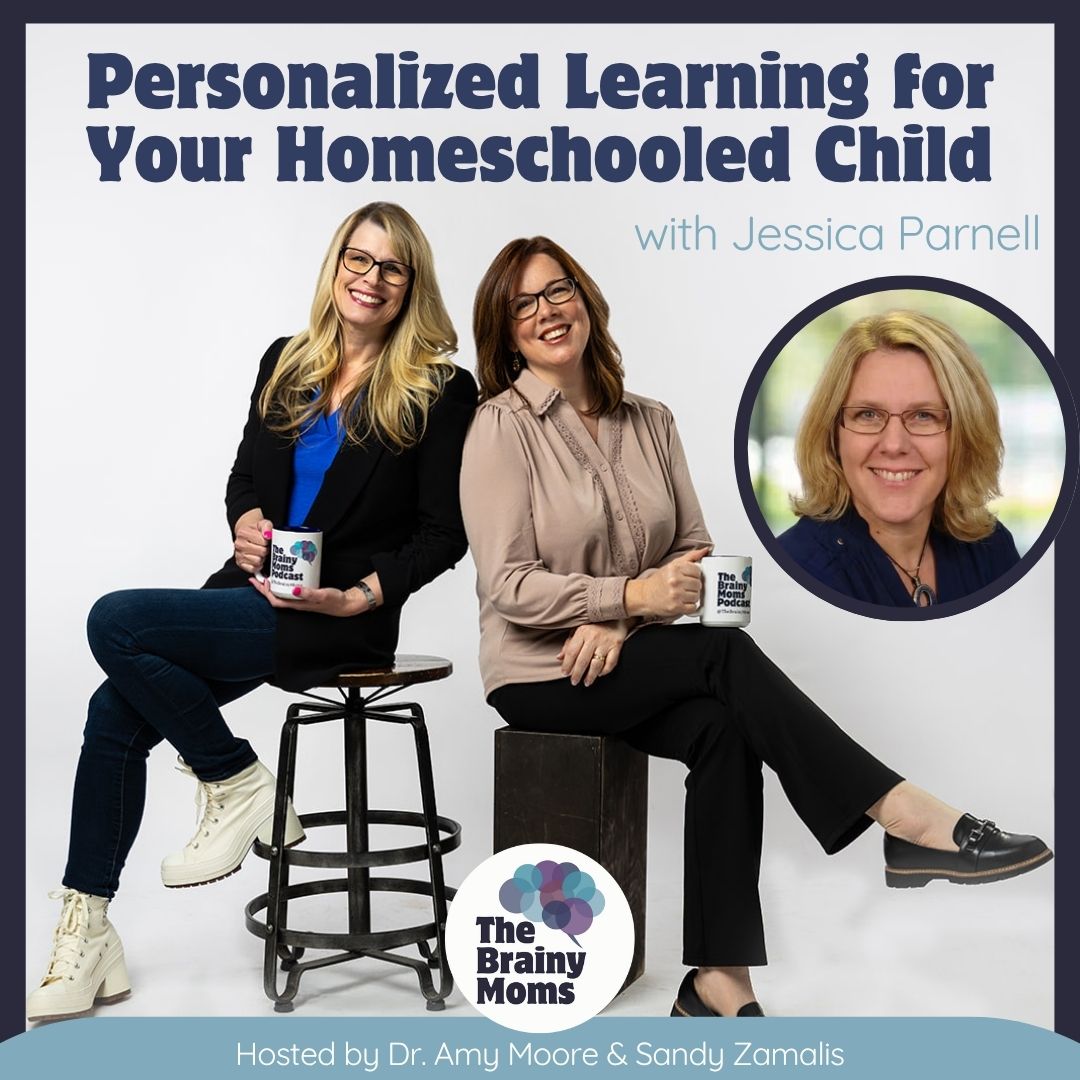
Personalized Learning for Your Homeschooled Child | Jessica Parnell
About This Episode
Your child isn’t a “grade level” they’re a whole person, and the fastest way to lose motivation is to teach them like they’re interchangeable. On this episode of The Brainy Moms Podcast, Dr. Amy and Sandy sit down with Jessica Parnell, CEO of Edovate Learning Corp, to get practical about personalized learning for homeschooling, online school, and hybrid models that actually respect how kids’ brains develop. If you’ve ever felt pressure to recreate a traditional classroom at home, this conversation gives you a cleaner, calmer path forward.
Jessica breaks down a key distinction: individualized learning starts with where a student is academically, while personalized education also accounts for personality, interests, and future goals. We talk through the planning process, including assessments that uncover an ideal learning environment and the “point of first failure” that often explains why a subject suddenly falls apart. We also connect the dots to neuroscience, including how repeated struggle can become a self-fulfilling identity and how small, targeted wins can rebuild confidence.
We go beyond theory with real examples, including a student who went from spiraling in ninth grade to being celebrated for his art in Florence, Italy. We also dig into common parent concerns: meeting homeschool graduation requirements, avoiding over-scheduling, building independent learners through inquiry, and using “responsible online” learning that keeps younger kids moving and engaged. Finally, we look ahead at the homeschool landscape, micro-schools, and how AI can support personalization without replacing essential skills like writing in a child’s own voice.
If this helped you rethink what school can look like, subscribe, share this with a friend who’s on the fence, and leave a quick review so more families can find the support they need.
About Jessica Parnell
Jessica is the author of the series Unlocking Your Child’s Genius and the former editor of Homeword magazine, Jessica Parnell has a passion for kids and education. As CEO of Edovate Learning Corp., she enjoys working with a talented and intelligent team to drive innovation in education, provide educational products, training, and support, and develop a personalized education model that works. A board member for Homeschool Trade Association, recipient of the “Stevie Award for Women in Business” and honored with the “2017 Lehigh Valley Women of Influence Award,” Jessica counts it a privilege to work beside educators committed to individual student success. Jessica also has a strong passion for understanding the neuroscience of the brain and holds education credentials including her BS & MA degrees as well as Certifications in Neuroleadership, Learning Disabilities, and Emotional Intelligence. Edovate Learning is the parent company to Bridgeway Academy, Curriculum Express, and Elephango.com. Find Jessica at https://homeschoolacademy.com/meet-the-leadership/jessica-parnell/
Free Downloads from our Sponsor, LearningRx
Download the free ebook, Unlock the Einstein Inside: Wake Up the Smart in Your Child
Download the Brain Training Game Pack
Link to our sponsor’s website: www.LearningRx.com
Listen or Subscribe to our Podcast
 Apple Podcasts
 Google Podcasts
 Pandora
 Spotify
 iHeartRadio
 TuneIn
 Stitcher
 YouTube
Watch this episode on YouTube
Read the transcript for this episode:
NOTE: This transcript was auto-generated by an AI assistant that thinks it’s smarter than we are. It’s not, but it has more free time than we do, so we gave it a low-stakes job. It probably spelled a few things wrong, but we’re okay with that. We’d rather spend our time interviewing cool guests!
Welcome And Guest Introduction
Dr. Amy Moore 0:00
Hi, smart moms and dads. Welcome to this episode of the Brainy Moms Podcast, brought to you today by Learning RX Brain Training Centers and the Homeschool OT. I’m Dr. Amy Moore here with my co-host Sandy Zamalis. And before Sandy and I introduce our guest today, we want to remind you that we have a monthly newsletter. It’s totally free. It’s full of cool tips about all the topics that we cover on the podcast. Just go to the BrainyMoms.com and you can sign up. Don’t miss out. Do it now. And now our guest today is Jessica Parnell. Let me tell you a little bit about her in case you don’t know her yet. Jessica is the CEO of Edovate Learning Corp, a family of education brands that includes Bridgeway Academy, Discover Curriculum, Elefango, and Curriculum Express. Through these programs, she leads the development of personalized brain-based learning solutions for families, schools, and micro-schools around the world. With a background in neuroscience and a passion for supporting neurodiverse learners, Jessica helps parents and educators move beyond one size fits all education to create environments where every student can thrive. So please help me welcome Jessica Parnell. Hello, good to see you again. How are you all? I feel like I just saw you. I feel the same way. I think what we want to talk to you about today, about that idea of personalized learning and how every child is different. And just super excited to hear your insights and expertise on that.Jessica Parnell 1:36
Yeah, I’m excited to I’m excited to do that. It is one of my passions, obviously. It’s made it made it my life’s work and uh really very, very much I’ve seen many, many, many children’s lives just transformed as a result. And it’s good to be part of for sure. My own included. So I think we are very aligned on our approach to learning and teaching and children.Sandy Zamalis 2:03
Well, and that’s why we invited Jessica, right? Uh, because we Jessica uh met um our colleague Dargan and I at a leader life conference. Um, and she spoke the day after Dr. Amy spoke, and we were like, ooh, kindred spirit. We need to talk to her.Dr. Amy Moore 2:21
Well, um, I think that we should give our listeners a little bit of your background. So talk a little bit about how you came into the homeschool space, how you came into this whole field of personalized learning. What is your background? Why are you so passionate about it? Why are you sitting in that seat right now?Jessica Parnell 2:39
Yeah, that’s
Jessica’s Path Into Personalization
Jessica Parnell 2:40
a good question. For me personally, I would say I came into personalized learning space out of the classroom. So I was an 11th grade English teacher and in charge of the gifted program and also responsible for working with twice gifted students. At the time, though, I was also actually the volleyball coach, the softball coach, the uh student counsel advisor, the yearbook advisor, and the newspaper advisor because I was one of very few young teachers in the school. And so now I’m interacting with kids all around in and out of classrooms and seeing them shine as they build backdrops for prom and all of these different gifts and talents that they have. And it I had this aha moment of I’m I’m responsible for these gifted kids. And we’re defining gifted as academically gifted, and we’re missing the fact that we have we have authors, we have artists, we have mechanics, we have all of these students with incredible gifts, and we kind of say, okay, well, they’re neurotypical, but in reality, I believe every student has gifts and abilities and talents. And when we when we categorize them in one way, we miss their gifts and talents. And so that’s what began my passion for personalization. In the meantime, as a teacher, I was also working in a program for learning disabled children, which was a all learning disabilities international, and I would come in and work in a clinic for them in the summers through a therapy, sensory integration therapy program to help them unlock their neuropathways so they could succeed. So I combine all of that, and then when I came out of the classroom to come home and raise my kids, I jumped into Bridgeway Academy and started to bring those thoughts into Bridgway Academy. How do we, how do we truly personalize? We were already individualizing academically, but how do we truly personalize to how a student learns, not just where they are academically? And so that’s sort of the background that led me here. And uh in Pennsylvania, you’re required to have a teacher, a certified teacher, do an evaluation of a student every year at the end of their homeschool program. So I’m also meeting all of these incredible homeschool kids who are doing amazing things. And so by this time, I’ve kind of embraced home education. And I knew when when my children reach school age, we would be teaching them at home.Dr. Amy Moore 5:11
So
Individualizing Versus Personalizing Learning
Dr. Amy Moore 5:14
then talk to us a little bit about that difference between individualizing learning and personalizing learning.Jessica Parnell 5:22
Sure. So when I talk about individualizing learning, I use it as a term of we were looking for where they were academically. What are their strengths? What are their struggles? Let’s start them there, which is important because if you have a student who’s struggling, let’s say in math, they begin to develop the sense of I can’t. And when you can look at where are they actually succeeding, at what level are they succeeding, find that point of first failure, back it up a bit and give them some successes, you can change that mindset for them. And that’s what we do when we individualize is we help them find where I can begin with success and get those foundations so I can continue to succeed. So Bridgeway Academy did that from its founding. We were individualizing education to students. When I came in, personalization to me meant, okay, let’s also find ways to draw out their gifts, to understand their learning style, to understand their personality, uh, to look at what they want to do in life, what are their interests? And so we tailor learning around that. So it might be a textbook, it might be completely off the page, it might be online, it might be an opportunity to go get an internship or an apprenticeship, and we’re really working to tailor learning around that individual student that is more than just academics.
Assessments And Planning With The Child
Dr. Amy Moore 6:41
What does that planning process look like? Does it include the child? Is it with you and the parent? How what does it look like?Jessica Parnell 6:50
Very much needs to include the child. So we start with an assessment that we’ve developed to test their learning style, personality style, and their ideal learning environment. So that assessment the student takes, and then we meet with the families to go through that with the children. So one of the powers of the personality style is it helps us understand, and we use the animals. So we have the lion, the beaver, the golden retriever, and the otter. So if I have a lion personality, I tend to think big picture. I want to make decisions, I want to move things forward. If I have a beaver personality, I want to gather data and analyze and think about it. So as we think about, for example, a high school statistics course, I want to give that beaver the opportunity to learn spreadsheets and figure out the data and get it, lay it out beautifully and gather it. I want to give that lion the opportunity to interpret data and learn from it. So we’re really also tailoring to those individual personalities. So we we begin there, then we do an academic assessment to see where are they, where are their strengths, where are their weaknesses, how do we help fill those, what do we call the point of first failure? Because many times it’s it’s simple, right? If a student has never mastered subtraction, they begin to struggle in in uh division. We don’t need to teach them division, we need to go back and teach them subtraction so they can succeed. So we’re looking for that. And then we meet with the student to say, what are you passionate about? What do you love to do? What are you hoping to do, especially for a high school student? Where are you hoping to go in your career so that we can make sure we’re setting them up for success in what they look, what they hope to be their future?Dr. Amy Moore 8:35
And then how often do we revisit that programming, that planning process? Every year.Jessica Parnell 8:42
What does that look like? Is it iterative? It’s every year, yeah. So and there actually are times where if you have a student who’s who begins to struggle in the middle of a school year, we don’t say tough, right? We say let’s let’s figure it out, let’s meet again, let’s talk about where’s the struggle, where can we help you succeed? And for Bridgeway Academy, it’s sort of it’s fun because one of my uh passions was that was actually the development of what is Elefango. It’s another one of our learning products, which is an online learning tool for students. And our vision for Elefango was to be the Google of homeschooling. So when a when a parent needed to know how do I teach decimals, they’re not going to Google and finding 32,000 pages, they’re going to Elefango and they’re finding lessons that are tailored to learning personality style. And really the vision for Elefango came out of Bridgway’s commitment to help students find what they need to learn. So if a student came to us and said, you know what, I’m just not getting, let’s stick with the fractions and decimals, um, we would not want to change their curriculum. We want to help find a solution for that. So we would write study guides, we would, we would purchase small PDFs, whatever it was to help tailor to that student. And L of Ango was born from that. What let’s let’s catch up to 21st century, let’s put it online versus drop it in an email, and then parents can get in there and find it when they need it versus reaching out to us for help when they need it. So we’re still there, but they have much bigger library to be able to help their students.Sandy Zamalis 10:15
Are
Curriculum Options From Preschool Up
Sandy Zamalis 10:16
your classes online for students or are you really because it sounds like you’re really coming alongside them as a not only as educators but as guidance counselors a little bit, right? To help guide and get them through um, you know, K through 12 education. And do you have kids all the way back? We do come into early elementary up through high school? Preschool through college.Jessica Parnell 10:38
Yeah. Okay. They can do completely textbook, they can do blended. Uh we have a program from uh kindergarten through eighth grade, discover that it is a blend of textbook and online, and and it’s really designed for home education. Then they can take self-paced online from seventh grade on, or they can take live online. So again, it’s part of that tailoring process. So if a parent says, I would want, I want to do everything myself, but I cannot teach them how to write, let’s put them in a live online writing class and you’re working with students from all over the world with a teacher who’s helping you and built around how homeschoolers, the schedule homeschoolers want, which is you meet once a week online, and the rest of the week is independent study with parents helping to guide so that you don’t lose that freedom, which I think is so important for students in their development.Dr. Amy Moore 11:31
So what does that look like for a preschooler?Jessica Parnell 11:35
Preschool is actually actually preschool is fully one-on-one. They don’t go online in preschool. So that is a it’s a introduction, the foundations of phonics. And one of the unique things about Discover’s preschool program is that it hits all of the subjects as well. So you’ve got some interesting things about animal science and earth science and things like that that get kids excited about it, a little bit about history. So they walk through that with the with the parent, really very live working with preschool kindergarten. Those years, your mom and dad, you really need to be highly engaged, leading them, reading adventures, teaching the listening skills, all of those things are so essential. It is certainly not a time to add an online component.Dr. Amy Moore 12:23
So,
A Spiral Turns Into An Art Career
Dr. Amy Moore 12:24
what have you noticed about the difference in outcomes between individualized learning and personalized learning for homeschoolers?Jessica Parnell 12:34
Let me tell you this through a story. So, one of my uh I’ve got a lot of stories from a lot of students, but this is one of my favorites. So we had a young man come to us in he was he was in ninth grade. He’d been doing fine academically up through eighth grade in middle school, very popular among his peers, went into ninth grade. He’s now uh on the football team, varsity football team, highly athletic. So he made varsity in ninth grade. And all of a sudden, he starts to unravel. He’s making poor decisions, he’s struggling academically, he’s he just first semester parents get to the end of that semester, and I said, We we need to intervene something. We’ve got to help him because he’s failing his courses, and we’re also seeing that beginning to affect his view of himself. And now as a result, he’s making poor choices. So he came to us and we we did that assessment, and we saw this creative side of him and his answers to the questions and some of the the um advisor questions, as they spoke directly to him, as well as on the assessments. And so we had him look at considering going into art, a study of art. He said, Well, yeah, I did like art in school. We’ll try it. Well, he took his first art course with us and loved it and was in it was just incredible the gifts that we were seeing in this art. And so his parents obviously taking the reins were like, we need to give him more opportunities for art. Well, he ended up in 11th grade. He was recruited to a program in Italy through Maris College to do his senior year in Florence in art. And he was the youngest student ever in their program to have his own arts, art show. So they dedicated an entire art show for him in Florence, Italy. And here’s this kid who was spiraling, spinning, struggling, starting to make poor decisions. Now he is this highly accomplished artist, and of course, back in the States, and his art is unique, it’s very sculpture-like, and so it’s a mix of sculpture and and flat on. I don’t even I remember he described it to me what it’s called. I can’t remember, but it’s it’s incredible. So he’s come back and he’s spoken a few times at our graduate, or at least one time at our graduation to other students. But that’s one of my favorite stories because here’s a kid that was potentially going to end up in a very bad place and instead celebrating incredible gifts and abilities because of the personalization.Dr. Amy Moore 15:06
I
Meeting Graduation Requirements Creatively
Dr. Amy Moore 15:07
love that. So, how do you balance personalizing learning with state requirements for high school graduation, for example?Jessica Parnell 15:19
Well, one of the wonderful things about homeschooling is yes, we need to meet state requirements, but those requirements are different than what you’d see in a public school as far as how much content, how much time, seat time versus mastery. So, yes, our students are required to earn certain credits based on state law, but we are not required to deliver that in any one unique way. So we balance that personalization again through making certain that they are getting the instruction they need, the credits they need to graduate, but giving them the freedom to do that creatively. And sometimes parents choose to take it all in classes, right? They say, Well, I’m just, I just I want all textbook or I want all online. I don’t, I don’t want the internship, that’s dependent study, the apprenticeship type approach. Other times students are athletes, performers, you name it, and they need that freedom and flexibility. And so they embrace those options so that they can really start to pursue. We s we we our mission is to help students discover and pursue their personal excellence. We want them to pursue that while they’re young because it begins to form foundational skills for them moving on.Dr. Amy Moore 16:33
So it doesn’t sound like it’s very hard.Jessica Parnell 16:35
It’s not. It’s not. As you said, with homeschool educators of Virginia, the the biggest mindset shift for parents is to just disentangle yourself from reproducing school at home because you don’t have to do that. In fact, school is very inefficient. We did a study, I think it was probably about 15 years ago now, where we surveyed a thousand teachers and we asked them how much time is spent in your classroom in new information. Any guess, what what would you guess would be the number of minutes per class period in teaching new information?Sandy Zamalis 17:13
I would guess like 10. Yeah, 20 out of an hour.Jessica Parnell 17:18
Seven minutes. The average of seven close minutes. So when parents feel this intimidation of I’ve got to do an eight to three school day, I mean, it’s it’s it’s not at all apples to oranges because you have that focused time at home with students and you can accomplish so much more when you’re one-on-one or one on three or four or even seven kids as you’re working with them because they have that freedom to work independently and uh really discover what their gifts and abilities are.
Letting Go Of Grade Levels With Neuroscience
Sandy Zamalis 17:52
I love how you framed like um going backwards and finding where the mistakes started, the root of where the success started to stop. Um that’s very much in alignment with how you know we work with students um at our learning arts centers too. So I want to kind of talk about how do you help parents, especially um, and maybe even students, because we do, we get so hung up on a third grade math level or you know, just leveled whatever reading levels up. How do we help families let that go so that we can meet the student where they are so that they can grow and make progress and start to build that snowball of success?Jessica Parnell 18:34
Can I ask you, when you say that, are you finding that parents bringing their students to you are saying, no, I want them on third grade level because this is where they are?Sandy Zamalis 18:45
Well, it depends. So we work with kids, homeschool families and um families that are in the public school system. And sometimes when, especially when you come home initially, um, if you decide to homeschool after being in a public school system, you are very much in that frame of level, right? Third grade, fourth grade. Um individuals like uh myself who homeschooled from the get, um, right from the start, probably not so much. You don’t hear those kinds of conversations as often. But there’s a fear when you pull a student out, you don’t want them to get further behind. So the goal is to get them up to grade level a lot of times when we talk to families. And so, you know, I’m sure when they come to you, you might have some of those same conversations. How do you meet the family where they’re at and allow that process of moving back to where they need to be so that they can make that progress forward?Jessica Parnell 19:40
I think for us, uh, and we and we encounter that often, especially as you said, with brand new homeschoolers to say, Wow, this is what my school is doing. Yep, we have to let that go. Because school is designed to meet the students that in order for them to meet their legal obligation, they have to meet the needs of the lowest learner. And so your high achievers are absolutely left sort of figuring it out on their own, right? Many times schools will give them independence or bring in an aid, but for the most part, they’re sort of lost. They’re not leveraging those strengths. Your middle of the road can kind of soar by sail by, but they’re legally obligated to meet the needs of the lowest learner. So if they have an inclusive classroom, your students are behind anyway, behind what they’re capable of anyway. So, one of the couple of the things that we do, especially if you pulled out a struggling learner, is that assessment helps them see data, right? So they see exactly where their student is. And we don’t do an assessment to it’s not norms referenced, it’s not how did you how do you look in a peer group of third graders? It’s how well have you mastered addition, subtraction, multiplication, whatever it is that they should have mastered by then. So that helps that that helps. But the biggest thing I think that helps parents have that aha moment is that we we talk through the neuroscience of it. So for a student who is consistently struggling in school, their reticular activating system, what we call the filter, starts to filter their reality around, I am failing, I can’t do it, I am afraid to speak up. And they begin to accept that as reality and look for proof in that. So even in a situation where student maybe is again, I’ll use math because it’s a simple subject to illustrate with a full page of subtraction problems. 20 of them, they get five wrong. They don’t see the 15 they got right, they see the five they got wrong, and it begins to really solidify that neural pathway of defeat. And so we try to help parents understand that that this is becoming many times an identity for them that we need to break. And being able to bring them back to success helps them approach that subject with enthusiasm rather than dread. So we need to give them those success opportunities to rebuild that thinking and have their filter see them as I can so that they can because otherwise reality perception is reality.
Sponsor Break
Sandy Zamalis 22:25
And now a word from our sponsor, Learning RX. In middle school, Kevin had given up on learning because of his reading struggles. His parents had tried everything and they were losing hope until they enrolled him in the cognitive training and reading programs at Learning RX. It was hard, but he gained confidence as he strengthened his memory, attention, processing speed, visualization, reasoning, and auditory processing skills. Years later, his mother wrote to us that Kevin has graduated from college and is beginning his master’s degree. He’s a military officer and is married with his own children. He’s thriving in life, in learning, and in his career. We can’t promise your child will have the same results as Kevin, but we’d love to talk to you about our brain training programs. If your child is struggling with reading or learning, talk to the team at Learning RX to see if we might be the right fit for your child. Visit LearningRX.com slash the Brainy Moms to learn more and receive a cognitive skills assessment with a consultation for just $99. That’s LearningRX.com slash the Brainy Moms. Homeschool OT is for families whose children want to learn and participate but struggle with what their days require. Things like starting work, staying regulated, writing, reading, or following through on plans. Created by occupational therapist and homeschool mom Sarah Collins, Homeschool OT helps parents understand why these challenges show up by breaking down executive functioning, sensory processing, and motor skills in real practical ways. Through the OT is in podcast, parent coaching, and targeted classes, families learn how to turn that understanding into strategies they can actually use in their homeschool day. Because homeschooling is not alone schooling. You can find support, resources, and expert guidance at homeschoolot.com.Dr. Amy Moore 24:19
So I
Training Parents To Stop Copying School
Dr. Amy Moore 24:20
want to talk a little bit about how as parents we sometimes become entrenched in what we believe school should be like, should look like, and should accomplish for our child. And so how do you communicate with families who have an expectation that you are recreating a traditional learning environment with traditional outcome measures, pretesting and post-testing and all of the things? Do you just say, well, maybe this isn’t for your family, or do you try to educate them on why this works for any family or could if they just opened their minds?Jessica Parnell 25:04
Yeah, I think we we take very seriously that responsibility of educating our parents. So we actually have a whole parent educator training that uh formally we’ve we’ve formalized it this year. We’ve we’ve had it all along as monthly webinars, but it’s formalized this year. So families who are new automatically can take that as a formal course for themselves as parents. And we take them through this. We take them through understanding learning styles, understanding personality styles, understanding the neuroscience, understanding what should a day look like, and help them escape that frame of mind of unrecreating school at home. I think most of us start that way, right? A lot of us think, okay, we have the desks, and some students work well with that. You have a there are certain students who need that structure. So that conversation to the parent is different based on the parent and based on the student’s needs as well. So we help them think through that. If you have a student who needs certainty, who needs structure, and whose threat response is around uncertainty, then yes, let’s create a structure. Let’s help them have lists and calendars and things that give them certainty so that they don’t immediately start with a threat response. But for the most part, giving students freedom and some room, they will explore things much more deeply than they will in school. I I remember my kids. Now, this is partly me. I did my master’s thesis in medieval education in medieval literature. And so when we hit medieval history, I was like, time out, this is one page, we’re going to explore this more deeply. And we took a month off of our curriculum and we went into the libraries and we took out books and we explored it. And I had my oldest who loved the whole idea of the dungeons and how did they get in there and did they ever get out? And so she was exploring all of that. Interestingly, she’s now an attorney. My middle one was very interested in the Courtly Love and the Knights and the Shining Armor, so she had a whole different interest. And so it’s just interesting when I saw the three of them and their different interests as we went through that unit. It didn’t look like school. We’re reading books, we’re creating shields, we got this one pretending to defend people and break them out of dungeons. I mean, it was just kind of a fun adventure. And they still will remember not just that one, but many of those types of experiences that we had in our homeschooling experience, because that’s when they had the freedom to really follow what they were most interested in. And they could be studying the same thing, but taking their own different perceiv um passions about that topic.Dr. Amy Moore 27:50
Yeah, I
Inquiry Learning And Real Confidence
Dr. Amy Moore 27:51
love that. I I did my master’s thesis on the inquiry approach to learning and how that increases engagement. Um, but that was in a traditional school. And but to see the same thing, to see that idea that we can look at a child and say, like, what do you know about this topic and what do you want to know about this topic? And how can we find out about this topic? How that increases engagement over a teacher just saying, today we’re gonna learn about this topic in this way.Jessica Parnell 28:23
That’s right. Good point.Dr. Amy Moore 28:25
So you So the applicability is there all the time.Sandy Zamalis 28:30
Yeah, absolutely.Jessica Parnell 28:31
Yeah.Sandy Zamalis 28:33
It sounds to me like uh the goal is to help students become strong, independent learners. Individuals who, you know, feel that they could tackle anything that their heart wants to follow.Jessica Parnell 28:49
Especially in today’s world where information is just so easy to find. So as Dr. Amy just said, when you when you can teach that that inquiry approach where they follow that curiosity and they and they and they take it further, right? They get the first answer, but it excites them to look for more and to look for more. That’s what we want to teach our children to embrace because it creates a love of learning that lasts through life versus, okay, I’m done with school, never want to learn anything again. We know we are learning our entire lives. Our brains are developing our entire lives. And so the more we can make that something they embrace and love, the better they will be prepared for adult life as well.Dr. Amy Moore 29:37
Yeah, I don’t know if this happened to you. I think we’re around all around the same age. But um, as an undergrad, I remember that we studied to memorize facts and then regurgitate them on a test. And then when I got to grad school and it was really about the application of knowledge, I had to relearn how to learn, how to study, what to do with this knowledge. And if I had had the opportunity to learn like that as a child, imagine um where I would have been then, right? At entering grad school, I would think that um one of the reasons why we see a larger percentage of entrepreneurship out of homeschoolers than we do traditional schools is because kids are learning um how to be self-directed, how to learn, how to learn rather than just what to learn from an early age. Do you think that that creativity is coming out of that approach?Jessica Parnell 30:46
I think it’s more I I 100% yes, I believe that is true. But I also think it’s it includes a confidence that they build because of that ability to pursue those interests and and and and own their own learning. Because when you think about students who’ve gone through school, and I’m not I’m not I’m not saying school’s not a it it should nobody should be in school, right? I don’t I don’t believe that. I think there are many families where that is the best option for their students. But when you have a student who is trying to fit in, who is doing what the doing what the teacher requires and not having, as you described, Dr. Amy, that creativity, that self-directed learning, that opportunity, they don’t have a chance to develop self-confidence either. In the same way that they can develop it when they are able to be self-directed and they are able to be successful and they are able to pursue those things that they are they’re so good at, and you can help as parents them recognize. And that confidence makes them bolder and and more apt to go after those types of opportunities because of that background of in of ownership in in their formative years for sure.
Exposure Without Overscheduling Kids
Sandy Zamalis 32:11
So as parents, we really have to give our kids exposure to lots of different things so that they can figure out what appeals to them.Jessica Parnell 32:22
Yeah.Sandy Zamalis 32:22
Where they because they might not know what their talent is until they happen upon it. Like your art uh student that you highlighted.Jessica Parnell 32:31
Yeah. But be careful because if you’re like me, you’ve got these kids in every activity under the sun and you’re running ragged. That my first year, we had we had the local zoo. I asked them to start homeschool classes. We had a gymnastics, an art school. I mean, we just went and said, hey, if we can bring you 10 kids, can you start a class? Sure. And so off we went. And pretty soon we were we were running like crazy. So be careful. That’s my advice to parents.Sandy Zamalis 32:59
Not all at once. Not all the experiences at one time.Jessica Parnell 33:04
I I wrote a paper long ago, the top 10 mistakes. And the first one was underscheduling, and the second one was over-scheduling, or maybe not in not in order, but they stood next to each other for sure.Dr. Amy Moore 33:17
So yeah. David Elkind wrote a book back in the 80s called The Hurried Child, and it had such an impact on me that I always thought, okay, are we doing too much? Are we pushing them too hard? Are we overscheduling them? Right. Like we want their schedules to breathe a little. Um it I mean, that’s where conversation happens and growth happens. And um, if they don’t have time to reflect on their experiences and it’s just one thing after another after another, then you miss that feedback loop for sure.Jessica Parnell 33:49
Yeah, that’s a good reminder. That was a that was one of my that was a book that truly impacted me as well. Thank you for that reminder.Dr. Amy Moore 33:56
Yeah, absolutely. So I love that you said, I love that you gave parents permission to say, hey, homeschooling doesn’t have to be for every child. And if I have three or four or five kids, some might be homeschooled, some might not. Right. And part of what I’m hearing you say is that personalization is finding the right environment for learning. I know that our middle child went straight through public school, sailed through it, loved every minute of it, was a natural problem solver, was a natural engineer, and and didn’t didn’t need us to make adjustments to that, right? And that’s okay. My youngest and oldest, we had to do a little bit of um this and that and the other. And so, you know, from homeschooling to online schooling to unschooling to public schooling, right? Like we we tried and failed and tried some more until we found what worked for our individual kids. And so I love that reminder that there isn’t a one size fits all. And that’s what your whole point is, right?Jessica Parnell 34:59
Exactly. Exactly. Yeah, and we did the same. So I had three. My oldest uh graduated home education, but she did some schooling in between. Uh, and then my middle one went out, went through she only she only homeschooled three years total, and then my youngest one graduated from from home education as well. So mixed and matched and did the same thing. They went into school, they came out, we tested things. I mean, it was just really making that decision year over year is a lot less intimidating for a parent than saying for some. Now, there are some that are I am absolutely a lifer, right? And we love those families, right? Because that’s when you really get to see the kids grow as you continue to interact with them. But I think that is a great reminder, is don’t be intimidated that I’m making a decision I have to stick with forever, because you may find this doesn’t work for your kid. And that’s okay, because you can be consistent in showing up, in in paying attention, in being there for your children and getting them through that year, however that looks. Sometimes it’s messy and sometimes it’s smooth, but moving on to okay, let’s let’s tweak it, let’s let’s adjust, let’s make sure we’re meeting the needs of our kids.
Online Homeschool Growth And AI Questions
Sandy Zamalis 36:19
Jessica, where do you see the homeschool landscape moving towards? Um You’re on the in the online space. Um, when I started homeschooling, there wasn’t a whole lot of online options. So there’s been a huge shift. Um, but even going into the future, where what are you seeing as things that we need to keep our eye on?Jessica Parnell 36:38
Yeah, that’s we are seeing it’s it’s interesting. It’s a new homeschooler. Today, when we were homeschooling, there were co-ops, you knew people, you’re chill, you know, there it was, it was a movement that was largely faith-driven, not all, but largely faith-driven. Now we’re seeing families, it’s a new movement, and it is a I can do better than what they’re getting in school. It’s a different, it’s a different shift. And so what we are seeing is that families want online, uh, they want more help, they want the resources that we can provide with our advisors and our teachers, because they’re not necessarily coming into home education thinking I can do this myself. I’m committed, I have a whole network. They’re saying, my school is failing me, and I can do better because I want to be sure my student is set up for success. One of the things we have seen, Sandy, which you mentioned, is people are looking for online as a study, and Dr. Amy, I know you will agree with me in this. In my opinion, based on the neuroscience, an elementary student should not be online all day learning. It’s not, it’s not building the neuropathways the way our brains are designed. They need movement, they need that engagement. And so we built discover around that because we were but hearing people saying, we want more online, we think, and we’re saying, well, wait a minute, you don’t. But we decided to build a responsible, what we call a responsible online. It’s a blended curriculum. So the online becomes sort of the launching pad for their students and their characters that walk with them, that send them to their work text, that send them to their parents, that send them to the hands-on activities, and does have a few games and things on it. But it is designed to sort of, I guess, satiate that desire for online in a responsible way so that the students don’t end up suffering from the decision of a parent that says you should learn everything online. I think it’s a very uh it will be a big miss in children’s development if if students learn exclusively that way.Sandy Zamalis 38:59
Well, I think COVID showed us that. Yeah, we’re gonna have studies, I’m sure. I’m sure for a while on that impact of being online for an extended period of time. Yeah.Dr. Amy Moore 39:11
Yeah. Well, and really not just being online, but I’m a firm believer that just not having the oxytocin release from the the arm-to-arm interaction with your best friend at the lunch table um really did a disservice to our social emotional health too.Jessica Parnell 39:29
So Yeah, I agree. Yeah, I agree. And the teachers are feeling it. We’ve good friends in the classroom and they are feeling it. Yeah, it’s it’s it’s going to be interesting, that’s for sure. So we’re already seeing it, but I think we’re we haven’t seen it all the way through yet.Sandy Zamalis 39:48
So I thought for sure you were gonna break up AI.Jessica Parnell 39:55
Well, we’re actually hearing a lot. We’re very mixed. So we have families that say don’t want anything to do with AI. Even if we have a support bot that will answer your questions around how to log in and it’s AI, they don’t want it. Right. And uh so we’re not that extreme, right? Like we’re like, well, this is helpful. You don’t have to wait for someone to call you back. Um, but then we also have families that were, and we are teaching our students how to use AI. I think it’s responsible. They need to learn how to use it if they’re going to be successful in the future. But uh there are those who have found ways to say, hey, I need my student to study this bank of words for the SAT. What do you suggest? And we’ll say, well, you’ve told us he really is interested in space. Let’s leverage AI. Put those vocabulary words in and ask AI to write you a story about space or facts about space with those words in context, and suddenly learning becomes easier because you’re you’re capturing their interest and helping them connect it. So you’ve got it’s all over the place, uh, what people will embrace or won’t. What are you seeing?Sandy Zamalis 41:06
Uh well, that’s a great question. So um I often talk about the comprehension and visual processing impact that the huge shift in screen use um has brought just anecdotally from kids we work with every day, um, just like where our baselines are versus where they were 10 years ago in those different skill areas. So um I do think it’s impacting our kids technology for sure. And I think there’s a lot of data to support us rethinking it. Um, but also it’s not going away. So we’ve got to figure out how to, like you said, use it responsibly, um, use it as a tool, right? Um, so that uh our kids can still have those strong neural pathways as they’re building and learning and growing. So yeah, it’s it’s a fascinating topic. So that’s why I because you’re in that online space, I was just curious, like, you know, as you’re thinking of your vision, you know, your next 10 years as you guys grow and meeting families where they’re at, you know, what kinds of things um do you see on the horizon for homeschool families? Because I think in 10 years it’s gonna look totally different even than what it looks like today.Jessica Parnell 42:18
Agreed. Yes. And and we are looking at ways we could leverage AI for immediate personalization, right? How do we take the content that we’ve written in our own lockdown library and let AI help recraft that to someone based on their struggle or based, you know, if or if they’re writing? I mean, that’s been around for a long time. That there’s technologies that have done that for a long time. So we are looking for ways to do that. But I I would agree we have to be very careful. I think back to, I don’t remember if it was Socrates or Aristotle who was bemoaning the loss when when the written word came out. And they say we’re going to lose our ability for auditory for memory, right? For memory of what we hear and be able to pass the stories down verbally. And that was the problem with the written word. And then you get to radio and you get to television. And I feel like we’re circling all the way back to listening through podcasts, through, through audio books, and we’re re-energizing that whole listening, comprehension, and and learning through hearing because AI is quickly taking over writing now, which I’m hoping and praying I recommend to parents. Don’t have your kids learn to write with AI because they will lose a valuable skill if they aren’t writing in their own voice first.Dr. Amy Moore 43:41
So absolutely.Jessica Parnell 43:43
And I am a writing teacher, so I’m biased, but right?
Where To Start And Final Encouragement
Dr. Amy Moore 43:49
So Um So Jessica, you’re you’re based in Pennsylvania, but your programs are available anywhere, right? Like it’s global.Jessica Parnell 43:58
Global, correct. Yeah.Dr. Amy Moore 44:00
Okay. And what would families do first if they were interested in learning more about it?Jessica Parnell 44:08
I would say the best place to start is homeschoolacademy.com. You can learn a bit of you can learn about our Bridgeway Academy there. And then from there you can get all of the information about Elefango and Discover and even Curriculum Express. We have a warehouse curriculum distribution arm where you can get your favorite titles for discounted prices. So that uh we’ve always been building around home education, but probably the best place to start is homeschoolacademy.com.Dr. Amy Moore 44:36
And then how can our um listeners and followers find more specifically from you? Where are you?Jessica Parnell 44:43
Where can they find you? Well you can find me on LinkedIn. I’m in there. Um, but I don’t have my own podcast or a blog right now. Um but I love being a guest on podcasts, and I have I have a book. Uh I have a small booklet series called Unlocking Your Child’s Genius. It’s around learning styles. I have now a book coming out that is that in a much more narrative form. The booklet series is more uh quick hits, quick strategies. And what we kept hearing from families is we want to know more, we want more information. So that’s the one that’s coming out at probably the end of this year. I think we’ve given the last word I got was October. Um, and then I also have a book on neuroscience that’s coming out, the neuroscience of learning, which I have don’t have a title yet, and I’ve only just got approved, so I have to uh get get to finish writing that now. Yeah, and I I will leave them with one last thought, and that is if you if you’re struggling with taking that first step, jump in. Just jump in because you it’s an adventure. It’s the the change you see in your kids when they are able to just shine, it it impacts their whole life. You change the trajectory of your children’s lives. So if you have children that are struggling, jump in. If you want more time with your children, jump in. Don’t be afraid. There are resources, there are people that will help you. And I I have not yet met a homeschool parent that have said, Oh, I wish I wouldn’t have. I’ve heard them say, I wish I would have done it sooner. I’ve yet to hear one that say, Oh, shouldn’t have done it. Because you you will accomplish more in that year, even with minimal work, then they well, of course you have to do the work. Like don’t do nothing, but it’s it’s so rewarding. And there are days you want to lock them out the door and make them stay outside for a while, but they’re it’s a rewarding, wonderful experience and and definitely worthwhile.Dr. Amy Moore 46:54
That’s great advice. I think so many opportunities we miss out on in life because it’s not the perfect time, or we aren’t quite sure we’re gonna be good at it or not. And so sometimes, like you’re saying, just jump in and make it happen.Jessica Parnell 47:08
Yeah.Dr. Amy Moore 47:09
Yeah. And it’s okay to fail, right? You learn from your failures. Right. Right? Like we’re gonna just try this differently tomorrow. Yep.Sandy Zamalis 47:15
And we all if you get more than seven minutes, you know you’re doing good.Dr. Amy Moore 47:19
Right. Absolutely. All right, we have to close the show. Uh so listeners, thank you so much for being with us today. We love it that you take time out of your schedule to spend this hour with us every week. If you want more from us, again, sign up for our free monthly newsletter at thebrainymoms.com. We’re all over social media at the Brainy Moms. And you can find Sandy on TikTok at The Brain Trainer Lady, where she demonstrates really cool cognitive training exercises for you to try out yourself as well. So, look, that is all the smart stuff that we have for you today. We hope you feel a little smarter after spending this time with us. We’ll catch you next time.