This is a placeholder for your sticky navigation bar. It should not be visible.
- Tags: ADHD, ADHD awareness month, Brainy Moms podcast, homeschool podcast, LearningRx, moms with ADHD, parenting, parenting advice, parenting podcast, parenting tips, podcast for moms, psychology podcast, signs and symptoms of adhd in women
About This Episode
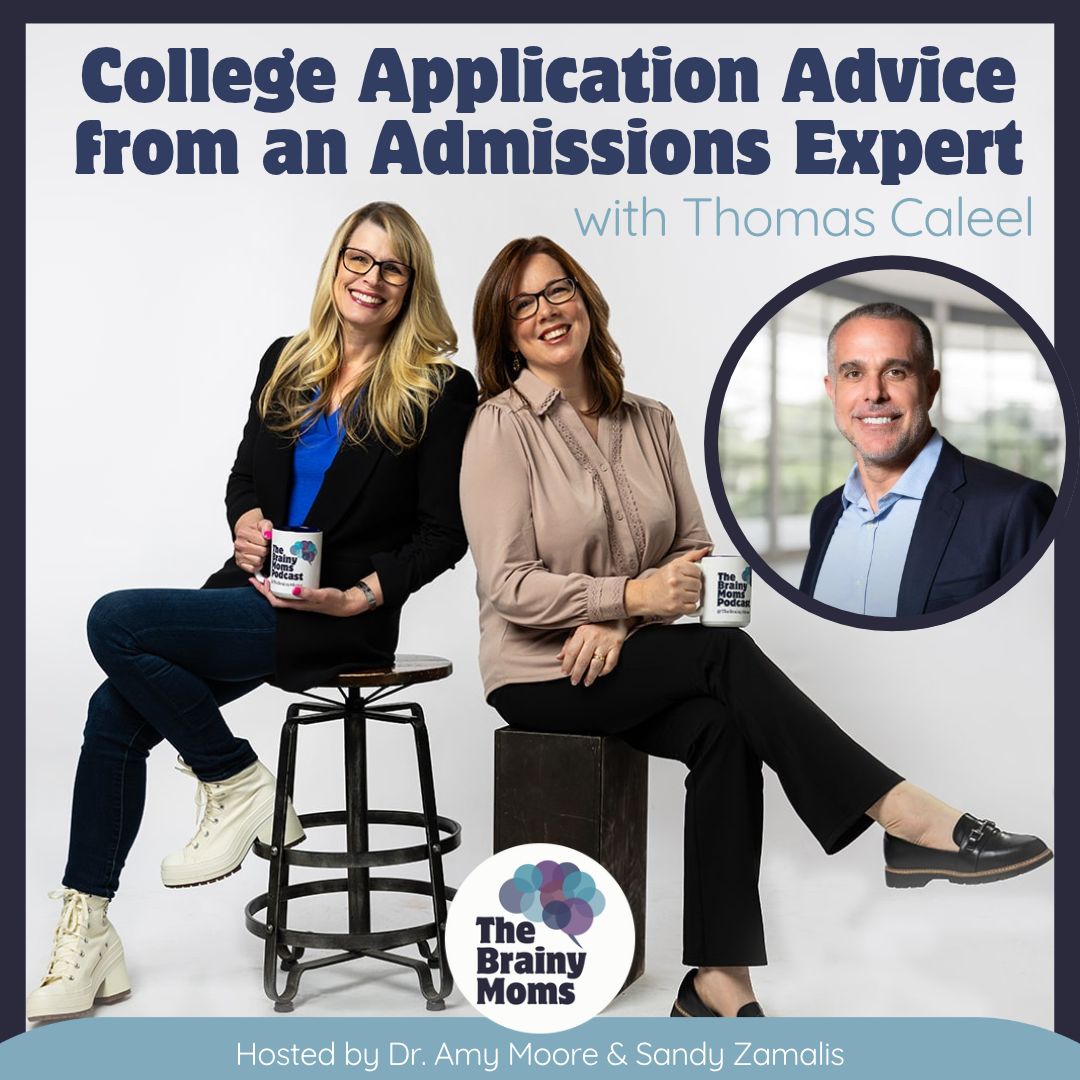
Wish you had some insider tips on the college application process? Your teen’s college application can feel like the ultimate high-stakes black box. On this episode of The Brainy Moms Podcast, Dr. Amy and Sandy talk with Thomas Caleel, founder and CEO of Admittedly and former director of MBA Admissions at the University of Pennsylvania’s Wharton School, to get honest advice about what drives admissions decisions and why the stress spiral is so common in high-achieving families.
They dig into what colleges say they want versus what families think they want. Thomas explains why massive applicant pools and the Common App changed the game, why “do everything” applicants blend together, and how students stand out by going deep on a real interest instead of chasing endless activities. They also talk academics: course rigor as the entry point, how grade inflation makes GPAs harder to trust, and why standardized testing is gaining traction again as schools look for clearer signals of readiness.
Then they get practical about fit and life paths. They unpack sports time commitments when recruitment isn’t likely, how work can become a powerful part of an application story, and why community college and transfer routes can be a smart return-on-investment strategy. Thomas shares concrete guidance for preparing homeschool student applications using external validators like AP exams and accredited college courses.
If you want calmer, clearer college admissions guidance that lowers the stress level a little for the whole family, this conversation is for you. Subscribe, share this with a stressed-out parent friend, and leave a review so more families can find us.
About Thomas Caleel
Thomas is the founder and CEO of Admittedly. As the former director of MBA Admissions at University of Pennsylvania’s Wharton School, Thomas reviewed tens of thousands of applications and made the final call on who got in. He has spent over 20 years shaping admissions strategies at the highest levels, not just for students, but for government and top institutions around the world. Thomas received his BA in international relations from the University of Pennsylvania and is MBA from the Wharton School. He lives in Santa Barbara with his wife Natasha and their three children. Thomas founded admittedly as an extension of his pro bono admissions consulting practice as a way to provide free, credible admissions guidance to everyone.
Free Downloads from our Sponsor, LearningRx
Download the free ebook, Unlock the Einstein Inside: Wake Up the Smart in Your Child
Download the Brain Training Game Pack
Link to our sponsor’s website: www.LearningRx.com
Read the transcript for this episode:
NOTE: This transcript was auto-generated by an AI assistant that thinks it’s smarter than we are. It’s not, but it has more free time than we do, so we gave it a low-stakes job. It probably spelled a few things wrong, but we’re okay with that. We’d rather spend our time interviewing cool guests!
Welcome And Guest Introduction
Dr. Amy Moore 0:01
Hi, smart moms and dads. Welcome to another episode of the Brainy Moms Podcast, brought to you today by LearningRx Brain Training Centers. I’m Dr. Amy Moore here with Sandy Zamalis. And before I introduce our guest today, Sandy and I just want to remind you that we have a free monthly newsletter. So just go to uh thebrainymoms.com, sign up, and get that in your inbox. It’s totally free. And now we’re gonna have a conversation with our guest, Thomas Caleel. Let me tell you a little bit about him in case you haven’t met him yet. He’s the founder and CEO of Admittedly. As the former director of MBA Admissions at University of Pennsylvania’s Wharton School, Thomas reviewed tens of thousands of applications and made the final call on who got in. He has spent over 20 years shaping admissions strategies at the highest levels, not just for students, but for government and top institutions around the world. Thomas received his BA in international relations from the University of Pennsylvania and is MBA from the Wharton School. He lives in Santa Barbara with his wife Natasha and their three children. Thomas founded admittedly as an extension of his pro bono admissions consulting practice as a way to provide free, credible admissions guidance to everyone. So please help me welcome Thomas Caleel.
Thomas Caleel 1:21
How are you? It’s so nice to meet you both.
Dr. Amy Moore 1:24
It’s nice to meet you too.
Thomas Caleel 1:26
I’m in the presence of serious celebrities here, so I gotta bring them up.
Sandy Zamalis 1:30
What are you talking about? The celebrities.
Dr. Amy Moore 1:51
Oh yeah. And and right before you hopped on, I said, I’m gonna bring it with this one.
Thomas Caleel 1:57
I’m gonna bring it. Fantastic. Go ahead.
Dr. Amy Moore 1:59
Yeah.
Why Admissions Feels Out Of Control
Thomas Caleel 2:00
I um I’m I’m deep in the in the throes of an application cycle. And it’s a you know it’s a it’s a very stressful, especially for parents. I’m a parent. Um it’s a deeply stressful process. And you have no control over it. And and so, you know, we get you get parents that are highly successful, highly educated, in control of almost every aspect of their life, and now their most valued asset, their child, um, one of the most important decisions in their life is now completely almost completely out of their control, and it’s stressful, and I get that.
Dr. Amy Moore 2:32
So that’s an interesting point to start on, because I struggle with why we are creating this kind of stress in the first place. So maybe the maybe the families that are looking for admissions guidance are the families that hold that tension already, right? That have these high expectations for their kids who now have adopted those high expectations for themselves, right? That’s a very common pattern.
Thomas Caleel 3:08
Very common path, exactly.
Dr. Amy Moore 3:09
Absolutely. Um and so I wonder, is that always the right choice for the child? And is that part of the discernment that you have to use in your in your guidance process with them?
Thomas Caleel 3:26
No, absolutely. And and so you know, I take a lot of heat on Instagram and and um and TikTok because you know I am responsible for all the stress that students are are feeling and the mental health crisis and everything else. And I think uh according to my commenters.
Standing Out By Geeking Out
Thomas Caleel 3:45
And so we need what we need to do is take a step back. And it’s very interesting because you know the schools are coming out and they’re saying, listen, we don’t want you to do all these things. We want you to be unapologetically yourself. We want you to be interesting in your own way and do things that matter to you. And when you think about um, I’m a dinosaur. I went to college a long time ago. And back when I was applying to university, the schools basically said, hey, you need community service, you need some sports or theater or arts or something like that. You need to get good grades and, you know, I don’t know, do a club or two. And what they realized is they were building these horizontal layers in the classes. So they were very ended up with very homogenous classes because they basically took people who were pretty similar. They had slightly different interests, but they’re generally similar. And what happened with the rise of the applications was the schools were really able to come, you know, with the common app and the internet and all the things that kind of went along with that, so that you weren’t like you used to have to call the school. They would mail you a lookbook, you would carefully tear out the application and then handwrite it, you know, and archaic. You’d apply to four schools, your hand wouldn’t work at the end of it. You’d have, you know, white out all over the place from from correcting your errors. And that’s how you applied to college. But now you can apply to up to 20 schools on the common app. And so what the universities realized were two things. Number one, we have a much bigger pool to choose from. And number two, um, we want students that are unapologetically geeking out on something. Because if you get somebody who’s really interested in astrobiology, and somebody who is a theater major, and somebody who is deeply invested in poetry, and somebody who’s a math genius, and that’s what they love, and you put them together, that’s where the magic happens. You get a lot of electricity, and the outcome is far greater than the sum of the individual parts. And so what gets lost in that, though, are families taking that pressure and being like, okay, you have to do everything. Because we don’t trust that, you have to do everything. And when you invert it and you look at it from the perspective of the universities, the universities are basically saying, look, there’s we get 50,000 applications. And if you’re doing what everybody else is doing, you’re not standing out. I’d rather take the kid who’s like, I love insects, and I’m completely geeked out on insects. And I’ve actually taken some of that learning and applied it to my interest in robotics. And I did this cool internship with this startup, but I also was a docent at the Museum of Natural Natural History and got to research with one of, you know, with the head person, the head entomologist there. That’s really cool. And that helps you stand out. But a lot of this stress, yes, is generated by parents. Yes, is generated by peer pressure, and yes, is is generated by the universities themselves inadvertently because they don’t know, you don’t know what you’re looking for generally as you head into a new admission cycle. You have a general idea of what you want the class to look like, but you also have to see what applications come in. You have to see what the priorities of the university are, and that changes and it’s opaque and that’s very frustrating to parents. And I apologize. That was a long, never-ending elliptical answer, but it’s it’s so complex.
Sandy Zamalis 7:06
That’s really fascinating.
Dr. Amy Moore 7:08
Well, it is. I’m glad it was as long as it was, and and we followed because we’re smart people. But um You said something really interesting that um every application cycle, colleges might be looking for something different, and they’re not transparent in what it is that they’re looking for.
Why Colleges Change What They Need
Dr. Amy Moore 7:29
Why does that change?
Thomas Caleel 7:31
Well, it changes for several reasons. Number one, um, you know, the in an admissions perspective, you are looking out 20, 30 years into the future. And you’re like, okay, what um you know, what skills are required? What are our what is our raw what do our raw materials look like? So what kind of students are we getting? Um, what are the priorities of the faculty? When you’re looking at undergrad too, you have a lot of different priorities. You have athletics, you have, you know, the head of the theater department, the head of the music department, the head of the school of engineering is coming in. They’re like, hey, we need this, we need this, we need this. So it’s this massive, complex, multivariable equation. And then what you have to do is look at the students that you get coming in. So if you need four tuba players and you only have two that are really highly qualified, sometimes you just have to take those two and go back to the music department and be like, look, we’ll try again next year, but you need to do a better job at outreach. Um, but then the next year, maybe you have 10, right? And now you have an abundance of riches. And so it’s not that the schools are trying to be deceptive or intentionally opaque. It’s that they’re balancing the admissions office is balancing a lot of different competing um priorities, and you have to admit students who are going to be successful because one of the hardest things that you do is a as a head of admissions when you’re making those decisions is you meet students who are exceptional. You read files that that make you cry sometimes. And you’re like, oh my God, this is an incredible person. But then you have to have that moment of clarity and say, but they’re not going to survive academically in this school. And those are really hard decisions to make. And then you also will have a group of a thousand students or so who look really, really similar. And you’re like, I can only take two. And yeah, because we just have two spots for this profile of student. And these are really hard decisions that get parsed, and there is an element of luck to it. Um, but it it that’s I understand why it’s frustrating. I am a parent. Um, I have a child who just headed into is a rising freshman in university. I’ve got another one in high school, I’ve got a sixth grader. And so, like, I’m right in it with our parents.
Academic Readiness Comes First
Dr. Amy Moore 9:46
So, what are those predictor variables for success? As an the admissions committee is reviewing these applications and they say, hey, this looks like a really cool kid, but they won’t be successful, what are the variables that are those red flags to the admissions committee?
Thomas Caleel 10:05
Well, I mean, acad people overlook the fact that you’re applying to a university. And so academics and intellectual curiosity matter. And so you look at academic rigor. Have they challenged themselves? You know, if you’re applying to Stanford and you’ve only taken regular level courses in high school, no honors, no AP, no, you know, advanced like IB level courses, you’re not going to survive. It’s that simple. Now, there might be mitigating circumstances. You might be like a first-gen low-income student in a school that doesn’t have honors classes, but you’ve taken the most rigorous curriculum you can in your school. And admissions is going to look at that and parse that and really dig in and understand that. But you you have to look, you know, standardized testing is coming back with a vengeance because of grade inflation, but you can’t just admit students because of a story. You have to admit students who can do the work. And and then so the flip side of that are the people that yell at me and say, extracurriculars mean nothing. It’s all completely subjective. It should be 100% of meritocracy, which is a loaded and terrible word, right? Because what do you mean by meritocracy? Do you mean the highest test scores and the highest grades? Great. If you take the 50,000 students that apply to, let’s say, Columbia, and you separate out the ones, you know, the top 1% SAT and the 1% GPA, number one, you have a very, very boring class. But number two, you still have more students in that cohort than seats in the class. And so it’s not that simple. And then, but when you look at countries like um, you know, South Korea and China that have merit-based national exams, they hate that system too because it’s inherently unfair. And so the in the US, you have a very liberal arts tradition where they’re like, okay, we want to evaluate the whole person. So the ticket to the dance is academic ability. If you show us you have the academic ability, now you get to tell us about who you are as a person. And that becomes critically important because what if you have a genius math person, right? A genius engineer who doesn’t do well in their English classes, for example, that their writing skills are not particularly great. You want to be able to sift that person out and identify that talent the same way you want the gifted English major who struggled in their math class to not get weeded out by an arbitrary GPA or standardized testing uh level.
Helping Kids Find A Real Interest
Sandy Zamalis 12:42
I like that you pointed out the liberal arts kind of thread that we have in our education system, because high school definitely has that mindset. And then now what I’m hearing you say is you know, we’ve got to give our kids room to geek out on something. Um and I and I think, I mean, my mom laments about this all the time because when she was in high school back in the 50s, 60s, um, she could take a writing class on how to write mysteries. Um, she could take classes in high school that she could just try things and see if she was interested in that particular topic. And that has all gone away for our kids uh right now. And when I think of college, I think of college as that place where you get to try things. So to me, this is an interesting conversation because you’re saying that kids in the high school level need to have room to geek out, get interested in something, but that is not the palette that they’re given in terms of being able to do that unless they do it on their own outside of the educational system. So, what would be your advice to parents then to to help foster that? Because we’re all trying to have work-life balance. And so to go to school all day and then maybe have a job or do sports and then also find something that you’re interested in just requires time.
Thomas Caleel 14:13
It does. It requires time. And I’m a busy working parent as well. So like I 100% get that. And I think there’s a couple things here. So you mentioned a couple of things like work, sports, things like that. And we have to remember that every single applicant that comes through is an individual. And so there are students, for example, who have to work. And that’s great, right? They’re not penalized for that. But my advice to them is if you can work in an area that’s at least adjacent to what it is that you want to do. Right. So I had a student from Florida, single parent family, kind of middle-ish, middle, lower middle class. And she had to work. And she was like, look, I like, I need to make my own money for gas and clothes and things like that. Um, and I’m deeply interested in fashion. I want to go to, in this case, it was Wharton. And because I want to work in fashion, but I’m at a total disadvantage because I’ll bet all the other kids are getting fancy internships and working on Wall Street or working at like big New York fashion houses. I can’t compete. I actually need to work. And so we talked about it. And what happened was we ended up, she looked at a lot of options and she ended up working for a small local clothing boutique. Wasn’t big name, wasn’t national chain. But because it was smaller, the owner gave her progressively increasing responsibilities. So by the end of her, you know, by the by like senior year, she was managing inventory, purchasing new lines, you know, working pricing, discounts, customer service. She was the manager of this boutique. And so when it came time to write the essays, like she had this really powerful story about the actual mechanics of fashion. Like, yeah, I want to run a fashion business, but now I really understand intimately what goes on at the customer and the retail level. And she took that, she got into Wharton early, got a very generous scholarship, and ended up uh winning a business plan competition, raised about $3 million into her company and is just killing it. She’s crushing it. And so these are things that you can sometimes do that. And sometimes you just have to work and make the money, and that’s fine.
Sports Work And Ruthless Priorities
Thomas Caleel 16:23
With sports, I I did a podcast, got a lot of pushback on. Um, and I basically said, listen, with sports, if you’re not being recruited, you have to be ruthlessly self-aware of how much time you’re spending. Because I talk to these families and they’re like, oh, we have club and varsity and it’s year-round, and that’s all they have time for. I’m like, great, are they going to be recruited? No, but they like the sport. I get that. I’ve been an athlete my whole life. I love sports. I think sports teach you all kinds of wonderful things. But when you approach a university and you say, I’m a baseball player, and they say, Are you recruited? And they say, and you say no, they’re like, okay, well, what else have you got? Because we’ve got a whole baseball team here of recruited athletes. We got all the baseball players we need. What else do you bring? And if your answer is, well, I spent all my time playing baseball, you can see where there’s a gap there, right? Because they’re like, well, we already have baseball players. We need something else. And so, and so part of this is the self-discipline to hold the space. And then the other thing is I think finding, you know, doing, I always talk about doing fewer things intentionally and well. And so where a lot of families get caught up is that people are doing so many things because they’re not, there’s so much bad information out there and there’s so much peer pressure on the parents and on the students, right? You gotta do all the things that you end up scrambling and doing a bunch of things frantically, but not well. And then you get crushed in the admissions process because the schools look at you and they’re like, well, we don’t really see and like we don’t see you really meaningfully engaged in anything, and you just it doesn’t work for you.
Dr. Amy Moore 18:03
Yeah. Well, I mean, I always say if you chase three squirrels, they all get away. And so right. I mean, so that’s really if you just have your hands in a whole bunch of pots, then it’s one thing I think, Sandy, like you’re saying, how do you know what you’re going to be interested in if you don’t have the opportunity to try them out? But at some point you have to drive a stake in the ground and say, okay, I’m really gonna dig in here. Um, because that is what’s gonna set me apart, then. Is that what I’m hearing you say, Thomas?
Thomas Caleel 18:37
Well, and yeah, and before everybody comes storming through your comments, I am not saying that these students in high school need to decide what they want to do for the rest of their life. And this is really, really important. What they do need to do is, you know, to Sandy, to your mother’s point, is do try new things, take advantage. And when you read the the course catalogs in some of these high schools, I’m jealous. I’m like, I want to go back, I want to take that course on political economy of, you know, whatever in the 14th century. It just seems really interesting. But what the universities are are asking is, hey, just show us that you’re curious about something. So it might be, you know, that we that you approach a university and you’re like, look, I love biology. I loved my biology class and I took AP bio and I loved it, and I did, you know, I interned at the museum or I interned at the hospital and I did this. I don’t know what I want to, like, I’m not sure. I think maybe I want to be a doctor, I’m not sure. But what I do know is I want to go really deep on this because I think it’s really cool. And that’s all they’re asking for, but it gets twisted and perverted because people are so stressed to like, you need to know what you want to do, you know, in high school. And I also get that because I’m writing checks for my own children’s tuition. And when you look at a college tuition that’s gonna cost you a half million dollars, the days of like, you know, when your mom went to college, I’m sure the price was a lot less expensive. And you could be like, yeah, I’m gonna kind of go experiment and see what’s going on. And now you’re like, hey, I need a return on my investment. You can’t just go out and like not be employed. You need to be focused. So it’s uh there’s a lot of pressures that are kind of coming in on these, on these poor students.
Sandy Zamalis 20:15
I feel like that’s every dad everywhere.
Thomas Caleel 20:17
Like making it. These dads have nothing on the moms. Generally, it’s the mothers that run the and I’m making a very broad statement, but generally the mothers are the ones that that drive the the um the bus on the college process, and they’re very sharp.
When Parents Add Hidden Pressure
Dr. Amy Moore 20:36
I find that to be really interesting, um, just from a motivation perspective. And uh, but I also I look at, you know, how do the messages that we send both overtly and inadvertently to our children, right? How do how does that impact their stress level, their anxiety level about their future, their mental health? Um, and some of the times those expectations are misinterpreted and misunderstood. And right, like that I think absolutely there are a lot of kids who um, you know, put that pressure on themselves as well because they think it’s expected when maybe it really isn’t. So I think that there’s probably some insight that you probably have to provide as you’re working with families to say, hey, I don’t think this is what your kid is actually interested in. Is that part of this?
Thomas Caleel 21:32
Oh, absolutely. Absolutely. You know, I just I just prior to this, I had a call with a family, staggeringly educated family. And they were like, Yeah, I don’t get it. Or, you know, our child, like, I we asked him what he wants, and he’s like, I don’t know. What do you think? And I’m like, Yeah, because he has two super type A, highly successful parents. And in the back of his mind, all he’s thinking about is how do I make you happy? Like in a good way, right? That’s in and they’re sitting. There as parents, being like, just we can help you with whatever it is. Just tell us what you want. And this is very, very common in the families that we deal with. And by the way, I’m not immune. So when my children applied to boarding school and applied to university, I didn’t work with them. They worked with a member of my team because I think it’s really, really important for students at that age, especially in high school, and you know the mechanics of this in a way that I could possibly I can’t understand. Um, I’m talking about very surface level here, but having a third party to talk to. Now, if it is an admissions counselor, great, but it could be a coach, it could be clergy, it could be a friend on the block or uh, you know, an uncle, an aunt, somebody like that. Because what it does is it gives them the perspective. And what I love is being on the calls with the students and the parents, and the student starts speaking to me. They there’s a certain point where they forget that their parents are on the call and they start talking to me about what they really want. You can see the parents are like, wait, you never told me that. I was like, Well, yeah, I mean, it’s uh, you know, I A, I know the questions to ask, and B, I’m not you, right? And so it’s I think it’s very helpful to get a third party in there because you’re it gives your child an opportunity to be a little bit more honest. But then as a parent, you have to listen. And that’s hard as a parent to hear what what’s actually being said.
Is College Worth It Now
Sandy Zamalis 23:25
I feel like there’s a big wave right now. Um, and it has been going on for a while, but I definitely feel like it’s kicked up quite a bit, probably since COVID, of kind of an anti-college kind of track for kids. Oh, yeah. Um, how do you help on that end with families to figure out um because you know, I hear a lot of because it’s a saving money thing, right? We want to make sure that they can handle it. So maybe they’ll do community college first or or just opt not for college altogether. Um, how do you help families kind of navigate that and figure out if college is even the right path?
unknown 24:03
Yeah.
Thomas Caleel 24:03
And so I’ll I’ll state right at the top of this that college is absolutely not the right path for everybody. Not at all. Um it it breaks my heart, and I’m a big advocate that uh for we need more trade schools, we need more apprenticeship programs, we need more community college. I think community college should be all across the United States and free. I’m I can’t I can’t think of a more powerful tool to help people. You know, I’m lucky. I live in California. We have phenomenal community colleges that lead into the state system, the University of California system. Like we’re very fortunate here. Um, and so college is definitely not the right path. I also think that, you know, I’m a big and I talk about this a lot, return on investment. I think it’s sometimes it’s very smart to go to community college for two years and then finish at a four-year university. You can dramatically lower your costs, especially if you’re going on to graduate school, because your your graduate degree is really what matters, right? It’s not your undergrad matters less than your graduate degree. Now, where I take exception is where people come in with the college is outdated. You don’t need college. That I disagree with. I don’t think that college is for everybody, but I think this idea of, because and I get into this all the time in the comments on my social media, right? Like AI, AI has rendered college obsolete, right? Technology is is taking over. And I and I know how I sound when I answer this, but I’m like, look, I’m actually old enough to remember the advent of the PC and the Time magazine cover saying, you know, office, office work is dead, everybody’s going to be unemployed. How did that work out? No, I went to get my MBA at Wharton in the middle of the dot-com froth. I started in August 2001, the dot bomb happened, and everything, but everybody, if you remember that, right? Bricks and mortar are dead, traditional retail is dead, businesses forever change, people are going to lose their jobs because the internet is here and everything has changed. And now this is the same thing with AI. And what I say to parents is look, you are, you need to think about your child’s future. They’re 18. They’ve got another 50, 60 years of productive life ahead of them, ideally in something that they love and they’re engaged in. I don’t mean that in like this like drudgery, you know, this dystopian future of working, but like be excited about that and prepare them for change. Because if you think that AI is the only, is the last final change, ground change that’s going to happen in your child’s life, you’re kidding yourself. So what you want to do is equip them and prepare them to be thoughtful, to be ahead of the next change, to capitalize on the next change, to leverage AI, but also leverage an education, leverage intellectual curiosity, leverage the relationships that they build, leverage the great tradition of education, which is to question the world around you and learn how to process information in a way that you can make sense of the world and succeed in the world. So I think there’s a lot there to be unpacked, but I think that you do need to find your best path.
Dr. Amy Moore 27:16
So I think what I’m hearing you say is there’s always going to be some new technology or new um trend that it will impact how we choose our careers or how our career shows up in that era or season. So is it important though to still have the conversation? You know, what what are your career aspirations and how might those be impacted by technological advances over the next decade or so as you’re choosing that path? I mean, I think of you know, computer coding, for example, right? So do I do I pay a quarter of a million dollars for a computer coding bachelor’s degree when AI can already do the coding? You just need to ask it.
Thomas Caleel 28:10
No, exactly. I think I think those are really important questions to ask. And and I think, you know, we all I always start out my conversations with students, no matter how old they are. I’m like, do you know what you like to study? Do you know what you like to do? And most of them will say, no, I have no idea. But I’ll tell you what, some of them kind of are like, yeah, this is what I want to do. I’ve known it my whole life, and I’m locked in on that. And that’s great. I think factoring in technology is very, very important. But I also feel like people, and and I know I talked about this before from the fact that college is so expensive, but people overweight what you study at call in college as you apply it to the rest of the world. And I get a lot of people, because of my background at Wharton, will say, well, I want to go into finance, so I need to study finance undergrad. I’m like, no, you don’t. Go look at the people that that you know Goldman Sachs hires out of Stanford and Yale. They hire French poetry majors.
Dr. Amy Moore 29:07
English majors.
Thomas Caleel 29:08
They hire English majors, philosophy majors, history majors. Why? They want smart people. So go do what you love to do and be smart at it and really good at it. And they will hire you because they train you, they teach you everything you need to know. And so I’m I’m a little bit of a romanticist in this. I’m like, go, there’s a million ways to make money. So go find out. I mean, I did not start my career intending to be in education. I was a venture capitalist and entrepreneur. I was starting companies or funding companies, and I ended up in education and used everything that I had learned to work in this space. So I think there’s a really big argument for you to come out with something you really care about, and then you will always find a way to monetize that.
Grade Inflation And Testing Reality
Sandy Zamalis 29:54
How can you help parents understand the grade inflation issue? Because this is something I deal with all the time. I don’t think parents really truly understand where grades are, especially at the high school level, and why, like to your point, like standardized testing is coming back with a vengeance so that we can kind of help really truly see what students are capable of.
Thomas Caleel 30:19
You know, grade inflation on the high school level is very, very tricky. And a lot of it is pressure from parents, right? And and one of the things that’s really difficult that I find in in my experience, my line of work, is that parents, and I love this for parents, but they think that their child is a lot more special than they actually are. And I know how I sound when I say that, right? But having been in a role where I had to evaluate staggeringly accomplished humans, and I do every year do that, um most people have a very narrow worldview, right? And that’s and that’s fine. They’re like, I look at my daughter and she’s top of her class and she’s volunteering and helping out at the retirement home, and she’s captain of her varsity, you know, field hockey team, and she’s got a 4.0. And that’s great. She’s fantastic. But when you look at her compared to the broader pool of the million-something students that are applying, she might only be in like the top 30%. And so that’s really hard. But and so what happens is they lose sight of yes, she has a 4.0. Okay. Number one, are those grades inflated? Is there upward pressure to make the school have higher GPAs? Did she take the most challenging courses? Um, and all of these things kind of come together where you have in, you know, what makes the headlines, the kids that get a 4.0 and still can’t read and write. And so there is definitely a crisis and there needs to be grade deflation. Parents need to understand that, you know, but it’s this, it’s this whole feedback loop because if you get a B, you can’t get into a top school. But the schools are saying, no, we want to see the B’s because if we can trust the B’s, we won’t hold that against you. Because now if we see a B, we assume it’s a D. But if we had comfort in the integrity of the grading and we saw a B, we’d be like, okay, you tried, you you pushed yourself, and maybe that didn’t go the way you wanted to. So I think it’s this, it’s this really, really nasty um circle that I’m not sure we’re going to resolve uh anytime soon.
Homeschool Admissions And Proof Points
Dr. Amy Moore 32:26
So talk a little bit about homeschoolers. So we we have a large percentage of our listeners and followers who are homeschooling families. Um, talk about what um homeschooling families can do to set their kids up for success in the admissions process.
Thomas Caleel 32:47
Sure. So so homeschoolers have uh a large disadvantage and a staggering advantage in this process. Um the disadvantage is basically under is for the universities to understand the academic rigor. Okay, and this is really important. So I always tell my homeschool students you need to look for external validators, external markers, take AP exams, take the standardized tests and do well. Um go take courses, if you can, at like a local college or online at an accredited university. Show them, like, hey, I took this Berkeley, UC Berkeley online extension advanced math class, and I got an A. Because that is an incontrovertible marker of your ability. Right. So you do have to prove out your academic and intellectual bona fides. That’s incumbent, that’s on you. But the great thing about homeschool kids is that you don’t have all the structure and wasted time of a traditional curriculum. And so the question is, and this is really where it comes down, this is both a blessing and a curse. What do you do with that extra time? How do you stand out? Now, certainly some homeschool students are like, listen, I’m homeschooling because I’ve got to help on the at home, I’ve got to help on the farm, I’ve got to help, you know, make money, I need to take care of family members. And those are 100%, I hate to use the term valid, but like those are admissions officers understand that, they give you credit for that, they respect that. But other students have a lot more flexibility where they can go do some really cool things. And so if you’re interested in biology, go get a job at the local zoo, for example. Go work at a veterinarian’s office, like go roll up your sleeves and go do cool things and be curious about it. And then you bring that, and your regular school peers are deeply jealous of you because you have so much more time to explore the things that you love. And you can really stand out that way.
Dr. Amy Moore 34:56
Okay. So that external validation of academic ability sounds like that’s a key piece. Um so just because parents have the freedom to assign grades doesn’t mean that a college admissions office is going to trust them, those grades just as just as they’re beginning to question the grade inflation in a traditional school as well.
Thomas Caleel 35:21
Exactly.
Dr. Amy Moore 35:22
Okay, I think that’s really important. Um really happened to my youngest, um, who was a you know, in high school during COVID. And so he was a duly enrolled high s uh homeschooler at the community college, um but played for the city’s youth symphony. Um, brilliant musician. Yeah. Um, but didn’t do great in some of those early college courses because they were during COVID and online and he’s very social and blah, blah, blah, right? All the things. And so even though he auditioned at the, you know, at CSU, got into the music performance program, the admissions office said, hey, we need to see one extra semester of college courses. So the music program held the spot for him for an additional semester. That was really disheartening, right? Like to go, but my mom gave me, you know, these grades based on the work, right?
Thomas Caleel 36:24
So it’s disheartening, but but always remember that you know admissions is acting in the best interest of the student. Sure. And and the worst thing would have been for them to have questions to admit him to the program and find out they made a mistake and that he wasn’t ready in some areas. And then that causes a lot of dislocation and you have you know higher dropout rates and things. I’m not talking about your son in particular, but like it’s you have to protect, you have to protect the the student’s experience.
Dr. Amy Moore 36:54
Sure. And I was only sharing that because I want my our listeners to hear.
Thomas Caleel 36:58
Yeah, no, of course. I know.
Dr. Amy Moore 36:59
Hey, like this really happens, right?
Thomas Caleel 37:02
This really happens, exactly.
Dr. Amy Moore 37:03
Just because we think our kid is amazing.
Thomas Caleel 37:06
Exactly. And every every kid is amazing and they’re wonderful, right? And it’s it’s just, you know, I’m the mean guy with the perspective of having to look at, you know, tens of thousands of applications and be like, unfortunately, just didn’t clear the bar this year. So
Sponsor Break LearningRx
And now a word from our sponsor, LearningRx. In middle school, Kevin had given up on learning because of his reading struggles. His parents had tried everything and they were losing hope until they enrolled him in the cognitive training and reading programs at LearningRx. It was hard, but he gained confidence as he strengthened his memory, attention, processing speed, visualization, reasoning, and auditory processing skills. Years later, his mother wrote to us that Kevin has graduated from college and is beginning his master’s degree. He’s a military officer and is married with his own children. He’s thriving in life, in learning, and in his career. We can’t promise your child will have the same results as Kevin, but we’d love to talk to you about our brain training programs. If your child is struggling with reading or learning, talk to the team at LearningRx to see if we might be the right fit for your child. Visit Learningrx.com slash the Brainy Moms to learn more and receive a cognitive skills assessment with a consultation for just $99. That’s LearningRx.com slash the Brainy Moms.
Networks Prestige And First Jobs
Sandy Zamalis 38:33
I think one of the key points you made, um, and this has been my argument, I think, probably for the last 10 years, is how important uh college is for network building and thinking about job prospects after college. Cause like, you know, we’re in this gauntlet of trying to get our kids into college in the first place, but then they go through that same gauntlet again, trying to get into a master’s program or get their first job and land on their feet. Um, but it’s the network, it’s the people that you meet, it’s the professors that you be come in contact with, absolutely. Being able to work jobs on campus. And all of those pieces are just as important in kind of helping your child on their journey.
Thomas Caleel 39:17
No, it is. And it’s often overlooked. And a lot of people will say, oh, the network. But the network is everything you just said. You don’t just show up and you go to Harvard and like all of a sudden every door opens up for you. That’s not how it works. It’s your reputation. It’s how you work with the professors, it’s, you know, how other people in your class view you. It’s how hard you work in your class. It’s all of those things that kind of come together. And that allows you to leverage what is an incredibly powerful brand, an incredibly powerful network, but just doesn’t occur because you went there.
Sandy Zamalis 39:51
Right. I would imagine everything that you shared just today and with your parents is just as applicable to the job finding process for applicants.
Thomas Caleel 40:01
Very much so as well. Very much so. And how do you stand out? How do you stand out? But also then, like when you talk about the job process, what are you trying to accomplish? If you want to go work at a white shoe bank or top-tier consulting company, you know, or something like that. Yeah, where you go to school matters. Um, you know, people get really salty about that. But you know what it does? If you want to work on Goldman Sachs’s trading desk, you get really salty about that.
Dr. Amy Moore 40:29
Yeah.
Thomas Caleel 40:30
Like if you want to work on Goldman Sachs’s trading desk, we know what matters? How smart you are. Just your raw smartness. They don’t care where you went to school. They don’t even care in most cases if you went to college. They’re like, you smart, you’re gonna make us money, you’re hired. If they want to bill you out as part of uh, you know, McKinsey deal team at you know, thousands of dollars an hour, then yeah, the fact that you went to Yale matters. Um you can like that, you cannot like that. That’s kind of the reality of, you know, depending on where, you know, where you’re where you’re aiming for. Um, so but there are plenty of careers and companies out there who don’t hire from the IV plus and you can be immensely successful. And one of the greatest things about technology and all the changes that are happening is you don’t even need to go work for a company to be successful. There’s so many paths you can do that are entrepreneurial and unique. And um, I actually just got into a bit of an argument with somebody in the comments the other day about this, and they’re like, Well, you know, I I do all this hiring and and I would never, you know, hire an IB plus grad. And I was like, look, the brutal truth is none of them would work for you. And he got really upset. I’m like, he’s like, they’re lazy. They don’t want to, they don’t want to work. I’m like, they’re not lazy. They have vast opportunities. And what they see is that companies will cut your throat as an employee the first chance they they need to bump their stock price by two cents, they’ll lay off 10,000 people, but they don’t care, right? And you are now out on the street. And so I think students have gotten a lot smarter about managing their own lives. And they’re like, hey, I’m gonna, I have agency, I’m gonna take control of my destiny. And I don’t want to walk that path. And so there’s a lot of kind of push and pull in there as well.
Dr. Amy Moore 42:21
So do you think then it’s important? I was saying to Sandy, I mean, obviously, if you have career goals to be an accountant at a big six firm or you want to be an attorney at a big five law form firm, then you know, you do need to pursue Ivy League educations to be competitive for that. So is that something, but sorry, on the flip side, you know, those of us in the behavioral sciences or the education fields, it really doesn’t matter if we went to a state school.
Thomas Caleel 42:48
And so Yeah, exactly.
Dr. Amy Moore 42:50
So are those important conversations then to have, even though your your 17-year-old might not necessarily know that that’s where they’re aiming.
Thomas Caleel 43:01
Yeah.
Dr. Amy Moore 43:01
Like how do you how do you work through those conversations?
Thomas Caleel 43:05
It’s very hard. And again, you you know, I I will restate you don’t need to go to an IV plus university to be successful. And you can go to an IV plus university and be immensely unsuccessful. We all know cases of both, right? Um, what I think is you need to know your child and you need to think about where are they going to thrive? Do they need a smaller school, a larger school? Um, are they still kind of getting their legs underneath them and dropping, you know, $80,000 a year on a college education when they’re not ready for it? You know, yeah, it’s send them to community college for two years. Let them get centered, let them figure out their path, and then lean into that and then go to grad school and and do their thing. So I think that um I think that that you do just need to be honest with yourself about where your child is is is going to fit and be happy.
Sandy Zamalis 44:03
It’s it’s such a fascinating conversation, just because I feel like Thomas, you just get to be the bearer of bad news all the time. I hear you say, Oh, I got an argument about that. I got an argument about that.
Thomas Caleel 44:17
Exactly.
Sandy Zamalis 44:18
But it’s but it’s to me it and what I hear from you is that you really want kids to be successful. And so we can’t just funnel them all to the same place. So we’ve got to actually sit back and think about, you know, where is it they truly need to be to get to their goals. And what I’m hearing you say is that as parents, we’ve got to either have those conversations with our kids or find someone or some other avenue where they can have these conversations. And I don’t necessarily think that’s the school guidance counselor’s office. I feel like that might be something else where we’re thinking through what are your talents? What are your gifts? What are you interested in? How good are you on time management? You know, am I sending you off to fail? Um, because to your point, the dropout rate is um a lot higher, I think, than any college wants it to be.
Thomas Caleel 45:15
No, for sure. And and universities are really like the top universities, not so much, but certainly the larger state universities really, really grapple with retention. There are a lot of firms looking at that and trying to figure that out and trying to, you know, dial, dial that in. But it it it really is an individual choice for the, you know, and journey for the student and for the parents, and and students mature at different rates, and students are ready for different things at different times. And I think really, you know, in my experience, a lot of parents, you want the best for your child, and sometimes you don’t you aren’t able to hear what they’re saying, and you aren’t able to really kind of step back and and be truthful about where they are in that process. And that’s that’s hard.
Community College Grad School And IEPs
Dr. Amy Moore 46:02
So how realistic is it for a student to um who maybe can’t afford to go to a private school or an Ivy League school? How realistic is it that they go two years to a community college, which then is a direct line to transferable to the state college, but now they’re ready for grad school. Is it realistic if they did well in undergrad that they could now go to a more prestigious grad program?
Thomas Caleel 46:34
Absolutely. Absolutely. I mean, it’s it is an absolutely valid, absolutely powerful path. Um, you know, what you’re looking for in the in the graduate admissions, you’re looking for, you know, and especially if you did community college to state college, there’s there are things that you look for in students like grit, tenacity, drive, and that is evidence of that. And you would talk about that in your essay. Like, look, couldn’t afford to go to uh a you know very expensive school. I got into Dartmouth, but I couldn’t afford it. And so I went to community college, I worked a job, got straight A’s, you know, matriculated up into UC Berkeley, graduated with my degree, had a you know 4.0 GPA, and now either I’ve worked for a few years or I’m applying directly to this program. Graduate programs love that. They love that, that, that just like that authenticity and that fire.
Dr. Amy Moore 47:31
And what about kids with learning struggles, special needs? What about those stories of overcoming a struggle?
Thomas Caleel 47:41
Um We love a good struggle.
Dr. Amy Moore 47:44
We love a good struggle.
Thomas Caleel 47:45
Sorry, I didn’t mean interruption.
Sandy Zamalis 47:50
Well, I think it’s to your point, right? Like if we could trust the grades, right? And we saw someone in an AP class that maybe got a C or a B. Um, but they clearly, with you know, with references and other things, worked really hard for those kinds of grades. That’s gonna mean more to you than a student who skated by and barely that grit and tenacity, I think, is the key piece that you’re kind of highlighting. Um, that I think a parent can readily see. Is my child, you know, going after something? Are they, you know, are they endeavoring to do something hard? Um, what do they do when they fail?
Thomas Caleel 48:32
Well, exactly. And that’s one of the reasons why admissions always loves you know, somebody who plays a sport, because you, in theory, it teaches you how to lose. And it teaches you how to deal with setbacks and and and failure. And it doesn’t mean you have to play a sport to learn those life lessons, but it is a good indicator of like, okay, this is somebody who knows how to win, how to lose, how to learn from failure, right? Because it’s not enough just to fail. You can analyze it and and move forward. So yes, those those are important markers. And in terms of um, you know, learning disabilities, things like that, most universities have very large, very well-established centers uh to help students and work with students. They’re very, very um well-versed on accommodations. And so one of the things you need to do in your school search is if especially if you go visit the schools, is go over to the center, say hi, see what it looks like, see what the vibe is. Are they friendly? Are they brusque? Are they, you know, all of those things, because that’s gonna be a really important part of your learning journey. And then you can absolutely talk about that in the application. It’s you know, you you want to avoid you always, with all things, you want to avoid a big dramatic sob story for lack of a better word. It’s more like, hey, this is a challenge I faced, whether it’s the you know, death of a family member or a learning challenge or a divorce or whatever it is. There’s, and there’s actually even an essay now in the common application specifically looking at adverse life circumstances, and just address it. This this is something I’ve struggled with. I’ve I’ve worked with a learning specialist, I’m taking medication, I’m meeting with a therapist, and I’ve gotten great grades. And I’m really proud of that effort because that effort, right? You look at relative effort and you’re like, okay, this student works really hard for that A. Um, and we get we give them credit for that.
Dr. Amy Moore 50:26
What about um a student who has an IEP or a 504 plan in high school? Um, what does that look like in the college application process? Is that a red flag? Is that a, oh, this is a success story?
Thomas Caleel 50:40
They were able to it’s become at this point so commonplace, to be honest with you, that it’s generally neither a plus nor a minus. Um if if you’re overcoming significant learning disabilities, you’ve really worked hard, your teachers are you know advocating for you, it can definitely be a plus. But otherwise, it’s kind of a check mark, to be honest with you. It’s like, okay, fine, we understand the context, we see it, and okay.
Thomas Caleel Mission Book And Resources
Dr. Amy Moore 51:06
Okay. Thomas, what’s your mission?
Thomas Caleel 51:10
You know, my mission when I when I started, admittedly, my mission was to basically take the years of experience, decades of experience I have in admissions and share it with the broader world. Um, I did a lot of pro bono work in my private practice. I I worked with usually three to four students every year, completely free of charge. I spoke at schools and and other events because this is something that, you know, I came to admissions accidentally. I was in Silicon Valley, I was doing venture work, I was an entrepreneur, and um was approached by the then uh dean of the Wharton School saying, Hey, we want you to come back and we want you to run admission, MBA admissions and financial aid and give it kind of your entrepreneurial focus. And I realized during that process that I genuinely love this. And every one of our admissions strategists, most of whom are former admissions officers, this is a mission for us. We love it. We love helping students, we love helping families. It’s emotionally taxing work, but it’s really, really deeply rewarding. And so when I found it, admittedly, the goal was to do a podcast, to get this information out there, to reach many, many more people and be like, listen, there’s a lot of noise out there. There’s a lot of really bad advice, some well-meaning, some not well-meaning. But here’s the truth you can accept it, not accept it. That’s on you. But this is the truth, and that has kind of grown into, admittedly, now, completely accidentally. But that’s the mission. That’s what wakes me up every day. And it’s really the most fun part of my job. I love talking to the students. I love working with them. I love that moment where their eyes light up and you’re like, yeah, okay, yeah, this, this is why I do this, and and we love it.
Dr. Amy Moore 52:54
And you have a book coming out.
Thomas Caleel 52:56
We do have a, I do have a book coming out. Um, it’s it’s a weird thing writing a book about your experience and your your journey, but um, most of it fortunately is focused on the admissions process, and uh that’ll be coming out this fall. I’m I’m really excited about it because the more information we can get out in front of people, the more informed people are and the more empowered they are to make the best choice for themselves.
Dr. Amy Moore 53:21
And how can our listeners work with you, find more from you, follow you?
Thomas Caleel 53:26
Um, the best the best way to so uh website is admittedly.co. Be careful, there’s no M on the end of it. It’s admittedly.co. And um, you can find us on social media, Instagram and TikTok at it at admittedlyco, admittedly C O. And then we’re also on YouTube, Spotify, and Apple, and all those links are on the podcast. So, you know, we we love for you to engage with us. We have a just vast amount of free resources available. Uh, just come to the website, you can download things if you’re engaging with us on social media. I’m in the comments, I’m in the DMs. I have an entire team in the DMs answering questions in detail because people want some really, really deeply personal answers. Uh, and we love it, right? We are an ed, I always say we’re an education company, and the word education comes first. That’s our core value, that’s our core mission. We do a lot more kind of free, um, we do free webinars every multiple times a month now, um, podcasts every week. Like our goal is to educate you, and then you know, you can work with us, which would we would love to do, but also we’re not the right fit for everybody. And so at least now you have the information and you can go do what you need to do.
Dr. Amy Moore 54:44
And it sounds like your social media is highly entertaining.
Thomas Caleel 54:49
Well, I don’t know about entertaining. I’m not uh I, you know, it it always amazed me, especially in the early days because I was so terrible on camera. I I mean, you just kind of look back and shake your head. I shake my head. But I think the candor resonated and the experience resonated and got through, thankfully. Um, and you know, I have a good time. I love what I do, I’m confident in my abilities, I love a good argument. Um, and it’s fun. And so for me, it’s it’s really been a lot of fun. Very old horse here, learning very new tricks. I never thought that I would be big on Instagram, much the absolute horror of my children, too, by the way.
Dr. Amy Moore 55:29
Right. I’m always fascinated that my children follow me on Instagram. Like, really, I feel so honored because we’re old also, by the way. We just have good filters on our screens.
Thomas Caleel 55:39
We love that.
Dr. Amy Moore 55:40
Thomas, thank you so much for being with us today, for sharing your wisdom and your insights, for blessing our listeners with that. This has actually been a really um fun and interesting hour, not how I thought it was gonna go at all, by the way. Because, like I said, I’m one of those salty people about uh the IVs. So uh this was so thank you for uh changing my mind about some things.
Sandy Zamalis 56:09
He knew he came in ready. That’s why he gave us flattery ready.
Thomas Caleel 56:13
No, listen, I I really appreciate it. I love having conversations with smart people who are really good at what they do, and and I never assume that I’m right. And there are certainly nowadays a lot of things that very rifle grievances against the Ivies, and they’re working very hard, I think, in some cases to fix them. Um, nothing in this world is perfect. And so to me, challenging, questioning um is part of growth, it’s part of life, it’s one of the most fun parts. So I appreciate both of you. This was absolute joy. Um, I really, really appreciate it, and I can’t wait to see what the final product is. And then you can come on uh I’ll go on on your Instagram, you can come on mine and see why everybody you know thinks that what I’m saying is completely outrageous. So it’s a lot of fun.
Dr. Amy Moore 56:58
Well, I appreciate you calling this South Carolina game cock smart. So did y’all hear that? He said that. I did.
Thomas Caleel 57:06
I said that you can quote me on it. I’ll put it, I’ll put it on the dust jacket of my book.
Dr. Amy Moore 57:10
Hey, look, you have an you have an international business degree, and South Carolina has a really highly rated international business program.
Thomas Caleel 57:18
So absolutely now that is not my degree, but you know, it’s all it’s all good. I had a I had a very good time in business school, and I had an even better time running admissions and getting to meet all the directors of like all these schools around the world and just seeing how people are doing cool things everywhere.
Dr. Amy Moore 57:38
So yeah, that’s cool. All right. Let’s we need to wrap up this show. Give me just a second. Thank you very much. Okay.
Final Wrap And Where To Follow
Dr. Amy Moore 57:44
Uh, listeners, we love it that you choose to spend this hour with us every week. If you want more from us, you can find us at the Brainy Moms on social media. You can find Sandy at the Brain Trainer Lady on TikTok, where she no longer dances. Um, and you can sign up for our free monthly newsletter at the Brainy Mombrainymoms.com. That is all the smart stuff that we have for you this week. We will catch you next time.
- Tags: ADHD, ADHD awareness month, Brainy Moms podcast, homeschool podcast, LearningRx, moms with ADHD, parenting, parenting advice, parenting podcast, parenting tips, podcast for moms, psychology podcast, signs and symptoms of adhd in women