
This is a placeholder for your sticky navigation bar. It should not be visible.
About This Episode
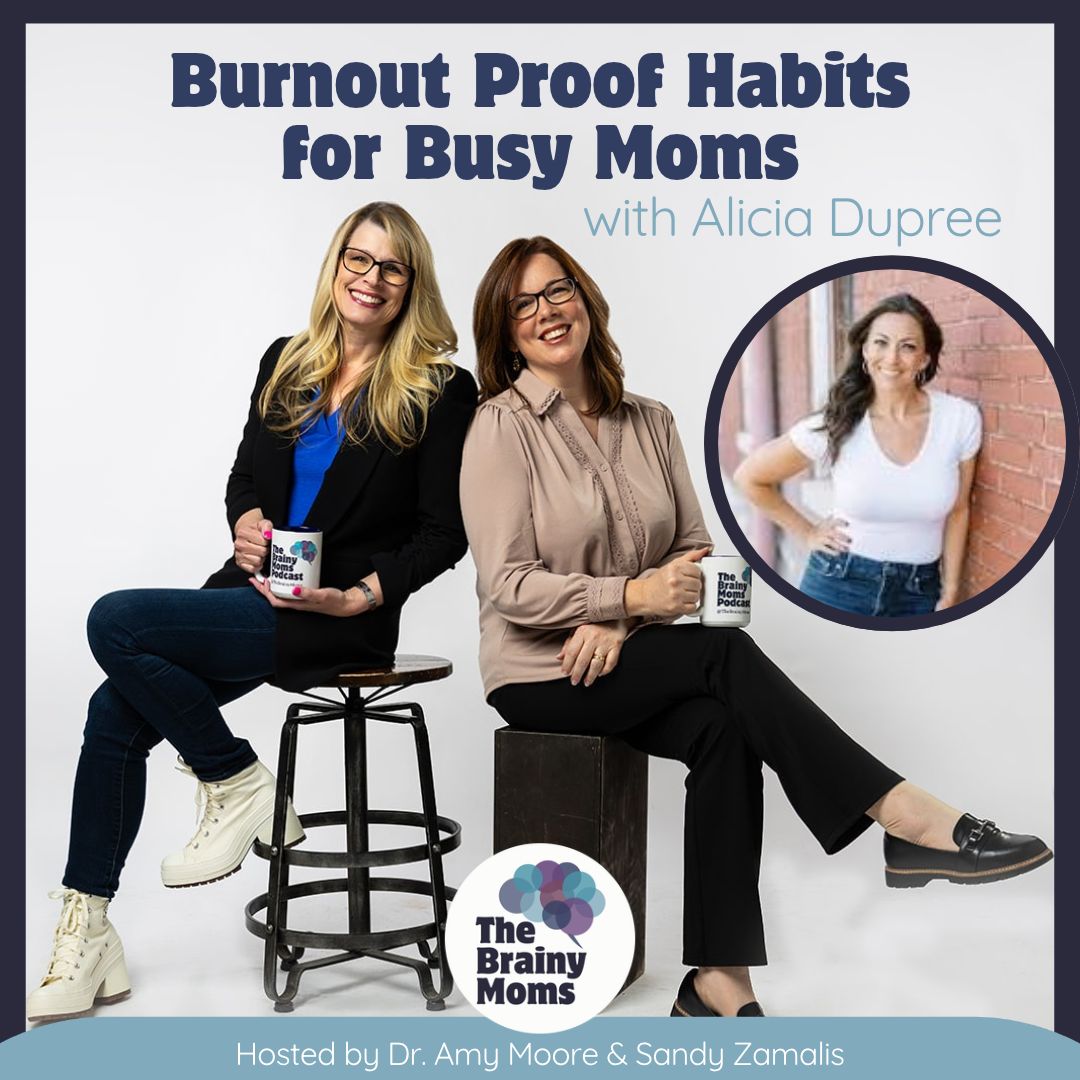
As busy moms, burnout doesn’t usually show up after one hard day. It creeps in when we stack responsibility on top of responsibility, then wonder why the old productivity tips stop working. On this episode of The Brainy Moms Podcast, Dr. Amy and Sandy chat with Alicia Dupree, a master certified consistency coach and working mom of three, to get honest about why so many moms feel like they’re failing while they’re also crushing it at work and at home.
They dig into the difference between discipline and consistency, why “waiting until Monday” keeps us stuck, and how to build a plan that still works during your busiest week. Alicia shares the idea of the “minimum version” of a habit, plus practical tools like if-then planning for curveballs, resetting faster when the day goes off the rails, and tracking a simple “book of wins” so your brain can actually see progress.
They also go deeper than surface-level self-care. Using a wellness wheel and values-based planning, Alicia talks about matching self-care to what you’re truly missing, navigating trade-offs like social time versus financial stress, and reframing mom guilt with a healthier both-and mindset. If you’re trying to balance career, parenting, marriage, and your own identity without burning out, this conversation will help you make small changes that compound into real momentum.
About Alicia Dupree
Alicia is a master certified consistency coach, working mom of three, speaker, and founder of She Rises Coaching and Consulting. Alicia says today’s moms are caring more than ever. Careers, parenting, household management, relationships, school responsibilities, and the invisible mental load that comes with trying to keep everyone else afloat. Despite doing all the right things, many moms still end each day feeling like they’re failing. Alicia helps busy women stop putting themselves last and build simple, sustainable consistency with structure and accountability so they feel better, stronger and more in control without adding more overwhelm. Find her at https://www.aliciadupree.com/ and on social media @coachaliciadupree
Free Downloads from our Sponsor, LearningRx
Download the free ebook, Unlock the Einstein Inside: Wake Up the Smart in Your Child
Download the Brain Training Game Pack
Link to our sponsor’s website: www.LearningRx.com
Read the transcript for this episode:
NOTE: This transcript was auto-generated by an AI assistant that thinks it’s smarter than we are. It’s not, but it has more free time than we do, so we gave it a low-stakes job. It probably spelled a few things wrong, but we’re okay with that. We’d rather spend our time interviewing cool guests!
Welcome And The Mental Load
Dr. Amy Moore 0:00
Hi, Smart Moms and Dads. Welcome to another episode of the Brainy Moms Podcast, brought to you today by LearningRx Brain Training Centers. I’m Dr. Amy Moore, and our guest today is Alicia Dupree. Alicia is a master certified consistency coach, working mom of three, speaker, and founder of She Rises Coaching and Consulting. Alicia says today’s moms are caring more than ever. Careers, parenting, household management, relationships, school responsibilities, and the invisible mental load that comes with trying to keep everyone else afloat. Despite doing all the right things, many moms still end each day feeling like they’re failing. In this conversation, we explore why that feeling is so common, why traditional productivity advice often falls short, and how moms can begin making meaningful changes without adding more pressure to their already full lives. So please help me welcome Alicia Dupree.
Alicia Dupree 1:00
Hello.
Speaker 3 1:03
Welcome. Great to be here. This is how we roll.
Dr. Amy Moore 1:07
Great.
Alicia Dupree 1:08
Me too. This is perfect.
Dr. Amy Moore 1:10
I mean, I like it. But as one of those women who is overbooked minute to minute to minute, right? Like this is the perfect topic for me. Yeah, I’m I’m just top right to you, Amy. Yeah. Okay. We’re good. Yeah. Sandy, you can just sip over.
Burnout Banter And Mahjong Rules
Sandy Zamalis 1:33
Oh, I’m in full burnout mode. So I was already prepped for this conversation because I was like, great. We were having our mahjong night last night, and uh our PR director lives near me. So she and I were playing and we’re both in just burnout mode and like balls are flying.
Alicia Dupree 1:49
You’re making time for mahjong. You’re making time for mahjong, which is like really awesome. I’m still learning. I still don’t know what a bam crack and one ban. I’m like learn, I’m I’m intro mahjong. There’s a woman in town that very smart has just created a business teaching women how to play mahjong, and she is making handover fist money with women like me that are like, I know.
Sandy Zamalis 2:12
Well, there’s 40,000 rules.
Dr. Amy Moore 2:14
Well, it’s Sandy, and Sandy breaks every single one of them.
Sandy Zamalis 2:18
Perfect. As we’ve learned from the theme from the interrupt. This is not surprising information at this point. Not at all. I mean I am shopped. So I’m at her house this summer and we go to play. And I’m like, Sandy, there are way too many tiles on this board. No, you said flowers. There’s way too many flowers.
Speaker 2:41
Right.
Dr. Amy Moore 2:42
So she was playing with all the extras. Like all the extra flow. Like so instead of eight flowers, she was playing with 16 flowers. Amazing. She got back to the phone. And not keeping score. Like they, which then changes your strategy. If you’re not playing with point. And now see, I play for money. So imagine my support. And do you take her money when you beat her, or does she take your money? Here’s my biggest complaint. My mom has no guilt, shame, or anything over taking her child’s money day after day after day. She does it with a smile.
Alicia Dupree 3:33
Hand out, give me your money, daughter. Yeah, that’s yes. If you’re coming to the table, I mean, these are the rules, right? I mean, in what world is it okay to take your child’s money every day? I’m just saying. As long as you keep showing up, I mean, I don’t, I don’t know much about the two of you, but given the title of the show, I have to imagine there is an intelligence factor just it just like baked in. So if you keep showing up as a coach, I would, I would just dig into why you keep showing up to pay her, more so than why does she keep taking your money? So it’s on me, is what you’re saying. I mean, it it may be worth examining.
Sandy Zamalis 4:15
Um but it’s also the competition. It’s the competition. Like I have been bit by the Katie Bug. And like, so I go to her house and I’m like ready to play with her mom and get annihilated because I wanna, I wanna try to hang.
Alicia Dupree 4:31
I mean, I love it that she’s taking money from a generation beneath her. I think that’s amazing. And listen, I mean, I am I have three kids and I I want them to win, but I’m not gonna let them. I let my five-year-olds win sometimes, but I also need her to know what it’s like to lose. Maybe your mom’s still trying to help you learn what it’s like to overcome adversity and get back up from. I mean, clearly you’re doing well at getting back up and trying again and trying again.
Dr. Amy Moore 5:02
Yeah, I don’t think there’s a lesson there. I think she’s just super competitive and loves to win. Um I respect that. I respect that. Um, so
Alicia’s Career Pivot To Coaching
Dr. Amy Moore 5:11
Alicia, tell us who you are and what you do and why you do it.
Alicia Dupree 5:18
I am, I gave myself the title Consistency Coach, because quite frankly, I didn’t really know what else to call myself. I feel like I’ve been a coach forever. Oldest of four. I’m the friend that everyone goes to when they have challenges. I was in a corporate leadership role, teaching and training and developing salespeople on how to do their jobs better. And I feel like I’ve always had a coach hat on in some capacity. And I was in corporate America for 15 years. I was one of the few women in the role that I was in. There were a hundred of us, roughly nationally, and less than 10 were women. And I think everybody but me, maybe one other person, had a stay-at-home husband if they were the breadwinner. That wasn’t my situation. I had a husband that worked, we lived in the New York City area. He traveled a lot. I had an infant, a toddler. I was juggling all the things. And I look back at what were the marker events that really led me to this career? Because I didn’t go to college to be a coach. I didn’t even think I’d be doing this. And in my mid-40s, I made a significant career pivot to really uh get certifications and education around the coaching that I kind of was already doing. Naturally, I wanted to see, like, okay, they teach this stuff. Let me actually go to school for this. And um I think it was the combination of turning 30 and advancing in my career, getting pregnant less than 30 days later after that promotion with my first son, and noticing, oh, this is this is the type of thing they talk about that it’s just different for women in the workforce. And I had great male leaders. This isn’t an anti-man thing. I had great peers, but no one was asking my husband, oh, you’re having a baby. That’s amazing. Are you gonna come back? Or, oh, that’s amazing. Are you gonna like have a nanny? Or how are you gonna juggle work? I’m like, I’m still navigating my, you know, like this, we’re not even halfway through this pregnancy yet. I don’t know some of these answers, but yeah, I want to still work and yeah, I want to be a good mom. And that was the first moment I was like, this is just different. And then flash forward almost two years later, I was in this role. I had, you know, at that point, I guess maybe like an 18-month-old or something. I was in my first big performance review and I had a killer year. I we hit all sorts of goals. I felt really good. I was living, like I was moved for the company. So it was my husband and I and this baby. We had no family around. And my leader was like, You had an amazing year. I just really feel like you’re trying to, you know, wear too many hats. I’m like, what are you talking about? He’s like, Well, you’re trying to be a really good wife and a really good mom and a really good leader. And I was like waiting for the back half of his point. And I said, Yeah. He’s like, I just feel like something has to give. Like you, if you really want to advance here, you need like a nanny. I I I heard you have a daycare, and I’m like, hold on, time out. What is my reliable childcare situation entering this room for? Like, we just talked about the million-dollar growth I had year over year. And you’re asking about, and and and what that was all in my head. And what came out was just tears shooting out of my face because I was so frustrated at the situation. And I said, I’m like, and I actually apologize. I’m like, these are not sad tears. I’m just really caught off guard with this question. Um, and I love the daycare. We’re fine. Like this, and I am trying to be all those things. And by being honest in that conversation, I felt like something changed with the lens that I was viewed in my corporate setting. And again, this was in this was in 2014 at the time. So the company’s evolved since then. I’ve evolved since then. But that made me go, is this the right role for me? Because if something’s gonna give, it’s gonna be this job. Like I’m not willing to compromise how good of a wife and mom I am. Like those are more important than any job. But I didn’t want to have to compromise on work because I loved what I did and I wanted to make a ton of money and I wanted to climb the corporate ladder. I had all these goals. And flash forward five years later, it just felt like an uphill battle all the time. I was growing and I wasn’t, I didn’t have wild success every year, but more so than not, I was very successful in my job until I realized like, this is not, I don’t have to keep battling. I’ve got to shift. And so as I made a career pivot out of corporate America, I said, okay, what are the things I love doing at my day job? And it was really coaching and teaching and development. But I was specifically focused on the women that I didn’t want to have to make a choice of home or work. I wanted them to figure out a way where they could still work and they could still feel like amazing leaders at their jobs and amazing leaders in their house. And so that really was what got me into this work and really helped me identify the women that I like serving the most.
Building A Framework Through Real Life
Dr. Amy Moore 10:16
How did you do your research for the framework that you teach women? How did you come up with these are the things that you can do to be able to wear all of these hats and not sacrifice what’s important?
Alicia Dupree 10:33
You know, a lot of trial and error in my own life, right? Through those years that I was, you know, I mean, I I live outside of New York City now. At the time, I was commuting into New York City with an infant and a toddler and like a breast pump and trying to figure out how to like keep my milk cold on the way home in the Lincoln Tunnel when the bus broke down. Like it was a very nutty season of life. Um, but it taught me so much because what I had to quickly learn was as an achiever, and most of the women I work with are, if you’re familiar with the Enneagram, they’re Enneagram threes, or they have some component of like they really want to hit big goals and they and they hold themselves to high standards, which I love. I did the same thing. But I was setting expectations that were just unrealistic in the season I was in. I was setting them for the, you know, 28-year-old version of me that had a husband and just all this time. Like I remember feeling so busy. What did I do? I don’t even know what I did with my time pre-kids, right? I’m like, was felt so busy. I was not busy. I still couldn’t get to the gym, you know, when I had no kids, right? And um I had to realize that if I had this big goal, I could still have that big goal, but I had to either reduce the pace at which I expected to get there, I had to take the action step. Like, let’s talk about health and fitness. It’s an easy one to illustrate. If I wanted to hit a goal to run a marathon, like the old me would have been like, okay, we’re training five days a week, we’re gonna go on these, you know, 15-mile runs towards the end. Like that wasn’t realistic for me in the season that I was in. Not that you can’t, but for me, as I was prioritizing what was important, running a marathon or training for a marathon was not important to me at the time enough to trump other priorities that I had. Um, but the version that worked for me was what’s what’s something I can do that makes me feel like I’m working towards that goal someday. And I hadn’t even run a 5K, right? So for me, it was like, let’s like try to run. People talk about running, I’ve never liked it. Let me just try it. So for me, it was like literally getting out in a 20-minute walk-run combination. That was like the minimum version that worked for me. And it still made me feel like I was doing something for me towards a goal that I either have or may have someday. And that was enough. It actually surprised me that that was enough because I felt like I had no time for anyone but my team at work and my young kids. And then I would get up and do it all again the next day, and I would wake up when they woke up and just be reactive and serve people all day until I crashed from exhaustion and then did it again the next day. And it was like rinse and repeat. And I realized quickly that like I need to serve myself first so that I can show up better. And it’s the whole metaphor of, you know, putting your mask on right first before helping others. And the framework was really built from that. Um, the course that I run was built from that. I really uh my hope is that I can help a woman get from point A to point B a little faster with less speed bumps than she could on her own. Because you don’t need me, but if I can help, you know, guide you a little easier with less detours and and speed bumps, then I feel like I’ve done my job as a coach and as a partner. So that’s really the the long version of kind of where that, where that came from.
Sandy Zamalis 14:06
I
Discipline Versus Consistency That Sticks
Sandy Zamalis 14:07
heard it said once that um like a lot of times when we struggle with this sort of like shift or uh trying to build a new habit or reach a goal, that we get stuck in this process of thinking that we aren’t just we aren’t very disciplined. Yes. But really, discipline is what what threw my brain around when I really thought about this. Discipline is really in that first act of doing the thing, whatever it is. And then everything after that is consistency. So I love that you call yourself a consistency coach because that’s really hard. It’s really hard to create a doable habit. Um, and so you almost have to start small because if you make it too big, you will not be consistent with it because it’s too much.
Alicia Dupree 14:51
Exactly. Yeah, I mean, that’s exactly why I think it’s January 9th is labeled National Quitters Day, because we we come into the new year, right? Setting these massive goals. And it’s like, I’m gonna work out five days a week at 5 a.m. And then maybe you do that that first week of January. But then that second week, when you don’t do it on Wednesday, the talk track often becomes, okay, well, I’ll just start again on Monday. It’s like, well, what about Thursday, Friday, Saturday, Sunday? What about if you can’t go to that workout class, what about a walk around the block, right? Something. And yes, that’s where the consistency comes in. And so many women blame themselves and they say they’re not motivated, they lack discipline. And it’s it’s rarely that. There’s no way that that you lack discipline and you’re lazy if you’re having all this wild success in your corporate life or you’re crushing it as a mom. I’m sorry, like you can’t, you can’t be so undisciplined and so lazy and have a functioning household or job, right? So I call them out on that. I’m like, and I’m really happy that you said that. It’s it’s not discipline. It’s you’re focusing on these higher level actions that I mean, I don’t know how you would keep it that consistent because you’re not planning. Like what I want women to leave with with this framework is if this framework won’t work during your busiest week, then it’s not the framework for you. It’s not. Because we plan for a week where there’s no unexpected meetings, no sick kids, no curveballs in your personal life. Like, that is not, at least for me, that is not a realistic week, right? So helping women plan for the busiest week. And then anything extra on top of that is bonus. All of a sudden, there’s some confidence built and there’s some momentum built because they’re feeling like, oh, I’m doing the thing I said I was gonna do, versus the opposite on a Wednesday having shame because you ate carbs that day and you weren’t planning on it or something, right? Like to me, that’s the permission that I want women to have is to start smaller so they can build that consistency.
Dr. Amy Moore 16:57
So
How Burnout Builds Over Time
Dr. Amy Moore 16:58
at the top of the show, uh Sandy said that she’s in like burnout mode this week. You talk about that idea that burnout just doesn’t happen, right? That it’s kind of an insidious.
Alicia Dupree 17:13
Talk a little bit about that. I just posted something on social media recently about this, that the sentence I hear or the theme I hear right before burnout is, well, I’m just in a busy season. And I’m like, okay, well, how long has that season been? No one says they’re burnt out after a tough week or a month that feels especially hard. It is consistently a routine that is not serving you, right? And so to your point, it doesn’t just happen overnight. And when Sandy says, I’m at burnout, it’s probably not because she had a busy week last week. It’s because as she looks at how she’s spending her time, it’s likely out of alignment from where she might need to be spending her time the most. And when I say this, I’m not ignoring the fact that we have responsibilities as humans, as employees, as parents, as women. I’m not saying you just clear your calendar and do whatever you want. I don’t actually think most people need that. They just need small tweaks to make room for the things that feel like they’re lacking. So we were talking about mahjong earlier, right? Like you made time for mahjong, Sandy, because that’s important to you in some way, whether it’s the social aspect, the competitive, the I’m stepping away from my responsibilities for two hours and it just feels good. You have time for mahjong because it’s important to you right now. And so when we think about burnout, we often solve it with self-care, which is also a term that I like to dissect for people because self-care, which I love, I I love manicures, I get massages. That’s great. But sometimes that’s not the self-care we need. Because if we’re having, if we look at like um all areas of wellness, right? I I give my clients an assessment. I’m happy to share this with you if you want to include in the show notes, but it’s just a quick check-in. There’s a bunch of things floating around online. I use eight different dimensions of wellness and I ask women to rate themselves, scale of zero to 10. Don’t use seven, because seven is safe. Um, are you a six? No fence sitting. No fence sitting. Gotta go one. Yeah. And I, in my book, I literally write, do not write seven on here. Like, even though I can’t tell if they’re going to, I’m like, do not write seven. But the reality is, are you a six or an eight? And let’s say in your social bucket, you’re feeling like a four right now. And you go get a manicure, which maybe you like. That manicure is not gonna fill your social void you’re feeling. And so if you go week after week after week and you’re not engaging with friends, coworkers, a spouse or family, or whatever you’re feeling when you defined yourself as the four, that four is definitely not gonna become a five. And it might even slip to a three, right? So maybe the manicure pedicure is with a girlfriend right after a fun brunch. And then, yeah, that might be part of what, you know, refills that that bucket a little bit. Um, and so I think that when we talk about burnout, we need to take it as like a level deeper. Where are you feeling burnout? What feels like it’s missing? Let’s look at your time. Where are you spending your time? It’s usually an easier fix and an easier solve than most people realize. But we’re so burnt out and stressed out and overwhelmed, we don’t even take a second to pause and reflect. And so, of course, it’s not going to get fixed. In fact, it’ll likely get worse unless there’s intentional effort to correct.
Dr. Amy Moore 20:55
Yeah, I love how you’ve connected this idea that, or what I’m hearing you say is that when we make self-care choices, they need to fit the spaces where we’re feeling deficient and not just add yet another thing to the calendar. Yes.
Alicia Dupree 21:15
Yeah, I mean, that’s huge, right? There’s a section that I have on there that’s financial wellness. If you’re feeling overwhelmed because you’re in debt or you’re feeling like, you know, there was a curveball that maybe made things tight, uh, manicure is probably going to make that worse. I mean, unless you know someone that gives is giving free manicures, right? That’s gonna cost money. And so maybe self-care in that category is sitting down, pulling up your credit cards, as as scary as that might be. Look at where you’re spending money and cancel some things that maybe need to be canceled or decide to cook a little more, then take out, right? Those are those are self care actions that’s going to help you feel better in that, in that bucket. And what’s tough is Is when they conflict. So let’s say you’re having a financial challenge and your social bucket is empty and you get invited to go out to dinner. And you’re like, wait, well, that’s maybe that’s gonna cost a babysitter, maybe it’s gonna cost an Uber ride and then a hundred bucks. I mean, sometimes you have to choose. You’re like, oh, I’m feeling pulled because I’ve got two conflicting areas. You might have to say no, thank you to that dinner, which isn’t gonna feel good, especially because it’s probably not gonna make that much of a difference short term. But if you’re trying to create different habits, then you might have to make that uncomfortable decision to say no to a friend, or it’s hey, I can’t make dinner, but do you want to go on a walk this weekend? Maybe you can find a way to still satisfy both, but your instinct is, yeah, let’s go to dinner. And now you’re, you know, like maybe not feeling so great about that dinner when the bill comes. So those are the little, you know, trade-offs that sometimes you’re forced with. And it’s hard to make decisions in that, in that area. It’s really challenging.
Sandy Zamalis 23:05
Um, because I would say, like, if I were to think of like where, because we were talking about my burnout, you know, some of it comes from being in a place where you are putting on a mask all the time of, you know, I’m a business owner. So, you know, I work with kids, so I have to be in the present moment with them and work uh one-to-one. Um, I work with colleagues and there’s, you know, some nuance to that. And then, you know, you’re constantly moving and you’re just the the fill, at least for me, is just needing to be seen as myself, where I can just be me, where I’m not having to pull all the weight or, you know, get things the the where they need to be or do the things I need to do or juggle the balls or whatever. Um, and so I think it’s really valuable what you’re saying is like you have to take an analysis of what’s missing. You know, are you a creative person who needs more time to be creative? Are you someone who really create needs and craves that physical activity? And so you’ve pulled that out and that needs to come back in because that gets you in alignment and helps you kind of get some of that stress off. Uh, you know, all of these things are good things, but you have to figure out where your balance is, is what I’m hearing you say.
Alicia Dupree 24:27
Yeah. I mean, do you feel like you wear a mask at Mahjong? Or can you just yourself? Right. That’s probably why you like it. It’s probably why it feels good, right? I mean, that’s I’m going to a book club tonight. As I look at my calendar, I have to outsource a ride to a soccer practice to go to this book club. But I’m like, no, I read the book. It’s been on the calendar for the month. The soccer practice got scheduled. I’m gonna ask for help, which is hard for me. I’m still working on that. I’ve learned that in order to feel the way I want at the end of the day, I need to involve other people. Um, and yeah, I’m going to the book club because it’s the same version of Mahjong. I’m I’m with clients all day. I’ve got kids at home still. We haven’t started school yet at the time of this recording. I mean, everyone needs me all the time. So by going to book club, right? So that’s important for me now. And there, listen, there are some seasons where I I don’t I don’t make every book club, but if I if I can, I’m going to because of that reason. And it’s interesting when when women say, Well, I don’t have time for that, um, I ask them to add because it’s not that important to me at the end of that sentence. So if if you said, I really want to work out, but I don’t I don’t have time for that, okay. Just say because it’s not that important to me. Or I don’t have time to work out because it’s not a priority for me. If that statement feels true, great. Okay, don’t work out. I mean, I’m not I I I never tell anybody how to spend their time, but I ask them to make that statement hey, having lunch with my mom is not that important to me. Well, maybe that feels different because it’s been a while since you’ve had lunch with your mom. And maybe when you say it out loud, it doesn’t settle. Well, then that is an indicator that it’s time to move some things around and get lunch on the calendar with your mom. Right. And um, you have to own how you spend your time because there’s a lot of tough love that I give with my uh clients and they ask for it, and I always ask for permission before I do it. But I’m like, well, what did you do last night between the hours of nine and 11? I scrolled, I finished the season on Netflix, and I watch Netflix, I’m online. I’m not, I’m not um downplaying those activities. But if you’re telling me you don’t have time to work out in the morning because you need more sleep, you’re not getting to sleep till 11, like help me understand that because we all have the same 168 hours in a week. And I’m not ignorant to the fact that some people are in situations that make it more difficult to just go to Mahjong or book club or meet their mom, right? I recognize that. But there are choices you are making with the free time that you have, even if it feels limited, that might be worth examining if you’re feeling pressed for time. That’s usually an exercise that I encourage people to do when it’s uncomfortable because we realize we do have time. We’re just not spending it in alignment with the things that we say are most important to us.
Dr. Amy Moore 27:38
Well,
Values Clarify Time And Priorities
Dr. Amy Moore 27:39
you actually encourage women to do a values-identifying exercise, right? Because that actually then creates this roadmap for you to be able to plan your decisions, your choices, how you spend your time, right? Talk a little bit about that.
Alicia Dupree 28:01
At some point in some season of our life, most people have gone through some values exercise. Or if we say, hey, what’s really important to you, right? There’s there’s some things that might come up. Family is really important, uh, joy, creativity. Some people say music or art, you know, and it’s all personal. And and you know, security is a great example. So security might be a value that all three of us share, but the way we define security might be different. So maybe Sandy defines security as having a safe place to live. Maybe financial security is really important. Maybe it’s job security that’s really important, right? So when someone says security, I’m like, what does that mean? Like, let’s actually write out what security means. And then once you have, I have I have women go through this exercise where I just give them a list of a hundred values and I have them just list as many that feel relevant. Sometimes it’s people come up with 30, sometimes people come up with six. It really doesn’t matter. I’m just like, there’s there’s no limit. Just write them down. And then I ask them to narrow it down to their top six and then their top three. And I want them to keep those six in mind. Oftentimes they’ll write down happy, they’ll write down joy, they’ll write down uh fun. And sometimes they all kind of blend to one and they can sum it up in one way. So let’s say fun is a value, like having fun, which I think is a great value. You’ve got to do an analysis on how you’re spending your time and say, what when’s the last time I had fun? And what am I doing when I feel like I’m having the most fun? I went to a concert last night with my husband. I love going to live music events. We bought tickets yesterday morning, wasn’t even on the calendar. We’re like, you know what? It’s a gorgeous night. We talked about maybe going, let’s just see if there’s tickets available and go. We had so much fun. And I’m not saying I have to do that every week, but if I were to look back at my calendar and go, when’s the last time we like really had fun? Or if you’re a creative person, when’s the last time I made space to like actually be creative, whatever that means for you? If it’s writing, if it’s art, uh, one of my clients is a doctor actually in Germany, and she’s a new mom and a resident, and is like her schedule, talk about no time. She’s got very little free time. She grew up playing the piano. And she said, I just don’t have time to play the piano. I said, Okay, for how long? She’s like, Well, like, I don’t have an hour to play. I’m like, don’t play for an hour. What who said anything about playing for an hour? Go just like tickle the ivories or whatever. Just play for five minutes, 10 minutes. And she tried that and she was like, I cannot believe how much those five minutes made me feel better. And now she’s playing for 10. Suddenly she’s finding time to play for 30 minutes a couple times a week when she has no time. Right. So because she recognized that a value of hers was music, arts, creativity for her, that that simple shift for her like made more of a difference than either of us expected, right? Because she took a second to go, what is most important to me? And is that being reflected in the way that I’m spending my time?
Dr. Amy Moore 31:18
I love that example because not only can we say, um, okay, it’s important to me. So I’m going to make this five-minute or this 10-minute time. But sometimes there’s a domino effect of those choices that we make in other areas of our life too, right? So I like that you mentioned the piano because I will get up in the middle of the day if I’m having writer’s block or I’m stuck on a trying to find a solution to a problem. And I will play the piano for 15 or 20 minutes because it actually creates my ability to think differently. Like it opens these doors of creativity that make me more productive when I come back to my desk. And so when we make those decisions, like, hey, do we have 30 minutes to go run? Not only is that a form of self-care and maintenance on our bodies, but what else is that doing for you? Right. So, I mean, that aerobic activity is going to make your brain work better, which has this trickle-down effect, right? And so when we can think, it’s not just about the one activity, but it’s about how can we impact the whole of our being and functioning too?
Alicia Dupree 32:40
Yeah, absolutely. When I uh when I have women go through that exercise on their wellness wheel, I call it, which is those eight dimensions of wellness. And they recognize, wow, I’m a six here, I’m an eight in these three areas. Sometimes they’re pleasantly surprised. They’re like, actually, I’m like a nine here. I’m like, great, right? See, it’s not all so bad. And no one’s ranking themselves a zero anywhere, right? Generally, it’s like a three to eight is usually the range. I asked them that question. Which bucket is going to have the most trickle-down effect, the most positive effect on other ones? So emotional wellness is one. If you’re not good emotionally, showing up in every other aspect of your life is gonna be, is gonna be affected, right? So putting some time to work on your emotional wellness, or maybe it’s your physical wellness, or whatever it is for you is going to impact other areas. Without a doubt, I use the term domino effects in my book right after that exercise. Because as I say, where are we gonna spend time first? It’s which one feels the most urgent and which one, and it might be a different one, might be the same, which one feels like if I move the needle here, I’m gonna start seeing positive effects everywhere. And
Mom Guilt And Better Boundaries
Alicia Dupree 34:01
what comes up a lot for women, and I don’t want to derail the conversation, but it’s this, it’s this mom guilt that if I spend the 30 minutes on the run, well, that’s time away from my family. Yeah. Yes, it is. It’s it is well spent time away from your family. And so that part of it, there’s self-inflicted mom guilt, and then there’s when your kids literally say, which I heard last night, you’re going out again with dad? You have to get a babysitter. And I’m like, yep. Gave him a kiss. And I’m like, it’s really important that dad and I go out without you guys sometimes. Meanwhile, I’m like, we were on vacation for a week last week. Like, remember that? Remember when we were together all day, every day for seven days, you know? Um, but but no, I I clue my kids in big time on the self-care that I’m taking and why I’m taking it. It’s important that they know that I care about my body. So I I move it. I have friends too, right? You know how I drive you to your friend’s house. I’m going to my friend’s house tonight, right? Or you’re going on a play date or you want a sleepover with your friend, so do I. My sleepover is just out of town for two days, right? So cluing the people in around you of why you’re spending the time there, I actually think releases some of the pressure to serve everyone else all the time. And they generally see it. I know that I come back as a better version of myself when I’m away for a couple of days, or when I get, you know, a mahjong night in or something. That, like my kids see me go. I come home and they’re mostly in bed. The older ones are now staying up later and later, but generally they’re in bed. And when I see them the next day, I’m a better version of me. And they feel it, right? So does my husband. So does my team at work. I mean, it it really impacts you in many ways. Just by filling the cup that you need, everyone else feels it too.
Sandy Zamalis 35:57
And now
Sponsor Message From LearningRx
Sandy Zamalis 35:58
a word from our sponsor, LearningRx. In second grade, Isla was struggling to read despite being pulled out of class to work with a reading specialist. Progress was slow, and Isla was frustrated. She hated to read, and it was a battle to get her to pick up a book to practice reading every evening. Her LearningRx cognitive skills assessment provided insights as to why, despite consistent reading interventions, Isla struggled to read and spell. Her assessment revealed significant weaknesses in memory, auditory processing, and attention skills. See, to unlock reading ability, it is critical to address underlying deficits in cognitive skills. Isla’s LearningRx training targeted these weaknesses and her reading has taken off. At the beginning of second grade, she was reading at a kindergarten level. After brain training, she is now reading at a third grade level. Isla now loves to read and is devouring books. Your child may not achieve the same results as Isla, but the team at LearningRx would love to talk to you to see if cognitive skills training might be the next best step in your child’s reading journey. Visit LearningRX.com slash the Brainy Moms to learn more and receive a cognitive skills assessment with a consultation for just $99. That’s LearningRX.com slash the Brainy Moms. So
Baby Steps For Putting Yourself Back
Sandy Zamalis 37:18
you mentioned that you end up in your world working with a lot of like type three Enneagrams driven type uh women. Um I’m a nine, so I’m the peacemaker side of the equation. So just to throw a little different way of thinking, um, because I I’m glad you brought up mom guilt or, you know, or any, I mean, it can’t, it’s not always just mom guilt, it’s guilt everywhere. It’s I’m I’m dropping a ball or I’m not showing up or I’m not doing the thing that I should be doing, whether it be for myself or for others. Um, how do you help maybe less driven women? Because I’m sure you have a variety, um, but that might be the main, because you you’re helping juggle work in life. Um, people who really struggle even understanding or wrapping their brain around that the importance of um putting themselves first, because for the for people who really, really struggle with that um and maybe aren’t as driven, and it’s easy to let themselves just fall to the back. How do you encourage that to come forward?
Alicia Dupree 38:24
This doctor that I mentioned, she really struggles with it. And so clearly she’s driven. She’s in a very intense training for an incredible career. She feels like she can’t spend time with away from her daughter because she doesn’t see her daughter as much. So she says, I can’t right now go out with my husband. I just can’t because I can’t, I don’t want to get a babysitter for her, or I can’t, she had a day off of work. So she pulled her daughter out of school. And I said, Oh, listen, again, you can spend your time however you want, but you’re not any less tired. In fact, you’re still further away from playing the piano or getting the haircut you’ve told me you needed for the last six weeks, right? Like, is there a way you can do both? And so I try to take them through baby steps on something that feels less dramatic than I’m going away for the weekend. It’s I’m gonna pick my daughter up a little early from school today because I can. But before that, I’m gonna do these couple things that I know that if I just do them, it’s gonna feel really good that I finally accomplished that task. Or is there a way to bridge the gap where you can combine something you’re already doing with something that might make you feel a little better? So I mentioned, you know, going out to dinner earlier versus a walk. If you’re trying to move your body more, or you know that you’ll feel better by getting outside, I don’t know what part of the country you’re in, but like eventually six months from now or middle of February, getting outside for a walk in New Jersey is going to be miserable, right? So if there happens to be a nice day, me taking a call outside, even will still allow me to fulfill my obligations and not let someone down. I don’t need to cancel a call so I can sit outside. But can I take a call from my backyard? Or can I meet a friend for a walk to still be able to slowly just add some of the things that I know that I feel like I’ve been missing? It doesn’t happen overnight. And if you have a history of hearing that it’s selfish to do that, or I can’t believe you would spend time doing that, or reminders from your kids or a spouse or someone that even if they listen, I actually have had to work really hard on reframing the fact that my kids want me around so much, like what a blessing that is. My oldest is 13. He still wants to hang with me. I don’t know how long that’s gonna happen, but it it feels harder to have him say, Hey, can we play? And me say, Well, I I have a client. I have to talk with this client. And he’s like, Okay. And I’m like, please don’t make that face. But but but I’m also not subscribing to those tear-jerking Instagram reels that are like, you only have 18 summers with them. And I’m like, Well, I mean, I hope I have more than that, right? Yes, it’ll be different in 18 years, but I was just at the beach with my mom for a week and I’m 44. So like, we’ve had more than 18 summers, right? It’s just, it just feels different. But my professional identity is important to me too. So if I if I fully neglect that and say, I’m sorry, client, I’m not gonna meet with you because my son wants to play in this exact minute, then now I’m letting her down, playing with him, and I know I’m not gonna feel good about that because I’m letting my client down. So in that moment, the solution isn’t drop everything and play with my kid or ignore my kid and meet with my client. How can both be true today? So then the conversation is, hey, Chase, I really want to play with you. I’ve got one more client. How about this? How about you finish your reading? I’ll work with my client, and then I have a break for an hour. Why don’t we go kick the ball around or let’s grab something to eat real quick, or will you run with me to the grocery store? Because they just want time with you. And you also might only need 15 minutes on the piano. We somehow think it’s it’s this, well, I now need to carve out a full day to take my son out. So, no, they don’t need that much time. And you may not need the full day either. It’s just these little moments where you can make some small shifts. Again, going back to consistency. It’s unrealistic to say to somebody who’s uncomfortable with, you know, that mom guilt piece, uh, just take a weekend, just go. It’s like that’s unreal. People aren’t there yet. So it’s like, how do I get up 30 minutes earlier so I can have a cup of coffee, start to finish, or take a full shower where I shave my legs and everything, right? Not just like a quick two-minute shower, right? Sometimes literally, I mean, for me, the luxurious kind, right? I mean, it’s like five minutes, not 90 seconds, right? So where you’re like hearing your kid cry, you’re like, Do I even have a baby in the house? Why am I hearing a baby cry, right? In the shower. There’s just something about it. And so, yeah, it’s it’s really like, let’s take the minimum version, like the smallest possible tweak we can make and start there and see
Identity Beyond Motherhood And Work
Alicia Dupree 43:22
Speaker 3 43:22
how that feels.
Dr. Amy Moore 43:22
Yeah, I love how this is not an either or scenario. It’s a both and. And, you know, I always um talk about um when I counsel couples, I will say, look, your relationship started before you had a family, and your relationship is still going to be there when your kids are grown and gone. And so we have to nurture that along the way. So if we apply that to our own identity as moms, right, we don’t get to say, okay, this is my identity pre kids. Now I have a kid. So now my entire identity is wrapped around mother. This child. And then when my child, 18 summers from now, is grown and gone, do I go back to my original identity? I mean, we have to find ways to integrate all of that into who we are along the way. Otherwise. Yeah. I mean, we have an identity crisis happening at both transitions, right? Yeah.
Alicia Dupree 44:23
And that’s exactly what I mean by shifting the expectations during the season you’re in. I definitely want on more dates with my husband, pre-kids, and probably will when we’re empty nesters. But I’m not ignoring the dates for 18 years or it’ll be 25 years by the time my youngest is out, because guess what? We won’t be dating after they leave if I’m not managing that relationship properly and we’re not pouring into that. But of course it’s not going to look the same, right? And the way that I parent is very different, right? I mean, I’m I’m starting to learn this like big kids, big problems thing. I mean, uh, raising a 13-year-old boy now who’s navigating middle school and the dynamics there. And I have two boys and a girl. I haven’t even gotten to the girl stuff yet, which I know is a whole different fall of wax there. But um making sure that I am the best version of me when my kids need me in the way that they have and will continue to need me is really important. And it’s gonna look different, right? Because the season of life I’m in is different. And that’s where the expectations have to be realistic as well, right? Even like around something as simple as a meal plan. I have two competitive soccer players and a competitive dancer. Dinner during the week, I don’t know what that is. I mean, sometimes we’re eating it two of us, sometimes it’s four of us, sometimes it’s all five. But setting a goal to have a healthy dinner on the table every night, five days a week, what an unrealistic goal for me to set. And then I’ll feel like I have failed by Thursday. Why am I setting that goal? What’s a better goal for our family right now that will still accomplish some of the togetherness, some of the health stuff we’re talking about, but that matches our life. That’s the part that, you know, we need to focus on right now.
Dr. Amy Moore 46:12
Yeah, and I think that’s a key point of what you’ve been saying that there is not gonna be the exact same plan for every single family, right? That you’re saying this is individualized to you, right? Based on, you know, where are you feeling deficient in in one of these areas in your life, but also what is gonna fit your family. So you can’t try and take, like I can’t take Sandy’s scenario and try to make it work for my life and right and vice versa, right?
Sandy Zamalis 46:43
Alicia, well, the other part that I think uh to Amy’s point about it being different individually, right? Um, it’s also different day by day. Um what I think a lot of times we lack or get stuck in when we think of these grand plans is that we’ve got to create the system or routine that we can do every day, but you have to embed flexibility so that you can make adjustments when the day doesn’t go as planned. And I kind of heard you highlight that. So, you know, giving people options sounds like you help people understand that, yeah, you didn’t get to the yoga class, but what else could you do today for yourself to feed that need of health or wellness? Or you did get to play music today, but maybe you got to listen to your favorite album in the car, um, so that you’re still feeding that need and giving yourself that flexibility and then modeling that for your kids so that they see how to do that through you.
If Then Plans And Faster Resets
Alicia Dupree 47:43
Absolutely. Yeah, I actually walk clients through an if-then planning exercise long before it actually happens, so that we already know what we’re gonna do. If practice runs late, or if I oversleep in my alarm or a kid comes in in the middle of the night and that 5 a.m. workout class is not happening, then what? And that decision’s been made ahead of time, right? We already have that planned. So it’s exactly for that reason. It’s not, well, is this gonna happen? No, no, no, it’s going to happen. But don’t worry, you already know what you’re gonna do, right? And if it totally goes awry, then I help women reset faster. I think that’s the thing. It’s this like waiting till Monday mentality, this all or nothing approach. It’s not, you know, this or that. It is and both. But it’s also this concept, and I didn’t make this up, but I’ve been living it all, you know, probably the last decade, is this concept of some is better than none, right? And getting women okay with that. And that is hard. Again, high achiever or not, Enneagram three or nine, it doesn’t matter. It’s this idea that it doesn’t have to be perfect. So if everything hits the fan by Tuesday at lunch, do not discount the rest of the week. Just reset faster. If you go off your meal plan tremendously, okay, well, have a vegetable the next day, right? We don’t need to say, well, mine as well. Like that phrase mine as well, like nothing good ever comes out of that. It’s never might as well run three extra miles. No, it’s might as well stop now because I can’t do right, or mine as well eat more kale. No one’s ever said that. It’s might as well have dessert too because I, you know, the day’s gone. So just watching that, those, those soundtracks that are in your mind, those things that play on repeat, are they serving you? And how do we replace that? So some of that is, okay, this didn’t happen. I’ve got a plan for this. I’m gonna do this instead. And if it’s all a disaster, we’ve got tomorrow to try again, you know?
unknown 49:50
Yeah.
Dr. Amy Moore 49:51
So I’m actually uh an Enneagram three. And um, you know, the big why are you laughing, Sandy?
Sandy Zamalis 49:59
She’s like, I’m just laughing because it’s like, this is me. But you are very good at giving yourself structure and boundaries.
Dr. Amy Moore 50:06
I’m here for it. Yeah. Um much better than me. The biggest fear of an Enneagram three is to not be valued or not to be perceived as bringing value to the world. And so I think we get in this trap of thinking that we have to do things perfectly in order for them to be of value. And I think that that’s erroneous thinking. And so we have to be able to say, okay, I cannot let perfect get in the way of great. And I can’t let myself think that if if I can’t do it perfectly, then no one will benefit from this or there won’t be any value to it because that is not true.
Alicia Dupree 50:51
100%. And as an Enneagram three, I can relate to all of that. And that was a huge shift for me. I had to like really workshop that for a while. It took me a long time to get good with the fact that again, some is better than none and messy action is better than perfect action 10 out of 10 times because like writing my book, it I had all these plans to sit down and write this many days a week, this many hours. And it didn’t work out that way. And so it just became, okay, I’m gonna write for 30 minutes. This is like the the most I can do right now. And it’s gonna take a little longer as a result. But I I gave myself some grace for that and also adjusted as it was close to the publication date. I’m like, you know what? No, like I am actually prioritizing this to get this last push done. And I felt good about that too, right? And um again, it’s this concept of if I can’t do it, yes, if it won’t add value, then I’m not doing it at all. But also if if I can’t do it at this level that I used to be able to do or think I could do, then I’m also not gonna do it. Like if I can’t, like I I started coaching in the health and fitness space. So a lot of people were like, well, I want to work with you, but I’m not gonna work with you until after the summer. Because you know, the summer, it’s crazy. And I’m like, okay, is the fall less crazy for you? Because to me, it’s you’re in a season where everything is crazy. I’m like, well, let me just wait. I have a wedding that one Saturday. I’m like, okay, so do you realize how much opportunity there is between now and the end of the month? Like for September. I don’t care if you half of the month is a disaster. What about the other half where you have opportunities to make good choices with what you eat, how you prioritize your sleep, the water you drink, the movement. Like, there’s an opportunity because what happens is we don’t take action. And not only are we not getting closer to our goal, we’re getting further away.
Dr. Amy Moore 52:48
Right.
Alicia Dupree 52:48
Right. Time is on our side when we’re making good choices, small ones over and over again. It compounds. You turn around, you’re like, oh my gosh, this book is written. Or I’ve lost 10 pounds. Or maybe it took a year, but you lost 10 pounds because you made little choices, more good choices than bad choices, or more choices that got you closer to your goal than further away.
Tracking Wins To Build Momentum
Sandy Zamalis 53:08
Alicia, that’s a great point. How often do you encourage the women that you work with to really celebrate those small wins along with the big ones?
Alicia Dupree 53:19
I have some women do it every day because they’re so far away from recognizing celebrations. I have them keep literally, I call it a book of wins. It’s on any notebook they have. There’s not a fancy journal for it. A dollar store notebook is fine. Um, although people are like, well, I need to get a new notebook for this. I’m like, okay, go get the new notebook. It has to be perfect with the perfect pen. I mean, right. I need, I need the pen. They’ll be here on the has to match the bedroom because it’s going to be sitting on the nightstand. Correct. Right, right. Yeah. So there’s a little bit of that. But once women actually pick up the book, I’m like, I need you to find a win you had in the areas you’re trying to improve. And it might be I ended up having a cup of tea instead of the ice cream that I wanted, if there was a health goal and you’re trying to have less desserts in the course of a week. Or maybe it’s I got up when I said I would instead of snooze, or I was nervous to make that call at work, but I ended up making that call anyway and put myself out there and left a message. Like whatever it is, what are the wins? Because what happens is when we are feeling stuck. And again, going back to health and fitness, if you choose to work out today or not, it’s not gonna change the number on the scale tomorrow. It’s not that you’re not gonna look in the mirror and all of a sudden, you know, have these killer-toned arms by doing bicep curls one day at the gym. In fact, you’re gonna feel sore the next day. It’s even worse. You’re like, wait a second, I don’t look any better and I’m sore. This is what is this, right? Well, that’s exactly when you have to do it again the next day and the next day. And so I’m asking people to find evidence of their progress more often. Because then when they look back and feel like, I don’t haven’t done anything or it’s not, it’s like, no, no, no, look, in your own writing, remember, you are doing things. And eventually they turn around and go, like, I can’t believe that happened. I’m like, I can look at what you’ve done, right? Like, you know, find it. And when we get our brain to start looking for evidence, sometimes we’re more proactive with our decisions. Like, oh, I could write this as a win tonight, right? So some people do it every day. Some people do it on a weekly basis as they look back on their week. I ask people to do it at a minimum 30 days, or sorry, a maximum 30 days, because I think a month can go by like that, and all of a sudden we’re like, well, I don’t really do anything. You probably did, but I think because there’s so much going on, oftentimes that’s almost too long to wait to capture some of those wins, especially for people that are used to celebrating only when there’s massive milestones, not celebrating the fact that you had water instead of wine one night, you know.
Dr. Amy Moore 55:59
I love that. And it’s a great way also for them to be able to identify patterns.
Alicia Dupree 56:04
Yes.
Dr. Amy Moore 56:04
And so you can say, all right, what do you notice when you look at the categories of all of these wins? And so then they might be able to identify why there are some other gaps, right? Because this is great and let’s celebrate this, but this is all in one area, and you’re still seeing, you know, a gap over here in this web of your eight key areas or nine key areas. And I think that can be an aha moment for us, right? To go, oh, okay, well, I can have that kind of success if I start setting different goals too.
Alicia Dupree 56:40
Absolutely, because there’s proof that you can have the wins. But usually early on, it’s it showcases the habits where you’re already winning, right? And so, yes, it very much identifies areas of opportunity to take a similar approach because where you are now is a result of all the things you’ve done or not done up until this moment, up until this podcast recording. But the cool thing is I can literally change anything moving forward. I can impact where I go at any time, middle of the day, on a Tuesday, in June. Doesn’t need to be January 1st or Monday or a new month, right? I have an opportunity every single moment of the day to create some new patterns. That’s the cool part about being human, right? You have that opportunity. And where you are now doesn’t determine where you go. It’s gonna determine your starting point, but it absolutely doesn’t determine where you can go. And sometimes recognizing some of those habits and patterns earlier than you would otherwise just make it easier to correct and get a little closer to where you want to be.
Sandy Zamalis 57:41
Our
Lead Indicators And Smaller Ladder Rungs
Sandy Zamalis 57:42
time is probably coming close to an end, but I I want to kind of leave our listeners with one helpful tip from a perspective of what if you do these kinds of small consistency changes, going for a big goal, but the big goal doesn’t seem to come to fruition. So whether that be weight loss or health goals or a job uh goal, how do you how can we help live in the present of just feeling in that that success of these small changes instead of really aiming for uh what we would call the gap of where we want to be versus where we are today? How can we really kind of focus in that present moment so that we can enjoy the change versus worrying about the the miss?
Alicia Dupree 58:33
There’s a great book that I read and and reread usually every year. It’s called the 12-week year. Uh, it’s by Brian Moran and Michael Kelly, I think. And they talk about lead indicators versus lag indicators, right? And and the lead indicators are all those controllable habits that you can feel good about. But we don’t celebrate them. We celebrate the 10-pound weight loss, which is the lag indicator of doing those things over and over again. And so I think it’s twofold. I think we need to celebrate the things we can control, which is the effort that we put in. So I get women excited to celebrate the fact that they hit their water goal four out of seven days, which is their goal for that season, right? Or I get them excited that they uh got to bed on time or woke up on time, right? Because over and over, that is what’s going to lead them there. Now, if they’re doing those things consistently and it’s not getting them to their goal, we have to like validate that are we actually doing those things? Right. And I I have people keep habit trackers or goal calendars, whatever they feel like they need, whatever tools they need. And is this plan actually going to get us to our goal? Because if there’s a 10-pound weight loss goal and the only thing you’re doing differently is walking for 10 minutes a day, but you’re eating junk, you’re not sleeping well, you’re drinking wine every night, well, then we need to be realistic that the habits that we have will support that goal. So we have to look at the lead indicators, make sure we’re celebrating them. And then if we’re doing all those like we said we would, are these really the things that are going to get us to that goal? The other thing I’ll add too is I saw this visual somewhere and I’ve tried to explain it. But if that there’s like a side-by-side picture of two ladders and they’re the same height, but and and the top of the ladder, let’s just say that’s the goal, whether it’s a weight loss goal, a work goal, et cetera. Well, one guy’s climbing and there’s only four rungs, and the first rung is out of reach, and then the second rung feels further, and there’s four rungs to get there. The other ladder has 20 rungs, much easier to climb, right? And so I have people not lose focus of that big goal at the top of the ladder, but let’s like add more rungs. What are other milestones and markers we can add? So if it’s a 20-pound weight loss, let’s focus on two pounds. If it’s writing a book, let’s focus on an outline or one chapter, right? Because when you show up and you get that two pound weight loss, or you you hit that marker of that first chapter or that that outline, whatever, you like have a little win. And that feels good. And it actually encourages you to keep going because the goal is not the book, it’s the chapter, or the goal is not the 20 pounds, it’s the two. So I actually have to get people to like lower their goal in the short term, which feels counterintuitive sometimes, but it’s just another rung on the ladder to get to that goal. And sometimes the combination of focusing on the lead indicators and shrinking the short-term goal is enough to keep people in the right direction.
How To Find And Work With Alicia
Dr. Amy Moore 1:01:45
Alicia, what do you want our listeners to know about how to find you, how to work with you? If they want more from you, uh let us know where you are.
Alicia Dupree 1:01:54
Sure. So my website is alicia dupree.com. So it’s my name that appears here on show notes, et cetera. That’s that’s the central place to find how to work with me in all capacities. The book that I wrote is basically a self-paced version of the course that I teach. It’s called The Busy Woman’s Blueprint. It’s on Amazon and on Instagram, is where I show up pretty frequently. It’s Coach Alicia Dupree, is my Instagram handle. And I do my best to share tips, techniques, value around a lot of the topics that we talked about. And I really engage with my audience. So if you want to actually get in touch with me without formally working, that’s the best place to connect.
Dr. Amy Moore 1:02:32
Awesome. Alicia, thank you so much for being with us today, for taking time out of your schedule to bless our listeners with some not only great insights, but some actionable tips too that they can start today.
Alicia Dupree 1:02:46
Uh so thank you so much. I appreciate that. Yeah, thank you so much for having me. Yeah.
Dr. Amy Moore 1:02:50
All right,
Final Thoughts And Where To Follow
Dr. Amy Moore 1:02:51
listeners, we love it that you choose to spend this hour with us every week. We hope you feel a little bit smarter uh after doing that. If you want more from us, you can find us on social media at the Brainy Moms. You can find our website at theBrainymoms.com or you can sign up for our free monthly newsletter. And don’t forget, you can see Sandy on TikTok at the BraintreLady. And that is all the smart stuff we have for you this week. We’ll catch you next time.