This is a placeholder for your sticky navigation bar. It should not be visible.
About This Episode
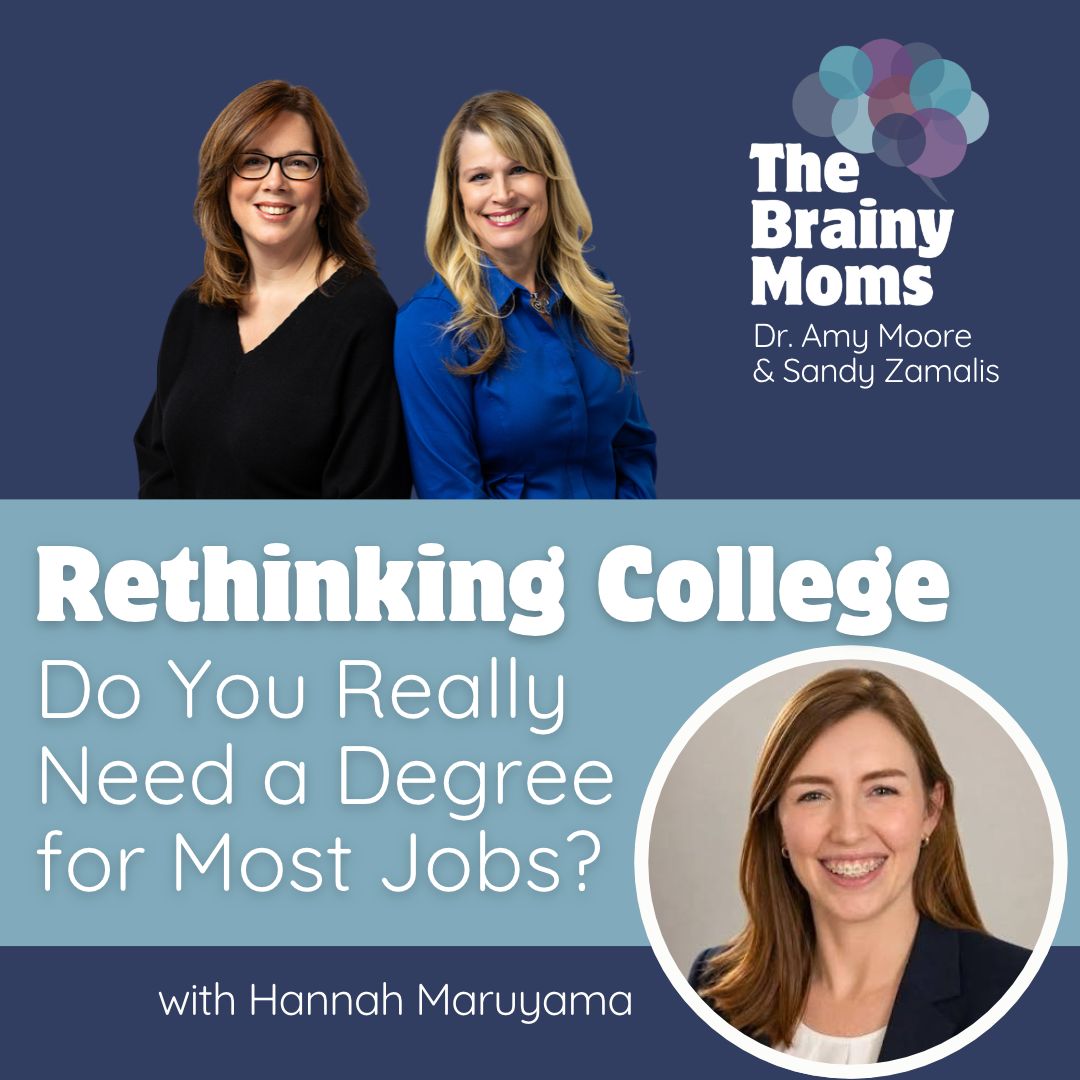
Do you really need a college degree for the job you want? On this episode of The Brainy Moms Podcast, Dr. Amy and Sandy chat with popular TikTok-er Hannah Maruyama, founder of Degree Free and author of The Degree Free Way, to unpack what parents and teens need to know about college return on investment, skills-first hiring, and how to make a practical plan without automatically taking on student loan debt.
We talk through Hannah’s own path of “breaking out” of college, why she believes most careers are not legally gated by a degree, and how she reverse engineered a career pivot during COVID by filtering options through four clear criteria: income, schedule, work environment, and location. From there, we explore why the popular “college or trades” dichotomy still leaves kids stuck, and why choosing the right trade or role depends on local demand, lifestyle fit, and what your teen actually wants their life to look like.
AI is a big theme too. Hannah brings an optimistic, grounded view: predicting doom is a race to the bottom, but spotting opportunity and growth is a smarter way to plan. We talk with her about early work experience, apprenticeships, and the huge opening created as retiring business owners struggle to find successors. If you’re trying to help your teen pick a next step, this conversation offers a concrete framework you can use right away.
Subscribe to The Brainy Moms Podcast, share this episode with a parent who is stressed about college decisions, and leave a review so more families can find skills-first alternatives. What path are you considering for your teen right now?
About Hanna Maruyama
Hannah is the founder of Degree Free, a custom career planning company helping families and young adults make practical decisions about college, debt, skills, and work. She’s the author of The Degree Free Way, and her work has reached more than 63 million people. She’s built an audience of almost 600,000 social followers, earned 286,000 podcast downloads, and she’s helped more than 18,000 families. A go-to voice on college return on investment, AI era careers, and skills first hiring. Hannah has been featured in Fox Business, CNBC, Business Insider, Newsweek, and USA Today. Find her @DegreeFree on social media.
Free Downloads from our Sponsor, LearningRx
Download the free ebook, Unlock the Einstein Inside: Wake Up the Smart in Your Child
Download the Brain Training Game Pack
Link to our sponsor’s website: www.LearningRx.com
Read the transcript for this episode:
NOTE: This transcript was auto-generated by an AI assistant that thinks it’s smarter than we are. It’s not, but it has more free time than we do, so we gave it a low-stakes job. It probably spelled a few things wrong, but we’re okay with that. We’d rather spend our time interviewing cool guests!
Welcome And Guest Introduction
Dr. Amy Moore 0:00
Hi, Smart Moms and Dads. Welcome to another episode of the Brainy Moms Podcast brought to you today by Learning Rx Brain Training Centers. I’m Dr. Amy here with Sandy, and Sandy could not wait to tell me all about our next guest because she follows her on TikTok. Sandy, who are we going to be talking to today? It’s Hannah Maruyama, and she is amazing. All right. I can’t wait for you guys to hear about her and then for this conversation. Hannah is the founder of Degree Free, a custom career planning company helping families and young adults make practical decisions about college, debt, skills, and work. She’s the author of The Degree Free Way, and her work has reached more than 63 million people. She’s built an audience of almost 600,000 social followers, earned 286,000 podcast downloads, and she’s helped more than 18,000 families. A go-to voice on college return on investment, AI era careers, and skills first hiring. Hannah has been featured in Fox Business, CNBC, Business Insider, Newsweek, and USA Today. She’s super popular on TikTok, which is where Sandy got to know her first. So we are really excited to have this conversation with Hannah. Please help us welcome her.
Hannah Maruyama 1:22
So nice to meet you, Sandy, and nice to meet you. Thank you. I’m so excited you’re here. Oh, thank you. I was uh it was so funny when I got your DM. I I I just went, oh, I know exactly who this is. I had seen a bunch of your clips actually. And I was yeah, I was stoked to talk to you both. I was like, oh, great, that’s awesome. So I was really looking forward to this.
Dr. Amy Moore 1:42
So like full disclosure, I don’t understand TikTok. I just don’t understand it. And my ADHD brain is so overstimulated by trying to understand TikTok that I just have to walk away. And I’ll like I’ll run into people and they’ll be like, oh, I saw this reel on TikTok of me. Oh, sure, sure, sure. And I’m like, yeah, I yeah, I have people that do that that put me on there. I I just I’m the people. Right. It would be me. I have people. And Sandy, every once in a while, she’ll be like, oh my gosh, we have to have this person on our show. And I’m like, okay. And she’ll send me the link. And I’m like, I gotta click on that. And so then I’m I’ll be like, Sandy, just give me the highlights.
Hannah Maruyama 2:27
Yeah. That’s how I feel about Instagram. I didn’t get on there. I did not log on to Instagram until about a year ago when it really shows in our social media growth because I did not, I was not on there. So I still, my Instagram world, what do you do? What does this button do? Why, why are there so many options here?
Sandy Zamalis 2:45
I know it’s a different world. Well, you know what’s funny? I was telling before you hopped on, I was telling Amy that the reason why um you were in my mind to get on the show is we had just done a uh episode recently with a college prep coach to help kids. Yeah, you’ll have to put my bangers on. Well, that’s where I was gonna go to because we had the we had those conversations, and then I had seen the micro episode recently of the guy that like did a year at MIT, but like has lost. Ethan Dorby, you know, I just interviewed him. Yeah, very cool guy. And I thank you. Well, yeah, it was it was we need Hannah because uh we got to figure out how to get our kids there.
Hannah Maruyama 3:20
Yeah. Well, he was that was such an interesting conversation. I’m starting this series called like founder FaceTimes, basically, where I’m trying to get these degree-free founders on. Uh engineers, I think, especially. Because if you can convince people that engineering is achievable without a degree, everything else is kind of up for grabs. And so I just went for the hardest thing. I was like, let’s what’s the hardest thing to convince people their kids don’t need college for? It’s engineering and physics. So let’s go there. And once we once I turn that, then everything else gets really easy.
unknown 3:47
You know?
Hannah Maruyama 3:48
Yeah.
Dr. Amy Moore 3:48
So my my middle son is 25 and he went to college to be a mechanical engineer, um, got fives on his AP physics exam and AP calculus exam, just brilliant kid, right? And then decided I don’t need to do this to do what I want to do with my life. And he actually had this 3D printer in his garage and he had wrecked his motorcycle and he 3D printed all of the parts that he needed to rebuild the motorcycle, built it back together, made a made a portfolio and sent it to BMW. And then hired him on the spot. Right now, yeah. That’s exactly. So hired him as in a mechanic, right? So he was a BMW motorcycle mechanic, and then he decided, hey, I want to see what else I can do. And so now he’s building a million-dollar gravity meters. Like he’s an engineering tech, right? But he’s a problem solver. He can look at something and say, this is what’s wrong with this, and this is how to make it better. And so, and now he’s just gotten another opportunity to go build something else. Like he and he he loves it and he dabbles and he would play with Legos for six hours a day. Yeah. He just wanted to build and take apart and build and take apart. And I think he is the perfect example of of that.
Hannah Maruyama 5:05
I think if you can get if if kids can get into engineering school, it’s a good indication they don’t probably need to be there. Because I mean, less than 20% of the PE of the employed engineers in our country are PEs. So they don’t need to have college degrees. There’s most of the vast majority of engineering jobs in our country don’t require degrees. Like even at the highest levels, you got semiconductor engineers, process engineers, chemical engineers, the SpaceX, they don’t have degree requirements on these jobs. It’s because it’s not a legal requirement, so it’s just not necessary. The future is not gated by all of these degree requirements, it’s just not. So yeah. I’m excited to talk about all this.
Sandy Zamalis 5:40
Why don’t we um why don’t we share with our listeners your story? Because I think your story is a great kind of kickoff to this conversation that we’ve already kind of jumped into about how you came to this place of really wanting kids to have other options other than just the college
Why The Engineering Field Does Not Need a College Degree
Sandy Zamalis 6:00
track.
Hannah Maruyama 6:01
Well, I think for that, when I tell the story, I usually go all the way back, which is quite a long way. So my background is that I’ve been in every type of school. Sounds like, Amy, kind of like your like your kids were. I’ve been in private school, public school, homeschool, um, charter school, you know, a magnet, a magnet art school. And that was just because my family moved around quite a bit. My dad was in the military, and uh my mom was an ER nurse. And so, you know, moving around a lot, my dad being deployed for long periods of time, our schooling just looked however it had to look in order to fit the needs of, you know, four kids and one parent. And so, uh, but my mom, I will say, is pretty was pretty intentional with our homeschooling as far as what she taught us. It was a lot of history, it was a lot of critical thinking, you know, speech and debate, like a lot of homeschoolers, uh, you know, basic logic. So we read extensively, read a lot. I hated math, but I read extensively. Um, you know, fast forward to high school. I was in a private high school, small one. My mom was a school nurse to get tuition for four kids and to this little tiny private school. And then I ended up transferring into a public high school, big public high school in Savannah, Georgia. And that was to do enroll at the local university. And so I went to this university, it’s now part of Georgia Southern, but I went to this university full-time, my senior year of high school. So technically I was accepted into college when I was 16. Uh, one of the, one of the rebuttals to my content a lot of the time is, oh, you just couldn’t get into college. And I always say, no, it’s really easy to get into college, they’ll take anybody’s money. Uh, and so they took my money. And uh, so I went in at 16. Um, and I was very disappointed with the level of instruction and a severe lack of open-mindedness. Uh, I did not do well in college, not from a grade standpoint, except for in math, which I’ve always struggled with. Um, even though that was kind of an interesting experience too, because I had a PhD student as my uh algebra teacher, my college algebra teacher, and he was unable to explain anything because he didn’t really want to teach. He just wanted to do whatever he was doing and not really teach or explain anything simply. And I do remember several times doing my very best, my level best as a student to try to understand. I spent hours in the math lab. Like I went after I never tried so hard at something in my entire life as I did to try to try to do well in this college algebra class. I went to his office hours, could not explain a single concept to me. So I don’t know if that was me problem, probably was, but that was that was an interesting experience just experiencing that. He just wanted to do this research. He did not want to, he had no interest in teaching, which to me is you know indicative of a lot of a lot of a lot of the professors now. Like the burden of much of the teaching is on these uh PhD students, and they don’t really want to teach at all. Um now, as an aside, there’s a little bit of rabbit trail. But the core thing that led me to break out of college, which is what we call it at degree free, we call it breaking out, we don’t call it dropping out. Amy, your son, is a clear example of breaking out of college. Breaking out dropping out.
Dr. Amy Moore 9:03
I love that. Yeah. Yeah.
Hannah Maruyama 9:04
Ethan Thornton also, clear example of breaking out. It’s a waste of time, money, and energy. And um, if you leave because it’s a waste of time, money, or energy, then it’s it’s breaking out because continuing to spend time there is actually not wise and not a good use of time, money, or energy. Anyway, so I ended up in what was it? I think it was an art, I want to say it was an art class that finally broke me. Uh I had been, uh I had taken lessons from a professional artist who had been the designer of a state quarter, you know, a decade before or something. And he had a private adult art class with with several students, and I ended up going to this when I was in middle school. And he taught, you know, classical, classical drawing, shadow, light, line theory, all this stuff. And when I went to this art class, it was a professor from the Moody Institute in Chicago, right? Prestigious art college, prestigious art college. And I’m just sitting there and being told how important Jackson Pollock is, and it may have just been that he’s my least favorite, I don’t even want to call him an artist of all time, but I didn’t appreciate it and I couldn’t sit there anymore. And then finally I had this economics class, and the professor was from another country, and she had fled here, so she was a refugee to the United States, and she was teaching, and she was a tenured professor, and I remember her giving us an opinion piece. That was the assignment. So I wrote an opinion piece, and she proceeded to to critique this piece, not for any structural issue with it, but because she did not like my opinion in the piece. So she gave me a bad grade on this, and so I, 16-year-old me, took this and I went to the university paper and I gave it to the editor and I said, I want you to publish this because it was good, I thought. And he agreed to publish it, and then he turned around and offered to pay me to write a column for the paper. And so that was a real turning point for me because it was I was able to write consistently, you know, and and I was getting paid to do so. Um, but I continued to run into this just closed-minded, no one like I was not allowed to ask questions. I was not allowed to have a different opinion. And that just seemed to me as somebody who had been, you know, majority homeschooled, it seemed very anti-academic. It did not seem intellectual, it did not seem to make any sense to me because I had been told that this is where all the smart people were. And so I left. I ended up leaving. Um, I just worked full-time, I worked a ton of jobs, I worked on a dolphin boat, I worked as a surf instructor for uh for kids, I worked as a swim teacher, I worked at a UFC gym in Hawaii, I worked at BJ Penn’s UFC gym in Hawaii, I worked um, yeah, at a Japanese wedding restaurant. I worked all over. Like I worked all kinds of jobs. Finally, uh I was offered a job uh in New York at a nonprofit. So I came back, I was living in Hawaii at the time. I came back uh and then ended up taking this job, college degree required. Obviously not, they hired me. So that was the first sign that maybe everything I had told about what it actually took to get a job was not true. And I think I was already inclined to believe that because I I just like to see when people tell me not to do things, I am one of those people, I will put my hand on the stove. I have to, I have to see if it’s hot. You know, I know you can I wise people learn from their mistakes. Unfortunately, I have to make them myself. But then I kept just applying to these jobs that said they required degrees, and then I just kept getting hired, and I I had no explanation for this. And then years later, this is a very long story, but my husband and I owned a very successful tattoo shop in Hawaii. This is we’d moved back to Hawaii at this point. This is a very long story. This is a very successful tattoo shop in this.
Dr. Amy Moore 12:42
Fascinating now. Like we’re on the edge of our seat, right? What next?
Hannah Maruyama 12:46
What next, Tana? It never really stops. I’m gonna be honest with you. Uh so we get back, we own this, it’s a paramedical tattoo shop. So it does like scar reconstruction, cosmetic tattoo, things like that, bit of LIGO cover up. Um, the only one of its type, the most successful one in the state. Very successful. We had people flying in from Dubai, from the continent, you know, from the continental US to come to come see us. And we’d own this shop for several years. It was doing super well, and then COVID happened, and they shut us down and they shut us down and they locked us down and locked us down. And this, it’s impossible to run a business while you’re paying rent, and they keep locking you down for oh, it’s three weeks. Oh, it’s a month, oh, it’s another week, and you just can’t run a business that way. So what happened was I ended up going, oh, and I was working part-time as well. So I was working part-time because it wasn’t, you know, we had a new business, and I was working part-time, and I, you know, I was at work and
Hannah Breaks Out Of College
Hannah Maruyama 13:40
they said, Hey, you gotta go home. Somebody here has COVID, even though we didn’t know what it was at that time. So this is 2020. They said, Hey, you gotta go home. Somebody’s sick. That’s what they said. I go home, then all the lockdowns happen. I saw immediately my job was not gonna come back because it was in tourism. And so I went, okay, we have to pay the rent on the on the studio. You know, we have to pay the rent on the tattoo studio while it’s closed. And so I just went, okay, what can I learn that meets these four criteria? The schedule that I need, which is flexible enough to run the shop, the work environment I need, which is remote because I have to be close enough to the shop to open if I have to, um, and then that earns enough that we can afford to keep everything afloat. And then um, you know, the income, schedule, work environment, and location. And so location being like it had to be in Hawaii on Hawaii hours. So that’s a hard thing to find. Hawaii is a terrible job market. It’s very low pay, it’s in the lowest pay in the entire country. And so I had a tall order here. And I went objectively and I took these criteria, then I went out and I looked for what careers fit that objectively. And then what I found was tech. I found Salesforce, which is a type of CRM and ton of demand at the time. And I went, oh, okay, well, I see that there’s a job opening here, and the job opening had just been posted. And I went, okay, it’s for Salesforce Administrator, which is like the lowest level of certification you can get in this type of software. And I was like, okay, I am gonna study for this. Like, I’m not a good student. I was like, I’m gonna study for this. I made hundreds of flashcards. I studied straight for 30 days. I passed this exam, and at 45 days, they had hired me for this job. And it says on, I have the offer letter still, because it says bachelor’s degree and computer science required on this offer letter. Obviously, it it didn’t require that because they hired they hired me. And this is where I realized that a legal requirement and a degree request are two very separate things, and that our economy actually runs in a way that is not um, it doesn’t track with what employers say. Interestingly, years later, when Ryan and I were contacted by the CEO of a major job board, he told us that the reason he wanted to talk to us is because he said that we were right on the back end where they see what employers actually post and then also who they hire, those things are not remotely the same. Not remotely the same. And he said that there’s they have to do a ton of engineering to try to separate from employers what they’re posting versus who they actually hire because it’s so separate that it’s it’s unbelievable, it’s unrecognizable. So for me, then I was able to replicate this result with family and friends, like reverse engineering what they needed and then helping them find careers that objectively fit that, and then strategically going, what skill stack do you need to get these jobs? Because it’s a specific set of skills and then the right attitude and the right explanation for the employer as to why you want the job. And so it’s this, but it really tracks to unlocking people’s internal motivation because you have to figure out what they need and then tell them, okay, if you want to get what you need, what you want, this is what you need to do to get it. And then it’s incredible what happens when you put these things together. It’s the right person at the right time for the right career. And that is the future, and that’s what we’re doing at degree-free is we take young adults who are 16 at the youngest to 20, our hard age cutoff is 21, and we help them to figure out what they need from their work, what careers objectively fit that, what they need to learn, skills, licenses, certifications, degrees if legally required, and then how are they going to do that? And then we link that to here are entry-level job options, resume. This is how you apply for jobs, which is a huge gap. Colleges do not teach young adults how to apply for jobs. Largely that’s because the people that work in colleges don’t know how to apply for jobs in the private sector at all. So that’s a huge problem. It’s a long story, but that’s how we’re that’s how we’re doing it. So since then, you know, we started the company in 20, we started the company, the podcast in 2020, but we started a launch program a few years ago, and we’ve had over 200 kids come through now, the launch program.
Sandy Zamalis 17:42
Wow. I love how you’ve just reverse engineered that and given people like steps because that’s the piece that’s hard. I was like, It’s stupid simple, right? Yeah. It doesn’t seem like it on the front end though. So I appreciate it.
Hannah Maruyama 17:55
It took years. It took years. Yeah, we took, you know, I I I remember like to build the launch program originally. I took, I surveyed, because we have a fairly large TikTok following. We have ha about half a million followers on TikTok. And originally, this is years ago, Sandy, what you were saying. The way that I built the launch program and designed it was I got on back-to-back phone calls. I had hundreds of phone calls, 15-minute phone calls with a set of questions that I thought parents, you know, would have. And I asked them the same set of questions to see what their major concerns were, where the guidance was lacking, what was the gap in the market. And I got the same answer to the point where I realized it was lack of options. That’s number one. It’s a lack of options. And then the second thing was a lack of ways to narrow it down. These are the two biggest problems. And then from there, you know, then we just tested. So like I just did a ton of them, I did a ton of launch programs for free in the early days. You know, now we have a strategist team that does this that I’ve trained, but but at the beginning, it was just me. And I was just working with these kids one-on-one, just trying to figure out, you know, it was messy at first, but we figured it out and we got a formula and then it worked, and then it worked again, and it worked again and again in Alaska and Miami and Colorado and Buffalo and San Diego. And we realized, okay, we’ve just got it’s it’s formulaic, it can be solved, and the more we’ve repeated it, the better we’ve gotten at it. And so it’s it’s really cool to see. But we can find anything for any young adult in the country.
Sandy Zamalis 19:19
Yeah, it’s amazing. Because, you know, I ran into this problem when my son was in high school because, you know, he didn’t know what he wanted to do or what he was interested in. And I don’t he, I think he’s still figuring it out, but aren’t we all? Aren’t we all? Um, and I remember him taking like a jobs test, like like what would be a good job for you. Yeah, those things are ridiculous. I was telling Amy he came back, like the number one was he should be an explosive explosives expert. And I was like, well, how are we gonna get there without you going into the military? Like I don’t like or jail.
Hannah Maruyama 19:55
Well, I would think like mining or quarry work, probably. That’s the only other option that I could think that would be.
Dr. Amy Moore 20:03
But the thing is, yeah.
Hannah Maruyama 20:05
I cannot stay the um the personality tests. Oh my goodness, they drive me up the wall. It’s the it’s is I’m gonna be very frank. I think it is the dumbest way in the world to help your job find a good career, but because your high school personality is not going to track to the career that is going to fit the way you want to live your life. You know what I mean? Especially now, I can tell you, you know, the most of these kids, and this is a global problem. There was a survey done a few years ago of five, was it six hundred and seventy thousand kids across the across the country across the world, I think it was. But globally, these kids only know 10 jobs. They know 10 jobs. In the US alone, we’ve tracked 57,000 unique opportunities. 57,000. And your kids know, I mean, American kids, the high schoolers know like six to eight. It’s always the same ones. And a lot of the problem is they’re trying to homeschoolers, actually, I find have a more well-rounded. I was just talking to a homeschooler today, like, you know, ancient history, uh, meteorology, uh, mythology, ancient art, crocheting, like she’s got watercolor, like she’s got a wide range of interests, but most kids have very little exposure to many careers. And because of that, they they can’t choose a career if they don’t know it exists. And that’s the biggest problem, right? Options. They don’t know what’s out there. And then people are just trying to, so a lot of times parents, if their kids are in high school, they’ll come to me and they’ll say, Oh, they’re interested in art and blah, blah, blah. I’m like, Of course they are. Those are the least boring classes in school, okay? Like, you know, and all kids are creative. That’s my belief. Like, my belief is that all kids start creative. That doesn’t have to be their career, though. You know, and I I use the example of Agatha Christie, one of my favorite mystery writers of all time. Prolific, one of the world’s most prolific mystery writers of all time. Billions of books, okay? Billions of books by a creative in every sense of the word. Her starting career was a pharmacy tech and a hospital. That’s how she got so good with poisons, you know? And so that’s why her mysteries are so compelling. But this idea that your child like must monetize this high school creative interest and like forcing that, that is not the that is not the way. And I know people don’t want to hear that, but I think that the whole like your, you know, your work needs to be your passion thing has really done a disservice. It’s not like you shouldn’t use your passions, but many of these kids, if they want to use their passions, it needs to be in a business capacity, probably, you know, in an entrepreneurship or self-employment capacity. And trying to force that as the first job is very difficult. And it’s going to take a lot of capital from parents to do that. Like I’ve seen it done well, but it’s going to cost you quite a bit of money, you know. Um, and whether that’s like sports or art or music production, you know, but people are just going about it the wrong way. Cause then what they try to do is they force it into a degree program. It’s like that’s not, that’s not the right, you know, that’s not the right option. Um, but I’ve also seen this for trades. People are doing that now. Like you like to work with your hands. So we’re gonna go be an electrician because everybody’s saying now go be an electrician. It’s like, yeah, remember how seven years ago everybody was saying go into computer science? Do we remember that? It’s not wrong that it’s high earning. It’s not wrong that it’s in demand, but it doesn’t tell you that it’s gonna lead your child to a life they actually want. You know, you have to make sure of that first, or you’re gonna have a ton of kids going to trade school, which is still student loan debt, by the way. And they’re gonna end up going, oh man, I should have just gone to a four-year college, you know, the way that all these college students are now going, Oh, I should have gone to a trade school. You still don’t know why. You still don’t know those four criteria, so it’s never gonna connect, right? It’s gonna be the right person at the right time for the right career, and there’s an art to it, you know. Anyway, I die, I I digress.
Dr. Amy Moore 23:39
No, I love that you pointed that out because there is this right, a little bit of excitement that, okay, college is not the right path for everyone. Look at the trades, look at the German apprenticeship model. And it’s still a dichotomous thinking, right? That okay, it’s either college or trade school now. Yeah. Which you just pointed out. Yeah, is is still school with debt.
Hannah Maruyama 24:04
Four years ago, I never heard, and again, this is like what we hear. Four years ago, I never heard parents coming in and never, never heard the kids, never heard the parents going, yeah, he’s thinking about HVAC, you know, or electrician. Every single boy, every single boy, I’m not exaggerating to you. We have hundreds of these conversations a week, you know. Every single boy. It’s like, yeah, I’ve been thinking about electrician work or HVAC. I’m like, I bet you have, because you know six jobs and those are two of them. Like, you know, and they’re it’s all over the news. It’s like we need electric, and I’m not saying that that’s wrong, but it’s it, you know what? And I have this story of a young man who he was 19 from North Carolina. He came through the program a couple years ago, and he went to four-year university, because that’s what you’re supposed to do, right? Go to get a good job. Hated it, transferred to a community college, hated that, because again, there’s no clear why. And then he transferred into an electrician program. Because if you don’t go to community college, we’re gonna go to trade school, right? And he didn’t want to go into the military. Those are your three, by the way. Those are the three options that we have, because you’re right, you just want to put them somewhere. But the the place where your children really excel is gonna be when you put them in the right place. And the likelihood that it’s one of these three is very low, in my opinion. And so he goes through these things, hates hates the electrician program. He comes into the launch program four weeks. This is how long our program takes. He comes into the launch program, like beaten down, you know, because how could this kid not feel like a failure, right?
COVID Pivot Into Tech Without Degree
Hannah Maruyama 25:30
Um, his mom is a licensed clinical social worker, also. So, like we got all the, you know, we got all the paper in the world. Like, you know, she’s a she counsels young people all the time. And his dad was an engineer. So he goes to this, feels like a failure. There’s nothing wrong with this kid, and I’m gonna prove it to you in a minute. So he feels like a failure. It’s like, oh, you know, I’m, you know, my life is just going nowhere. We get really clear on what do you want. Okay, so he wants to live at home, like he wants to live in his hometown. He doesn’t want to move, he likes where he lives. He wants to be able to propose to his girlfriend. Okay, that’s super doable. You want to own a home here? Okay, great. And you have an idea of what um what amount of money you want to earn. Great. That’s a very clear list of criteria. And none of them required him to do any of the things that he was doing before. So we go through and he ends up choosing fiber optic installation. We then find a local company, regional company that had been around for like a hundred years, one of the best employers in the state, like per the stats. They had three open listings in that zip code. And this is the power of the right person at the right time. We said, hey, this is a really good fit for you. This is his top choice. He chose this career. Like, so he the kid steers the whole way. No one’s telling him you should do this, you should do this, you should do this. Because especially for young men, they are never gonna be motivated if somebody is just telling them what to do. They have to choose it or they’re never gonna follow through. That’s a big thing why I think so many young men are depressed, is everyone’s just telling them what they’ve got to do, and no one lets them pick and then follow through. And and they never get the chance for like positive feedback and the chance to earn respect from society. And I think that’s a huge problem. So he ends up doing this. It was crazy. Like, but this has happened multiple times since. So we realize it’s a result of the program because it’s the method. When you get the fundamentals right, it always works. And so he picks his fiber optic installation role. We say, Hey, these are some really good local options for you. He applies, uh, he has his review call, his final review call on a Sunday night. Monday, he applies. Okay, he applies to this job. They call him back, they invite him in for a job fair on Tuesday. He’s hired by Wednesday. Company car, paid training, 401k, full benefits, cell phone, everything. He gets promoted six months later, and then he gets promoted again 10 months later. Nothing was wrong with him. He was in the wrong vehicle. And it’s because he didn’t see how what he was doing was going to get him what he wanted. And that is the difference. That’s the difference. Also, he still ended up in a trade. He just wasn’t in one of the ones that you hear about because there are a lot of trades that are not necessarily all the ones you hear about, that are still in demand, high paying, lead to, you know, can lead to contracting, it can lead to business ownership, all these things. But it’s so individual. Like you can’t just, whoop, all right, you guys are going to, there’s a vote program here, you know? Okay, but is there a job there? Because I’ve heard that so many times. Like the welding is the other one. It’s a welding electrician HVAC. Those are the ones right now. Um, but people will go into these welding programs, and I’ve heard lots of times that, you know, moms will be like, oh, my son went to a welding program and he came out and he couldn’t get a job. Like, did did you check? You have to check and make sure that there’s local demand. Like, just because there’s a vote program doesn’t mean that there’s a job on the other end. You know, like you have to, it’s very specific to where your child wants to live or where they’re willing to move. You know, I have my youngest sister also doesn’t have a college degree. She’s degree-free. She’s just she was a structural welder, but on the job training, not, you know, she and our complete opposites because I ended up actually working in AI and machine learning after I learned Salesforce. So I worked in AI enterprise level software for years before I started degree-free. And she started to weld, you know, totally different choices, but fully informed about why and what it was going to get us on the other end, you know. And and it’s it’s the art of finding the right fit for every single person, you know.
Sandy Zamalis 29:07
I’m glad that you brought up AI because where do you see I AI taking us on this spectrum of how we help our kids find their path, or or at least get them in the right place that they can find their own.
Hannah Maruyama 29:21
I find that there’s two uh there’s two like distinct parent groups. Um the larger group is definitely terrified, very definitely worried, definitely very afraid. Um, I so I’ve seen those parents, a lot of parents come in afraid and trying to figure out what career their child can choose that will be protective against AI. And the truth is that nobody knows. Nobody knows. Um, the other group comes in and tries to look for emerging industries that are going to grow because of it and how their kids can be positioned for things that fit their goals in those industries. And I think that that is a far more secure position because it’s going to be easier to predict growth than it’s going to be to predict shrinkage. That’s just what I think. Um, it reminds me a lot, though, I tell a lot of stories about this because I think it’s so important. I gave a speech about this at the FPEA conference in Florida a couple years ago, but about um the phone camera. So Sonya created the first phone camera in the early 2000s and they released it to the US market. And after that, um, everybody said like photography is going to be over. There’s no more photographers all over. This is the end of all photographers. Photographers, there’s more of them, they get paid more. Like none of the things that they said would happen happened. And actually, as a result of that, that’s why we’re talking right now. It’s the result of it. There’s a billion-dollar, multi-billion dollar creator economy that has sprung up on the other side. My business, my service, my I run a services business. It only exists because of the smartphone, because of smartphone camera. Um, so it’s difficult, I think, to predict what industries are going to go away, but it’s much easier to see where the growth is, you know, and that I think is actually a safer bet. Um overall, though, I’m I’m an AI optimist. I do not believe in this doom and gloom, generally in big technological leaps. If you read the headlines about AI, they are identical to headlines about the internet. It’s the same. Like we run this playbook every 15 years and we tell everyone’s gonna world, the world’s gonna end, and that no one’s gonna be out of work, everyone’s gonna be out of work, and we need UBI, and we don’t ever need that. And so I don’t see that happening. Same thing happened with the ATM, actually. When the ATM was originally invented, like so before this is before Sonya, this is like I think it’s the 80s. Um they said, oh no, all the bank tellers are gonna be out of work. No, like way more bank branches, way more bank tellers. There wasn’t even shrinkage until I think you’re looking at like second order effects. There wasn’t even shrinkage of bank tellers until mobile banking, which was way later. You know, like we’re talking like, you know, mid mid to like mid-2000s where that became like commonplace. And so I think that parents who are trying to predict where shrinkage will be and avoid it, it’s a race to the bottom. But I think parents who are looking at it and going, where is the opportunity and growth? That’s a lot more secure. That’s what I think.
Sandy Zamalis 32:02
That’s so smart.
Dr. Amy Moore 32:03
So we just simple, you know. We interviewed someone, I don’t know, a couple years ago who worked with high schooler, middle schoolers, and high schoolers in kind of determining what you know their next step looked like. And, you know, part of her message was that we don’t have to choose a career and stay in that career for our entire career anymore. Like it doesn’t work that way. And I I think about, you know, the way my neurodivergent brain works. I mean, I’ve changed careers multiple times in my 56 years. And so I really liked that message. So how does that how would that idea factor into how your model is working? Like I always say it’s not a kidney, just try it.
unknown 32:51
Yeah.
Hannah Maruyama 32:52
I like that, I like that expression a lot. I think I think that would be it’s tough for parents to hear that because I think it’s a uh it’s really a very crystallized generational view that you’re gonna work in the same job. Now, actually, I do think that there are gonna be industries because we’ve gone through this period of time where the market is like people are changing jobs so often. There’s so much churn. And churn is the most expensive things for companies to experience, like small businesses and large businesses, uh to the point where you see now companies have just accepted that, and this used to be, you know, think about like company towns where they just accepted that it was gonna be very expensive to like
The Four Criteria Career Filter
Hannah Maruyama 33:30
keep and maintain their workforce. It was just an they just accepted it. I’m gonna have to fund schools, hospitals, general stores. Like, I’m just gonna have to do all this stuff in order to keep people, because otherwise they’re not gonna work for me. And I think we’re moving back a little bit more towards that because the churn has just gotten so frequent and so expensive for these companies. And you see companies that are doing really well right now, the ones that are doing super well, uh, examples would be like Quipch Quick Trip, which is a gas privately owned gas station chain, and then Costco, where a lot of these people that work at these companies, and I’m talking cashiers, right? We’re talking like what you would what people would view as an entry-level work. These people are retiring with multi-millions of dollars in their pensions or in their in their retirement accounts. Like these people are multi-millionaires. I’ve heard both personally and then also just online people talking about this. And it’s because they have done the calculus that if they just pay more, then they can retain people longer. And I think that that is gonna become the name of the game, especially for a lot of like aerospace industries where the people are really expensive. Um, you know, so you kind of see that in tech, and I think you’re gonna see it in in in aerospace, but then you’re also seeing it in like consumer businesses that are trying to stay alive and do well. So I think that that’s gonna become a lot more common. But also, I think you kind of got this divergent economy. So you’re gonna have half, you know, some people need to go find things that are stable where they can grow. There’s a lot of internal promotion, you know, they they pay you more frequently and it’s worth the 20 years of service you’re gonna give them, you know, versus the other side, which, you know, one in one in two, one and two business owners now is degree free. The other group is gonna go, I think, to contract self-employment, and business ownership. So I think I’m I’m a proponent of the future is the past. Like it’s it’s all happened before and it’s all gonna happen again. Um, and so I think we’re moving back towards where I I’ve read like Little House on the Prairie. I don’t know if you all read those books when you were like your, you know, when you when your kids were younger. But if you think about Charles Ingalls over the span of those books, like he doesn’t have the same job the entire time. He’s self-employed and he does multiple different jobs because that’s what self-employed people do. Like you change when the market changes, it’s unlikely that you’re gonna run the same business, you know, for like 20 to 30 years. Business owners just statistically are gonna start multiple businesses too before they find the right one. I think the big thing now is helping your child figure out if they are more a stable, grow with something person or if they are going to go an uh a route where they need to get entry-level work now that is gonna gain them the experience they would need to start a business. Because a mistake I see parents making is like, and I see this a lot, is oh, they’re in school for business. I’m like, they should be in school. I I I don’t, I literally don’t care what kind of business you think they’re with rare exception, like trying to think of an exception. If your child is trying to start a VC-backed startup and they get a free ride to Stanford, full ride. They pay nothing. Okay, maybe that makes sense. Like because of the connections and the angel investors, they’ll be around. That is the only reason. So we’re talking a, you know, a point of a zero, zero, zero, zero, zero, one percent. Like nobody should be listening to that and go, oh, that’s my kid. Like, probably not. Like the stats just say that that’s not the case. Um, and so I think that it’s very much, it’s very much your child figuring out like what they want their life, their schedule, their income, their location to look like. Because if they’re prioritizing income, you know, that might be a sign that they’re more entrepreneurial because like wanting that higher income, you know, can be something where, okay, we’re gonna go entrepreneur route because your ceiling is higher versus valuing like schedule or location or work environment more is probably a good sign that we need to look for the right career path for you, you know, where you’re gonna you’re you’re gonna work for somebody, but you’re gonna be way lower stress, way more stable. Um, and that’s stable is one of the things we hear a lot from young adults now, where they’re like, I just want something stable because they’re worried about the future too, you know, just like parents.
Dr. Amy Moore 37:21
Yeah. Can we go back to the beginning of that first, the first part of this question? Um, where you alluded to whether or not uh you recommend kids getting practical work experience before trying to own their own business. Is that what you were saying?
Hannah Maruyama 37:39
Yes, because I’ll have so many, so many kids come in. It’s usually young men, I will say. They’re like, yeah, you know, I just uh and the parents will say, Oh, they’re really entrepreneurial. And I’m like, that’s good. Um, but like entrepreneurial in what way? Because typically they’ll say, Yeah, I just want to start a business, and I’ll say what kind, and they’ll say, I don’t know. Like, that’s not really on that’s not really entrepreneurial. Like you need to have some idea what kind of business you want to start. Like it’s good energy, but like what that tells me is you need to go work for a business owner, any business owner. Like ideally it’s something you’re interested in, but you need to go work for a business owner because you need to see what that looks like and how that plays out. Because many young adults like have this idea that they want to be business owners, but actually, if they saw, as a business owner myself, if they saw like the stress and the uncertainty and the years where it is very much famine, you know, they might not be as interested in that option because it wouldn’t necessarily help them get to their goals. But for some for some young adults, it is definitely going to attract them. And I’m big on getting them that experience as early as possible for any reason, because then they can rule in and rule out things that do and don’t work for them. Uh, I also recommend early work experience for people who are going into what I call high cost, high-risk degrees, like social work and teaching and nursing. Uh, anytime we can get exposure to those fields before we commit to buying degrees in them is a really good thing to do. Uh, because many, many young people think, oh, I’m, I just want to help people. And then they get funneled into one of those three jobs and then they realize too late that it’s pretty, it’s pretty low paying. And then the only way you’re gonna make high pay is buying multiple more expensive degrees, and then you have to go into business ownership anyway. And they didn’t realize that was part of the deal. And so it’s a very, it just creates this like cage situation that I think is best avoided because it’s gonna close more doors and it’s gonna open. Yeah.
Dr. Amy Moore 39:26
Yeah. Okay. I wanted to drive that point home. Yeah, because I think we just barely touched on it. And I I know, you know, there are so many parents who want to support their child’s dreams. And, you know, especially I I’ve been there. Like I’ve been there with my oldest son who has dabbled in lots of different areas and I’ve paid for certifications in lots of different areas. And I actually said, what kind of business could I buy for him? Right. Like and I love that. Right. It’s one of those, wait a minute, what am I talking about? I’m not gonna just buy him a business if he hasn’t worked in that kind of industry yet. And and just right, like you don’t buy your kid a business. You don’t go into debt yourself. Buy your kid a business only for them to turn around and that be one more thing that they figure out they’re not interested in.
Hannah Maruyama 40:15
Yes. And and that I think what’s cool about that is I think that there’s, and I’ve heard multiple stories about this, all kinds of different businesses, there’s a very unique opportunity as so many baby boomers retire and their children actually do not want their businesses. It’s so interesting. But it’s almost like there’s an allergy to working in mom and dad’s business, which is such a bummer. Because if you want to talk about the one of the easiest ways to get a job that you actually like or run a business, it’s definitely just working for your parents’ business, you know, if you have that option. However, for whatever reason, you know, who knows why? The smarter, smarter people than me can can diagnose that. But for whatever reason, a lot of people do not want their parents’ businesses. And because of that, there is a huge opportunity. And I’ve seen this because what’s going to happen is all of these businesses that have taken years to build, they’re just gonna disappear overnight. And business owners, small business owners do not have retirement plans. They don’t. They have no idea what like they just don’t. So the best thing to do is if you can figure out how to get your child early work experience, basically, this is all back to the future too. So I believe that the future is, and I haven’t quite figured this out yet, but it’s something I’ve been thinking about for years, and I’m trying to figure out how this could be possible currently with Department of Labor regulations and stuff. It’s not, but what needs to happen is there needs to be a thriving private apprenticeship market. And what they’re what I mean by that is you need to be able to find the right person for your child to learn from. And then you need to be able to work out some sort of cash flow deal so they can retire and your child can take over the business while they’re still working together. That is the best way to salvage all of that effort and work and also bring in Gen Z and train them to run businesses that already exist, which is the hardest thing to do. Surviving businesses, like if it’s already existed that long, it’s a good business. It just needs somebody to come in, give it a little bit of social media marketing, and just learn the operations of the business, you know? And that’s something where I see that cash flowing much better than college for most families. That’s something that’s achievable. It’s a win for the business owner because they can retire. Many of them want to, and they just can’t because their money, they’re they’re now living off social security, right? They’re they’re immediately, they’re they’re struggling, but they want to retire, but they can’t because there’s no one to hand it off to. And many people would love, love to hand their business over. Like I’ve heard so many, I just saw a guy that does uh woodworking, he makes bowls. Um, you know, he has he probably brings in six figures a year. It’s a good W-2, you know, it’s a good like living for somebody as a full-time job, you know, because you’re buying a job basically when you buy business. It’s a good living for somebody, but he said he can’t find anybody who wants to learn it. And so I think the the art of the future is going to be figuring out how do we get these kids to these people as early as possible. Like I and I look a lot about um,
Trade School Hype And Better Options
Hannah Maruyama 42:50
you know, I read a lot about historical people and how they’ve learned. You know, James Jewell, the father of theramodynamics, he was he didn’t have much formal schooling past 13. Uh, John Dalton, who taught him, the father of meteorology, did not have much formal schooling past 13. There’s a great movie called The Dig about um Sutton Who, which are these Viking ruins. It’s Ralph Fines, and I forget the lady’s name, uh the gal from the Great Gatsby. And it’s about this guy named Basil Brown, and he’s a self-taught archaeologist. And again, no formal schooling past 13. Like it, and it’s it’s very obvious if you get people, if you get kids with the right people to learn from, they are just, they just do so much better. They go on to do incredible things. And I think if we can figure that out, our society is gonna be in much better shape. Our young adults are gonna have much more practical experience. There’s gonna be a lot less debt, there’s gonna be a lot less wasted, you know, capital because all these businesses aren’t gonna just dissolve for no reason. You’re gonna have older people with retirement accounts when they wouldn’t have had them before and an actual purpose. You know, like we don’t just retire and then we die because we’re business owners and your business is gone, so now you just die, right? They have like a reason to, oh, hey, you know, hey, John, can I ask you about what? blah blah blah. Hey, I noticed this, blah, blah, blah. You know, it just gives them, you know, some sense of of purpose as well. They keep that because they’ve had it for so long. And then it supports young people with the mentorship they need. But I think this needs to start very young, like 14, 15, probably at the latest.
unknown 44:14
Yeah.
Hannah Maruyama 44:14
I think that it probably should replace high school, honestly. That’s where I’m at. No, I actually think kids like there’s a joke, right? The kids yearn for the the children yearn for the minds. I’m like they do. They learn they yearn for work. They want to do real things. They’re tired of this like fake hey, because basically the job we give them now is sports. You know, like here, go learn discipline and grit and mentorship and teamwork. All of those things are learned at work. All of them. You know, communication, all these things. And if they were at work, they would be building an actual skill set instead of us, you know, parents paying thousands of dollars for them to learn a skill set in this fake controlled environment instead of in a real environment where they’re going to use it. You know, um and also that would make it accessible to a lot of kids who can’t afford those types of can’t afford sports in that at that level.
Sandy Zamalis 44:56
You know and now a word from our sponsor LearningRx. In second grade, Isla was struggling to read despite being pulled out of class to work with a reading specialist. Progress was slow and Isla was frustrated. She hated to read and it was a battle to get her to pick up a book to practice reading every evening. Her LearningRx cognitive skills assessment provided insights as to why despite consistent reading interventions Isla struggled to read and spell. Her assessment revealed significant weaknesses in memory auditory processing and attention skills. See to unlock reading ability it is critical to address underlying deficits in cognitive skills. Isla’s LearningRx training targeted these weaknesses and her reading has taken off. At the beginning of second grade she was reading at a kindergarten level. After brain training she is now reading at a third grade level. Isla now loves to read and is devouring books. Your child may not achieve the same results as Isla, but the team at LearningRx would love to talk to you to see if cognitive skills training might be the next best step in your child’s reading journey. Visit learningrx.com slash the brainy moms to learn more and receive a cognitive skills assessment with a consultation for just $99. That’s LearningRx.com slash the brainy moms. So in your program um you know and let like you teach you teach Amanda Fish, you know, he’ll leave her forever is your process to help a uh your client uh or the family like learn how to do this on their own. Like you walk them through four weeks of like this is how you figure this out now you can figure this out again in perpetuity. Yeah.
Hannah Maruyama 46:43
Because I find that young adults say that once they realize how the process is not like a it’s not like complicated process. It’s very simple and you know we go over a lot of it in the book set, but the part that’s difficult is that last mile of research. So really where the value is for our service is that we do all of that last mile work, which is calling vetting and finding the right educational options or training options or on-the-job training options. You know, as granular as I use an example of a young lady who actually did choose a career that did require a degree. She’s decided she wanted to be a nurse. We helped her find her specific specialty of nursing and then a contingency plan for she wanted to have kids and be able to be home with those kids while they were small, something that I don’t think anybody ever talks about, which I have a huge problem with. And so but we don’t do that in the launch program because we actually care about what the life looks like in the future and not putting people into careers that will prohibit them from the things that they actually care about. And so um so she ended up choosing nursing and they were from California. I’ve told the story a few times because I think it’s so it’s so illustrative of how if you need help with the research part because it’s so much hours, hours of research. And in order to find all of this stuff, um she was actually at a big public high school in California and California has free community college right so you can go get you can get you know you can get degrees for for free in California but she the wait list for the nursing programs is so long because there’s so much demand. And then the only option there if you want to be kind of expedient is private colleges. They’re very expensive. Private nursing colleges are incredibly expensive in California. And so with her, she was so young that we were able to find her a medical assisting program partnership that her school had that they were not even aware of. This is something that I think it’s important for parents to know like this isn’t as relevant for homeschoolers but I mean and I and I’m a believer that actually homeschool moms can usually find anything, but I know a lot of times this particular area is very difficult because it’s not curriculum betting, it’s job market analysis and then vetting of those options that are outside of that well trodden path of K through 12. And I know that that’s really hard which is why I think homeschoolers send their kids to college at such a high rate. I think that that’s a huge well two reasons. One, it’s tough because there’s a lot of unknowns and then two, it’s to validate that you did a good job homeschooling. I think that that’s like a huge because my mom did that to me. Like I’m not faulting homeschool parents for that it’s I did so good. You’ll see homeschool moms like, oh my child’s in a PhD program like okay are they going to be able to do the things that they want in life though? Is that really like is that the metric for success right? Is it PhDs or is it or is it my child is is actually able to afford a home and get married and have kids and like start a business and or travel the world and you know and and backpack around in hustles. I don’t know whatever they want to do, you know, have a cat farm have a you know rescue cat farm. I don’t know what their goals are, right? But um yeah so we helped her find this medical assisting program. She changed her classes around so that she could do this during school hours. And then we found her an LBN to RN Bridge program that she could start as soon as she graduated. And then we found her a uh a bachelor’s degree in nursing program in South Dakota that was only 17 months long or sorry 13 months long accredited and it was like a hybrid nursing program and it was $17,000 save them like $80 grand. You know, and that’s the piece where we’re very like we’re very high impact with the analysis. But like that piece is difficult for for private and public school kids because the counselors are trained to college first, right? If everything, you know, if if you have a hammer everything’s a nail right so it’s it’s college for everybody. If it’s not college you’re going into the military. If it’s not the military you’re going to trade school like this is what we got because because high schools track success metrics by college admissions which is a terrible metric. That’s a terrible North Star. It’s how many kids did you get to go in student loan debt. That’s that’s what that is. So when I see people like you know I I I I gave this uh homeschool program guy he’s from Miami and he’s running this like really competitive you know homeschool like uh junior senior year program entrepreneurship high school some sort of program and he’s like yeah yeah you know our college you know our our college admissions rate’s 99% and I was horrified like that’s way too high it’s impossible that the amount of kids in your program that that many of them need to go to college. That’s impossible. Like it is very it is impossible. That’s statistically impossible. And and he’s what? You know yeah the a lot of these kids don’t need to go at all like that’s a giant waste of their time and you know you’re not vetting correctly because you’re just putting them all into whatever college but you’re not helping them figure out like what do they need from their future and then is that the right next step in order to achieve that goal because success is your child getting what they want out of their life. It’s not them doing what looks good to everybody else because that does not matter you know and that comes home to roost when you have kids that graduate and then they’re back home, you know, at 26, 27, 28 and then they have no direction and they think the only way to find a new one is buying another degree you know so Hannah for our listeners who are who are now interested in hearing more who is your ideal client like what would what would parents need to know if they were saying okay how would I know if college is the right choice for my child?
Dr. Amy Moore 51:59
What questions would I ask? And is maybe reaching out to Hannah for her program the next step that I should take?
Hannah Maruyama 52:07
Ooh good question. Okay so there’s uh two two types so I would say there’s in high school which we call career prep and then out of high school which is career start. Career prep, you’re not really able to start a career yet because the majority of careers uh are going to require you to be over age 18, right? So we don’t want to we don’t want to give you options that are only for while you’re still in high school because that’s going to change drastically by the time you turn 18. So the way that we do it is career prep I actually advise the only people who I think should come into the launch program at 16, which is our youngest age bracket that we accept. We do not accept 15 year olds. We have parents all apply all the time they’re like oh well he’s 15 I’m like that’s not 16. It’s a very strict cutoff we’ve tested I was like and I’m not interested in like I’m a business owner you know I want you I would love for you to purchase our service I am not interested in getting a bad outcome for that to happen. And so it is not applicable. 15 is too early they are too young. I and I don’t care how mature your child is homeschoolers I’m talking to you. I know they’re mature they’re not ready like they’re not ready yet um they need to be at least
AI Fears And Where Growth Is
Hannah Maruyama 53:10
16. I think for even homeschooled 16 year olds it’s best if they are graduating really early or there’s some extenuating circumstance that requires them to need early career planning. And I think I would include like physical disabilities in that that’s more the crowd for the 16 year olds it’s more for unusual cases. The vast majority of young adults are going to get the most benefit out of the launch program in high school when they are seniors because they are able to act, start prepping and it’s going to save them time, money and energy that is when it’s the most useful because you know if you do or don’t have to fill out that BASFA like you know if you do or don’t have to apply for scholarship, what are they eligible before? If if you’re a homeschool family, like are there things that are associated with work programs in your state or special things that are in your state that are only available when they’re still under the age of 18 because of you know XYZ, which is is, which can vary by like zip code and state. And then out of high school I would actually say our ideal client is 19 and has tried a little bit, has tried some things and it has has realized that either college is not for them, trade school is not for them or they’ve been working and they have continuous work experience and they are now looking for the right career fit and they’re ready to move into their first career. And that we’re very high impact there very high impact there for a career start. 20, you know, we we still work with 20 year olds but I find like if you have a 19 year old child and and they’re kind of in this loss window, that is my that the I I feel like we get the best returns for 19 year olds.
Dr. Amy Moore 54:41
And how involved can the parent be in the process because you know as you know homeschooling families are DIYers and they like to have their hands in it.
Hannah Maruyama 54:49
So I recommend homeschool parents who are interested in our service to first purchase our books, our workbooks their parent and young adult books, you go through them together. They’re designed to be used together and it’s to teach you our methodology. The other reason we did that is because some people I’ve heard lots of stories of people who have been able to find the right career for their child using the books. And I’m like great if you never have to talk to us that’s fantastic. Use the books you know because what we’re about is trying to keep the most amount of young adults from wasting time money and energy possible getting into the career that’s going to help them have the life that they want. That is the goal. That is the ultimate goal. So the books help because for people who are able to solve it with the books it’s gonna it’s gonna fix their problem for people who are like I really want a professional a neutral third party to come in here and do this. We parents get recordings and transcriptions of all the calls. They’re welcome on the calls too but we ask that they don’t uh interrupt because then the strategist is working for the parent and not working for the young adult. And the whole goal of this is to transfer stewardship of your child’s decisions to them so they can start steering that way the plan, the resulting plan is completely theirs and they are completely, you know, in control of it. And that is the handoff I think that most parents want for their kids in the future. You know, and what we do is we hedge our process make sure that they’re not going to pick a career that’s not going to support them. That’s what we do. Because we’re it has to meet their needs. It doesn’t matter if it’s interesting to them, you know, if it doesn’t meet their needs like it’s great that this is interesting to you. But you have to be able to do XYZ according to your own statements. So these are the careers that are going to objectively fit that now we’re picking by interest by excitement by experience and then by how much you know how much they’re willing to invest in time, money and energy to learn the skills, the licenses or asserts that they need to do that. Yeah that would be my answer.
Dr. Amy Moore 56:41
This has been such a great conversation Hannah thank you so much for taking time out of your busy schedule to bless our listeners with such a great conversation.
Hannah Maruyama 56:50
Well thank you for having me and for listening so patiently I feel like there’s just so much to cover uh here, you know it’s just Oh I think we could do a whole nother episode. Yeah if you’re interested you know we didn’t we didn’t get into the history of so much of this too and like why it matters and then what the market looks like now I think another thing that might be useful for your listeners to know is that less than 10% of jobs in our country legally require degrees. There’s very little chance your kids need to go like very little that that’s the right first step. And so you know just urging caution with that especially as the cost continues to go up. Yeah yeah absolutely well thank you both for listening to me I know it’s like drinking from a fire hose it’s just so much um so much so much information. There’s just so much information you know all at once and I know it’s tough for it’s tough for people to just go, oh whoa more and more there’s more.
Sandy Zamalis 57:40
And what I love about you and and what I’ve loved I’ve loved about you for years is that you your mission is clear from every time I talk to you or listen to you. Your mission of wanting to save people time, money and energy is is that that comes through. And so you know I just thought our listeners would really want to hear what you have to say and you’re so knowledgeable. Oh thank you.
Hannah Maruyama 58:06
I it’s just a you know I have the luxury of of doing this as you know full time I worked multiple jobs for years while we built this company and now it’s my full-time job so I just obsess about everything and you know that’s beautiful it’s a beautiful thing. It’s it’s um yeah it’s a beautiful thing. But it’s it’s exciting because you know we’re getting to a point now where um it seems like you know it seems like everybody’s looking for the answer. And because we we just built so slowly I think that we have it and and that’s a really fun place for me to be, you know, as a as a founder. Like cool. Now I just have to figure out how to tell people that we do this you know um but we’re the I think the future’s actually bright. I don’t think it’s bad at all. I think a lot of things are self-correcting. Uh a lot of parents too I think are just they’re just looking at things and going I know that everyone says that this is going to get a good outcome but it doesn’t seem like it’s doing that. You know, so I don’t believe it. And and that’s that’s really good to see. That that skepticism is is definitely definitely necessary. You know I have this document and and we’re probably going to publish it this next year, but I have uh I’m calling it uh college sense, the common sense case against college and it’s basically five years of my like just basically just methodically debunking the million dollar earnings myth and and all of these different things you know uh that that people just believe that are just not that are just not true just because they’ve been repeated so many times and people just think that these things are still true. I get, you know, I see the same five comments every single day all the time it’s like oh you know but they’re they earn so much more and I’m like they it it doesn’t really matter if you can’t retire at 62 because you still have student loans. Like that doesn’t really you know and if you remove the graduate degrees it really doesn’t look like how you think it looks you know um and just kind of t talking to people about the f the the stats too because I think parents just don’t have not been told the correct stats on what’s going on and it explains a lot because so many I don’t know if I’ve how you both feel
Apprenticeships And Buying Existing Businesses
Hannah Maruyama 1:00:00
or how you felt when your kids were going through this age but like a lot of parents are just going, I I people keep telling me they need to go but I just I don’t know these people keep coming home from college and they’re not employed and I don’t I don’t see this you know it just doesn’t seem like this is true. But you know you’ll just get you know the talking points of yeah this is you know it’s still true you still got to do this and and that fear of their kids like missing something will drive them to do it anyway. And and that’s a huge you know um I I say this sometimes on our podcast but like the main driver for why I’m so passionate about this is because the amount of people that um that are trapped in trapped in lives that they don’t want like you know the it’s like I get messages from people who are like you know psychologists psychologists they’re vets um you know they went into the military and they probably shouldn’t have to pay for college that they didn’t even need like they’ve just done things that they they didn’t have to do and I want that freedom for people because they don’t have it. They can’t start businesses they can’t start families they can’t get married they can’t create beautiful things and our society is not good as a result of that and there are a lot of people who really hate their lives and it’s completely avoidable if we do this now. But it’s that you know it’s that my Angelou quote about you know their dreams just dying drying up like a raisin in the sun. I see that all the time and it’s just so bitter because it’s like it’s not the problem I solve because not because it’s unsolvable but it’s so hard. It’s so much easier if you just don’t do that. It’s like the doors are just open and it’s so much easier to just okay I’m not gonna walk through that door then I can only walk through this door now. You know I can only walk through this door because I I did this and now I need public, you know, service loan forgiveness. I can only walk through this door because you know I signed up for the military to pay for this this bachelor’s degree in business that I didn’t need to do anything. Thank you for asking such good questions. This was one of the best podcasts I’ve ever done actually it’s crazy. It was so easy to talk to you guys. Thank you.
Sandy Zamalis 1:01:58
Oh well Hannah thank you so much for coming I think you like you literally made my day I don’t usually text big like confetti emojis to Amy and Rebecca when I get a guest but I did for you thank you.
Dr. Amy Moore 1:02:13
Well well and there’s always like this hesitation before Sandy asks me, hey, can we have this person on the show right? And yeah like I could tell she was like afraid of what I was going to say and I’m like oh my gosh no I think she sounds amazing. Okay so how can we find more from you?
Hannah Maruyama 1:02:30
Uh so uh I’m at degree free on Instagram as you both know now I do get on there. I’m engaged in Instagram I’m an I’m an Instagram user now and then uh degree free at TikTok at degree free on YouTube. We have a weekly podcast that we release. And then um yeah if you’re interested in learning more about what we do, about our books or about our launch program, degreefree.com forward slash book is our books and then degreefree.com forward slash launch is our launch program. So you can read reviews of families that we’ve worked with how we’ve helped them and same thing for our books how families have used them to help their put their kids on the right path for them for their specific career at the time that they’re looking for it.
Dr. Amy Moore 1:03:07
Fantastic. Hey thanks for tuning in to today’s episode wondering what’s next well don’t forget to sign up for our free monthly newsletter at the brainy moms.com be sure to follow us on social media at the brainy moms and subscribe to our YouTube channel at the Brainy Moms Podcast. And last check out our sponsor at learningrx dot com