
Nurturing Leadership & Grit Through Hard Things | Dr. Josh McConkey
About This Episode
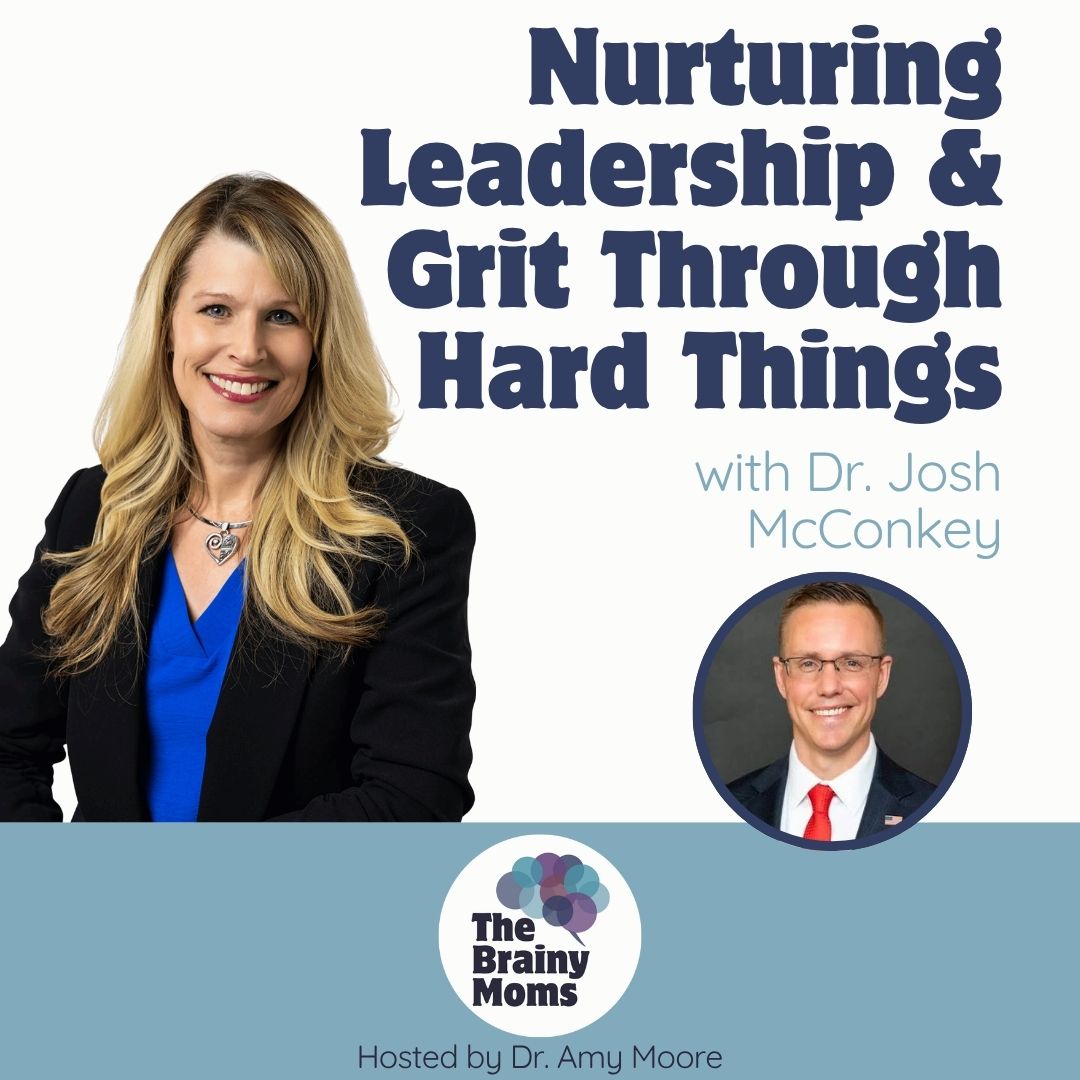
If you’ve ever stepped in to “help” your child and realized you might be making things worse, this conversation will hit home. On this episode of The Brainy Moms Podcast, Dr. Amy sits down with Dr. Josh McConkey, an emergency physician, former U.S. Air Force commander, and author of Be the Weight Behind the Spear, to talk about a problem many families feel but can’t always name: kids can’t build confidence and grit if adults remove every hard moment.
We dig into the shift from helicopter parenting to “lawn mower parenting,” why it fuels fear of failure, and how resilience grows when kids are allowed to fail safely. Dr. Amy brings in self-efficacy and the power of the feedback loop after a setback, while Dr. Josh shares how leadership starts at home with small habits like a dinner table family debrief: what went well, what didn’t, and what we learned. We also talk about co-regulation, emotional honesty, and how to decide when to step in versus letting natural consequences do their work.
You’ll hear real-world stories about integrity, accountability, and what it means to take responsibility without slipping into victim mentality. We also explore why face-to-face mentoring through coaches, teachers, volunteering, youth sports, and community service matters more than ever in a screen-heavy world, especially as anxiety and depression rise among kids and teens.
If you want practical parenting strategies for raising leaders, teaching accountability, and building resilient kids who can handle real life, press play. Subscribe, share with another parent, and leave a review so more families can find the show.
About Dr. Josh McConkey
Dr. Josh is a board certified emergency physician, prior U.S. Air Force Reserve Commander, and award-winning author with more than 20 years on the front lines of medicine and leadership. A former Duke University professor, he’s dedicated his career to service, both in uniform and in the community. His acclaimed book, Be the Weight Behind the Spear, along with his TV and podcast appearances, has earned multiple honors, including a 2025 Telly Award and a Pulitzer Prize nomination. Off the clock, he’s a husband and father of three focused on raising the next generation of leaders. Find Dr. Josh at www.weightbehindthespear.com
Free Downloads from our Sponsor, LearningRx
Download the free ebook, Unlock the Einstein Inside: Wake Up the Smart in Your Child
Download the Brain Training Game Pack
Link to our sponsor’s website: www.LearningRx.com
Listen or Subscribe to our Podcast
 Apple Podcasts
 Google Podcasts
 Pandora
 Spotify
 iHeartRadio
 TuneIn
 Stitcher
 YouTube
Watch this episode on YouTube
Read the transcript for this episode:
NOTE: This transcript was auto-generated by an AI assistant that thinks it’s smarter than we are. It’s not, but it has more free time than we do, so we gave it a low-stakes job. It probably spelled a few things wrong, but we’re okay with that. We’d rather spend our time interviewing cool guests!
Welcome And Newsletter Reminder
Dr. Amy Moore 0:02
Hi, smart moms and dads. Welcome to this episode of the Brainy Moms Podcast, brought to you today by Learning RX Brain Training Centers. I’m Dr. Amy Moore, and we just want to remind you that we have a monthly newsletter. It’s totally free and full of amazing parenting resources. So you can sign up at the Brainymoms.com for that newsletter. Don’t miss out. And now our guest today is Dr. and Colonel Josh McConkie. Dr. Josh is a board certified emergency physician, prior U.S. Air Force Reserve Commander, and award-winning author with more than 20 years on the front lines of medicine and leadership. A former Duke University professor, he’s dedicated his career to service, both in uniform and in the community. His acclaimed book, Be the Weight Behind the Spear, along with his TV and podcast appearances, has earned multiple honors, including a 2025 Telly Award and a Pulitzer Prize nomination. Off the clock, he’s a husband and father of three focused on raising the next generation of leaders.
Why Leadership Training Starts Young
Dr. Amy Moore 1:09
Please help me welcome Dr. Josh McConkie. I’m really excited to hear your application of leadership principles and the idea of like starting that early, right? That kids can be leaders, that they need confidence, they need grit. I did see you talk a little bit about the pitfalls of helicopter parenting. That’s one of my bandwagons. So I mean, and that and how that does thwart that idea of developing leaders early, right? So that’s kind of where I envision the conversation going. But you tell me, we can just talk.
Dr. Josh McConkey 1:52
Yes. So, you know, it’s my whole be the weight behind the spear ethos. So it was the title of my my first book. And then I turned that into the children’s leadership book series because as a military commander, you know, you just see so much, and you’ve got these kids, uh, I say kids, but like 18 to 25 years old. And wow, they just lack a lot of the communications and resiliency. And it’s really hard to teach it at that age. There’s a lot of yelling, there’s a lot of push-ups, you know, in the military. And I learned that you have to start much early earlier than that. So I started the books, you know, for that four to nine-year-old range, the Be the Wait series, and the first one is the heart of a leader. But you have to teach those at a very young age. Resiliency, you know, you don’t have to be the fastest and the strongest. You just have to care and take that active role and bring people into the fold. And I think the more that we have of that, the better off we’ll be as a country. And during, you know, the last five to 10 years, we just had a lot of changes in the country where this younger generation now was shut out of schools and churches and their communities, and they just lived on iPads and phones and social media. And we see all the mental health side effects now. But what it also did was just, I think they’re really lacking in some of those basic leadership skills. So this is an all hands-on deck team approach. Life is a team sport, and you know, I’m I’m pretty excited about this book series. It’s done well so far.
Lawn Mower Parenting And Lost Resilience
Dr. Amy Moore 3:25
So do you think that the whole COVID era is solely responsible for that shift? Or do you think there’s something else happening?
unknown 3:33
Aaron Ross Powell, Jr.
Dr. Josh McConkey 3:34
There’s a it’s a perfect storm. It’s a perfect storm of the COVID policies and the intersection of social media. And when you talk about the helicopter parenting, it’s even worse than that now. It’s lawnmower parenting. So the lawnmower parenting is where those parents just mow down every single obstacle in their kids’ path because they want everything to be perfect and shiny and happy and no mistakes made. That’s the exact opposite thing you should be doing. So kids learn by mistakes. So, you know, being there as a parent, letting them get out there and explore the world, make some mistakes safely, right? There’s certain mistakes that you just don’t want them to make. I have three kids of my own, you know, let them fail safely, but they have to learn. Like climb a couple branches up there and have that fall. You know, if they’re 20, 30 feet up there, okay, you need to step in. That was going to be dangerous, right? But they have to get some of those bumps and bruises and make those mistakes because that’s how they learn. If you mow down every obstacle, they don’t know what to do when they encounter one. And so that’s the lack of resiliency. And what I noticed as a military commander was these these kids, they just quit like that. If something didn’t go the way, that’s it. I’m out. And you just really had to sit down and do some mentoring and some teaching. And it just was very shocking to me. I know that this younger generation that social media is their life. I mean, that perception is their reality. And it’s just a big generational gap, you know, to leaders and community leaders, teachers, professors. We have to find a way to bridge that gap. And I’m hoping that starting younger with some of these leadership skills, we can do that.
Teaching Kids To Frame Failure
Dr. Amy Moore 5:12
So I think that whole idea of helicoptering and lawn mowing, all of those obstacles out of the way, creates this fear of failure then, right? Because you’re sending the message to kids that it’s bad to fail. Therefore, I’m going to set you up so that you won’t. And so then do you think it has an exponential impact on a child when they or a young adult when they do fail, if they haven’t had those experiences of living through it?
Dr. Josh McConkey 5:44
Yes, because they don’t know what to do when they fail. They don’t know how to even frame it correctly. So failure is not bad. You know, my take on it is get out there, push yourself. If you’re not making some mistakes, then you’re not pushing hard enough. You have more to give. And you keep finding those boundaries and you break down those boundaries and you move on and you realize it’s okay to fail. Like I learned from it. I’m a better person for it. I mean, uh, Thomas Edison would have never invented the light bulb, you know, had he not failed like hundreds of times. And so you got to keep pushing that envelope. Failure is not bad. We need to teach that, you know, in that framework that, you know, it’s uh if you’re not pushing yourself hard enough, then and you’re not pushing, you know, if you don’t reach that edge, then you’re not pushing hard enough. So failure is not a bad thing.
Dr. Amy Moore 6:32
Yeah. So Dr. Al Bandura, who was you know the father of self-efficacy theory, talks about how, you know, the key component of self-efficacy, like after you’ve you know tried to master experiences and after we as adults have modeled those experiences and given feedback, that that feedback loop is the key component, right? That once you fall flat on your face and you fail, right? An an experience can be self-critiquing, but it’s probably better to have a conversation with it, you know, with your parents about it. Hey, this is what happened. You know, this is where it went wrong. This is what I might need to do next time. Right. That feedback loop is so critical, right? We don’t just watch our kids fail, laugh at them, tell them just rub some dirt in it and move on, right? Like we have to have conversations about what went wrong and how we can make changes, right?
Dinner Table Debriefs That Build Skills
Dr. Josh McConkey 7:28
Yeah, yeah. That leadership starts at home. And it starts right at your dinner table. So many families, I have three kids. They are everywhere. We’ve got soccer, basketball, um, for a while, gymnastics, and then guitar practice, piano, and just we’re pulled a hundred different directions. But you have to have that time. Sit down at the dinner table. Just something that simple. Just sit down, however many nights a week you can manage that. But sit down and talk as a family because it lets your kids know that you’re prioritizing them. And then you get that opportunity. I ask my kids, hey, what went well today? What didn’t go well today, and then what mistakes did we learn from? What decisions could we could have been made differently that would have changed the outcome of that day? And it’s like a little family debrief. And we get some great stories, we get a lot of dialogue. They’re they’re getting into those teenage years now. They’re not quite as chatty as they used to be. But last night we had a wonderful dinner, and I got to learn a ton about my kids. And making that time as a family, it starts right there at your dinner table.
Dr. Amy Moore 8:33
How
Integrity Under Pressure And A Costly Lesson
Dr. Amy Moore 8:34
do you differentiate between just natural consequences of our choices and our actions and when we actually need to step in and make some correction?
Dr. Josh McConkey 8:48
You know, and that that’s the lovely thing about parenting is you know, it might be different for each family, but for me, you know, as long as you like if there’s a toxic relationship, like they’re there in a relationship with an individual who is just making bad decisions or making them feel bad about themselves, and you know, just like, well, we’re gonna step in on that one immediately. But those natural repercussions of I don’t want any any victim mentality, right? It’s always somebody else’s fault or this or that, or my teacher doesn’t like me. Like, no, none of that. You are 100% responsible for your actions. And myself, I had a uh it was a great learning lesson for the kids. It was a horrific learning lesson for me about five years ago. So you you learned that you can’t control other people. All you can control is yourself and how you respond to situations, but you’re not a victim. So I owned a business in Texas. We moved out there, owned to Freestanding Emergency Department. We’re making crazy money, things are going very well, put so much time into marketing and getting out in the community. And I find out the CEO is embezzling money. And, you know, there was a sexual harassment lawsuit of $90,000 that he wrote off through our business that was from another business that he owned. And then it was siphoning off money through payroll. I had a forensic accountant hired, stole $130,000 there, and then towards the end, just stole $650,000 for back management. And it was a situation in that I should have done more research on this individual before I got involved. I approached them because I’m in the military. I was getting a top secret security clearance and getting a position on the National Security Council. And I came to that individual, was like, listen, I cannot be a part of this, okay? Because there was some Medicare, Medicaid stuff going on as well, as far as violations. And first offered me a bribe for $3.4 million. I’m a colonel in the U.S. Air Force. You cannot buy my integrity. And then he just punished us. So he controlled the bank account, had majority ownership, and just ran things into the ground, didn’t pay the electrical bill. I mean, I paid like personally like about $80,000 of expenses on my own credit card, trying to keep things afloat, wouldn’t distribute, no distributions, just starving us out. We filed a lawsuit, you know, to get an injunction, and COVID hit. So we couldn’t get a court date. And at the end of the day, he just ran it into the ground, bankrupted everybody, and then he threatened my family, moved to Australia for a year, you know, just to get away from them. And it was just a crazy situation. But my my kids saw all that. And there’s just there’s bad, there’s evil people out there, but you can control how you respond to that. I can’t, I can’t cure crazy, but you know, you can’t control other people. You just control how you deal with the situation. I’m not going to change who I am for anybody or any amount of money. And then four or five years after that, you know, we’re back in North Carolina, getting our lives back together, and I won the North Carolina educational lottery. Like for real. So for me, I just felt like there was a little bit of divine intervention. I did the right thing because I lost five million dollars in that whole debacle. And, you know, I just felt bad about that, but kept trucking through that. And it was a great learning experience for my kids. You got to know who you’re getting into business with. But then, you know, got a little um divine intervention later on in that uh you’re doing the right thing. And yeah, here’s here’s a bit of a windfall to get you through everything. So it all works out in the end, but you can’t control other people, just how you react to things. That was a good lesson.
Dr. Amy Moore 12:28
So when you talk about it being a good lesson for your kids, and I’m sure very humbling for you, how honest were you with them? How much how much detail did you share with them? And do you think it’s important to be transparent with your kids as you walk through seasons of struggle like that?
Dr. Josh McConkey 12:47
Trevor Burrus, Jr. Yeah, you was pretty honest with them. They obviously knew we were moving to Australia and were quite inquisitive why. And I I actually, you know, being a military guy, I I keep a lot of backup plans like A, B, C, D, E. And so, boy, however many 10, 15 years prior to that, I actually got board certified and uh was able to work in Australia. I’d set that all up previously. My son Luca was born in New Zealand. And that many years later, we actually needed to fall back on that plan, but it gave us a nice soft landing in space, a distance. The FBI got involved, and at the end of the day, they they didn’t press any charges on them because it was kind of the gray, uh blue-collar crime stuff, or I guess the white-collar crime, and and it was the middle of COVID. It was crazy. I I still can’t believe they didn’t charge him with anything, but you know, it he he’ll he’ll be in jail eventually. It’s just not gonna help me at all.
Dr. Amy Moore 13:41
Yeah. So did your kids know, oh my gosh, I got involved.
Dr. Josh McConkey 13:48
Yeah. Yeah. There was there was so much of the legal games going on. You know, um basically I I had to call the police in several times because he was like threatening staff and shutting down systems, refusing to pay bills. And they they could you have to be honest with them. So I was pretty transparent because they could just tell like the amount of stress and the discussions my wife were having. Your your your kids know there’s something wrong, right? So I was pretty honest with them. And then obviously with the move, they had a lot of questions at that point. But it was just a nice opportunity to talk about integrity and sticking to your guns and not changing who you are. I mean, it’s always not always about money. You know, integrity. You once you once you give that away, you can’t get that back. So after about two years, when we uh the first year we moved back here to North Carolina, my son Luca actually got this integrity award at school. And that was that was a nice full circle moment because, you know, I just talked to my parents and they’re like, hey, you know, they’re they’re watching. I mean, you just went through absolute hell. And, you know, maybe it was for some right reasons there. So you get to teach your kids an awesome, uh, awesome lesson for this small sum of five million dollars.
Dr. Amy Moore 14:58
That’s an expensive lesson.
Dr. Josh McConkey 15:00
Yeah.
Dr. Amy Moore 15:01
So so as a parent educator and psychologist, I talk a lot about co-regulation and how we help kids learn emotion regulation skills and emotional awareness. Were you able to narrate what you were feeling in the in this situation? Were you able to say, look, I’m really angry about this, but this is how we’re gonna handle it? Or talk to me a little bit about what those conversations were in terms of how you managed your emotions or if you shared any of that.
Dr. Josh McConkey 15:33
Yeah, I was definitely short-tempered and it you that stress always follows you at home. When you’ve got that type of work stress going on, it definitely had some impact on the relationships at home with my wife and the kids. And my wife just sat me down and she said, Hey, listen, you know, the money doesn’t matter. This doesn’t have to say they change you. And it was actually her idea to just pick up and move to Australia. Because he actually had made some threats to the family there. He sent a goon over from Louisiana. It’s like, hey, Josh, uh, you know, this you got to know some pretty scary people, you better be careful. And I’m a military man, and I was not I didn’t take very kindly to that. And so you start cooking up some you just that that that that type of evil and that just negative energy just kind of seeps in. And uh I I did not tell my kids what I was thinking, but my wife and I had some very legit discussions, and you know, we should say, okay, we need we need to get out of here before I before I do something that that might get me in trouble because I just don’t take kindly to people threatening my family. So it was her idea. We moved, and I I didn’t have those levels of discussions with the kids, but that they clearly knew that I was stressed and that there’s just bad people out there, and you can’t let it change who you are, and you can’t control other people, but you just control how you respond to it and move on with your life. So it was it was crazy. There’s a chapter in the first book, Be the Weight Behind the Spear, chapter eight. Uh it’s titled Nightmares or Dreams Two.
Dr. Amy Moore 17:03
Yeah. I read it. I was like, whoa, this is insane. Oh, yeah, I read your whole book yesterday. So yeah.
Face To Face Mentoring Over Screens
Dr. Amy Moore 17:10
Um okay, so I want to go back to where we were talking in the beginning of this conversation about sort of how this COVID era and this perfect storm of we have now this um huge population of young adults who don’t have the leadership skills that they need to, you know, be in the military or run businesses or lead families. And so back in 2012, I published an article in uh the Air Force Academy’s leadership journal about how do we, yeah, so how do we accelerate expertise in these young second lieutenants, right? So they come out of the Air Force Academy and oh, here’s your squadron to lead, right? And so they don’t have the life experience yet. They don’t necessarily have the moral leadership formation yet. And so that article, I it was a conceptual piece, how I thought, hey, let’s do it with virtual reality. Like let’s immerse them in some scenarios, right? So that they can practice, practice, practice, practice, practice to see if we can accelerate that idea of leadership development for 22-year-olds who really have no real world leadership. So, in thinking about um starting young, because that’s your premise, right? That’s your philosophy that we have to start with youth, like well before we get them to college. So, talk to me about what are those characteristics that we need to start working on? What are those lessons and experiences that we need to start exposing our kids to so that they do build this leadership and character and they’re ready for adulthood.
Dr. Josh McConkey 19:00
So, you know, the most important part when you would talk about that is it has to be face-to-face. So these kids have just grown up and lived, and their world has been on social media and digital phones, iPad, all of that. So my big push is on mentoring, face-to-face interactions. They have to, you have to model that and see that. So when you get out in your community, you know, just be the weight in your community. That’s our best resource. It’s teachers, coaches, volunteers, families. Like that is what sets America apart. And that’s what has made us what we are for like hundreds of years, almost 250 years now. It has to be those face-to-face interactions. So get out there and coach Little League. Go volunteer at the soup kitchen, get involved in your church or your school, or for some, they don’t particularly like working with uh with other individuals. That’s okay. There’s so many organizations in your community. Go to the animal shelter. You know, you work with those animals, those animals become emotional support animals for somebody. So when I say life is a team sport, you know, it just has to be that face-to-face interaction. And the more you get involved with those youth, athletics have been a great uh have been great for me. I I coached T ball and soccer when the kids were little, and it and it’s chaotic and it’s crazy and they’re running around throwing sand at each other. But but you’re you’re modeling leadership for them. As crazy and as chaotic as it is, they are seeing that. You think they’re not paying attention and they’re doing somersaults on the outfield, but I’m telling you, it that that forms that that basis for them. And if that’s what they’re exposed to these years growing up, you know, that that’s what they’re gonna model and become. So I I know so many people have done like the research and trying to like the virtual reality, I think it’s fantastic. It’s a great idea, but it really you have to start off. It has to be face-to-face interactions because too much of these kids growing up, everything is virtual, everything is on digital. And that’s it it is not panning out well because as an emergency doctor, I see these kids coming in with anxiety and depression, and I’ve seen a lot of suicides, and it rips my heart out every single time. So clearly, like there’s something out there that’s changed over the last 10 to 15 years that is contributing to to this mental health crisis. I think social media is one, some of the other changes, and and obviously the the whole COVID debacle was uh the icing on the cake for them. But we have a lot of work to do and we can overcome that. But you know, that that’s the whole be the weight behind the spear ethos.
Helping Natural Leaders Lift Others
Dr. Amy Moore 21:34
Yeah. So what what we tend to see um our natural leaders emerge, you know, throughout childhood. These are those extroverted Enneagram three achievers that sometimes dominate the group. They assert themselves as the boss of their peer group. And um, it doesn’t give Everyone else in the peer group an opportunity to practice their skills at leading. So, what is your advice to parents who have one of those extroverted, you know, Enneagram achieving type kids? What is your advice to how to nurture that? Like we don’t want to squash that initiative at all. But how do we how do we talk to those kids about allowing space for other kids to practice being leaders as well?
Dr. Josh McConkey 22:32
That’s having those discussions. So you recognize someone that has those skills, they’re very outgoing. Physically talk to them. Like what is leadership? You know, for me as a military commander, it took me 20 years, you know, to get into a command position. And I saw fantastic leadership, I saw horrific leadership and all kinds of leadership in between. And for a true leader, it’s not measured with you, right? Oh, I did this, we did this, I got this award. It’s how better, how much better do you make everyone around you? Like how are you developing your talent and your people? When you talk with having those discussions at a very early level with some of those kids that have these leadership skills, okay, you’re doing great. How can you make this person better? Or how we can how can we develop these skills and those group projects that you do in school? Athletics is great as well. You know, you always have those egos and some of the narcissists, you know, athletics, surgeons, okay, cardiothoracic and neurosurgeons. I’ve been dealing with them for 20 years as an emergency physician. You know, true leadership is making everyone around you better. When you see some of these baseball players, they’re getting into the Hall of Fame, you know, or basketball, their football, it’s how how do they bring a team together? I mean, yes, they can win all these personal awards and MVPs, but you look at a Tom Brady, like seven championships. Like that’s that’s making teams and everyone around you better. He brings that energy. So it’s pretty intense. And sometimes it rub people a little bit the wrong way. But he made sure everyone else around him was being held to that same standard. So like that’s like a championship level leadership. That’s that that’s that’s super crazy. And how many people can could work or do those things. But just how do you work with other people and how do you make them better? Having those discussions with them, I mean, and just teaching those types of skills, that that’s the best way to start.
Dr. Amy Moore 24:26
I can remember that transition from undergrad to grad school was really difficult for me because undergrad was just full of learning information and then regurgitating it and getting the highest grade in the class and being responsible for your own grades. And then grad school was more of a collaborative process where we had all of this group work where everyone had their own role in projects. And I was so frustrated because I didn’t want anybody else to be responsible for my grades. I wanted to be responsible for my grades. And it was actually my mom, who was a child development specialist as well, who said to me, other people are also competent. And it was this aha moment that, you know, I kind of had to take a step back and say, all right, I am not the only one in this group that can do this. And so we have to work as a team. That’s how real life is, right? We don’t operate in a vacuum. Most jobs require a team. Um, and so it was a really huge learning experience for me. But it was frustrating that it was I was in grad school before I got there, right? How cool would it have been if I had learned that lesson at age seven, eight, or nine?
Dr. Josh McConkey 25:41
Oh, and and for me, probably a similar type of uh trajectory there, except it was way later because in medical school, it is super competitive. I mean, there’s just some of those kids out there that are just trying to rip your throat out. And I mean, they would it it’s just so, it’s so incredibly competitive that by the time I got to residency, though, that’s where you really learned about like being in a team. I mean, you’re running codes, you’re making life and death decisions, and you’re you’re stuck with this group of people on these call rooms for 36 hours straight, 80 to 110 hours a week. This is before all the work restrictions and things, right? And you just you just you just live and breathe it. And I I learned a lot more about teamwork. And then certainly in the military, as you start climbing uh like chief of staff, and then as you take command, boy, that’s that’s a tremendous responsibility. I think people don’t realize at times that a commander is not only a CEO of like a hundred-some people, you know, you’re you’re also the mentor. And when there’s a a death of a child, when there I had one individual that got in involved in a shooting at a road rage incident. You know, it’s you’re you’re responsible for everything. Every decision that those airmen make, good or bad, falls on you. And so it’s uh it’s like the ultimate CEO because you have a purview of everything. And I I learned a lot. And we built a fantastic team, and it really culminated in October of 2000, um 2023, October 7th. So the whole two years prior to that, you know, I had just worked so hard to get these that did this team up and running. I I started with um a lot of challenges, you know, from previous leadership that was just not great. And so had to overcome a lot of different obstacles, and then you build them up, and then they ship out to the Middle East. And I had told them, you know, before they left, hey, the world changes on a dime. You never know what’s going to happen. That rabbit hole gets pretty deep. Go take advantage of opportunities. And there were so many decisions where, you know, my commanders were trying to shortchange us on training and money, and so I had to ruffle some feathers and go to the one-star and then the two-star. And I mean, it it just kind of I let them know respectfully, hey, I know you have to manage a budget, but I disagree and I had to have my people ready, had multiple exercises in the deployment. And then October 7th kicked off, and it was my people there responding to that for the Israeli Hamas conflict, and was super proud of what they accomplished. And as a leader, I just don’t know if I could have lived with myself had I not fought that hard for my people. So I I knew we had done everything we possibly could. Unfortunately, everybody came home. Uh, because I know I worried about that a lot. But yeah, that that’s leadership. It’s about other people, it’s not about you.
Dr. Amy Moore 28:22
Yeah, I think you mentioned in your book that you your leadership abilities are reflected in how well your team operates, that you don’t have to take credit for everything. You don’t have to be the one to say, I did this. It’s already going to show in how well-oiled the machine is that you’re actually leading. And I think there’s applicability to that in childhood and teenage years, right? Like to be able to say, you don’t have to be the all-star all the time, that you can share this. And it still is going to be something that you get to brag about too.
Dr. Josh McConkey 29:02
Yeah, those are things that coaches look for. I mean, you can have those physical traits and you know, you don’t have to be the strongest and the fastest at everything. And that that’s what you know, the book, The Heart of a Leader, is all about. It’s how do you treat people around you? Are you bringing everyone else into the fold? You know, you’re kind of reaching out to one of the new kids in school, like, hey, you want to play soccer with us today? And and just um being inclusive and letting people know that you see them. I mean, that’s that’s good leadership. And if we can instill those skills earlier, so this is a whole series. So we’ve got, I was planning eight books. This is the first. The second book we’re almost done with. Um, it’s on perseverance. So the first book was leadership, the second book is perseverance, and then we’ll talk about accountability and integrity and just some of those just really basic tenets of leadership that I don’t think really young kids get that. And so we’re really excited about it. My illustrator is a gentleman, Joe Jakobetic, and is a Disney illustrator, just world-class, amazing individual. He did work with um uh Lelo and Stitch, you know, and Little Mermaid. I mean, just like some amazing things. I had there was no way I could afford his talent, but just had a couple of discussions and he really believed in what we’re doing. So we’re in on this project 50-50. So we’re super excited.
Picking The Core Traits To Teach
Dr. Amy Moore 30:21
So how did you determine which characteristics you were going to focus on? Like how did you say, all right, these are the eight character traits or eight characteristics or eight qualities that kids need? How’d you how’d you make that determination?
Dr. Josh McConkey 30:40
Well, after you know, 20 years in the emergency department, you know, leadership there, leadership in the military, when you really try to analyze like what makes what makes a great leader? What what teams are successful? And you look at even like championship level teams, accountability is big. So without accountability, you have nothing. And that means everybody. That means senior leadership too. When I came into into this squadron, there were two lieutenant colonels that just they were, you know, you hear that like retirement active duty. Like they just they’re there and they got some rank and they just do absolutely nothing. And I gave them every opportunity to kind of get things moving in the right direction. And then it’s time for you to retire. So when the whole squadron sees that, like even senior level leadership, including myself, I mean, you have to hold yourself to a higher standard. That’s what I love about military service and um it it’s uh it’s it’s it’s very unique. Like we hold ourselves to a higher standard. You know, there’s higher expectations, and so we accountability was big, integrity, you know, especially with what I went through on the business side of things, and then just the basics of leadership. So I just looked at all those different characteristics of great leaders that I’d worked with in the past. I’m a huge uh military history nerd as well. So if you’ve ever seen Band of Brothers, uh Major Winters, one of the main characters in there, just demonstrated amazing leadership. And what I liked about that series is they actually interviewed those individuals between the episodes as well. And uh they’ve all passed away now. But in that series, that whole World War II generation was clearly the greatest generation. So that’s where I really pulled a lot of my leadership from.
Sponsor Message LearningRx
Sandy 32:21
And now another success story from our sponsor, Learning Rx Brain Training Centers. Here’s what Jacoby from Atlanta, Georgia said about his experience at Learning RX. I just wanted to say how thankful that I am to have been recommended Learning RX. Before now, I did not fully understand the power of cognitive training and the difference that it can make in my everyday life as a graduate student. Through their expertise, my attention to detail, processing speed, and overall academic confidence have all improved considerably. I recommend these services to both children and adults who’ve had to work extremely hard to excel thus far or are just looking for ways to improve mental sharpness. At Learning Rx, we target the root cause of learning struggles, cognitive skills that need to be strengthened. Every child is different, and you or your child may or may not achieve the same results as Jacoby, but give Learning RX a call to see if brain training is the next best step for you or your child. Around the world in our centers and over Zoom, we’ve worked with more than 130,000 children and adults who struggled with thinking and learning. Visit LearningRx.com or call 1866-Brain01. Mention that you heard about us on the Brainy Moms podcast to get a special pricing on the cognitive skills assessment. That’s 1866-BrainZero One or Learningrx.com.
Accountability Through Chores And Sports
Dr. Amy Moore 33:47
So talk to me a little bit about what conversations around accountability look like with kids.
Dr. Josh McConkey 33:56
So for little kids, it’s those simple things like dishes, taking out the trash, the cats, like pets. Pets are a great way to instill some accountability in some of that. Um you’re always there helping out because sometimes they forget some things, but then you have those discussions like, hey, listen, so we have we have two cats, Buzz and Woody, and they are two uh orange, which orange tabby cats, their brothers. There’s a chubby fat one that we call the Wood, they named Woody, and then his brother uh Buzz is kind of skinnier. But just those those little things, like those are chores that have to get done. I mean, they’re part of the family. You usually you let them starve. You know, you got to clean the litter box, you gotta take out the pea pads, I mean, all those little things, you know, when when those don’t happen. Um for me as a kid, sports I’ve talked a little bit about, but just like wrestling, like that accountability was fantastic. And so I got to talk about that in the first book. It’s just, it’s just you one-on-one with another person, and you’re either stronger or you’re faster or you’re not. So you either put in the time or you did it. And there’s nobody else to blame. That’s what I love about it. And and that’s I know you talked about, you know, just always being like the top of the class and, you know, that that leader. And uh it’s really hard to give that control up and bring other people into the fold. But, you know, for me young growing up, wrestling was fantastic because nobody dropped a pass, nobody missed the basket, like there’s there’s nobody else to blame. It’s just you. So athletics and wrestling was a fantastic way to teach accountability. But um that’s how I’ve done it.
Dr. Amy Moore 35:32
So be very specific with me. Let’s say one of your kids drops the ball on taking care of the cat. What does that conversation then look like around accountability?
Real Consequences That Teach Responsibility
Dr. Josh McConkey 35:44
Well, you know, it’s um even a better example would be we just went on vacation. And we were in a at a very nice rental, and the kids were arguing about something in the bathroom. I wasn’t there, I was out for a run, and they they they tried to kick a door open and actually broke the the part of the lock. And so we had that discussion. I was I was upset, and then I had a chat with my wife, and our kids have the phones, they’re teenagers, and they have access to their bank account. And both of them the next day, hey, um, where did that $300 go in my bank account? I was like, oh, well, that that door that you broke yesterday, that’s gonna cost some money. They were gonna get charged for that, and you’re gonna pay for that. Like, oh, but but that’s I don’t want any excuses. Whose fault was it? Your fault, your sister’s fault. You guys are both gonna be accountable. You’re both paying 300 bucks, and uh this is called accountability. So there’s accountability for your actions. I don’t care whose fault it was, it happened. And so that accountability just it was it was it was great seeing that. And it actually ended up being okay, and we have just checked out. We ended up not getting charged for that. But yeah, that accountability. There’s no excuses. And so if you allow those excuses, that’ll just permeate through everything and there’s always an excuse, it’s always somebody else’s fault. There has to be accountability.
Dr. Amy Moore 37:15
And if that costs money to fix it or it costs labor to fix it, then you take care of it. And so that was directly related to the offense, right? It’s not that you said, hey, I’m taking your phone away for a month because you broke a door. I mean, in real life, if we make a mistake, we fix the mistake or we make amends for that mistake in a way that’s meaningful. And so what I’m hearing you say is accountability is just that, right? That it’s related to the specific task or the specific responsibility or the specific act.
Dr. Josh McConkey 37:51
You know, and and accepting responsibility for it. So like as a commander, you’re responsible for everything, period. I mean, even when you’re clearly not, it is. I’m the one, I walk into that wing commander’s and like, this is what happens, sir. And you know, I didn’t I take the blame for everything. You know, that that’s your job as a commander. But you know, in the in the family, they they have to take that responsibility. And so even myself, like, oh, poor me, I had some crazy CEO steal a bunch of money and you know, it cost me five million dollars. Like, no, I own that. I made a very bad decision. I didn’t do as much research as I should have into that individual. Had I found the two previous lawsuits at other businesses that I found about later, probably wouldn’t have gone into business with that. So what can I learn from that? I mean, he’s a terrible individual, yes, but this is no victimhood here. This is on me. I made a bad call, and uh I learned a very expensive lesson about owning a business. If you don’t have majority ownership, that puts you in a bad situation. So, you know, you have to be that’s holding yourself accountable as well, no excuses.
What Matters Daily And Where To Learn More
Dr. Amy Moore 38:54
So, of all of your um leadership lessons that you are already teaching and are planning to teach with your book series, what do you think is the most important? What do you want um parents and our listeners to take away as hey, this is where you should start?
Dr. Josh McConkey 39:15
That what you do matters every single day. Like the decisions that you make, all the interactions that you have with people around you, friends, family, coworkers, colleagues, you matter and it really makes a difference. So when I say the best resource is people, teachers, coaches, volunteers, families, it it it’s true. Life is a team sport. So get out there and make a difference. Get involved in your community, coach, teach, work with the animal, go to the animal shelter, something. So get out there and be part. When I say be the weight behind someone or something that matters, they the government is not gonna save us. So that’s always the big point there. You know, they want to wait for someone else to be the savior, right? Oh, the government will do this or somebody else will do that. No, it has to be you. Like you’re looking at yourself in the mirror, you’re the only one that can solve your problems and your community. So if you take that ownership, and that’s like the special operations side of things, where everything is your problem, 100%, nobody passes the buck. I love that. So it has to be you. Get out there.
Dr. Amy Moore 40:22
Hey, how can our followers find more from you?
Dr. Josh McConkey 40:26
You can go to weightbehindthespear dot com. So W-E-I-G-H-T, weightbehind the spear dot com. And you can learn more about the books at lovelittle leaders.com. It takes you right to the Amazon page.
Dr. Amy Moore 40:41
Awesome. Thank you so much for being with us today. I know that you um are a busy clinician and leader, and we appreciate you taking time out of your busy schedule to bless our listeners with some really great advice.
Dr. Josh McConkey 40:55
Thank you very much. I appreciate you
Closing And Ways To Stay Connected
Dr. Josh McConkey 40:57
having me on.
Dr. Amy Moore 40:57
Hey, thanks for tuning in to today’s episode. Wondering what’s next? Well, don’t forget to sign up for our free monthly newsletter at thebrainymoms.com. Be sure to follow us on social media at the Brainy Moms and subscribe to our YouTube channel at the Brainy Moms Podcast. And last, check out our sponsor at learningrx.com.