
Stop Teaching Zen to 5 Year Olds (& Other Parenting Advice) | Dr. Will Dobud
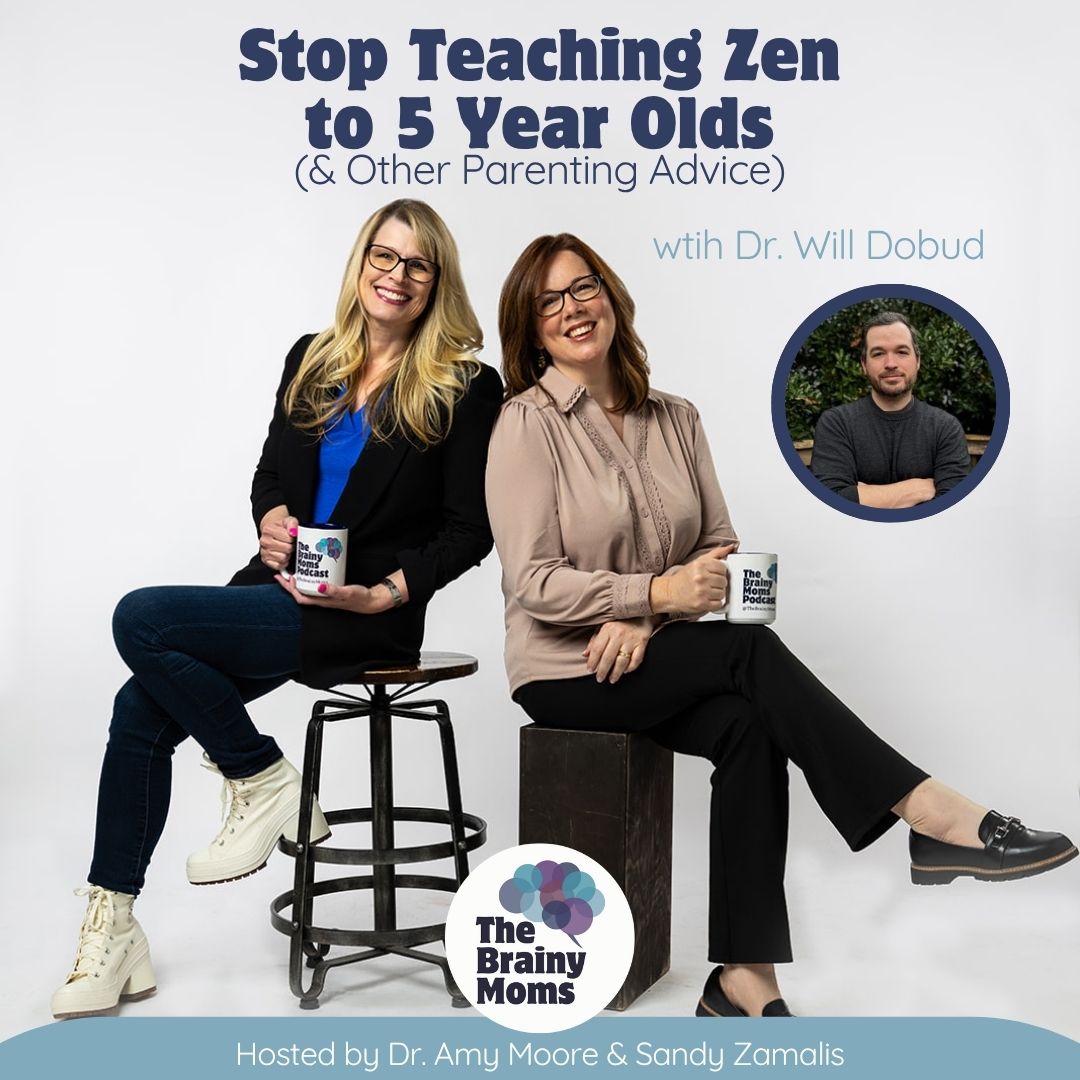
About this Episode
A lot of parenting advice sounds like a to-do list. On this episode of The Brainy Moms Podcast, Dr. Will Dobud joins Dr. Amy and Sandy to make the case for something both simpler and harder: stop chasing the perfect technique and start rebuilding the conditions where kids can actually thrive. We talk about youth mental health trends, why anxiety can rise even when “support” increases, and how easily adults can confuse more intervention with better outcomes.
We dig into research on school-based social emotional learning and universal stress management programs, including why broad rollouts can sometimes make students more anxious. The thread running through it all is co-regulation: kids learn emotional regulation through safe, trusting relationships with adults, not by being pushed into independent coping skills before they are developmentally ready. We also connect the dots to psychotherapy research and why the relationship matters more than the modality, whether you’re a therapist, teacher, counselor, or parent.
Then we go practical. We explore risky play, challenge, and why “be careful” can transfer adult anxiety onto kids at the exact moment they need focus and confidence. We also question perfection-driven schooling, the pressure to be exceptional, and the importance of community and a real village of adults. If you’ve felt overwhelmed by parenting tips, school pressure, screen time debates, or youth anxiety headlines, this conversation offers a calmer, more evidence-informed way forward.
Subscribe for more Brainy Moms conversations, share this with a parent or educator who needs it, and leave a review. What’s one change you’d make to give kids more connection and real-world practice?
About Dr. Will Dobud
Dr. Will Dobud is a social worker, researcher, and educator who has worked with adolescents and families in the United States, Australia, and Norway. Will is an award-winning researcher and educator who has received recognition for excellence in research, teaching, and crime prevention. Will’s research focuses on improving therapy outcomes for teenagers and promoting safe, ethical practices. Find him at http://www.willdobud.com and http://www.kidsthesedaysbook.com and at the social media handles below:
Facebook: @WillDobudPhD
Twitter: @WillDobud
Instagram: @WillDobud
Instagram: @Kids_These_Days_Book
Free Downloads from our Sponsor, LearningRx
Download the free ebook, Unlock the Einstein Inside: Wake Up the Smart in Your Child
Download the Brain Training Game Pack
Link to our sponsor’s website: www.LearningRx.com
Listen or Subscribe to our Podcast
 Apple Podcasts
 Google Podcasts
 Pandora
 Spotify
 iHeartRadio
 TuneIn
 Stitcher
 YouTube
Watch this episode on YouTube
Read the transcript for this episode:
NOTE: This transcript was auto-generated by an AI assistant that thinks it’s smarter than we are. It’s not, but it has more free time than we do, so we gave it a low-stakes job. It probably spelled a few things wrong, but we’re okay with that. We’d rather spend our time interviewing cool guests!
Welcome And Guest Introduction
Dr. Amy Moore 0:00
Hi, smart moms and dads. We’re so glad you’ve joined us for this episode of the Brainy Moms Podcast, brought to you today by Learning RX Brain Training Centers. I’m Dr. Amy here with Sandy. And before we introduce our guest today, we just want to remind you that we have a free monthly newsletter. You can sign up at theBrainymoms.com. It’s full of really great information about parenting, tips related to our podcast topics each month, so don’t miss out at theBradyMoms.com. And now, our conversation today is with Dr. Will Dobud. Let me tell you a little bit about him in case you don’t know who he is yet. Dr. Dobud is an award-winning social worker, researcher, and educator who has worked with adolescents and families in the United States, Australia, and Norway. Will has received recognition for excellence in research teaching and crime prevention. His research focuses on improving therapy outcomes for teenagers and promoting safe ethical practices. He’s the co-author of the book Kids These Days: Understanding and Supporting Youth Mental Health. So let’s welcome him, Dr. Will Dobutt. Will, where are you located?
Dr. Will Dobud 1:06
I’m in Australia at the moment. I I’m from Washington, D.C., so I’m not far from you, Sandy.
Sandy 1:12
Okay.
Dr. Will Dobud 1:13
Most of the time, but I’m in Australia at the moment. We’re teaching.
Dr. Amy Moore 1:17
And you split your time, right?
Dr. Will Dobud 1:20
I’m I’ve been mostly working here, but I still go back and forth all the time for anything that I’m doing.
Dr. Amy Moore 1:25
It’s a really long flight.
Dr. Will Dobud 1:27
Oh my gosh. No kidding. It’s horrible. And I can be a nervous flyer, not to get in all of you know all the therapy stuff, but oh my gosh, it’s terrible.
Dr. Amy Moore 1:41
You have to not think about it, right? Like you have to not think, oh my gosh, I’m in the middle of nowhere over an ocean with no land nearby, right?
Dr. Will Dobud 1:48
I’ve been I’ve been everywhere. And just something happened, and mostly after 9-11. I don’t think it’s my fear is not related to 9-11, but something happened, and I was like, why does this make me nervous? No one else is nervous here. Like and the first time I flew with my wife, I said, listen, you’re gonna get anxious on this flight just because you’re next to me. Just order red wine and we’ll be fine.
Dr. Amy Moore 2:18
And just a couple tequila shots.
Dr. Will Dobud 2:21
Just like we’ll we’ll be fine. We’ll be fine. And she goes, she’s sitting there and she goes, Yeah, you’re really making me anxious. And I go, Well, it’s communicated nonverbally. So here we go.
Dr. Amy Moore 2:34
I was like mirror neurons, right? They’re a thing.
Dr. Will Dobud 2:38
I was like, sitting next to me is the worst. And then people go, Do you want to like play a game or have a conversation? I go, I’d rather you just not talk to me.
Dr. Amy Moore 2:46
Right. Just leave me alone. Just leave me alone. If I white knuckle this chair hard enough, it’ll all be fine. Yeah.
Dr. Will Dobud 2:56
Yeah. Oh, anyway. No.
Dr. Amy Moore 2:58
So then you’re absolutely no help as a psychologist on a plane.
Dr. Will Dobud 3:03
No. And I’ve had to pick up um pick up clients. Like parents have said, My my my daughter is nervous. Can you come pick them up on a plane? I said, What are they a good therapist? Can they help me, please?
Why The Book Hit Home
Dr. Amy Moore 3:20
Yeah, that’s funny. I have to tell you, I love your book. Love it. Um read it in, I don’t know, six hours. Cover to cover. Yeah. Um what I love about it is um it’s so common sense.
Dr. Will Dobud 3:46
Yeah.
Dr. Amy Moore 3:48
Right? Like you identify so many problems that we’ve created as adults with good intentions a lot of the times, right? But that we’re just throwing gasoline on fire. Um and so I like I’d love to spend some time talking about some of that today. Um for example, right? You you talked about um how school-based stress management and emotion regulation programs have actually made the issue worse because it’s taken out that uh one-on-one loving, caring relationship with an adult that you need to co-regulate with, right? That while it it was well intended, what’s it doing? It’s raising the temperature on fear and anxiety and sending the message that, you know, big emotions are bad. Right. Rather than I anyway, let’s talk about that because that stood out to me. And that’s a space that I live and breathe and work in in terms of child development. And so I want let’s talk about that. W like how did you come upon the idea that you needed to look a little more uh deeply into what was happening there?
Dr. Will Dobud 5:15
Well, the cool, the cool thing about writing kids these days is I was mostly as um someone who’s written previous sort of more academic books, I was mostly staying in my lane of psychotherapy, outdoor therapy books. And Nevin Harper, my co-author, he sort of pushed this idea. I think we started in early or mid-2022. And um Nevin and I had written a lot previously together. And so one of the things he did is he said, let’s look at youth mental health. Something’s going on. We can’t have more experts, more headlines, more, you know, we have a treatment prevalence paradox. More people are treated for their mental health than ever before, but the population data says everybody’s getting worse. Something doesn’t make sense um regarding that. So um he started, I believe his first interview was with Dr. Gordon Newfeld, who wrote, you know, Hold on to your kids with Gabor Mate, a attachment-based parenting book. And I listened to the first, he recorded it on Zoom, and I listened to the first 30 minutes. And Nevin had been to Gordon Newfeld, because Nevin’s in Canada where Gordon is, and had been to some parenting workshops they were doing and said, No, he’s great, he’s great. And I was listening to it, going, the first 30 minutes, I was like, I’ve I’ve read his book. Like, I’m not learning anything really new here. I was like, this is cool that it’s like unscripted and a really neat conversation. And then Gordon took off like the kids’ gloves and was like, well, at the end of my career, I got nothing to lose. Here’s what I really think. And and that’s where like that chapter that you’re referring to, like don’t teach Zen to five-year-olds, is like that was a Gordon line. And it wasn’t an anti-mindfulness, anti-Buddhism, anti-Zen comment. It was for some reason we’ve got this, we we we turned from giving kids experiences like Gordon calls an emotional playground, a place to feel your emotions, to feel big feelings, to you have to sit in a classroom and learn feelings and learn these things, and then learn these kind of solo regulation skills. And so it was something I didn’t think about. I would have thought at the time, eh, social emotional learning in schools sounds like a really good idea. Mental health literacy, we know, is a good uh preventative factor, uh, you know, uh a protective factor. And then we read the data and the and the the big studies, the good the things, the good things with data that come from school districts is their big sample size. And what we found is when schools do these universal rollouts of these sort of emotional training programs, the kids are more anxious who have to go through those programs than the ones who can just go to school as usual. So it actually has seemingly an adverse effect to what we were hoping what what these were hoping to achieve. The other, the um, the other thing that happened is you see the rollout of these social emotional learning programs. Um, and we and we use the term that we that we got from literature, like universal programs, like a program for everybody. And that sort of is probably a big theme of the book, that rolling out a good idea and imposing it on everybody is usually not a good idea, speaking of like Sandy, like you said, like about tyranny ideas. But I understood why this happened. Teachers are overworked, their classrooms are too big. And if if if we really believe that youth anxiety is increasing, one of the things that is um happening is there’s any way to make the teacher’s life a bit easier, but what we’re um missing is the actual co-regulation of adults and children, of doing this together. So if anything, we could probably make life a lot easier, and not that I like I Nevin and I have spent a lot of time in Norway, so we we have a you know, our heart is also in in Scandinavia, but we could actually really take seriously the Scandinavian approach. And this conference I was at last week, you had a had a uh an educator from Finland do a talk, and things like um in in Finnish primary schools, like your your child’s homeroom teacher is their teacher for maybe two years or three years. So that teacher becomes part of the family. And so, you know, the joke um that we were talking about is like, you know, you want to be an annoying parent to a teacher or a really demanding parent. Don’t don’t do that to someone who has your kid for three years. Like, you know, be be conscious of who’s actually raised who’s with your child from, you know, arguably nine to three o’clock every day. So there’s different approaches to this that we thought was common sense. And I think the the the part you said, Amy, that I that I really like is that, you know, I actually think we’ve really overcomplicated this. And in and being on planet mental health, um we have access to too much information. And I’m not saying being misinformed, but I think the more informed we get, the more it should be. Can we go back to basics that connection and groundedness and having a cool neighborhood to live in is probably enough here? That um so yeah, so that that was sort of the social emotional learning aspect um of the book, for sure. That we’re we’re rolling these things out, they get a lot of funding. Um people create workbooks and training packages, and then the outcomes might not be as good as we probably think the intention is.
When SEL Programs Raise Anxiety
Dr. Amy Moore 11:49
So what’s the answer then, right? I mean, you we have these school psychologists and counselors who really want to provide tools to struggling children, right? And like you mentioned, well, like the teachers need some support there too. So what what is the answer, right? So these universal programs are not, but what is it?
Dr. Will Dobud 12:14
Well, this is the hardest question because um, as you’ve probably gathered from our our 30 minutes together already, I don’t really love being told what to do. And so I I think that there is a uh a challenge about what the answer is. And and this is my kind of, I think, the the pitch of the book to parents, because we were pretty adamant that this is a parenting book that is not a parenting book. That uh like if you need to be told what to do, speaking of all our talk about flying, go to the airport, look at the self-help and parenting section. Every book there will give you four norms, twelve rules, seven habits of highly effective teens. We’ve had all these books. You’ve been we’ve all been told what to do forever. Now, the issue with that, uh, and we write about this in the introduction, that especially with new mothers, to-do lists, checklists, how to get your child to sleep perfectly, how to do really great feeding habits, more often than not leaves parents feeling demoralized when it doesn’t look like the utopia. And then meanwhile, every other parent that you’re around is lying to you about how perfectly their child sleeps, how perfectly their child eats. And every, you know, I I hear this with boys all the time. They’re going, why does my teenager behave like this? And I go, well, because they’re a teenager. Like that’s that’s how teenagers behave. Um so one of the um one of the things with what’s the perfect answer, I think, and and what was our sort of passion project with kids these days was I’d like people to make informed decisions. And so there’s there’s we cover a lot of stuff. Like my mother said, your book’s a bit nerdy, Will. Um and so fair enough. And so I I I think we cover a lot of information, but I think it’s a lot of information so that, you know, my and no book knows your child better than you do. And no school, you know, school knows your kid a bit, but they’re so busy, that’s hard too. That I think we have to just start making the informed decision and not falling for the latest fad of things. Now, at the end of the day, the things that we probably do give the most advice about is things uh just just about social connectedness that like the longest-running happiness study out of Harvard from I think it started in the 40s or 50s, you know, connection with parents and especially the mother is the like your biggest predictor of having a healthy life. It’s your it’s a predictor of income you’ll make no matter what disadvantage you grew up in. Um and so even like UNICEF and all these, you know, you know, United Nations big international agencies say that connectedness is the cornerstone of health and well-being. And so we’ve created a world that is a lot about uh for kids academic pressure. You know, we all we’re all worried about social media. I get it. I’m I’m a bit less, I’m probably more contrary about this, but people are worried about social media, but I I just think to myself, what are adults doing on the phone? Like speaking of flying, I I fly all the time and I look at they’re they’re actually telling us how to escape this plane if something goes wrong, and there’s people on speakerphone. I’m going, didn’t they tell you to turn this shit off like 30 minutes ago? Like the whole thing to me, I go, can we look at ourselves as adults and what world we’re creating for kids? And and so I think we have to get back to thinking about are we giving young people something to imitate? And so how how do they see us? How do we communicate with them? And that to me, I think is probably the really simple what do we do? And um but I also really empathize with therap. I mean, I’m I’m I’m I’m a psychotherapist, I’m a social worker, and um I work with young people in a range of settings, and um I’m a I’m a huge therapy like advocate. I I’m a huge psychotherapy nerd. I love psychotherapy research uh and reading about it and these ideas and the history of it. At the same time, I think that it’s become too much about therapists thinking like technicians and like, okay, if I do this specific technique or this specific parenting advice, all of a sudden, this will solve this child’s problem. And what I think that inadvertently does did was treat young people as passive to the mental health intervention. I need to teach all kids about box breathing so that we don’t have anxiety in the classroom. And then they’re passive. And then when they act out, we go, I need to refer you over here, instead of going, I wonder why they’re acting out in this environment. So I think thinking the the the story that we’ve told ourselves about kids for millennia is that there’s something wrong in here that’s the problem. And maybe they’re reacting to the environment that they’ve been placed in. And so if we start taking the environment a bit more seriously, we can think about how someone, Amy, like you and I, who probably were terrible in high school to teachers, and not like I was never rude to people. I just hated school. And then I learned about psychology and social work, and I got a PhD at 32. Like something clicked, and it was about education. So I think it’s it’s there’s there’s a part of it that we have to work on our own anxiety, which we can talk about, and we have to think about that. Most of our intervening treats the young people as a passive aspect of the intervention, where all therapists really know that the wild card is actually your client. You know, therapy is two people figuring out what the hell the other person wants, you know, and and finding some consensus about it. We have to work with the people. Um, so I see these interventions and the banning as like I don’t I don’t think you you all understand kids. Like uh it’s it’s it’s interesting to me.
Dr. Amy Moore 19:07
Yeah. I mean, we know that research says the number one predictor of therapeutic success is the relationship with the therapist, right? And I think even in your book, you talk about how when you compare all of the different therapeutic approaches, there isn’t one that comes out on top because it isn’t about the system, it’s about the relationship, right? And so we can apply that idea in classroom relationships. We can apply that idea in parental relationships, right? Can’t we like it it’s sending this huge message that I think we’re missing.
Dr. Will Dobud 19:42
I I think it’s funny because when I talk about one of the first I think the second peer-reviewed article I ever wrote was about how there’s no difference in outcomes if you do therapy outdoors or indoors. Now, you would have thought in my outdoor therapy community, I like I threw a grenade at our professional community. And I said, like one of our one of our research leaders, he came up to me before I was doing a presentation and he said, Will, you should be much more careful about what you write. Insurance companies aren’t going to fund outdoor therapy anymore. And I said, But I said it’s just as effective as everything else. Like what what did I write here? But no difference in outcomes doesn’t mean ineffective, right? So virtually, if we think about the world of therapy, to geek out on this for a second, we had in in 1977 the first meta-analysis of therapy outcomes. Also, the first meta-analysis ever was a psychotherapy study, which is fascinating to think about.
Dr. Amy Moore 20:53
Right.
Dr. Will Dobud 20:54
And that study found the average person who goes to therapy is better off than 75% of people left in a no-treatment control group. This is better than taking an advil or a Tylenol for a headache. That’s an amazing effect, right? But they also said there’s about 40 to 60 different types of therapy in 1977 and uh can’t find any difference in outcomes. Today, if you have a very specific phobia, I would go to exposure therapy. That’s probably the only one that kind of sticks out as a specific for this condition works better. After that, you can’t really find anything that’s better. But what has happened to our therapeutic community is we get siloed away. And then when we get siloed away into our own sort of this mod this modality is what I love the most, right? And I can speak, I was trained in solution focused therapy. Wrote a book about it. Apparently, it wasn’t solution focused enough for that community. So I was like, oh, well, now I got to go this way and find some other club to hang out at. Like that, that’s the part that’s really troubling. It becomes more, and this is going to sound really cynical, but a lot of therapy is more about preserving the theory than about the outcome to the client. So for instance, if you think a young person comes to see me, and usually it’s a parent or a court or someone dragging them by the ear to come to my office, right? And they come into my office and they sit down, and then they leave and they go, I’m not going back there. It wasn’t because I was evidence-based or cognitive behavioral or using eye movements or solution focused or indoors or outdoors. No one leaves my office and goes, you know, Dr. Will, evidence-based, trauma-informed, but I think he’s an idiot. You know? They actually leave and go, I’d rather do anything but sit with him for another hour of my life. You know? So all of these ideas that give us this um vibe of like I call it like expert itis. Like, oh, I’ve done a lot of training in this thing. I’m a third-level clinician in this modality, or I’ve written about this. They give us this veil of security of what we’re doing. But at the end of the day, kind of like I I when I teach about this, I say it’s like the light switch. Your relationship with the person is the light switch to turn on how expert you think you are. So you could sit there and just be expert with a really crappy relationship. Nothing’s gonna happen. So what time you’re right. Go ahead, Cindy.
Sandy 23:54
So well, what I’m hearing you say is that um what needs to have a resurgence is as an adult, trusting your instincts about how to work with kids and also doing your own work to make sure you were regulated so that you can lead a child to that space of regulation.
Therapy Works Because Of Relationship
Dr. Will Dobud 24:21
Yeah, absolutely. And I think it’s oh I think we’ve uh in in some ways. I I’ve been thinking about this lately that um when we talk about our own regulation, it doesn’t mean being the perfect parent. That’s non-existent, right? And it also doesn’t mean having to be happy and put a smile on your face all the time. I actually think young people find and I do and it I don’t mean this the other way, like be neglectful and awful. I think that’s terrible too. Um I think young people can actually deal with realness much more than we than we give them credit for. And so when I think about how do we regulate ourselves, in the probably the biggest change I’ve seen from my from my understanding of the of the research is adults, we we don’t hang out with other adults as often as we used to with our children. And so, you know, we’ve all seen this at parties where there’s a kid’s table. I’m like, just put the kid at your table. Like have a conversation that the kid can be a part of. Um and so sometimes if you’re if you’re anxious, let’s say, if you go to the park and your kid is playing and doing something risky, and you’re going, oh my gosh, is my child going to get hurt? Oh, like no one wants to be responsible for their child getting hurt. I get it. If you’re next to another adult and you can say, Oh, I’m really nervous about them playing like that, that other adult will not be as nervous about your child getting hurt, and they will go, I think they’re okay. So if we can have our kids around other adults, I think it’s really helpful for regulating our own anxiety. Now, t ten years ago, um my wife, Renee, and I, we we bought a bulldog, right? And Renee and I have never owned a pet. We didn’t grow up with pets, nothing. We were brand new dog owners.
Dr. Amy Moore 26:38
What an interesting choice.
Dr. Will Dobud 26:39
Uh worse.
Dr. Amy Moore 26:41
To buy a bulldog.
Dr. Will Dobud 26:42
I know. We well, we we we’ve got a tiny backyard and we thought laziest breed, right? He’s amazing, right? He’s wonderful. Three weeks in, I said to Renee, this was a huge mistake. We love him too much, and he’s fragile. I said, Oh my gosh, what are we gonna? But other friends come over, I go, oh, why is he eating grass? And they go, Will it’s a dog. Relax. So other dog owners are really helpful for me as a first-time person of this, right? I also know when I see this is just my own anxiety about things, watching infants learn to eat. I know I go, are they gonna choke? Because I’ve because when I worked on an ambulance, I’ve seen a choking baby before. So it’s my own stuff, you know. But they have to learn how to eat. They have to learn how to do these things. So having people around is actually really helpful. So I think in and in some parts of this, we talked about like the the saying, you know, it takes a village. But you it really what I mean, what I think that means is having other adults around that might be more experienced than you. Um, you know, parenting is amateur sport. Like it’s something most people do what, once, twice, three times, you know? If you want to feel like a loser, do it one more time, and then you’ll have to learn it all over again with a new child. So I I think that yes, it’s in it’s about regulating ourselves, but we’ve become in society somewhat disconnected. So like kids don’t know their neighbors as much as they used to. And I’m generalizing here about communities, but the more you can be, you you can have other adults around, the more it can help you to regulate what you’re going through, and then let your child, the blueprint for development is there. They, they’ll, they’ll they’ll do it on their own for the most part. Just like learning to walk. You’re the parent is not responsible for the child learning to walk. You know, you protect the child from harm so they can fail in walking until they figure it out.
Dr. Amy Moore 29:04
So I love that you talk about allowing the child to fail, right? Because that’s that’s the learning process, right? I mean, you try, you fall, you get back up, you try again a little bit differently, right, until we master whatever it is.
Dr. Will Dobud 29:20
Yeah.
Dr. Amy Moore 29:21
But you talk about the importance of allowing our kids to be challenged and take risks, and that that that’s a critical part of development that the whole helicopter parenting movement has stolen from childhood. So talk a little, those are my words, but talk a little bit about like why risk taking and challenge is so important.
Dr. Will Dobud 29:49
Yeah. So so we interviewed for the book um Dr. Ellen Beat Hansen Sandseeder, who is in in in Norway and across Scandinavia, the risky play guru. Uh she’s amazing. And um she told me this story, and I thought it was so interesting. Um she talked about how, you know, if your child, let’s say you’re teaching your kid to chop an onion, right? And so they have a knife in their hand and they’re chopping, and then we start going, oh my gosh, this is this is terrifying me, right? Or your child’s climbing a tree and you’re going, oh my gosh. The second you say, be careful with that, now your child has to worry about learning this skill and caring about your worries. So if you want your child to stay focused in a tree, you’re better off letting them stay focused in a tree. You know, like let them think about this because they’re learning. And so Ellen’s quite clear and probably a bit more radical than I am, but she’s much like you you you if they get a cut while chopping an onion, they will learn something about how to use a knife. And what’s the worst thing? It’s it’s what’s the So she did an amazing research project in with kids in a in a you know in a correctional facility where they did whittling with sticks. And the people so first off, convincing like a jail to give kids knives, sharp things, was interesting. But she talked about how at the end of it, the little nicks or little scars that they got on their hands, which were nothing bigger than a paper cut, right, were things where they had pride and they learned something. So this doesn’t mean, and I think sometimes in the um how the pendulum swings in like way too bro culture is like all kids need to chop wood and be outside and do all these dangerous things. Like I think that’s gone way too far the other direction. It’s actually that we need to remember that humans, we are meaning-making creatures. We uh we love making meaning from experience. We love superstition, we love all of these things that are important to how we navigate the world. And so the we have to give kids experience to navigate the world. So think like ideas like this is something um Ellen said to us as well while we were writing the book. Like, like we look at kids not dating as much. They have sex less, they drink less, they smoke less, all these good things that are mostly good things, but also kind of are they good missing rite of passage things? And I’m not saying give your kids alcohol, let them sneak it, let them figure it out themselves. Um but one of the things is if you’ve also kind of banned play to near extinction to the point where kids don’t play house, you’re expecting a 13-year-old to play house with real hormones now? Like, imagine how terrifying that would be. So more risk and and and rough and tumble play is really good. Um my co-author, Nevin, did a study in British Columbia um years ago where they wanted to build a a nature playground. Do you know how this was like the fad of making the playground more risky? And um they wanted to build a hill so kids could sled or roll down the hill. Now, the the uh landscaping union had they only mow things at a three degree um level or or nothing else. That’s as big as they can get. And so the researchers, they were like, this is this is crap, like three degrees of elevation. What is this? But they built it, and then they got all these trees and things that made this nature playground. That slope was the most played thing for the kids. They rolled down it, they ran up it, rolled down it, ran up it, and they said their um the physical activity metrics they did on that study were better than anything else they bought or put into this playground in their study. So kids will naturally play, um, naturally sort things out themselves. And so they need those experiences of of risk, of rough and tumble play, of um, you know, this is where I think like learning, even learning consent is really good with wrestling with jujitsu. Like you learn these things quite quickly in a gym of when to stop. Um so it also, I believe, and I think about it probably a bit differently than some of the risky sort of uh uh people talking about the risky play and let them get on with life. I I also think it’s good for democracy that we leave kids alone sometimes, that they can be together, talk about ideas, not be scared of talking about ideas, um, and they can create partnerships and collaboration and community that involves more people. Like, and as uh Nev and I are both ice hockey players, and you see Mike, I’ve got a Capitals jersey on the wall. Like, one of the things in ice hockey, when we go to play, there could be a five-year-old there, and that just gets sorted out. We would love to play. Like everybody can play, you know? That’s like you think about like movies about like the outdoor ice rink, and everybody goes there and plays together. Like this community stuff is really important, but if we’ve scared taking a risk out of all the kids, to me, it’s no wonder the narrative is they’re all glued to their phones. Like, what alternative have we given them? You know, I heard Jonathan Haidt on Australian news say, you know, kids should be outside till the streetlights come on. And I was like, that’s exactly what my dad said about me. And I was outside till the streetlights came on. Like, I was like, this is a story that adults are telling themselves, but have we taught them what to do outside? Like I live on a busy road. I could plop the kids outside and say, go play. They’d have no idea what to do. And so I think we have to be we have to think about what world have we created for the kids.
Dr. Amy Moore 36:52
Yeah, I love that. It reminds me. So I have three boys. They’re all in their 20s now, but um, my husband is an avid, extreme outdoorsman. Yeah. And um so he, you know, he skis double black diamonds and he’ll take the snow cat up and then ski the back side of the mountain, right? And so the kids were learning how to snowboard. And so my husband, the first couple of times, like got them lessons, and then he would just, you know, stay down on the, you know, lower slopes. And he said, I’m not having any fun because I ski double black diamonds. So let’s go. And so he puts them on the lift, they get to the top, and he’s like, All right, figure it out, see it at the bottom. And they’re like sliding down on their butts. I mean, whatever it took, right, to figure out, okay, we’re at the top of this double black run. We got to figure out how to get to the bottom. And now they all ski double blacks, right? Because he just said, You’ve got the basics, right? You you you’ve taken some lessons, you’ve practiced a little bit. Okay, figure it out, and I’ll see you at the bottom. And and I think he was like that with a lot of um activities, like their whole childhood, right? So I’ve got one who’s, you know, a motorcycle racer, supermodo. I’ve got one that’s, you know, a rock climbing, um, you know, competitive rock climber, right? Like they take risks because they know that um that’s how we how we experience the world.
unknown 38:30
Yeah.
Dr. Amy Moore 38:31
Experience it on our phones.
Dr. Will Dobud 38:33
And I think going like uh the outdoor part of it is is important, and it’s also important to um like I gave like I gave I did this keynote last week. And I had a friend there, and and my friend at this conference was going through a tough thing. And when I got on stage, I went, I I’m nervous. I was like, I’m not really a nervous public speaker. Why am I going through like what’s going on here for me? What am I experiencing here? And I was like, well, it’s probably because I’ve held this person’s space for an hour, and now I’m supposed to go do this other thing. And I was a bit nervous, and I thought, well, I can handle people disagreeing with me. Who cares? Let’s have a conversation. And I was like, all right, I’m good now. And I think that sometimes when it comes to I I think schooling has a lot to answer for as in the schooling system, not getting an education. I’m all for education. Um, but one thing is it’s created this worry that kids have to be perfect, right? And things like um, you know, as an experiential educator, love the term. I know the idea is like kind of silly these days. Everyone thinks they’re experiential. Everything is experiential anyway. But talking about the skiing example is we talk about in like this is an old John Dewey ism, like a old John Dewey saying, is scaffolding, right? Making things harder over time on purpose, but never setting somebody up to fail. So your husband probably thought, they’re ready for this. They’re they’ll be okay here. And at the end of the day, they can sled on their snowboard all the way down the mountain, it’ll be no problem. You know? And that would also be very fun, too, going down on your butt. So I think that sometimes what has happened is everything has become about perfection and not actually about learning. And so as therapy folk, we all know the the sometimes our our worst sessions are our best teaching moments. Sometimes when you make a mistake like not actually reading your case notes before another session and you say something stupid, we’ve all done it, you know. Sometimes, you know, people say, you know, therapists, we say things like, you know, our our clients are our best teacher. It’s like, well, usually because of your mistake, you know? So we learn from things that we think are really meaningful. So sometimes we we really need to loosen the reins of what we think is most important so young people and kids and adults can do things together and learn with each other about these things. So, like when when when Lucas got into cooking, um I was very keen on letting him cook whatever he wanted, you know? Um when Bella’s learning about um uh this was an interesting one when she when she was doing her paramedics degree. Um it’s a bit different context in Australia to what a paramedics degree is in in the US, but um she had to learn about um, you know, certain public health ideas and public health concepts. And I was like, I don’t know about this, but I’ve got a public health researcher in our faculty. Should we have a Zoom with this person and learn some things together? Like I was like, I’m keen to hear these ideas. So sometimes we can be a part of the learning and not have to be a part of the controlling the environment. So I think the the the risk part of it is important, but it’s also risk with ideas, risk with things that people are talking about that kids don’t feel comfortable talking about. Um, and these pendulums swing different ways back and forth, but I do think in many ways a lot of young people are feeling like I don’t know if I can contribute to the classroom the way that people think I’m supposed to contribute to the classroom. I think not a lot of people know that I just have to sit still and shut up. And that’s my whole day. And I’ll say this as like a quick segue. If you look at the data about this, if you look at um, and this is probably a big, well, this is totally grim. If you look at youth suicide rates in the US, they drop in May every year. The closer you get kids to leaving school, suicide rates decrease. In the UK, which has a different schooling system, um, every long weekend has reductions of stress-related emergency room visits. Easter break, half semester break, summer break. In Australia, which has four school holiday, uh, they’re like two and a half, something two weeks, and then a longer summer break when it’s Christmas, well, opposite holidays, um uh emergency room visits for suicidal ideation plummet during all of those breaks. So there is a very serious At what cost are we treating kids like this every day in the environment? And I don’t mean to be fear mongering or moral panic about it, but I see the talk about social media and harm. But wouldn’t kids be on social media more when they’re not at school? But all the harm decreases when they’re not at school? So there is a actually serious problem that we have to revisit about the environments that we put kids in where we tell them these standardized tests are important. These are the most important years of your life. What if you don’t get into the best university? Like, I started at community college. No one is like that community college academic? Nobody cares. I got kicked out of boarding school twice, you know? Speaking of, when I got let back into boarding school, I talked my way back in and I had to agree that I would have detention every Saturday night for the rest of the year as an agreement to come back. I came back to boarding school with detention. You know, I got kicked out again quite quickly. But still, these these notions that the child has to fit in to this environment. And to speak on a study that just came out, and I can’t quote this verbatim, but I read it yesterday. Um in st in society, and and I think this is something really um alarming to me about the way the pressure that we put on our children, and I don’t mean don’t have expectations are very important that we have expectations for our children. But in societies that have in in cultures that have the most gender equality, young women report having the most pressure on themselves because they have to be the perfect parent, the perfect partner, the perfect academic, the perfect employee, the perfect and that is not a good way to navigate life. And that I think is only imposed by the adults. That’s not just something children came up with. So expectations good, pressure for no reason about silly things, about how to be the most mindful, how to learn the most calculus, only if you’re interested in learning calculus. You know, I’ve gotten through life without it. Kind of okay.
Dr. Amy Moore 46:24
Me too.
unknown 46:25
Yeah. Yeah.
Dr. Amy Moore 46:26
Like so We have PhDs without calculus. Imagine that.
Dr. Will Dobud 46:32
And that’s right. And and and speaking of PhD, I got slammed for my PhD. I had one examiner that kicked my ass, but it actually taught me a really valuable lesson when I got over it. I was like, I actually know how to craft an argument way better now. You know? I was like, actually, I was trying to be more objective. I’m actually just gonna bring myself into this. And he’s not gonna like it, but I’m answering his questions, you know? So the it’s I think we could teach these skills to kids much earlier on of how to think, how to construct an argument, how to one of my PhD supervisors, she talks about um, this is all academic jargon, but the pedagogy of discomfort. And what she means is not force people out of their comfort zone, but if you hear an idea that you don’t like, sit with that for a second. Figure out why that feels uncomfortable, why you don’t like it. And at the end of the day, even if you still don’t like that idea, you sitting with it means you’ll probably have constructed a better argument about why you don’t like that. Instead of nobody can talk about this. No, this is and this is the you know, the the thing with social media um that is on everyone’s minds. Like the the data about any harm being caused by social media is is literally so small, it kind of could just be statistical noise. It could be nothing. And we’re saying, no, no, no. It’s turning the kids into gambling addicts. Well, that’s what we said about pinball. It’s the infinite scroll. That’s what we said about the kaleidoscope when it was invented in 1818. Like all of these narratives have happened forever. And so one of the issues is are we making a data-driven decision, or are we seeing all the children do something that maybe we don’t like? And then what does this mean? I’m not saying many some kids aren’t harmed by social media, for sure, but the narrative doesn’t match the data about this. Um and so, and it’s also quite it can be quite a fear-mongering story as well. So I do think if we from early on we worried more about, and I I hate saying this this way because it sounds like I’m being a kind of old man, get off my lawn about it. But if we worried more about what we teach people in like how to think about things, instead of I’m the expert that has to fill you up with all of my expertise, right? That’s how you start that story is how you start treating kids as empty vessels. But they’re the ones making meaning from the world. They’re active in making meaning from things. So we should actually start with lived experience and take it seriously. That this person is coming into my classroom um and they’re bringing everything about themselves that I I know nothing about and have nothing I can do to control. And if I start from there, we can actually probably build a really cool connection and make make things more interesting as we wrestle with ideas um about the world.
Sandy 50:01
And now a word from our sponsor, Learning RX Brain Training Centers. Susie was a working professional and a mom whose son, Matthew, was kicked out of preschool for attention and sensory challenges. She tried everything to help him, but knew something was missing until a friend pointed her to Learning Rx. After seeing the one-on-one brain training programs in person, she left her profession as a physical therapist and opened a Learning RX Center. Her first clients were her own boys, and Matthew’s executive function skills like attention, memory, and processing speed soared. Now he’s a robotics engineering major in college and is on the dean’s list. What a story of what Learning RX brain training can do. We’re looking for parents just like Susie and you who want to make learning easier and faster for students, change lives in their community, and own a business they can feel good about. Visit openascenter.com, that’s openasscenter.com to learn more and take the first step.
Dr. Amy Moore 51:03
Yeah, I love that mindset, really, because we have to get away from this odd indoctrination that seems to be happening um in education um and like go back to okay, let’s let’s teach kids how to learn rather than what they need to know.
Dr. Will Dobud 51:24
And this is, I mean, the the most radical thing about like my profession as a as a social worker, like one of the most radical things, um, and I think it’s a shame. It took me actu after getting a PhD to actually really dive into this stuff. But like, like you look at Jane Addams and and the founding of social work. So that’s like starting in the 1880s, 1890s. Um, she’s in Chicago, she starts a settlement house, it’s informed by what’s going on in the UK, and and she she creates a settlement house. She was an intellectual soulmate with John Dewey. The two of them were like, uh school kind of sucks, guys. Like, this is not good. And and just John Dewey has a saying um in his writings about the philosophy of education, you know, we have a crowd, we have a crowded curriculum. That was like the 1920s, where he’s like, this kids are gonna learn to read. We don’t need to force this too early. We see this in Scandinavian countries, again, not that that’s utopia, but they’re teaching, they’re not worrying about language and numbers too early on. And by the time kids to get get to like 12, they’re all on the same page anyway. Um so there’s this issue of actually not listening to the right experts. Because Jane Addams, um, when when I mean when she died in the 1930s, she was the most famous American woman in the country. She was the first American woman to win the Nobel Peace Prize for getting women the right to vote. I mean, again, that’s a collective effort. I’m not giving that credit all to her. Um, but also getting kids out of factories, getting child labor laws. Now, the issue Jane Addams wrote about, she she wrote this book that I think in the last 100 years, I’m probably the only person that has read this book. It is dense, hard to read, annoying to read, frustrating. She wrote a book called The Spirit of Youth in the City Streets. And in the book, she’s talking about crime crime rates are rising in Chicago at the time. And she says, but we have all these kids cooped up doing nothing all day. They’re working in bottling factories, and then they giving all their parents, you know, this is the depression. They’re giving all their all their parents all their money. And then they’re making $5 a week to sit, if they’re lucky, to do nothing all day. And then meanwhile, uh the availability of like recreation in the city was going down. And so if we look back and think, what were the 1900s, like early 1900s? Well, we just kind of finished the horse travel craze. You know, New York City had a six-story pile of horse shit, which is a hilarious story if you if anyone wants to Google this. The great horse manure crisis of 1890s, right? And then there’s a car, but no one can afford the car. So everything is why did Chicago become a bloom uh a huge city? Trains, right? Chicago was the railway hub. And and Jane Addams was is writing about why do you think all crime happens at the train tracks? She goes, it’s the only it’s the only place kids see where they can go somewhere, where they can get the hell out of this place, where they can see adventure, where they can So she has a chapter called The Spirit of Adventure. So even Eric Erickson, our, you know, the guru of child development and and this and that, he said he has a great quote we used at the end of the book where he says, We learned how to stop stunting the growing body by forcing children into gr into child labor. Now we need to stop stunting their emotional development because of our own anxiety. That was the 1960s. You know, child and children in society, whatever his book is called. And so the interesting thing to me was the blueprint was all there. Now we think, well, stimulants, tranquilizers, and sit still and social emotional learning and more therapy, and you’ll all be okay, where it’s like, actually, maybe we could get out of the way a little bit, and the kids will mostly be okay. Because the irony of things of books like The Anxious Generation, um, the kids that Jonathan Haidt thinks are the anxious generation, they’re going to grow up and they’re going to write books called, you know, the fragile generation about these kids, about their kids. Just the same way people talked about us, our parents thought about us as being the weakest, laziest generation. So I do think there’s an interesting thing about learning from history, learning about what what sort of our our what it means to really be progressive. And I think what I’ve learned about Jane Adams and John Dewey and William James, like the father of American psychology, like was all about this stuff. Um I think William James wrote, you know, you should do one hard thing every day. And he, you know, he was navigating religion and science, and he was like, ah, you two, you, you two groups fight too much. You all should hang out together and and learn that you’re probably arguing about all the same stuff. What does it mean to be here? What’s what’s all this living about? What does believing really mean? And I so I I I think we can be much nicer to each other, and that will in the end, I think, hopefully lead to uh creating a more exciting and engaging world for young people to play in. I think that’s an emotional playground to go back to where we started.
Dr. Amy Moore 57:25
Yeah. So how can our listeners find more from you if they want to hear more of your wisdom and insights?
Dr. Will Dobud 57:34
Wisdom. More rambling. Um no, I uh my name, Will Dobot, is very easy to Google and to find. I’m a pretty open book. Um even though we’re we’re kicking all our kids off social media, I’m a fan. Well, not a fan. It can be soul destroying. So um no, but I’m available in all the social media accounts. I have a uh a sub stack that’s quite fun called Unscripted. Um that’s about this this idea that we used in the book of what what happens when you ask unscripted questions? And we stop asking the same question all the time. Um but I’m available, and then I do lots of talks and travel around. So spend a lot of time in in Maryland and Washington, D.C. and uh a lot of time in Australia. Um but I’m yeah, I I the coolest part since since writing this book is meeting so many new people. It’s my it’s my favorite thing. And so I’m grateful to have to have chatted with you both. It’s been really fun. Um but yeah, no, I’m an open book. So reach out. If you have problems with what I said, hit me with your concern. That’s okay. That helps me figure out my ideas too. So yeah. Yeah. Someone interviewed me the other day and they said uh after the recording, and they said, you know, I just didn’t agree with these three pages of your book. And I said, I think we should hit record again and have this conversation.
Dr. Amy Moore 59:06
I’d much rather That’s why we record before you even pop on, right?
Dr. Will Dobud 59:11
Because now everybody knows. Yeah.
Final Thanks And Newsletter Reminder
Dr. Amy Moore 59:16
These are human conversations about, you know, human topics. Uh so Dr. Will Doughud, thank you so much for being with us today. Um, uh we will put the links to find you and your book in our show notes so that um our listeners can find more from you. Uh, because we could talk to you all day, but we can’t, because we have to talk to some more people today.
Dr. Will Dobud 59:38
Yes, you have to do more things. No, thank you, Clack. You’re all the best. And I I really enjoy your podcast. Um, I’ve been listening to it since we’ve scheduled it. So I really enjoyed it. And the last person who just came out, he’s got an interesting name.
Sandy 59:53
Oh, uh Renton. Renton Ransom. Dr. Renton Ransom.
Dr. Will Dobud 59:56
That was so good.
Dr. Amy Moore 59:58
He was so fun. That was that was a really fun show. And you talk about like why we start the show already recording, right? All of that banter in the beginning, it was so fun. And we would have missed that if we had said, okay, let’s officially begin, right? We just don’t do it that way. Like you hop on and you’re already our friend.
Dr. Will Dobud 1:00:19
So at five in the morning in Australia.
Dr. Amy Moore 1:00:21
All right. Listeners, thank you so much for being with us today. We love it that you choose to spend this hour with us every week. Um, if you want more from us, don’t forget you can sign up for our free monthly newsletter at theBrainymoms.com. You can find us on social media at the Brainy Moms. You can find Sandy on TikTok at the Brain Trainer Lady. So, look, that is all the smart stuff that we have for you today. We hope that you feel a little bit smarter after spending this hour with us. We’ll catch you next time.