
Tidy Dad Tips on Flexibility, Time, and Scruffy Hospitality | Tyler Moore
About this Episode
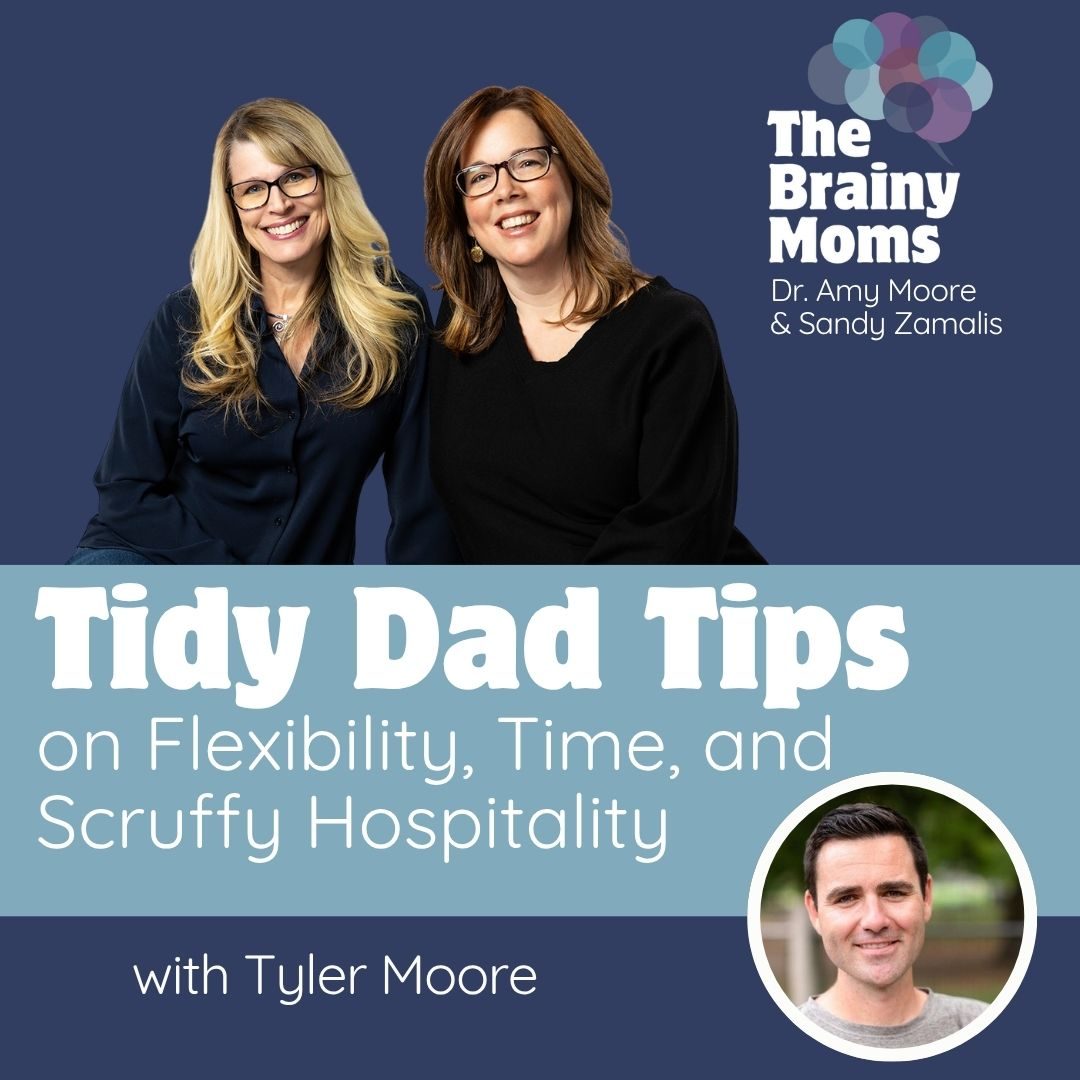
Do you love the tips from Tidy Dad on Instagram? Then you’ll love this hour with us! On this episode of The Brainy Moms Podcast, Dr. Amy and Sandy sit down with Tyler Moore, better known as Tidy Dad, to talk about small space living, decluttering, and the kind of simple home organization that actually holds up in real family life.
Tyler shares what it’s like parenting three daughters in a NYC triple bunk setup in 750 square feet, why an early bedtime boundary can be a sanity saver, and how “just enough” square footage can protect what matters more: time, flexibility, and the ability to say yes to the life you want. We also unpack the deeper idea behind “tidy” as more than clean counters. For Tyler, tidying is about clearing visual clutter and decision fatigue, building systems where everything has a home, and aiming for “easily tidied” instead of “always tidy.”
Because many of you are homeschooling or supporting learning at home, we dig into how his teacher brain shapes his approach: kid independence, supply stations that make sense, and routines that serve you rather than control you. You’ll also hear practical strategies like starting small when decluttering, toy rotation and “yes spaces” for younger kids, and his favorite concept of all, scruffy hospitality: invite people in, stop apologizing, and just make sure the bathroom is clean.
If this conversation helps you rethink your space, your stuff, or your routines, subscribe, share it with a friend who feels buried by clutter, and leave a review so more parents can find us.
About Tyler Moore
Tyler Moore, also known as Tidy Dad, is a father of three daughters, a cleaning and organizing expert, and a full-time NYC public school teacher. He’s gone from scrubbing toilets to appearing on the Today Show and designing rooms for Real Simple Magazine. His work has been featured on Good Morning America and in The New York Times, The Washington Post, Better Homes & Gardens Secrets of Getting Organized magazine, and Apartment Therapy. He also hosts the top-ranking podcast Tidy Tidbits, and publishes the weekly newsletter The Tidy Times on Substack. During the school year, he lives with his wife, Emily, and daughters in Queens, New York. In the summer, they spend as much time as possible at their cottage in the Poconos. Find him at https://thetidydad.com/ and on social media @TidyDad
Free Downloads from our Sponsor, LearningRx
Download the free ebook, Unlock the Einstein Inside: Wake Up the Smart in Your Child
Download the Brain Training Game Pack
Link to our sponsor’s website: www.LearningRx.com
Listen or Subscribe to our Podcast
 Apple Podcasts
 Google Podcasts
 Pandora
 Spotify
 iHeartRadio
 TuneIn
 Stitcher
 YouTube
Watch this episode on YouTube
Read the transcript for this episode:
NOTE: This transcript was auto-generated by an AI assistant that thinks it’s smarter than we are. It’s not, but it has more free time than we do, so we gave it a low-stakes job. It probably spelled a few things wrong, but we’re okay with that. We’d rather spend our time interviewing cool guests!
Welcome And Meet Tidy Dad
Dr. Amy Moore 0:00
Hi, Smart Moms and Dads. Welcome to another episode of the Brainy Moms Podcast brought to you today by Learning RX Brain Training Centers. I’m Dr. Amy Moore here with my co-host Sandy Zamalis. And before we introduce our guest today, we just want to remind you that we have a free monthly newsletter full of really great tips for parents on lots of different topics. So just go to theBrainymoms.com and you can sign up for free. And now let me introduce our guest, Tyler Moore. Tyler Moore is also known as Tidy Dad. He is a father of three daughters, a cleaning and organizing expert, and a full-time New York City public school teacher. He’s gone from scrubbing toilets to appearing on the Today Show and designing rooms for Real Simple Magazine. His work has been featured on Good Morning America and in The New York Times, The Washington Post, Better Homes and Gardens, Secrets of Getting Organized Magazine, and Apartment Therapy. He also hosts the top-ranking podcast, Tiny Tidbits, and publishes the weekly newsletter The Tidy Times on Substack. During the school year, he lives with his wife Emily and daughters in Queens, New York. And in the summer, they spend as much time as possible at their cottage in the Poconos. So please help me welcome Tyler Moore.
Tyler Moore 1:21
Hi. Great to meet you
March Burnout And Early Bedtime
Tyler Moore 1:23
all.
Dr. Amy Moore 1:23
Great to meet you too. How are you today?
Tyler Moore 1:26
Good. We have school off tomorrow. So there’s nothing like the night before a three-day weekend in March, because March is like the slowest, saddest, most depressing month ever.
Dr. Amy Moore 1:39
But why? Why do you say that?
Tyler Moore 1:42
It’s just cold. We’ve had fake spring here in New York, and it’s like it’s just still cold and dark. And school-wise, it’s such a long month. And we’re leading into state testing next month. So everyone is like at heightened anxiety. So between my children at home and then the children at school, it’s just like so much. It’s a lot. And it’s why even my oldest, she’s about to turn 11, but on nights when we don’t have activities, I still put them all to bed at 7:30. Because I’m like, you have, you know, they’re stacked triple high. And I’m like, they can read. It’s like age appropriate. You can read. You can crochet. You know, you can do your little like puzzle logic books. I don’t care. You just cannot walk around my house. So you know. That’s just because I’m done. Because I’m done. So tonight, even though it’s like it’s not really a school night, it’s still the same thing. Like I just need a break. I need to be off. So it’s a very controversial.
Dr. Amy Moore 2:52
And I was thinking, so like, you know, I do a lot of parent coaching and I talk about making bedtime, you know, just another activity, right? An opportunity for connection, things like that. But I also understand your perspective because I was there. Um, I have three boys, like three girls, right? And so I was done, like I’m done at the end of the day. But I was thinking as you were saying that, um living in such small quarters, I would think that that space is even more important.
Triple Bunks And Kids’ Independence
Dr. Amy Moore 3:30
Okay. Because I could I like, you know, my kids could disappear and I’d have to go look for them somewhere in our house.
Tyler Moore 3:38
You know, we j it’s it’s almost where the girls have made their little beds. Because I get asked all the time of like, but don’t they want their own bedroom? And I’m like, well, of course, they ask us all the time, and even when they were little, we would they would go to their cousin’s house and they’re like, Why does why does my cousin have their own bedroom and I don’t? Um, we have a cottage in Pennsylvania and it’s sort of the same thing where when we’re there in the summertime, you know, the three of them still like bunk together. But I do feel like they’ve made their own little beds, their like own little, I don’t know, cozy corner, safe spot, whatever. Um, you know, so I do feel like that helps a little bit.
Sandy Zamalis 4:19
Tyler, I love how you were kind of talking about your kids have kind of made their bunks, their little domains. Like, do they decorate it? Do they have their own artwork on it?
Tyler Moore 4:29
And yeah, they’ve added like little artwork. It’s like my youngest on the bottom, she has the glow in the dark stars. My middle one, she has up some baby photos. And then my oldest one, she really enjoys like at the holiday times when we get cards from different friends that she has decorated it with her, you know, like friends and photos, but she has the gift of the ceiling. So sometimes she uses that as her like fourth wall, and she will put like important school papers at the very top with sticky tack, which I actually thought was very sort of inventive. And it’s funny because we never really talked to the girls about personalizing it and making it their own, but yet they sort of see that they have that independence to sort of do something with it. They wondered about like color blocking, that if they could choose paint and like, you know, like just color their like one little section, which I would be open to. Um, because I do feel like as they’ve gotten older, there always is that question of like independence and also individuality, and there’s that balance that we play as parents of like what’s too much together time, what’s not enough together time? What are we doing to sort of separate them? Like, does my wife take one kid and I take the other two? And we sort of like trade off. How do we give our oldest one? How do we make her feel like she has more freedom and choice that’s obviously age appropriate? But then how do I differentiate that from her sisters? And so that 7:30 bedtime, while allowing some of the choices within that boundary of that boundary is I need you in your bed at 7:30, they sort of naturally and developmentally, the youngest falls asleep first, and then my older two are up a little bit later. And some nights I need to say, all right, I’m going to bed because I go to bed at nine, and I’m like, okay, you guys have been reading long enough. But I feel like as a parent to say you’ve been reading long enough. I’ve never had a teacher say to me, We’ve got to get those reading levels up. Like I am happy for them to continue reading and then go to sleep when, you know, when they’re ready, but I do feel like it’s that choice is within boundaries that sort of helps.
Sandy Zamalis 6:49
I’m sure it’s all harmony in your house, but this has struck a chord. Struck a chord for me. It has opened up a core memory. So um when I was in high school, my parents had to go to Korea to kind of get an apartment and find a place to live and and do what they needed to do. And my brother and I uh stayed with my aunt. Um, and they had a very small house in California, and she had three kids. And so we were all bunked in. Um, and of course, that was hilarious in that cousins bunking together for an extended period of time. There was there was some love and accord, and there was also some full full-on knockdown drag outs that ensued. Um, and I remember those times with real fondness, which is really kind of funny to think about it right now. My I was older. Um, and my I slept in a bunk with my um my cousin, who was uh about four years younger than me. So it was almost like being with my brother, but um the girl version, and they’re very close. So um, and oh my gosh, like she would throw pillows at me, I would kick her.
Tyler Moore 7:58
There’s the like that sometimes they’re like, Daddy, she just keeps shaking the bed. And I’m like, I know, can we please stop shaking it? And then there’s like the thump of stuff that like falls, and I’m like, you are three stories up, you know, with the bed. I’m like, you cannot just drop stuff down on the ground. But I do feel like, I don’t know, I get lots of questions about the triple
Space Expectations And Judgment
Tyler Moore 8:20
bunk. And I get lots of questions about, well, what are you gonna do when the girls are older? What are you gonna do when you have three teenagers? What are you gonna do when they don’t want to share a bedroom anymore? What are you gonna do? You just have that one bathroom. And I feel like so often underlying those questions that I get from people is this sort of like emotional baggage that they may have, or this wondering, but I also feel like, you know, it’s really just been in the last, what, 40 to 50 years that there has been, especially in America, this like entitlement towards space and stuff. And it’s as if kids and then both adults are owed something when it comes to square footage that when I think about my parents growing up, yeah, they shared a bedroom and they moved on and they turned out fine. You know, there was one bathroom in the house and they were fine. Um, so it is fascinating. I feel like when I share my story of our space, it always triggers something in people. And I get a lot of, you know, like kudos to you, that’s great. But then I get another healthy amount of if you can’t afford a larger space, why did you have all those children? Why are you choosing to smash them all in that tiny New York City apartment? Don’t you know that you’re inflicting like some sort of damage? They’re not gonna love you, they’re gonna hate you when they grow up. And I’m like, okay, it’s when I’m not a psychologist, but I have to step back and I’m like, this is actually isn’t about me. This is something about you that I have triggered, but I I don’t know. It’s it’s it it’s interesting.
Dr. Amy Moore 10:03
So let me ask you a question, because I can’t relate um at all to the idea of everyone sharing a bathroom. I mean, I have five bedrooms and five bathrooms, right?
Tyler Moore 10:18
Because that sound wonderful.
Dr. Amy Moore 10:20
That’s how it works. So, but I also don’t live in the city, and so I live in the suburbs. So the question I have for you is did you come up with this mindset? Did you adopt this mindset because you have chosen a city life? You’ve chosen a huge city life. And so I’m I mean, real estate’s at a premium in the middle of New York City. So you probably had to make adjustments in order to survive in a small space with five people, right? So did you adopt this mindset because of those circumstances? Right. And circumstances that you’ve chosen, right? You could live in the suburbs if you wanted to go live in the suburbs, right? You love city life. Um or did you already have this mindset? Did you already have the mindset of, hey, you know, I I only need 750 square feet and we could have 12 children and we’ll figure it out because I’m tidy.
Choosing “Just Enough” Square Footage
Tyler Moore 11:24
Mm-hmm. So I think it’s it’s funny. It’s a little bit of both. That’s such a good question. And I think that one, you know, when my wife and I moved to New York City, we moved from Kentucky, that’s where we grew up, which was the land of suburbia. The idea was that you moved from one home to the next larger home to the next larger home. And that’s generally how you showed in a largely middle class sort of community that you were moving up whatever perceived social ladder that it was. And my family did that until when I was in eighth grade, my parents decided to divorce. And we went from one home that was large to two smaller homes. And I sort of saw what it was that my parents had to do to sort of take on more responsibility at work, what they had to do to earn more money in order to give our my sisters and I this much larger home space. And so when you go through something like your parents’ divorce, I feel like that concept of home, it really shifts. And so for me, it became much less about the physical dwelling and more about community and friendship and sort of like what was surrounding me, because that’s what I really had to rely on. Um, and so when my wife and I moved to New York City, we moved here for two years originally because I was getting my master’s at Columbia. And so I thought, let’s just have this grand adventure. But then there were the questions of, oh, well, you’re gonna have to move back when? Or when this big life thing happens, you know, you’re gonna come back to Kentucky. And a little bit at first, it was, let me prove all of these people wrong. Let me prove to them that life in New York City is possible. Because in America, life in New York City might as well be a completely different country. I mean, it just feels like one of the most foreign things that many people could think about. But when it came to space, I realized that by sacrificing a little bit in terms of square footage, it opened up all of these other possibilities. And there’s something about me that doesn’t ever want my hand forced. Like I don’t want decisions made for me because of some other decision that I may have made. There are people who talk about being house poor, where they have sort of overextended themselves in terms of what they’re spending on their mortgage every month, which means it’s difficult to vacation. They have to work overtime. They’re not seeing their kids as much. They may be commuting hours and hours every day. And so for me, I really have adopted this mindset of what is just enough for this season of life. And for this season, 750 square feet is enough. But also in 2019, we bought a small cottage in Pennsylvania that’s 1100 square feet. And since I’m a teacher, as soon as the school year is up, we retreat to that, you know, small cottage. But yet the realtor, we drove, we pulled into the driveway and he was like, You’re not gonna want this house. It’s only 1,100 square feet. What are you doing looking at this one that is so tiny? And I was like, but you don’t understand. Our apartment is 750 square feet, so this is so much greater. But to me, I look at what we sacrifice on square footage, we more than make up for in other things in life that we really enjoy, be it time or travel or just being able to live in New York City and not feel like we’re completely constrained because of rent and mortgage and those types of things.
Dr. Amy Moore 15:10
So um I saw one of your Instagram posts um, you know, where you said something like you get a lot of, you know, haters for your messaging, but you’re gonna keep putting out your messaging, right? Because well, first of all, I get a lot of haters, right? We are, I mean, people have opinions. What is your mission in having your Instagram account and having your podcast? What is your mission?
Tyler Moore 15:40
Mm-hmm.
The Real Mission Behind Tidy Dad
Tyler Moore 15:41
It’s a great question. And I feel like what it comes down to is, you know, I feel like from a mission standpoint, I want people to feel emboldened to make decisions that they feel like are in the best interest of themselves and their families and aren’t dependent upon all of the opinions and all of the messages that we get all the time about bigger is better and more is more. And I feel like with, you know, with Tidy Dad, so I had someone, I posted a video last week that went viral and it was a tour of our apartment on a random Thursday afternoon. And this woman, she was like, I don’t understand your name, Tidy Dad. Um, that apartment looks messy to me. She continued to attack me in all of these different posts. And so finally, I just blocked the woman, which felt really good. But I what I was trying to articulate that people, you know, it’s when people sort of jump in that they’re like, the name tidy dad, it’s not just the aesthetics of a home. I wrote a whole book about how tidying it is this idea of tidying up your mind and tidying up your space. But tidying transcends the aesthetics of our home, our habits, our jobs, the ways in which we choose time, decisions that we make about families. I really do believe that you can tidy up any sort of category that is important to you. And so that’s the larger mission behind this is make the choice that you want to make, but have that really strong articulation of why, so that when you find yourself needing to justify why you aren’t driving a brand new car, you can say, you know what? Because I drove a 2000 Chevy Malibu for a really long time, being able to say, you know what? That 2000 Chevy Malibu gets me from place to place, and it is just enough right now. We don’t need anything more. And I’m saving on my car payment, which means that I got to go do X, Y, or Z, which is really important to me. So that is the larger mission behind this.
Systems That Simplify Teaching And Home
Dr. Amy Moore 17:49
So you’re a teacher, and um, a lot of our listeners are homeschooling families. How does your mission and your mindset translate to the classroom? How does it translate to the learning environment and those interactions and conversations that you have with young children that our listeners could take away from?
Tyler Moore 18:12
Well, I think the big thing is this idea of a team mindset that it’s how we run our home, but it’s how I have to run my classroom. That at any given point in time, from year to year, I have been responsible for over 30 kids and multiple different adults in my classroom, be it a co-teacher or a para or volunteers. And I have to orchestrate very carefully all of these movements within that classroom while also meeting the end-of-year goals that are set for me and are tied to my performance evaluation at the end of the year. So I have to motivate, inspire, teach, I have to be funny, I have to have all of the materials ready, I have to be able to adapt in a moment’s time if something happens. And so for me, the goal is to simplify as many things as I can so that when those hiccups happen, I’m able to respond and adapt. So in the classroom, when students know where to go when their pencil breaks without needing to ask me where the pencils are, that saves so much time and energy. When I’m able to say, boys and girls, pull out your books and they’re able to pull them out and know where they are, that saves me time. It’s the same at home when the girls are like, I really want to draw or paint. I can say, Great, go ahead and get your supplies. They know where the little tablecloth is that we put over our table to hopefully protect it from all of the paint. But I feel like whether you’re homeschooling or in my case, being a public school teacher, it’s like you’re navigating so many different decisions all at one time and you have so many things in your head. And that’s when that systems approach really helps, plus just simplifying and cutting out that noise. Because if you have all of that clutter around you, you’re going to feel completely frazzled on the inside, and then that’s inherently going to impact what you’re doing with your child or with your students.
Easily Tidied Beats Perfectly Tidy
Sandy Zamalis 20:16
I find that fascinating because um I think what trips people up um, you know, from listening to what you’re saying and kind of how you approach your job and your home life. Tidy doesn’t necessarily mean, and correct me if I’m wrong, from your definition, that everything is perfectly clean and a hundred percent pristine. It means that things have a home and a place, and if it doesn’t serve a purpose or a function, then it can find another home and a place, either that the garbage or somewhere else. Um so tidy, I in your perspective, for what I’m getting is that it’s really about understanding your space and how you need to for function and like systematizing what you need to do so that everybody knows where things are.
Tyler Moore 21:06
Yes, the goal isn’t always tidied, but it’s easily tidied. It’s that idea of just like before we got on the podcast today, my wife, she’s been out of town for the past three days visiting her grandma. We’ve had after-school events, we’ve had dinners to make, we’ve had laundry that needs to be done, which I’m doing as soon as we finish here. And as we were walking home from school, I said to girls, let’s just work together and let’s do a 20-minute reset so that we can then have an easier like bathtime, dinner time, bedtime. And I was like, and I know that you girls want to have a movie night tonight, so like let’s let’s make space for that to happen. We walked in now. Are my children always 100% compliant? No. But I do feel like that foundation of we live life in our space, we put things back generally after we’re finished. But if we need to have A reset that involves everybody working together, then we do that. And I think that that’s where when I go back to that reel and the person who was sort of saying, But you’re tidy, Dad, isn’t your space always supposed to be tidy? I’m like, I just I think people are just tired of that messaging. And I go back to, you know, I love watching Martha Stewart, but many of us who grew up, you know, it we’re sort of having that like 90s resiliency. But like that idea in the 90s with Martha Stewart and Martha Stewart living of everything being perfectly perfect, the joke that I make is like that perfectly perfect led Mark led Martha Stewart then into prison. And I’m like, I don’t want to, I there were many reasons why. And I’ve watched the documentary, but I do feel like for her, you know, sort of watching that and seeing this emphasis that for so long we placed on perfection, where did that actually get us? Like, isn’t a much better definition of tidy be that idea of, I know where my things are when I need them. I generally put things back after I’ve used them. But that idea of easily tidied versus always tidied, that feels so much more approachable to people and so much less overwhelming because perfectly perfect just never is ever going to happen, ever, in whatever space you live in, unless you completely live alone and have very few possessions. But that also seems kind of sad.
Good Enough And Starting Small
Dr. Amy Moore 23:33
Yeah, it does. I had a mentor who said, Don’t let perfect get in the way of great. And as I have grown wiser over the years, I’ve changed that to don’t let great get in the way of good enough. Um because not everything has to be great. It doesn’t.
Tyler Moore 23:54
No, and I feel like that is a huge lesson that even when you know, the I feel like the biggest existential sort of crisis they had a few years ago was when I was finishing up the manuscript of my book. And that was a huge undertaking project where you’re trying to pull from all of these different theories and perspectives and you’re constantly scrutinizing. And I remember that it wasn’t until the very last sort of round that I was like, oh, I actually like this book. It was this pursuit of perfect that was totally getting in the way of me being able to channel my own sort of like writerly voice and perspective while also digging deep into what is the average person sort of struggling with. And it was when I was able to name for myself how hard writing was while also balancing teaching and my children and life, that I was able to sort of narrow down onto what are these actual tips that actually make sense for the real person? You know, this idea of like even when you talk about decluttering, that it’s like, don’t declutter other people’s stuff, declutter your stuff first. That’s like such a groundbreaking thing. Like when people are like, where do I start? I’m like, start with your socks and underwear. It’s a very narrow category. You wear it hopefully every day, but you automatically know what you like, what you don’t like. Set a timer, go through the drawer, and you just might feel a little bit better. And then gradually you start to take on more complex sort of, you know, tasks. But I do feel like I am trying to live that out. That there are times when I say, you know what, this is good enough for right now, and I’m just gonna walk away because what’s more beneficial right now is for me to read my book, to watch my trash TV show, to go for a run. You know, there are there are there’s more to life than just perfectly putting everything away and then projecting that onto my children who are like, I lived with my dad and my mom, but everything had to be neat and orderly and put in its place, and now I have my own set of issues because of everything they projected onto me.
Sponsor Message From LearningRx
Sandy Zamalis 26:12
And now a word from our sponsor, Learning RX. In second grade, Isla was struggling to read despite being pulled out of class to work with a reading specialist. Progress was slow, and Isla was frustrated. She hated to read, and it was a battle to get her to pick up a book to practice reading every evening. Her Learning RX cognitive skills assessment provided insights as to why, despite consistent reading interventions, Isla struggled to read and spell. Her assessment revealed significant weaknesses in memory, auditory processing, and attention skills. See, to unlock reading ability, it is critical to address underlying deficits in cognitive skills. Isla’s Learning RX training targeted these weaknesses and her reading has taken off. At the beginning of second grade, she was reading at a kindergarten level. After brain training, she is now reading at a third grade level. Isla now loves to read and is devouring books. Your child may not achieve the same results as Isla, but the team at Learning RX would love to talk to you to see if cognitive skills training might be the next best step in your child’s reading journey. Visit Learningrx.com slash the brainy moms to learn more and receive a cognitive skills assessment with a consultation for just $99. That’s LearningRx.com slash the Brainy Moms.
Routines Serve You Not Control You
Sandy Zamalis 27:32
You say in your book that routines are there to serve you, not control you. And that’s what I’m getting from what you’re saying is that you really do have to think through what works for you and what doesn’t. And then also hopefully as a parent, model that for your kids too.
Tyler Moore 27:48
Yes. And I the other tizzy I sort of set people into a couple weeks ago on Instagram was I shared my like morning routine because mornings like fuel me. I’m one of those people I set my alarm to go off at five o’clock every single morning. Now I will tell you this. I had the girls yesterday. Um, I had to pick up one daughter for school at 3.05 p.m. I accidentally set an alarm last night for 3.05 a.m. So it went off this morning. I woke up at 3.05 a.m., walked into the kitchen. I went to the bathroom. I was like, oh my gosh, why am I so tired? I brewed the coffee. I then made my electrolyte drink because I always work out in the morning. I drank my electrolyte drink. I laid down on the mat because I always do a yoga practice while my coffee is brewing. I laid there on my back, about to do my first like sort of yoga sequence, and then I looked at my watch and that watch said 3 10 a.m. And I was like, what is happening right now? And then it all connected. So I went back to bed until 5. But, you know, with the routines there to serve you, not control you, I find that personally with my own routines, I have pretty well mapped out from 5 until 7:45 a.m. every morning. I do things very predictably. I have my coffee, I stretch, I do my workouts, I make, I love making breakfast for my daughters every day. So I like have our little cookbooks and I’m always trying to figure out something sort of fun and new. I drink the same general smoothie every morning and I drink it at 7 o’clock a.m. I get dressed around 7:30. When I told people that was my routine, they were like, that’s overwhelming. I couldn’t do all that. Why are you doing all of these things? You just need to sleep in. And it again goes back to exactly what you’re saying that the routine is there to serve you, not control you. It’s sort of a plug and play in the morning. If you don’t thrive on exercise in the morning, then don’t do it. If you want to sleep and you feel like it serves you to sleep till as late as possible, then do it. But me personally, I’m a teacher. I’m with like screaming children all day long. If I don’t get quiet time in the morning, it feels overwhelming and defeating to me to think that the next possible time it’s going to be quiet is once all three of my children are actually asleep in their beds. That is what feels overwhelming to me. So whether it’s early in the morning, whether it’s late in the afternoon, whether it’s some sort of lunchtime ritual routine or practice, if you can name for yourself what the problem is and then connect that to the routine and how it might solve that problem, I feel like that’s where there’s real power and change. And that is so individual for each person. So don’t do exactly as I do, but you can adopt some of the frameworks in order to help.
Lint Roller Cleaning Hack
Dr. Amy Moore 30:54
Could you hear her? Anyway, I’m wearing a black shirt and I have a white cat. Anyway.
Tyler Moore 31:01
Well, I’m sure you have that lint roller and that’s a cleaning tip, which is that you can use that same lint roller to clean your lampshades. Everyone loves that trick. It’s so difficult to get the dust off of lampshades. So you use your lint roller, and you also know that you never take the dirty lint roller strip off. You always roll it, leave it on, and wait for it later, or else your clean lint roller will just attract stuff. So there you go.
Dr. Amy Moore 31:31
Uh okay, that’s those are great tips. Because that was two tips, not just one.
Tyler Moore 31:35
There were two tips, yes.
Dr. Amy Moore 31:37
I always, I always peel the used one off right when I use it.
Tyler Moore 31:43
Yeah, it’s because you want to get rid of the dirt. You want to get rid of it.
Dr. Amy Moore 31:46
But it does, you’re right. It attracts it.
Tyler Moore 31:47
But it attracts it. Yes. So you roll yourself, leave it on, and then you peel it off for the next time. Yes.
Dr. Amy Moore 31:55
Okay.
Tyler Moore 31:57
Changing day.
Dr. Amy Moore 31:59
Yeah. Um, I forgot what I was gonna ask. That is so sad. Um because my cat distracted me and I have an ADHD brain. Okay. So oh, I know, I know.
Marriage Differences And Shared “Why”
Dr. Amy Moore 32:14
Do you and your wife share the same mindset? Or is there are there points of contention um with this idea of having everything in its place and only decluttering your own things first? I mean, are are is there some um disagreement about any of any of these practices? So And how do you resolve it?
Tyler Moore 32:38
Yes, it’s such a good juicy topic. Now what I d will say is some of the day-to-day practices, yes. Am I tidier than my wife? Yes. Are my drawers organized in a different way than hers? Yes. Does she leave laundry on the floor? That like pending. I feel like we’re in constant disagreement about, you know, when you’ve worn the outfit once and it’s not quite clean and it’s not quite dirty, and where does it go?
Dr. Amy Moore 33:07
It goes on the stool in the closet.
Tyler Moore 33:10
So our closets are very on the towel rack in the bathroom. Yes. So I feel like within those, you know, we do have individual sort of disagreements and even preferences. So for example, I love things closed behind doors. Visual clutter is very overwhelming and stimulating to me. Whereas for her, things being left out triggers in her that something needs to be done. So there are times when I will see something like out on the table and I will sort of scoop it up and put it away. And she’s like, Why did you do that? I was working through that, I was dealing with it. And so we have had to learn how to communicate to one another, especially in a really small space where pretty much everything is shared. Like it’s a lot of shared real estate. But underlying that, I do feel like is we’re aligned on the greater why behind decisions that we’ve made around square footage, why it’s important to teach our girls about caring for their things, that team mindset. Like, again, I’m about to go do the laundry. I walk it across the street to the laundromat. I do the laundry, but I don’t fold everyone’s laundry. The girls are responsible for folding and putting their things away, which I feel like is an age-appropriate sort of task. Um, so I do feel like with any couple, I think that she should get rid of more pairs of pants that she has. You know, I have a very small capsule wardrobe. If you can make space for all those Converse sneakers, make space for it. You know what you really love and enjoy. But when it starts to come over onto my real estate, that is when we have to talk about it. And so I think that can be a pain point for some people. But I do feel like underlying this, you’ve got to have a deeper why. Because if you are a neat freak and the other person is a total slob, that’s gonna create a lot of conflict. And it’s gonna build resentments and it’s gonna build this, well, you don’t care about me, because if you did care about me, you would take care of all of your stuff. And so I do feel like you’ve got to tackle it as a couple, as we have done, and sort of come up with our own sort of definition. Again, it’s sort of like that what is good enough. Like what is good enough in each of these individual categories.
Sandy Zamalis 35:35
And where can you compromise, right? And where can you compromise?
Tyler Moore 35:38
Yes.
Men Who Tidy And Tyler’s Origin
Sandy Zamalis 35:39
Sure. Tyler, I think it’s so fascinating that um you’re kind of the you’re kind of the man’s voice on the internet on this topic. Um, and I know that Dr. Amy’s husband, Jeff, would be right there with you because he’s very much a neat and organized human. And I think that men in general don’t necessarily come out as like people who are really concerned about tidiness, but like I can name all the men in my life who care more about it than I do. So talk about that a little bit, about how you kind of landed in this space being the voice of men who really do care.
Tyler Moore 36:20
Oh, it’s fascinating. And it’s yesterday afternoon in all of that frenziness, the New York Times reached out to me and they were like, for a comment on this decluttering article. And the the the person writing was like, you know what, I’ve had a different idea. I think that we should write a story about men who are in this decluttering organizing space. And she was asking me all of these questions, and then she was like, Who else would you consider to be in this space that are men? And I was like, I was like, I’m gonna have to get back to that with you because I don’t really know because I know that there are men out there who are teaching people, both men and women, like how to care for their homes, you know, sort of how to tidy up that maintenance of all of those things that happen in a space. I was like, there’s the laundry guy who has written several books teaching people about how do you care for your laundry, how do you get all of the stains out. And so how I sort of found myself in this space was I selfishly was trying to persuade our friends to stop moving out of New York City to the suburbs. And I thought, if I can help them tidy their things, then maybe they’ll stop moving and they’ll see that life in a small space is possible. So I went over and I organized people’s closets. I was doing all these consultations in our neighborhood, but I was really good at giving advice and tips and inspiration, but I was not good at landing the like paid job to help them organize. And I was like, I like teaching. Am I really going to start organizing for people on the weekends? So that’s when I shifted and I was like, what if I post videos and what if I write about it? Because I’d always wanted to be a writer from the time that I was a little kid. And so, you know, there’s a little bit of selfishness there, but also at the heart of what I do as tidy dad, it is the teaching. Like it is trying to empower people to make decisions for themselves. It’s helping them rethink. You know, when I show you my socks and underwear drawer and how I have my like little organizers, that might inspire you to think about that one drawer that’s just really pesky and sort of annoying to you and feel like you can tackle that. When I share my morning routine, does that help you think about what might be possible in a particular chunk of time that may better serve you for the season of life that you’re in? So I do feel like I could have the name teacher dad, but that’s probably taken. I feel like tidy dad, it was a very catchy, I’m not in marketing, but years ago I started using the hashtag Tidy Dad, and then I was on a bus with one of my dad friends, and we were going skiing, and he was like, Why don’t you change your Instagram handle to tidy dad? Like that’s really a smart name. And I was like, Okay, let’s do it. So on the bus, I changed the name and the rest is history.
Dr. Amy Moore 39:13
Yeah, it’s a sticky name, right? That’s what they call it in marketing is sticky titles, sticky.
Tyler Moore 39:19
Yeah, and so and when you hear it, you sort of get what you expect, apart from that little troll who wanted to take my name away from me because she didn’t think that my apartheid was perfectly perfect. And little does she know that that has inspired like three separate posts, you know, that it’s like I can I can figure out kind ways to respond. And, you know, it isn’t just haters, but like, as you mentioned, whenever you post something online, the goal is to get people talking and reflecting and thinking about their own sort of lives. And I don’t think that everyone should move to New York City. I don’t think that everyone has to live in a small apartment. Um, if you want five bedrooms and you want five bathrooms, then do that. You know, I personally don’t want to clean them all. The one bathroom is enough for me, but that’s just me. So, you know, sort of you do you, but I think the bigger thing is that idea of being forced into something that you don’t really want. That’s what I’m trying to help people with.
Dr. Amy Moore 40:28
Yeah. I love it that you give the advice to declutter your own things first. Um, my husband could use that advice. I frequently am looking around for something that I haven’t seen in a while, and he has already donated it or thrown it away. Um, because if it doesn’t serve him, then it doesn’t take up space in his house, is sort of his mentality. Um, and he was like that with the kids, you know, growing up too. So we had some tears occasionally, right? Anyway, uh, so I, you know, I did shake my head to that. Absolutely. Um, you have some great tips. I love your tips for organizing your nightstand, and I should do that. Um, and I’ve always joked that the secret to a happy marriage is separate closets. Um, but the reality is not everybody can have separate closets. So then, you know, how do you how do you compromise? How do you have those conversations, right? And so I think um you’re having those conversations and they’re so desperately needed.
Tyler Moore 41:31
When we switched bedrooms with our daughters, so we gave them the larger bedroom and we took the smaller one, and we had this really tiny closet in the bedroom that we moved into that was only 14 inches wide. And my previous, I had a wardrobe that was like three feet wide. And you better believe that I got all of my clothing down to 14 inches simply because I was like, Emily, my wife, I love you, but I am not sharing a closet with you. So if it means that my closet is 14 inches wide, then that is what I’m gonna do. And that was a huge, though, decision that helped make these other sort of possibilities sort of happen. And I think that’s the fun thing about tidying and organizing is that you sort of you clear the space, you sort the stuff, you decide what to keep, what to move out. And then when you organize it, there’s this moment of like joy where things just like click and you’re like, oh my gosh, this drawer, like everything sort of lays there and there’s not this other stuff on top of it. But then that feeling is what encourages you to move on to other spaces. And then when you’re walking through those stores or when you go to someone else’s home and you see all of the stuff, you know, you can remind yourself that I have just enough like measuring spoons. I have just, I don’t need that avocado peeler because you know what, a knife and a spoon really work. You know, so you have to decide what is important to you. And if you are this like master chef, then you should make space to have a really well-stocked kitchen that serves you, which may be different from someone who loves having this tool shed, you know, like if you want to have lots of tools, great, but you can’t upsize all categories, you do have to declutter and set boundaries and limits, or else you’ll never be able to find anything.
Kid-Friendly Organizing Yes Spaces
Sandy Zamalis 43:29
Because you work with kids, uh what tips would you have for our listeners about organizing things in with kids in mind so that they know how to put things away? What kinds of containers or methods should parents kind of think about so that you can get the whole family involved in this kind of easy to tidy kind of mindset?
Tyler Moore 43:54
So I think one is this idea of what do you actually want them to have independence to? So we learned. Very quickly, when we had toddlers, that we did not want them to have access to all of their toys all the time because you leave a toddler in a room, and what do they do? They immediately start to pull everything off all of the shelves, which is developmentally appropriate. Like they are exploring their area. And so one thing that we tried to do in our apartment at first was this idea of how do we create yes spaces? And my wife is an occupational therapist, so that was part of her training. And the idea is how can you make a space where whatever the kids sort of pull out to play with, it is a yes. And then those other things that are maybes or no’s, how do you put those in another space in your home so that you can bring them out when you are ready for them to be out or when they ask for them? So for us, a toy rotation was huge. The idea is we turned our kitchen pantry into a very, very well-stocked toy, arts and crafts sort of like zone, but that door had a lock on it, which meant that the girls could not have access to it all the time. But if they’re like, can we play with play-doh? It’s like, sure, let me get down the play-doh for you. So I think that was pivotal. You know, I think another thing is kids want generally want to be little helpers. They like, you know, sort of following you around and mimicking and doing the things that you do. And I feel like as parents, you also have to hold on, as I have a little, a little child walking into me. Um, you know, you have to model for your kids. So for us, them seeing us tiding and putting our things away was helpful. We have a decluttering calendar. So within a year, we’ve sort of we have these things, these categories of items that we come back to every single year in the same month because new things come in, we’ve got to make space, so then the old things have to go out. And I think the more that kids see this as a natural part of life, it just becomes a bit more intuitive to them. Because for us, we don’t have a storage unit, I don’t have an attic, I don’t have a basement, I cannot stuff things away. And I have not really met a grown adult who is so thankful for their parents holding on to every single thing from their childhood. Like generally, I haven’t met anyone who is like, thank you for every single artifact. It generally only comes with judgment as to why in the world did you hold on to that forever. So I do feel like at some point, someone is gonna have to go through every single possession that is in your home at some point. And it’s very overwhelming to think about that, but it’s always in the back of my mind is I don’t want someone walking into my space and judging me. So let me just sort of be on top of my things as we go. And we try to do that with our girls too, that what’s important to them, we keep, what they’re ready to move out, we move out. And it’s a normal part of life.
Scruffy Hospitality And Bathroom Rule
Dr. Amy Moore 47:12
So speaking of somebody walking into your space and judging you, you had you had an interesting term. Um, was it scruffy hospitality?
Tyler Moore 47:24
Hospitality, uh-huh.
Dr. Amy Moore 47:25
Yeah. So where you do kind of lower the expectations on perfection, talk a little bit about that because I really resonated with that.
Tyler Moore 47:36
So again, it’s sort of as the counter to perfectly perfect. It’s that idea of when we invite people into our space, we want them to feel welcomed at home. We want the the goal is to have a sense of community, a sense of belonging with people, friendship. And I feel like homes are so deeply personal that oftentimes it’s this whole part of our identity that we want to shut off from other people for fear of what are they gonna think about me? How are they gonna judge me? Um, and I think that I have learned, even from just opening up my home to Instagram, that I don’t have to worry about everything being perfectly curated behind me because no one lives life that way. And the more that we just invite people into our space and into what we’re navigating and going through, I think that it inherently calms other people down. And so Scruffy Hospitality, you know, it’s saying, yeah, just come on over. Not make feeling like you have to make excuses. Everybody does it. When a friend walks in the front door, they’re like, oh, I was just going through the mail, or, oh, it’s been so busy, let me put away these shoes, or, oh, you know, X, Y, and Z has happened, so I don’t actually have food to serve you, even though everybody has a full pantry of the pantries and the food. People have food. It’s like if we can just stop putting on this facade that we have it all together all the time, because no one does. Like, serve the crackers, invite someone in, give them the half bottle of wine. But I do say always clean your bathroom before someone comes over. That’s like my like one little asterisk. Like, if you’re gonna do something, just check your toilet, check your sink. Like, you don’t have to do much, but like give those two. That’s what you should actually. No one cares about the shoes by the door. But they just might judge you for your toilet. Even though I did have another person this week tell me that I need to stop showing my toilet on Instagram because don’t I understand that that’s private? To which I then had to tell her, don’t you understand that I teach people how to clean? And I found this really incredible toilet bowl cleaner that when you pour it in, it foams up bright pink. And I was trying to show everyone how exciting this is. So that’s my one thing.
Dr. Amy Moore 50:06
And you weren’t on the toilet. I mean, that’s like I saw that real. Right.
Tyler Moore 50:11
Nothing nothing was in the toilet. Nothing nothing. Like, and that was the last step. I had already wiped down the whole thing, including the back, which no one does, including at the bottom where the little screws are. No one does that either. So I had done my due diligence and I had cleaned it. So back off, but also get that toilet bowl cleaner because it’s really good.
Sandy Zamalis 50:40
I’m just thinking like my my whole TikTok feed is going to be cleaning products today after this conversation. I know because everything is the shower brush and everything.
Tyler Moore 50:49
Everything’s fetchy. I know. I know. Mine is because I’m about to turn 40, and I was explaining to my wife all these different feelings. We were talking about skin creams. And then my for you page was how when you turn 44, that’s one of the greatest like leaps that your face makes in terms of aging. And I was like, this is preying on all of my insecurities while also giving me tips for like 15 different creams that I should be using, plus the new little like tools that they’re making for.
Dr. Amy Moore 51:19
Oh, I saw you put the patches on in one of your somebody was like, What’s on your face?
Tyler Moore 51:24
I wear those patches religiously. Religiously. I put them in the refrigerator because then when I put them on in the morning, it just zaps me right back up. That I will gladly stand by. But it again, it pushes those boundaries that I’m like, women are wearing them. We know that there are men who should be wearing them too. So why not just go ahead and put them on and give myself a little zhuzh in the morning so that I’m primed and ready to go? You know, I just am a wealth of very useful, very useful tips.
Sandy Zamalis 52:04
One of my favorite creators on the internet right now is another um gentleman who um he’s in the cleaning space, but he’s like more bohemian than you. Like he’s like out in his yard and his bare feet with a scythe, like you know, or like if he teeth if he cleans the oven, like he literally pulls the oven into the driveway and like takes it apart. And then like, oh, it’s mind-blowing. I watch it just for the sheer problem solving piece of it. Like, clearly, sir, you’re an engineer and like you just need to like scale this down. That’s amazing. He did a whole, he did a whole video on how to how to uh shovel your driveway. It was the most bizarre shoveling because it was very geometric the way he did it. It’s like it wasn’t just a straight up. Um so I’m with you, Tyler. Awesome. I love tips and you know, the quirkier the better because those are the the fun ones that you just like. Yeah.
Where To Find Tyler And Closing
Dr. Amy Moore 53:03
Okay, so obviously you have almost 400,000 followers on Instagram, but where can our listeners find you if they are not one of your followers?
Tyler Moore 53:13
So on Instagram, I’m Tidy Dad. I also have a Tidy Tidbits podcast. So the podcast are micro episodes, so between five to eight minutes. So they’re nice and bingeable, but they’re a very narrow, sort of like tip-focused topic. And then I’m also on Substack. My Substack is called the Tidy Times. Essentially, you just Google Tidy, you’ll see Marie Kondo, but then you’ll see me pop up. So that’s the that’s the easiest way to find me. I’m like the token dad out there. Tidy, Tyler is my first name, and it all just sort of runs together.
Dr. Amy Moore 53:51
I love that. All right, tidy dad, Tyler Moore. Thank you so much for being with us today and sharing some great tips for our listeners. I I know you’re busy, um, and so we appreciate you taking time out of your day to be with us.
Tyler Moore 54:04
Thanks. It was fun.
Dr. Amy Moore 54:08
Okay, thanks for tuning in to today’s episode. Wondering what’s next? Well, don’t forget to sign up for our free monthly newsletter at thebrainy moms.com. Be sure to follow us on social media at the Brainy Moms and subscribe to our YouTube channel at the Brainy Moms Podcast. And last, check out our sponsor at LearningRX.com.