
Dopamine Magnets: How to Replace Screens, Social Media, and Junk Food with High Value Habits | Dr. Michaeleen Doucleff
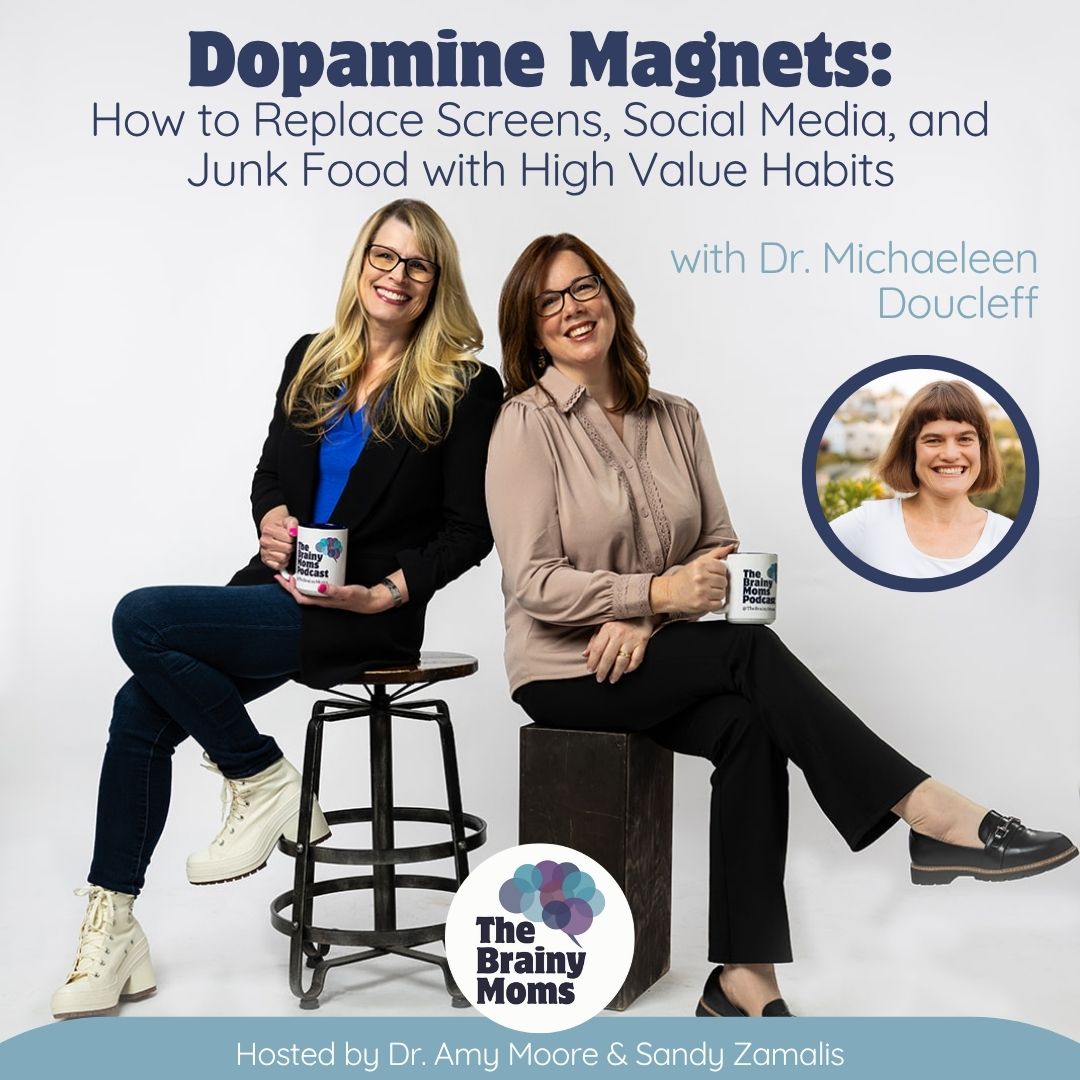
About this Episode
Dopamine gets blamed for everything from doomscrolling to snack attacks, but the real problem is that most of us were taught the wrong story. On this episode of The Brainy Moms Podcast, Dr. Amy and Sandy chat with biochemist and best-selling author of Dopamine Kids, Dr. Michaeleen Doucleff to unpack what dopamine actually does in the brain: it drives wanting, motivation, and the powerful “do it again” loop, even when the thing we’re chasing doesn’t deliver real joy. That single shift explains why kids can feel pulled toward screens, social media, and ultra-processed foods and still end up more dysregulated and less satisfied.
From there, we get practical. We talk about “dopamine magnets” in a child’s environment and why the best parenting strategy is not just taking something away, but replacing it with high-value activities that build competence and connection. You’ll hear concrete ideas for swapping screen habits with hobbies, how to “ride the wave” of your child’s motivation, and why tiny, permanent changes beat big resets every time. We also dig into the importance of context like car rides, mornings, and bedtime and how to hype offline activities so your kids actually want to do them.
We don’t stop at screens. We connect the same brain circuitry to ultra-processed foods, why snack products are engineered to increase wanting without providing satisfaction, and how changing what’s stocked at home can change cravings and behavior fast. If you’re trying to reduce screen time, improve sleep, support emotional regulation, and build healthier food habits without living in constant conflict, this conversation gives you a clear, science-based path forward. Subscribe, share this with a parent friend, and leave a review with the habit swap you’re trying next.
About Dr. Michaeleen Doucleff
Dr. Michaeleen Doucleff is a biochemist and best-selling author of Hunt, Gather, Parent and Dopamine Kids. She has spent the last decade covering cross-cultural parenting, psychology, and neuroscience, primarily for MPR Science Desk. She earned her PhD in chemistry from the University of California, Berkeley, holds a master’s degree from UC Davis, and a bachelor’s degree in biology from Caltech–a background that allows her to bring a rigorous scientific lens to parenting and mental health. Drawing from both her professional reporting and her own journey as a mom, Dr. Doucleff now helps parents rethink discipline, cooperation, and family life with tools that are both deeply researched and remarkably practical. She joined us to talk about dopamine which is the subject of her book, Dopamine Kids: A science-based plan to rewire your child’s brain and take back your family in the age of screens and ultra-processed foods. Find her at https://michaeleendoucleff.com/
Free Downloads from our Sponsor, LearningRx
Download the free ebook, Unlock the Einstein Inside: Wake Up the Smart in Your Child
Download the Brain Training Game Pack
Link to our sponsor’s website: www.LearningRx.com
Listen or Subscribe to our Podcast
 Apple Podcasts
 Google Podcasts
 Pandora
 Spotify
 iHeartRadio
 TuneIn
 Stitcher
 YouTube
Watch this episode on YouTube
Read the transcript for this episode:
NOTE: This transcript was auto-generated by an AI assistant that thinks it’s smarter than we are. It’s not, but it has more free time than we do, so we gave it a low-stakes job. It probably spelled a few things wrong, but we’re okay with that. We’d rather spend our time interviewing cool guests!
Welcome, Newsletter, Meet Dr. Doucleff
Dr. Amy Moore 0:00
Hi, smart moms and dads. Welcome back for another episode of the Brainy Moms Podcast brought to you today by Learning Rx Brain Training Centers. I’m Dr. Amy here with Sandy. And before we introduce our guests, you got it. It’s the reminder about our newsletter. You can sign up at the Brainymoms.com for our free monthly newsletter that shares extra tips for everything that we’re covering each month on the podcast. So don’t miss out. Our guest today is biochemist and best-selling author, Dr. Michaeleen Doucleff, who has spent the last decade covering cross-cultural parenting, psychology, and neuroscience, primarily for MPR Science Desk. She’s the author of the New York Times bestselling book, Hunt Gather, Parent, which explores how ancient cultures raise helpful, confident children and how modern families can bring those practices into everyday life. She earned her PhD in chemistry from the University of California, Berkeley, holds a master’s degree from UC Davis, and a bachelor’s degree in biology from Caltech, a background that allows her to bring a rigorous scientific lens to parenting and mental health. Drawing from both her professional reporting and her own journey as a mom, Dr. Ducleff now helps parents rethink discipline, cooperation, and family life with tools that are both deeply researched and remarkably practical. She’s here today to talk with us about dopamine. The subject of her book, Dopamine Kids, a science-based plan to rewire your child’s brain and take back your family in the age of screens and ultra-processed foods. And we’re so excited you’re here. You have so much energy. That makes it really fun to have a conversation with someone with big energy like yours. I said that to Sandy last night. I’m like, she has big energy. Yeah, I don’t know. I don’t know why.Dr. Michaeleen Doucleff 1:53
I’m not sure why, but well, thank you.Dr. Amy Moore 1:57
Well, it’s it’s really challenging to have a conversation with guests who are low energy and who, you know, maybe give us one sentence every question and you have to dig. And you use we I always say at the end of those conversations, I’m out of neurotransmitters. Like I’ve used them all up. I gotta go take a nap and replenish them.unknown 2:22
Yeah.Dr. Michaeleen Doucleff 2:22
I know that feeling. Maybe it’s because when I, you know, I went to Caltech when I was an undergrad and I used to say to myself, okay, Mike Lane, this conversation’s on you. You know, like with some with some people that don’t, you know, they like to socialize, but they don’t really know how to talk. I’m like, you just gotta keep it going.Dr. Amy Moore 2:39
Yeah. Well, and I want to like I’m a dramatic introvert. So most people don’t realize that I’m an introvert because I I have that, you know, ADHD brain where it takes 26 minutes to tell a two-minute story. And so people just automatically think I’m extroverted. But after a day of talking or being at a conference, I’m like in the bed by 5:30, just at Sandy. She’s like, You want to go to dinner? Nope.Dr. Michaeleen Doucleff 3:10
That’s my husband. Although he’s publicly an introvert too. So maybe that’s it. I’ve been living with him for 25 years. And but there are times if you get him talking, then there’s no room for me. Right? Oh well, thank you so much for having me. It I’m I’m it’s gonna be fun.
Dopamine: The Do-It-Again Signal
Dr. Amy Moore 3:30
What I love about your book um is that you are telling a message that is actually creating a new understanding about dopamine, right? That we that we’ve thought one thing for so long.Dr. Michaeleen Doucleff 3:47
Yeah.Dr. Amy Moore 3:47
Um, and then we’ve thought about it wrong. And so talk to us a little bit about what dopamine actually is, what’s happening in the brain, and how it relates to human behavior.Dr. Michaeleen Doucleff 3:57
Yeah. So I what I wrote this book when I started to really understand what dopamine is. And I started to realize, whoa, it is not what we think it is. And once I understood it, I felt so much more powerful, like as a person, but also as a parent. So I was told for a long time in college, graduate school, you know, dopamine equals pleasure that we do things in life. They give us dopamine hits and we feel pleasure, we feel happiness. And the more dopamine we have, the more pleasure we have. And that’s why we all do what we do, right? That’s why we seek out pleasure with screens, with food, um, with alcohol. And then I started reading the neuroscience of it, and I was like, whoa, in the last like 20 years, 30 years, that’s not what it is at all. Instead, dopamine is a part of the circuit in our brain that gives us desire and wanting and motivation to get that. Uh, I kind of think of it now as like the do-it-again button, like go do that, and then when you see it again, do it again, and then do it again and keep doing it as long as it’s there. And understanding the difference, this difference between wanting and pleasure is really key because in our modern life, we have things, foods, and activities that trigger dopamine, trigger huge amounts of desire, but actually don’t give us very much pleasure or reward afterwards. Um, and actually can make us feel worse, oftentimes make us feel worse. So you can think about dopamine as like wanting things that seem important. Not necessarily wanting things that give you pleasure, but wanting things that seem important. So, for instance, I think social media is a really good um example with this. You know, a lot of kids are on social media, the science studies tell us, because they want to feel a sense of belonging, right? They want to feel connected. But science is also showing us that in the end, as they stay on the apps longer and longer and longer, they actually can feel lonelier, right? And so the dopamine is pulling them there. Do it again, go on again, go on again, go on again. But it’s not giving them what they’re looking for. It’s not giving them the pleasure. It and over time it’s taking, taking it away. But the good news here, and this is what gets me really excited, is that the dopamine system is really flexible, especially in children. And as a parent, once we understand how it works, we can swap out social media, the screen, and ultra-processed foods, and we can put in what what we want, what we value, and we and what makes the kid actually feel really good. And we can actually shape their environment so they naturally reach for and want the offline activity, the the whole foods, the things that really fill them up and and make them them feel nourished.Dr. Amy Moore 6:39
Yeah. So I think one of the fascinating things when I was um reading about how we need to, I think you call it high-value activities or high value hobbies that we can replace these things that we are wanting, yes, creating new patterns so that we want these other things that might not be as damaging, that might not be as dangerous. Um, and it reminded me, so I have two kids with Tourette syndrome, um, and we used something called habit reversal training. Yes. When they when they had ticks that were painful, right? Like they would have a head jerk and they would it would pull a muscle in their neck or something that either was embarrassing for them or painful for them. Yes, right. We just swapped it out, right? It was like the competing response. Like you feel the urge to do this, do this instead. And so it reminded me of that. And my guess is it’s the same mechanism of action, right, in the brain.Dr. Michaeleen Doucleff 7:43
Yes. I mean, this is how our brain works with habits and things that we do kind of unconsciously every day is right, is there some trigger, right, or cue? Something it can be something you see, something you smell, but also a thought, a feeling. And that trigger activates a dopamine surge and activates a wanting. Okay, when I when I when I feel a little bit bored, I want to check social media, right? There you go. There’s the trigger. Um, and then you go do it. And if it somehow rewards you, you do it again, right? And you kind of reinforce that pathway and it strengthens. Um, and you’re exactly right. One of the best, easiest ways to change a habit is to when when you identify the cue, identify the trigger, and then replace it. The replace the response, replace the action with it, right? And in the case of like screens and ultra-processed foods, that surge of dopamine triggers a lot of willingness to work, motivation to work. That’s why children get so intense with screens and food, because the dopamine makes them feel like they have to have it now and they’re gonna do anything possible to get it, right? And so I switching out another activity that’s kind of related, that kind of fulfills their same, the same desires really works because you’re taking all of that beautiful motivation, all that beautiful willingness to work, and you’re putting it somewhere where the child will actually feel rewarded and pleasure and satisfaction and gratification. So, for instance, with my little girl, loves cookies, loves very food-driven, loves all croissants, you name it, like just always has, always will. Um, and one day in the grocery store, she said, Oh mama, I want a box of cookies, please. She starts begging. The sight of the cookies triggers dopamine, triggers desire, wanting, but also willingness to work. And so instead of saying, No, this was a really aha moment for me, I was like, I’m gonna like ride her wave of motivation, her willingness to work. And I said, Okay, Rosie, you can have the cookies, but you’re gonna go home and bake the cookies. And you and you’re gonna get to do it all by yourself because that’s what she wanted to do, right? There’s the the reward. And so I’m not just saying no, and I’m not leaving her empty-handed. I’m actually cultivating a new hobby, a new activity that can replace or just substitute going to the store, buying a box of cookies, and eating cookies. And in the end, this was, I think she was like seven or eight. In the end, this this has been uh wonderful for her. She’s learned to bake. She’s got, you know, she’s the baker of the house. If we need something baked, she does it. But she’s also like learned to bake lasagna and things at dinner. And she’s it’s been so much more rewarding and so much more pleasurable than just eating the cookies.
Dopamine Magnets And Environment Design
Dr. Amy Moore 10:33
You said something funny in the book where she goes into a store and she says magnet on or something like that, because you call all of these dopamine magnets, right? These things that you desire.Dr. Michaeleen Doucleff 10:45
Yeah, I think because we desire them, but they also pull us to them. You know, some of the original experiments in the 1940s on this system of our brain are called place, uh, place preference experiments. And they still use this today that if if dopamine is being triggered in like a rat’s brain in a maze, a one part of the maze, the rat will go there and sit there. So he starts to prefer the place where the dopamine is triggered and starts to want to go there. And so these products, the screens, the video games, the iPad, the ultraprocessed food, they pull us to them. They make us go there. Um, and so if they’re in your child’s environment, especially if they use it regularly, the child will want it really badly, and you’re gonna struggle to limit it and regulate it. And that’s what Dopeing Kids is really about, is like learning to create an environment where the high value options, the Whole Foods, the offline activity are the default, and the child naturally goes there. And you don’t have to keep fighting this incredibly powerful system in their brain.
Start Tiny And Make It Permanent
Sandy Zamalis 11:51
One of the things that one of the things that you uh share with parents is to start small, like really, really small.Dr. Michaeleen Doucleff 11:57
Yeah.Sandy Zamalis 11:58
Um let’s tell our listeners what you mean by that.Dr. Michaeleen Doucleff 12:02
Yeah. And so this is um, this comes from about 20 years of research from a behavioral psychologist named BJ Fogg at Stanford, who actually pioneered a lot of the tricks on Facebook and social media to get people to use it for hours and hours each day. But what he has found is that the way people actually change their habits and their patterns is to start tiny, tiny, tiny. So um, I I interviewed a really smart, um powerful scientist at Google DeepMind, and he told me his version of this. He said, Yeah, when I want to go and start working out, you know, it’s not like I go to the gym and I spend five minutes working out. He says, I literally drive to the gym, walk into the gym, and walk out. So, and so that’s like how small he’s saying you’re starting. And he, and and and a couple of, but the key here is that it’s permanent. So whatever change you’re making, you’re never gonna go back, especially with kids. I think this is the key. So, like, for instance, if you made that change, right, about okay, I’m gonna drive to the gym every Friday or every Thursday, I’m gonna drive to the gym after work, walk in, come out, then basically you do that every Thursday and you don’t go back. I think food is a great place to give you an example with this. So one of the habit experts, behavioral psychologists, he said I he was overweight and he was like really trying to lose weight. And so what he did was he picked one food that he was gonna get rid of forever. I can’t remember what it was. I think it was like milk duds or something. It was something really not good for you. But his point was like, it’s never coming back. No matter how much weight he loses, no matter what, it’s he’s never gonna eat milk duds again. And what this does is one, it makes you feel successful, right? Because you can do it. You pick something so small that you’re gonna knock out of the park, right? And when we feel successful and we feel positive about what we’re doing, we wanna keep doing it, right? Um and but but number two, you’re mi you’re you’re retraining your brain that this is what you do, right? This is the new habit. And then so you’re working, you’re working with this dopamine system instead of against it, right? If you say, like, okay, we’re gonna do it for a month. What uh people like a lot of families tell me is we’re gonna get rid of screens for a month. We’re having a screen-free month. And then I asked them, like, how was it? And they’re like, Well, I just we couldn’t wait to go back to the screens. Number one, right? There was like this anxiety of it going back. And number two, I felt kind of like a failure because now we use the screens just as much or more, right? And so it’s be because this is not how our brains work. It’s not these big chunks, it’s these tiny things that are permanent. And so I say, you know, if you can’t start with no screens in the car, no screens on the commute, on the train, because this is a really great context to start with, because it’s a very clear context to a child’s brain. So when they get in the car, it’s a very clear cue of like, I’m in the car, um, I do X, right? And you can very quickly change it to I get in the car, I read a book, I color, I talk to my mom, like if you want, you know, what whatever it is, flip, switch it out. So take away the screen, put in something that they might be interested in, puzzle books, um, Legos, even my daughter for a while was like braiding bracelets in the car, crocheting. Um, and then what you’re doing is you’re teaching them that every time I get in the car, I do this other hobby, right? And you’re also teaching them every time I’m bored, I do this other hobby, right? Because that’s what the car has been training them. Every time I’m bored, I go on the iPad or I go, I go, I use my phone. So I say start there. Maybe even one day a week, try it. You know, you could with younger kids, you can get rid of it completely. They’ve younger kids are are so flexible. Like you know, it’s the older the teenagers are harder, but um but there’s there’s tricks there too. Uh yes, so starts the key to changing is small but but permanent. And yeah.
Why You Must Replace Screens
Dr. Amy Moore 16:06
What I’m hearing you say is this huge missing piece that I think parents have good intentions of saying, okay, I’ve read The Anxious Generation, or I’m hearing from experts who are saying social media is bad, so I’m gonna take social media away. Yeah. All right, go to your room and figure it out, find something to do. Right. The missing piece is we have to be intentional about replacing what we’re taking away with something of high value that is going to create these new patterns.Dr. Michaeleen Doucleff 16:33
Yes, this is a big mistake. And I this is this idea of like just take it away, go outside, be bored. I was just looking at there’s always a story that comes up. Let them be bored. Summer’s coming up, let them be bored. This is based on very old psychology, no psychology on children. But it also is based on a time when kids already had a lot of activities in their lives, right? So one of the things I I really started to appreciate is like you can’t want to do something or want to eat something if you haven’t experienced the joy of it. Right. So if a child hasn’t experienced the joy of playing outside and there’s no friends out there, you know, then saying like go outside and figure it out is is is not gonna, it’s it’s just gonna make them feel bad, right? Feel visible, miserable, aggravated. Um, and so that yes, this is a very big mistake of like, take it away, don’t replace it. Kids, look, it’s setting up like cravings in them, right? If they are if they’re playing Roblox every day at four o’clock in the afternoon and you just say, sorry, go outside and play, the child has in their mind these dopamine surges that are telling them, go play Roblox, go play Roblox. Like, what are you doing? It’s time to play Roblox, you know? And like it’s it’s uncomfortable. It’s like a smoker on a plane, right? It’s like, it’s like, you know. Um, but if you say, okay, we’re before you play Roblox today, we’re gonna go outside and I’m gonna help you, or I’m I’m gonna help you learn to ride around by yourself, or I’m gonna help you set up an activity outside. Um, and now you’re helping them kind of get rid of some of that motivation and and start to build up a pathway of wanting in their brain for something other than Roblox, right? And you could piggy, even better, piggyback on to Roblox. Before you go on Roblox today, build me outside what you’re building in Roblox or on a piece of paper, draw it for me, right? So you’re taking all that motivation and creating a new hobby, a new high-value activity for them. Then over a couple of weeks, you can slowly start to take away the Roblox, right? And now they have something else that brings them joy, brings them satisfaction. Um, that it’s gonna make the no robots after school stick and become a habit, right? Because they’re not just like, oh, what do I do now? I feel so bored. You know, I feel bored, I think is code word for I don’t have other interest in my environment besides the screen. You know, and so in the 80s and 90s, when parents were just like, I grew up in the 80s and 90s, and you know, my mom would just be like, go outside, go play, and I’d have my sister, but we also had like all these things that we had been doing since we were toddlers, you know, riding bikes, building houses, gardening, digging in the dirt. And you know, my my husband was, they were building tree houses and skateboard ramps, and and so it wasn’t like you were the parents were just saying, go out and be bored. The kids had already cultivated all these high-value hobbies and experiences. And I think it’s our job as a parent to kind of help seed those, and then we can really start to take away the screens without um such a struggle and a constant struggle, right?Dr. Amy Moore 19:52
You talked about how that uh desire and motivation pathway is separate from the actual joy and reward and pleasure, right? And so it seems to me that if we replace screens or whatever is that we need to replace or want to replace with an activity that also includes time with you, that gives connection and relatedness and that it would activate some oxytocin release. And I mean, that even just even just the connection piece, right? Not just sending them out alone, but the importance of having that relatedness as well.Dr. Michaeleen Doucleff 20:37
Yes, you’re exactly right. So the dopamine system, the the circuits in our brain that are like this really powerful form of motivation is fueled by dopamine. And then once you get what you’re wanting, what you’re working for, like a different part of the brain lights up. And I love the name. It’s called hedonic hotspots. And um, and and other things light up too, but this is kind of the core. And yes, you’re exactly right. This part of the brain runs on different neurotransmitters, you know, endorphins, serotonin. And these are the, you know, this is the part of the brain that tells you you can stop. You have what you need, you can take a break. This gives you satisfaction and gratification. You know, we say we live in a world of instant gratification, but we actually live in a world of no gratification because we never get these feelings of like I’m done, right? Because the foods and the screens are triggering this constant one more, one more, one more. And they’re not giving us that ah, satisfaction. And you’re exactly right, they’re not actually giving us connection, right? The data are becoming really clear that it’s really not social media, it’s like parasocial media, right? You can’t fulfill a child’s need for connection through a screen. Like you just can’t. And so when you replace or you substitute for a while a video game or social media for some in person. Or connection with you or doing something with you, like I say in dopamine kids, you’re giving the child more pleasure, like way more pleasure, because they’re getting the pleasure of being outside. They’re getting the pleasure of actually connecting with somebody. They’re getting the pleasure of learning and exploring, right? And so that it’s a myth that when we take away the screens, we take away pleasure. It’s the opposite. When we when we limit the screens and replace them, we actually reclaim pleasure and satisfaction for our kids. Um and one of the things I say in the book that is really, really powerful is that, you know, even if the kids are doing something on their own, you know, like, because a lot of parents will be like, well, this is just more work for me because now I have to do it with them, you know? And I’m like, I was like, I’m like, it’s called parenting. I’m like, well, you you could if you just do it with them for a little bit, then you act the kids actually learn to be more independent and like, you know, then you but one of the things, one of the things I tell them is have them present to you what they’ve done afterwards, you know, like if they’re drawing or constructing something, or when Rosie rides her bike, I tell me what happened. Who’d you see? What did you do? You know, and um I think you’re it’s doing what you say, right? It’s building that connection, that oxytocin, that like, but it’s also giving them this spark of like, I want to do it again. Because wow, mom really, mom really valued this. And this was really cool that mom was interested in it. Um, so I like always have that. Tell me about it, present it to me. Sometimes we’ll hang things up on the wall, or I’ll say, Oh, can you make a version of that to give to my friend Judy? Because she would really want that, you know. Elevate the offline activity, elevate the the the activity that took real work, right? Um, one of the moms in the book says, anytime a kid puts forth that effort offline and puts forth that effort instead of just staring, staring at a screen, you know, I want to value that work. I want to appreciate that. And then the kid wants wants to do it again. You’re you’re pressing the do-it-again button in their brain.
Teens Need Buy-In And Brain Science
Dr. Amy Moore 24:03
So I love that because you think about um what motivates that video game play is I’m reaching the next level. I’m reaching the next level and how proud they feel. And I’ve mastered this level, right? And so when you can take that offline and create these invitations and experiences where they can also build competence and mastery, that actually drives intrinsic motivation. I mean, we know that from self-determination theory, right? It drives that. And so it just seems like do we have to have a conversation with our kids about it ahead of time? I like I t I tell a story in my book of how um bedtime, we had a bedtime battle um getting our teenage boys off of video games at bedtime. Right. And um, we couldn’t get them off. And so my husband’s um solution was to just turn the internet off. Yes, at the router. So he would just flip the switch and like clockwork, within 12 seconds, I had one of my teenagers in our doorway screaming and crying. Screaming and crying. Right. And so we used a problem-solving model and figured it all out. But I think what helped was explaining some of the brain science to him about like what happens in the brain when we sleep. How does that benefit? Like, we wash the toxins out of our brain during sleep, right? Like to actually talk to him about, hey, this is our goal for you. Yeah. And so let’s let’s solve this together. You participate in this process of getting from point A to point B. And I think it would be the same thing here, right? Like you we have to share why we’re making this switch, right?Dr. Michaeleen Doucleff 25:49
You know, I th I think it depends on the age of the kid a lot. You know, and I mean, a teenager, like I talk I talk about this towards the end of Dopamine Kids in the practical section. Um, you know, absolutely a kid that is is a tween, a teen that’s you know, used to the having a game or a screen at a certain time, you gotta get their buy-in, right? Like you, you know, and and you’re so right in that like explaining to them how it’s working, you know, how it all works, right? Like, like one of the neuroscientists in my book, Jonathan Morrow, has two teenage boys too. And he before he let his the one I think was 12 or 13, 13 at the time, get social media on his phone, he gave him like a PowerPoint presentation on how the dopamine system works, how the phone and social media like manipulates it and exploits it. And like he was like, I want you to see this. Because and and then he said to him, like, look, let’s decide how much time you want to spend on this each day. You know, what’s important? It’s it’s basically dopamine kids for a teenager, right? It’s like, what what what is important in your life? What do you want to do? What how do you want your day to look, your life to look? You know, what do you want it to involve? Your soccer, your schoolwork, and then how much of it do you want to devote to video game playing or social media? And let’s set those limits together. Like, what do you and he and he said that I kids can be pretty like, especially you do it before they start to use it? You know, it’s like, um, and then he said it’s the parents’ job then to kind of trick keep track of that and help the kid reach that goal for themselves, right? But he but absolutely like all the psychologists I talked to and neuroscientists I talk to with teenagers are like explaining how it works, explaining how they’re taking your time, they’re taking their m your money, they’re manipulating you is a really powerful thing for teenagers, right? Because they don’t want to be manipulated. But also it makes it a fair, much fairer, a little bit fairer fight in the sense that they they start they can see what’s going on here. That this isn’t just a device like a regular toy. This is a relationship you’re building. This is a device that is intentionally designed to make the teenager overuse it, right? And I and so yes, I agree with teenagers. I think explaining this in betweens. With my little girl Rosie, so she’s 10 now, I talk about it with her. You know, like she went over to a friend’s house one night, and the mom said, Okay. Is it okay if they watch one movie? And I was like, Yeah, you know, that’s like a whole nother discussion at other people’s houses. Um, and I was like, sure. And then the next day I asked Rosie, or we were driving somewhere, and I was like, Did you watch that one movie? She’s yeah, we watched movies all night. You know, they were like in a like a back room and they just watched movies all night. And it and I was like, interesting for the the mom that told me they were watching one movie, noted. Um number two, like it gave me an opportunity to talk about some of this with her. Like, oh, you felt, you know, you f the app kind of made you feel like you needed to watch another one and another one and another one. And like, how did that make you feel? You know, it’s almost like they’re designing it to make you keep watching it, even if you were tired and want to go to sleep. And so we like had this whole discussion. And that was the beginning of, and at the time I think she was nine. That was the beginning of us talking about this. And so she’s well aware that YouTube and these things that every now and then she’s she sees, you know, aren’t just there like look like a TV show. These things are there trying to get her to stay there. They’re these magnets. And so I think explaining that to a tween is is good or but but at some age they’re just not gonna, you know. I think I think it’s at some age it’s better to just make the changes and maybe explain later.Dr. Amy Moore 29:38
Well, sure. And I think we can be enthusiastic with younger children about what we’re gonna do now. Right. Like I have this really fun activity planned for us. I cannot wait to share this time with you. Let’s get that, you know, what making cookies, whatever it is.Dr. Michaeleen Doucleff 29:52
No, this is a huge because I think this is another mistake that’s out there is this idea that when like it’s time to turn off the TV or stop the video game, saying to them, you know, I know this is gonna be hard. I know that this is this is your favorite activity, and this is gonna be so hard, it’s gonna make you mad. I the neuroscience and behavioral psychology tells us that is the last thing we should say. That’s priming them. That is priming them. And that is cranking up their motivation for the screen activity and decreasing their motivation for the offline activity. You’re exactly right. We should be just be saying, like, oh my gosh, I’ve got this awesome activity that we’re gonna do next. You think you can do it? I don’t know if you’re ready. You know, right. You know, you’re right. Like pump up, like market, hype up these offline activities because they don’t have any marketing team. Like Facebook has, you know, or Instagram has or TikTok has, right? Your own marketer. Yeah. And it’s the same for Whole Foods.Sandy Zamalis 30:52
Yeah. Would it be wise to start with something like maybe not as high value to you as a parent? Like maybe like trying to try it on a lower level so that you’re not disappointed when they don’t love it. Well, or just I’m thinking like um, for example, you talked about like the car. Like we just made a rule about the car, right? Like so starting those little small little habits versus oh no, we have this, because I I know me as a parent, I’m a rack reactionary parent, would be like, this is not working. We’re shutting it down. You mean like if it doesn’t work, then it’s well, yeah, or or like if there’s a problem, like the video games like Amy was talking about, and the husband just shuts the internet down. Like yeah, there’s there’s a space and a time if we have the bandwidth to think ahead a little bit, maybe and start small somewhere.Dr. Michaeleen Doucleff 31:42
Yes.Sandy Zamalis 31:43
Like no screens in the car.Dr. Michaeleen Doucleff 31:46
Yes, for sure. And I mean the the nighttime one is hard. I that’s why it actually in my four-week program, it’s the last or it’s the third one, because it was very hard for me. Like Rosie was fine, but I was like, it took me months to to not feel the urge to go on my phone at night. But I will tell you and your listeners, it is so worth it. It is like the sleep improves enormously when you um when you stop looking at your screen like an hour before bedtime. But um, yeah, I I I think so. You know, I I think it’s it’s about it’s it’s kind of a um, it’s it’s finding that sweet spot, right? Where it’s like something you really want the kid to do or closer to what you want them to do and what they really want to do. Um it, you know, it doesn’t mean kids is really about figuring out what motivates your kid. And oftentimes they’ll just tell you because it’s what they talk about, right? Like I know kids that like are on Minecraft all the day because that’s all they talk about, right? And so then I would start there, right? And I would be like, let’s figure out something that connects to Minecraft, but that I also really value. And, you know, that so and and ask them, like, you know, you love Minecraft so much. I’m just trying to think of the is there a way that we can even have Minecraft in the house, you know, or Minecraft in the yard, right? So then the pitch is very different then. I want you to start coloring, right? The pitch is bring Minecraft here, right? And I so some of it maybe is the pitch, but it is really about like what gives them this twinkle in their eye. And I I talk to parents almost every day now, and like they at first they’re like, I don’t know what motivates my kid. And by the end of our discussion, they have like five or six things that they know because the kid has like kind of told them, right? Like, oh well, he’s been trying, dying to do this, but I won’t let him do that yet. Well, there you go. There’s something that you could start with, right? Because there’s already some sort of motivation. Um but sometimes I think parents, like and myself too, you have to let go of some of the worries because a lot of these high motivation activities involve a little danger, involve a little in independence, a little bit of good growth that, you know, a lot of American parents are a little afraid of.Dr. Amy Moore 34:03
I love
Real Adventure With Tools And Fire
Dr. Amy Moore 34:04
how you talk about letting them use sharp tools and fire. Exactly. Right. And it it’s so funny because um so my my master’s degree is in early childhood education. So my PhDs in psych. But um I was absolutely shocked when I consulted with early childhood programs on their national accreditation process and how the National Association for Education of Young Children wanted real tools in these early childhood classrooms so that they could experiment with saws and hammers and nails and wheel blocks of wood. And I thought, oh my gosh, they’re gonna saw their hands off. And I was this is a longer story than I meant it to be, but I was in Reggio Emilia, Italy doing um a conference there. And we asked um one of the program directors there, and she looked at me and she went, children aren’t stupid. Yes, yes. I thought, wait a minute. And their whole message is that children are strong, powerful, and competent. And that when when we do things for them that they’re capable of doing for themselves, we rob them of that growth and that joy. Yeah. And so that that I remembered that when I read that part of your book, that I was like, Yes, children love to use sharp things. They love to use fire. And yes, what a cool way to entice them, right?Dr. Michaeleen Doucleff 35:23
Exactly. They have a like a natural drive and motivation. They get dopamine surges from it, right? Because in the past, that’s what so dopamine pulls us to things that we think keep us alive. That’s its job. It’s not messing around. These are things that keep us alive. And that’s the big trick of or sleight of hand of video games and social media is it makes the child think this thing is keeping them alive, right? It taps into these deep, deep needs. And, you know, learning to use fire kept kept people alive, you know, when we were evolving. Learning to use sharp tools kept people alive, right? Like that’s how you got meat and food and um and tubers when you’re forging. And so, yes, we have these things in our children’s lives that are like kind of hijacking this big survival drive, right? And so instead of just taking it away, give them the thing that it our brain, their brain evolved to be attracted to and and motivated to do. And the thing is, is like uh it’s keeping them from these things isn’t just robbing them, I mean, it absolutely is robbing them of pleasure and joy, but it’s also stunting them, right? It because in order to be a functioning human being and eat healthy food, you need to know how to use a knife. You need to know how to use fire, right? Like, um, and and so I think again, it’s this idea of like limiting the screens, limiting the video games isn’t depriving them, it’s filling them up. It’s giving them these opportunities to do purposeful things, right? For their family, to make purposeful items, to create things. It, you know, we all need adventure. You know, children are on video games because they want adventure and exploration. These were also survival, right? You had to explore your environment. You had to go on adventures to survive. Um, and so give the child the real thing. Help the child learn how to have the real thing, you know. And so you’re then what you’re doing is you’re you’re fulfilling their needs as human beings, not just taking away their their their hobby, right? Um, that’s what I hope dopamine kids is really about at the end of the day, is like, how do we fulfill our kids’ needs as humans? Um, because that’s what that’s what they’re trying that’s why they become so obsessed with a video game or social media um or or TV even, is because it’s making them feel like it’s it’s fulfilling their needs, right? But in the end, it it can’t. It just it just can’t, no matter what the tech industry tells us.Sandy Zamalis 37:52
But
Trauma And Stress Amplify Wanting
Sandy Zamalis 37:53
is that why you say that trauma supercharges the dopamine system?Dr. Michaeleen Doucleff 37:58
So uh yes, and because it’s it’s it’s about survival. Absolutely, right? So uh the amygdala is connected right to it. And the amygdala, you know, is all about stress, right? And and when we feel stress, it turns up the dopamine system. Because if you’re stressed, let’s say we have chickens, let’s say like sometimes late in the summer, I don’t go out there and give them fresh water and the water is dry. And when they now they’re stressed, right? And so their amygdala turns turns up their dopamine system and so that they seek out and want and their willingness to work skyrockets to get the water, right? And so when I come out there, they all run at me and they start screaming at me, and they’re like, they’re trying to tell me, get the water, get the water, get the water. And so trauma does the same thing, right? If a kid feels like their needs weren’t met when they’re a child, you know, they’re they’re stressed and their amygdala turns up the dopamine system and says, you need to work harder, you need to go after it more, right? And so kids with trauma in their childhood are gonna be more vulnerable to these tricks, more vulnerable to auto-processed foods and the screens, um, because that was what they had to do, right? To survive when their kids, or at least they felt that way. So I had trauma in my childhood, and I can feel it. I can feel like the stress then turns up my like willingness to work and my motivation, and I get really, you know, oh my gosh, I gotta go do this, I gotta go do that, you know, and that that’s um it’s exploiting that part of me, right? It makes sense, right? That if you were in a state of scarcity or deprivation, that you should be you should you should be char supercharged and work harder to get what you need, right? And and and so that’s really that’s really what’s happening um with that. The other thing is like kids aren’t gonna be all vulnerable to the same products, right? Which I think is really good to keep in mind. Like in the same family, some kids are gonna be really vulnerable to like overeating ultra-processed foods, and some kids are gonna be really vulnerable to overusing social media, right?Sandy Zamalis 40:02
And now
Sponsor Break: LearningRx Story
Sandy Zamalis 40:03
a word from our sponsor, Learning RX. In middle school, Kevin had given up on learning because of his reading struggles. His parents had tried everything and they were losing hope until they enrolled him in the cognitive training and reading programs at Learning RX. It was hard, but he gained confidence as he strengthened his memory, attention, processing speed, visualization, reasoning, and auditory processing skills. Years later, his mother wrote to us that Kevin has graduated from college and is beginning his master’s degree. He’s a military officer and is married with his own children. He’s thriving in life, in learning, and in his career. We can’t promise your child will have the same results as Kevin, but we love to talk to you about our brain training programs. If your child is struggling with reading or learning, talk to the team at Learning RX to see if we might be the right fit for your child. Visit LearningRx.com slash the Brainy Moms to learn more and receive a cognitive skills assessment with a consultation for just ninety-nine dollars. That’s LearningRx.com slash the Brainy Moms.
Ultra-Processed Foods Hijack Dopamine
Dr. Amy Moore 41:20
The same pathway, same mechanism of action. Yes. So I want I want to talk a little bit about the ultra-processed foods. I like I preach and preach and preach on sugar and artificial food colors and all the things. So d talk to us about what the problem actually is. What is happening there? Yeah. Why is it like that? I mean, I like I was fascinated by um that the ultra-processed food industry started from the tobacco industry. I had no idea. Like, of course, they’re they’re like supermarketers.Dr. Michaeleen Doucleff 41:50
Yes. And not just marketers. So I’m actually writing a piece right now with this study that just came out that’s incr that maps this all out is incredible. So it’s way more than what’s in dopamine kids. But essentially in the 1980s, the cigarette industry saw that like sales were gonna plateau or decline. Like the writing was on the wall, that the cigarette too. Yes, the cigarette boom was kind of ending, right? And so they saw this opportunity to like replicate what they did with cigarettes in the in the uh 20th century 20th century with ultra-processed foods. So throughout the tw the 20th century, uh, the cigarette industry slowly and deliberately uh boosted the addictiveness of cigarettes with all of these. There’s like a five-step protocol that I’ve just learned. Um, and at the same time, they made it very acceptable to smoke anywhere, right? So it wasn’t just this thing you did, you know, after dinner or with friends, it was something you did all day long. So in the 1980s, they bought um some of the ultraprocessed food companies, Kraft, Nabisco, General General Foods. I have to look at that one up because that one the name changes. Um and they started using the same protocol to design ultraprocessed foods, which largely are children’s snacks. So crackers, pretzels, granola bars, chips, uh design them to so that children overeat when they eat them and that children eat them when they’re not hungry. And essentially create a product that used to be perishable, used to be something you didn’t do very often, you only ate a breakfast, lunch, and dinner, uh, to a product that now kids consume all day long. And this study that just came out shows that they succeeded more more incredibly, right? I mean, can you go to the playground today without kids eating ultra processed snacks, right? It’s it’s kind of a continual flow of them and it’s very acceptable, right? Snacking and eating is now in every context of a child’s life. Right. Um, and so in Domain Kids, I talk a lot about how these foods do this, and one of the key things that they do is that they’ve jacked up the calorie density of these foods. So, for instance, like a Ritz cracker or granola bar has like 10 times the calorie density of, say, a potato or five to ten times a potato. And it also doesn’t have any of the fiber, or the starch is not embedded in the plant matrix. It’s taken out, right? And so there’s no digestion needed. So if you take a cracker and put it into a glass of water, it dissolves, right? And that’s exactly what happens in your kids’ mouth and in their stomach, it just dissolves and then rapidly goes into their blood. And so what this is doing is this is sending a huge dopamine signal, it’s a huge signal to their brain saying, this is really high calorie dense, energy dense food, and I don’t have to do any work to get the calories out. It’s fast, it’s a lot, every bite gives me a huge amount. And our brains evolved to value that, to prioritize that. Because it makes sense, right? Like, like, why would you go and eat like a bowl of carrots that are gonna give you way fewer calories and your body’s gonna have to work really hard to get those calories when you could just eat a few crackers, right? Or a whole tube of crackers, right? And so what ends up happening is that children and I would argue adults too, um, if the ultra-processed food is around and there, we’ll eat that and prefer that and want that over any whole or many minimally processed foods that’s there. And it’s they’re not, there’s nothing wrong with the child. The child’s brain’s just doing what it evolved to do. And the ultra-processed food industry is just exploiting this part of our brain that eats and seeks out the lowest amount of work per calorie, basically. If you watch, kids will do it. If there are crackers, sure, chips, corn chips, they will eat those and they will just ignore the whole um foods. And so it’s just like the screens. If the iPad is sitting there, they are not gonna pick up the book. You know, they’re not gonna color. Like it’s it’s the same. And so that’s why the book is about both of these things because they work the same in our brain, and the two industries have really used the exact same mechanisms to maximize the time and consumption our kids have with these products. That’s so fascinating. Isn’t it? It’s crazy.Dr. Amy Moore 46:35
And so I always push back because parents are like, well, my my child will eat the whole sleeve of Oreos. They won’t eat just one. And I always say, Well, who’s buying the Oreos? Who’s in charge of stocking your pantry? Right. It doesn’t make any sense to me. Stop buying the Oreos.Dr. Michaeleen Doucleff 46:51
I mean, I I a hundred percent agree with you. I think I have a line in the book that’s like, your decision to eat the Oreos or your children, child’s decision to eat those Oreos came when you bought the Oreos, right? It’s it’s it’s not a matter of if, it’s a matter of when I don’t remember reading that.Dr. Amy Moore 47:06
I mean, this is literally the the words that I speak to parents that I coach. Stop buying them.Dr. Michaeleen Doucleff 47:11
Stop buying them. But you know, while I was writing this book, I remember the moment. It was almost finished. The book was finished. And I was I was going to see my neighbor Judy, and it hit me because I was the same. I was like, stop like buying like like equipment for video games, right? Like if you don’t want your kid on the video game and you’re trying to limit it, stop kind of propping up their habit, right? In a way. And then it hit me though, uh the the parents value it. Right. Because the thing about dopamine is it’s it’s and and this didn’t make it really strongly into the book, is that it’s not just about desire, but your brain, dopamine is also about valuing this something that it’s saying this is important, right? If it’s do it again, because this is important. And I think what happens is that the parents, the value the parents place on the Oreos, on the phone, on the video games, I think has has risen too, you know? And so that’s why they keep buying it, because they have the same, because we have this thing, I’m in the same boat. I’m not better than. But like we have this thing, we have our dopamine system is has valued it too, you know? And so a little bit of Doming Kids is is kind of trying to help the parents devalue these things as well, right? And really see them for what they are and not for kind of what the food industry or the tech industry wants us to see them for, you know, like in order to limit the iPad or social media for a child, I think the parent has to realize this isn’t actually valuable, you know, and in many ways this is harmful. And then I think once you do that, it’s so much, it’s easy, you know, because you’re like, I don’t want to give something harmful to my child, right? But if I’m valuing it myself, then it’s really hard to take away from a kid. Yeah. Yeah.Dr. Amy Moore 49:01
You
Devaluing Snacks And Resetting Taste
Dr. Amy Moore 49:02
know, my my children are all adults now. And so I look back at, okay, what patterns did I create with my own habits? And, you know, how could I have done that differently? Like I I haven’t had sugar since last July. And so the first month was really hard. Really, really hard because I still had that desire. Right, absolutely. But the further out I get from last July, the less I even care about sugar, right? There’s just a lot, a lot of things.Dr. Michaeleen Doucleff 49:35
And even if it’s even like gross. I mean, I really I so I we stopped eating ultra ultra-processed foods. I mean, I Rosie still eats ultra-processed foods. Like we don’t have it in our house. That is our that’s how we do it. We don’t have it in our house, or we try. It always sneaks in. You know, yesterday she brought these like bagged potato chips that my husband had brought in. They were like, it’s somewhere deep in the pantry. She’s like, Where did these come from? You know, and like dopamine magnet. Yes, exactly. It always comes in. And they actually one day, so there’s there’s a profile of me. I won’t say where it is, but there’s a there’s like a a picture of us cooking in the kitchen, and there’s like salt on the counter. And like after it came out, I showed Rosie the picture of it, and she said, Mama, that salt is ultra-processed. And she was right, it’s ultra-processed. Anyway, we try to keep ultra-processed food out of our house. That is, that is our that’s our rule. But Rosie is totally open to having it outside our house. She decides. And this is where the conversations come in of like, how does it make you feel if you have three cookies or this is like where she’s learning to regulate. Um, so but we did, but I really try not to eat it because I’m almost 50 and my metabolism cannot handle it. I cannot handle it. Like it makes me feel horrible. So it’s been about almost two years. And I have to say, I think it is disgusting to me. Like, I’m not kidding. Like it is like, I don’t, it’s not like this thing of like, oh, I can’t eat all it’s like I don’t want to eat it. Like, I’m just like, and I’ll just make like little comments, like when her friends are eating it or we’re somewhere and she’s eating it, I’ll be like, it’s disgusting. And I’ll just walk away. And like, because it it if you stop eating it, just like what you’re saying with sugar, you start to like really realize like it doesn’t taste very good. And it it it is really tricky our brains into thinking, uh, it tastes good, it feels good, it’s like the treat in life, and it’s not. It’s it’s really not like for me, it’s like the treat in life is like not eating from lunch until dinner, you know, building up a real hunger, and then making a really good meal and sitting down with my family and like really enjoying it’s you know, like seared salmon, bak choy, wild rice, it’s like really enjoying that, that is pleasure. And then seeing Rosie eat it and enjoy it. That’s like, you know, instead of snacking all day on like crackers, you know?Dr. Amy Moore 52:07
Right. Then it’s just another thing to put in your mouth by the time you get to dinner.Dr. Michaeleen Doucleff 52:11
Yeah, and you know, they they they in this this piece I’m working on, they are designed to to make you feel unsatisfied and to keep give you these little sugar highs. Like even if they don’t have sugar in them, they give you these little sugar highs because it’s just basically sugar that’s that you know, the body just turns into sugar like this, and then you get these little crashes and you get hungry and you do it again and you do it again, and you’re never getting nourished, right? You’re never getting satisfaction. And you know, there’s a great study out there that shows that like what correlates the most with pleasure and eating is how hungry you are. It’s not what you’re eating. So if you really want pleasure in your life, you gotta feel a little bit of hunger. Like really intermittent fasting and make that Yeah, like a four or five hours. I’m not you know, it’s never anything like painful or uncomfortable, but it’s like this like, I haven’t eaten for a while and I can’t wait to eat something really good, you know.Dr. Amy Moore 53:06
Well, I
One Tweak A Week With Context
Dr. Amy Moore 53:07
think what I love about your message is, you know, everyone is sort of talking about the dangers of social media and screens and being held hostage by the algorithms. But I love how you talk about ultra-processed foods in the same way. And if we give ourselves that thought, I don’t want to be held hostage by a food product. Yes. Except like I don’t want to be held hostage by an algorithm on screen. Yeah. Then it then you have this kind of aha moment about it, don’t you? Yeah, for sure.Dr. Michaeleen Doucleff 53:41
I mean, it is it is really intentional. You know, the um the tech industry is kind of pushing, not no longer saying everything is so intentional because you know they’re having legal troubles now. But they used to say, like, that’s our goal to maximize the time your child spends on YouTube. Like engineers told me that was their job. But the food industry still admits it completely. It is intentional to like get you to eat, overeat, and to get you to eat when you’re not hungry. And the transformation that occurred in our home when we got rid of, we weren’t eating a lot of sugar. Because I I I was like, but but we were eating like crackers, you know, and the American Pediatric Association recommends crackers. It’s like when we got rid of the ultra ultra-processed carbohydrates in our house, the transformation that occurred for Rosie was extraordinary. My daughter, she within a couple weeks, she started eating foods that she never would touch before. Um, and I just I I just tell like every parent, like, try it. Just try it, like get rid of one of them. You know, get rid of one, one of the go-to snacks, replace it with fruit, replace it with nuts. Fruit and nuts are like a potent calorie sugar combination. All human beings love. And and then like, or cheese if you want. That’s another one you can try. Again, potent calorie combination. But I would say fruit and nuts. Um, you get more fiber. That’s what you really want. Um, and then see how your kids change. You know, it it they’re they might be uncomfortable for a couple days because those cravings are coming, but they will quickly, quickly get them, their bodies will get the message that the food that’s available to them are these whole foods at meals, and they will start to love them. I’m telling you, they’ll start to love them.Dr. Amy Moore 55:27
I love that. We have a recurring guest who’s a nutrition scientist, uh, Maddie Lansdowne, and he always says, just make one tweak a week. One tweak a week.Dr. Michaeleen Doucleff 55:36
I love that. One tweak a week. That’s part that is that is really, really good. I, you know, and if you look at habit science and behavioral psychology, it’s like you can also just tweak a context, right? A time and a place. So that’s how our brains work. Like I in in Israel, you know, they have they do a lot of people um have Sabbath and they have a technology Sabbath where they there’s no screens for 24 hours. And the parents tell me that it’s fantastic. The kids know exactly it’s Sabbath time, we we do puzzles, we go outside, and your brain knows exactly like the time of the week, the time of the day, I do this. And so if you just cut out the screens in the morning, you know, or then their brains will very quickly learn. In the morning, we don’t do this, right? We do X instead. So Tweak a week and in con context. It’s all about context. That’s how you get that’s how you make your life more peaceful and and and just l less struggle, right? Because you’re working with their brains instead of against their because this willpower thing, this thing of like constantly trying to teach the child to resist what’s in front of them or what’s in the pantry or what’s in the drawer, it just it doesn’t, it really doesn’t work long term.Sandy Zamalis 56:53
And it doesn’t work for adults either.Dr. Michaeleen Doucleff 56:56
It doesn’t. And the day the data show that the data show that it is not a viable strategy and it wears you out. Right? So just don’t just stop. I like one day I I think I said a couple of days ago, like just stop, just don’t do that anymore. Do what’s in Domingates. Um where can our community find more from you? So I’m
Where To Find Dr. Ducleff
Dr. Michaeleen Doucleff 57:19
not on social media because my amygdala and don’t and limbic system can’t can’t handle it. Um, but I have a website that I put up and I made. I spent a lot of time and work on it. And you can email me there and I read them all and I try to get back. And I have a little newsletter I started. I’ve but so send me messages there. I love to hear about how things go in the book or questions, or um yeah, I like to communicate with people kind of one-on-one. It feels much or like this through a podcast, it feels so much more rewarding and more pleasurable. So, and I will do it. I spend the time, that’s how I spend my time.Dr. Amy Moore 57:54
So um, so listeners, we rarely endorse books, right? We talk about them, but we rarely endorse them. But this one is a must-read. Dopamine kids, it’s a must-read. Uh so uh get on Amazon. Thank you so much. Buy now and read it tonight. It’s amazing. Oh, thank you so much. Michaeline, thank you so much for being with us today. We really appreciate you taking time out of your busy schedule to bless our listeners with this incredible science. Oh but not only the science, but the practical application of the science to parenting. We just love that about you. So thank you so much for sharing that with all of us today. Oh, I’m so happy to be here. Thank you both. All right,
Closing And Newsletter Reminder
Dr. Amy Moore 58:40
we’re gonna close the show. Listeners, thank you so much for spending this time with us. If you want more from us, you can find us on social media at the Brainy Moms. Don’t forget to sign up for our newsletter at theBrainyMoms.com. You can find Sandy on TikTok at the Brain Trainer Lady. So, look, we hope you feel a little bit smarter about spending this hour with us. We’ll catch you next time.