
Calm and Confident Mindset for Homeschooling Moms | Lori Beth Auldridge
About This Episode
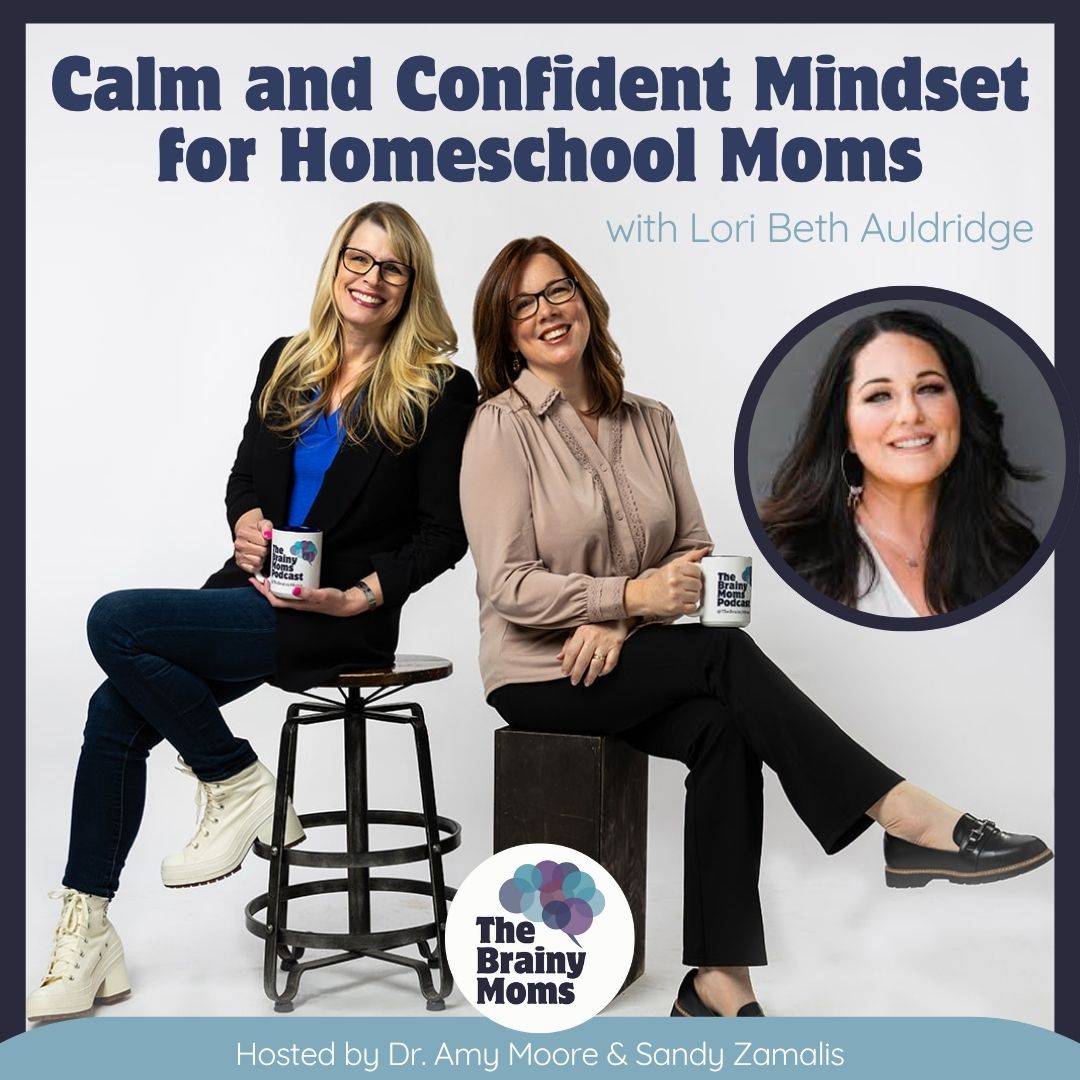
What if all your homeschooling chaos needs is a new calm and confident mindset? Being a homeschooling mom can feel like a daily referendum on your parenting, especially when you are teaching multiple kids, supporting neurodivergent needs, and trying to keep the family from melting down at the dining room table. We wanted to offer something more useful than a new planner or a better curriculum: a way to lead your home with calm and confidence that is real, practiced, and available even on messy days.
On this episode of The Brainy Moms Podcast, Dr. Amy talks with the amazing Lori Beth Auldridge, longtime homeschooler and host of Elevating Motherhood. They talk about the small choices that change the emotional climate of a home. Lori Beth shares how experiential learning and a slower, interest-led approach can take pressure off academics, but then they get very practical about regulation: meeting basic needs, building routines, and using Lori’s “after-lunch coffee no matter what” ritual as a boundary that supports the whole family. They also connect this to interoception, helping kids learn what hunger, thirst, and fatigue feel like by hearing us name it and watching us respond calmly.
Dr. Amy and Lori go deeper into mindset and the repeated “soundtracks” running in your head, why victim thinking and vent loops keep families stuck, and how replacing those scripts with truth can change your next action. The throughline is legacy: the kind of table you want your kids to remember, the kind of parent you are becoming, and the hard-earned wisdom you build one imperfect day at a time. This Holy Spirit-led conversation is one that all Christian moms need to hear!
If this conversation helps you, subscribe, share it with a homeschool friend, and leave a review so more parents can find it.
About Lori Beth Auldridge
Lori Beth Auldridge is the host of Elevating Motherhood. She’s a longtime homeschooler and homeschool coach, and a mom who helps women approach home education with more confidence, better perspective, and calm. She’s got a bachelor’s degree in communication for the child and master’s degrees in both children’s literature and creative writing for children. Lori Beth combines her academic background and more than 19 years of homeschooling experience to encourage and equip mothers on their own learning journeys. She’s passionate about helping moms grow in confidence, trust their intuition, and cultivate a love of lifelong learning within their families through intentional motherhood and creative resources. Find her @loribethauldridge and at https://www.elevatingmotherhood.com/
Free Downloads from our Sponsor, LearningRx
Download the free ebook, Unlock the Einstein Inside: Wake Up the Smart in Your Child
Download the Brain Training Game Pack
Link to our sponsor’s website: www.LearningRx.com
Listen or Subscribe to our Podcast
 Apple Podcasts
 Google Podcasts
 Pandora
 Spotify
 iHeartRadio
 TuneIn
 Stitcher
 YouTube
Watch this episode on YouTube
Read the transcript for this episode:
NOTE: This transcript was auto-generated by an AI assistant that thinks it’s smarter than we are. It’s not, but it has more free time than we do, so we gave it a low-stakes job. It probably spelled a few things wrong, but we’re okay with that. We’d rather spend our time interviewing cool guests!
Homeschooling as a Calm Posture
Dr. Amy Moore 0:01
Today, we are talking about homeschool, not as a perfect system or as a curriculum, but as a posture of calm and confidence. My guest today is Lori Beth Auldridge, and she’s the host of Elevating Motherhood. She’s a longtime homeschooler and homeschool coach, and a mom who helps women approach home education with more confidence, better perspective, and calm. She’s got a bachelor’s degree in communication for the child and master’s degrees in both children’s literature and creative writing for children. Lori Beth combines her academic background and more than 19 years of homeschooling experience to encourage and equip mothers on their own learning journeys. She’s passionate about helping moms grow in confidence, trust their intuition, and cultivate a love of lifelong learning within their families through intentional motherhood and creative resources. I am really excited to welcome Lori Beth Auldridge. Lori Beth, I’m really excited to talk to you today because you come at homeschooling from a perspective that I’m not sure we’ve covered in our show before. This whole idea of calm and confidence, because I think that that’s um sort of a zebra in the in the homeschooling world, right? Especially when we’re homeschooling neurodivergent kids, because that’s really the space where I work. And those are the parents that I spend time with. And I don’t get a sense of calm. And a lot of times I don’t get a sense of confidence either, because these are parents who want to do the very best they can for their neurodivergent child, but it’s hard. And a lot of times it’s, I tried this and it didn’t work, and I tried this and it didn’t work. And how am I supposed to balance family harmony with this chaos that’s happening at my dining room table, especially when I have multiple kids? And so I would just love for you to kind of settle hearts
Experiential Learning Beats Perfect Curriculum
Dr. Amy Moore 2:10
on that and um maybe share some of your wisdom around that.
Lori Beth Auldridge 2:16
Oh, I love that, Amy. I really do. And I even love the notion of wildness at the table. I really do. Because I’ve gotten to a place after almost 20 years. We’ll be entering our 20th year of homeschool. Um, but my oldest will be 13. So how about that for some homeschool math, right? I love your face right now. I love it. Yeah. So I came to homeschooling when I worked as a personal assistant to an international rock star. And I had that job for almost 10 years. And as part of my job, when we were traveling on the road, I would homeschool their two incredible children. And we would find ourselves studying Rome, ancient Rome, in Rome. We would find ourselves having all these experiential learning adventures together. And I was standing on the stage of the Coliseum in Rome, and it hit me like a ton of bricks. That homeschool curriculum we had sitting back in the hotel room, you know, the five-star hotel room, like was had nothing, nothing on standing there and actually experiencing it, eating the food, walking around, listening to the language, even the gelato. Mm-hmm so good. And so I went back from that particular leg of the tour and told my then boyfriend, now husband Chris, that when we get married and have kids, we’re gonna homeschool them. He’s like, sounds awesome. Let’s do it. And so that’s how I ended up with almost 20 years of this. And I’ll tell you, it was a long road to get to this point of calm confidence. And I’m really grateful for those years I had with somebody else’s children. Although I dare say the pressure’s a little bit stronger when you’re getting paid and being responsible for somebody else’s kids. It just like there’s like some motivating factors there that we don’t have, you know, when we’re homeschooling our own children. Absolutely.
Dr. Amy Moore 4:05
It’s like when you’re dog sitting, right? You have to keep somebody else’s dog alive. It’s the pressure is more stressful than assuming your own dog is gonna stay alive throughout the day, right?
Lori Beth Auldridge 4:15
Totally, totally. And then when I had my own kids, I had three girls back to back to back, you know, 19 months apart. It was a wild time. So when I think about those, the dining room table, I think about that wild time of trying to get them to sit down. And still to this day, now that they’re 12, 11, and nine, just really still trying to get them to sit down. I also a lot of people will hear, like, oh, you have all girls, like, oh, okay, well, you’re a whole different thing. I will tell you, I also had a boy when I was 41 years old. So we also have a wild four-year-old boy in the mix and all of that too. And so the picture my dining room table with three girls, you know, wanting to study Pride and Prejudice and things like that, and you know, their little brother dressed up in a costume with like arrows, you know, pointed at them. It just, it’s it’s a wild time. And yet, and yet when they were little, I had the inspiration from Waldorf teachers and, you know, the family that I worked for, their kids went to a Waldorf school, and so it was a slower pace. And I kind of took on that slower pace as much as I could. I mean, we also lived on Maui, so there’s such a thing as island time, and that was slower, and that helped. The Waldorf pace and you know, interest-led learning and things like that kind of helped me with their preschool years and whatnot. And then I started the podcast when my third, my podcast, Elevating Motherhood, when my third daughter was two or three, something like that, because I felt really strongly about equipping moms. And mostly because I did not have a calm, confident example. I did not. As and I came to believe and understand that even if you did not have a calm, confident motherhood modeled for you, it’s still available to you. And so I started to pursue that very intentionally with asking questions that I needed answers to as a mom with three little kids at that time. And I we covered everything from death of a child, you know, that didn’t apply to me, but I saw the beauty and in that story and having that information so I could help others through that and all kinds of challenging times, but then just the everyday thing of like, let’s understand child development a little bit more so I can understand concepts like vestibular input and proprioceptive input, so that I can understand why my kid is just spinning all the time or throwing throwing themselves on the couch. And instead of seeing it as wild and crazy behavior, instead I took the posture of like, my kid is always seeking to have their needs met. Always, always, always, always,
The Wild Table And Slower Rhythms
Lori Beth Auldridge 6:50
always. And I tell you this now from a calm, confident space, but it again, hard won wisdom, hard won wisdom because it took me years. I dare say, even like having moved from Maui to Idaho, I remember a lot of deep thinking happens in my laundry room. There’s like, it’s like a pause in the day, right? And you’re folding the laundry, and all of a sudden you realize you’re in this tiny little room getting stuff done, and you actually have a minute to process and think and self-reflect. And I thought, man, none of my basic needs are being met as a mom. None. And I am getting so frustrated with that. And that is my biggest frustration. I just want to go to the bathroom by myself. I just want to go to the bathroom, period. I need a drink of water. I am hungry. I am tired. I want my after-lunch coffee, and it feels like everyone is in between me and that coffee maker. And I’m just not getting my coffee, which is a want, not a need, but it’s actually a need, kind of. And and I I would say it’s a need. Thank you. Thank you. But coffee is my love language. Yes. Oh, same thes. So I had my after-lunch coffee today, but I wasn’t meeting my basic needs. And then it struck me, oh my gosh, I’m not modeling for my kids how to get your needs met at all. I’m modeling the exact opposite for them. And they are reflecting that back to me big time. I’m thirsty and I’m not stopping to get a drink of water. Why? For the sake of productivity, for the sake of me feeling like I’m doing enough as a mom, especially as a stay-at-home mom, work-from-home mom, whatever you want to call me. Like efficiency and always saying the right thing and doing the right thing took precedence over everything. And then I would beat myself up over not being as efficient as I possibly could be. And then you add into the mix being married. I’m I’m very, very happily married, but you add in little things like your husband saying, like, oh, the lot that laundry didn’t get done today, or oh, you didn’t order this today, or you didn’t do that today. And that’s it. I mean, you’re already standing so close to the edge. And a comment that’s not meant to be a commentary on your character or anything like that just pushes you over the edge, and then it’s just all downhill from there. So I had to take a step back from that and start with meeting my own basic needs. And for me, that looked like the after-lunch coffee no matter what policy in my house. And so it took, and this is almost kind of embarrassing, and it’s not a slight on my family at all or myself, but it took over a year for me to get into the habit of making sure I got an after-lunch coffee no matter what. That sounds crazy, but it’s true. We would be out running errands, and I’d be like, okay, I live in the land of coffee drive-throughs now. There’s literally like two or three on every corner. And so I was like, okay, it’s after lunch. I’m gonna get an after-lunch coffee. And if that means stopping in the middle of our errands and going through a coffee drive-thru, so be it. Well, my family’s like, well, we don’t have time for that. Oh, yes, we do. Well, it’s gonna put us a little behind schedule. Well, then so be it. You know, I just that’s how it is. Or like after lunch, if we’re at home, I’m like, okay, I’m gonna make my coffee now because the temptation as a homeschool parent or a stay-at-home parent is to just move directly into meeting the needs of your child or doing the next thing on your to-do list and not meeting a basic need of your own. So I came up with this tangible after lunch coffee, no matter what, rule for myself. And it took over a year for that to stick for my family and myself. Not just my family, but also myself. And now it’s just a thing that happens and it’s become an afternoon ritual, and it’s calm, and I confidently walk to the coffee pot and make my coffee without guilt or anything. It’s just something that happens. I can shut the door and I can lock it. I can, I can. But I did not feel like I could for a really long time. I felt like I needed to be absolutely one million percent available no matter what. Even if I didn’t have 1% to give, I was still striving for that million percent. And it was stressing me out. And my kids were matching that stress too. And so now after lunchtime is probably the calmest part of our day because that’s one of the moments where all my needs are met. If it’s after lunch, I’ve already eaten and had something to drink. I’m not hungry or thirsty, I’ve gone to the bathroom, whatever it is. These are basic, basic needs, right? And then I take my coffee, and then I now I’m trying to up that routine and I go outside if I can, if the weather’s nice, right? Just for like some fresh air and some sunshine and just doing something for myself and meeting my basic needs. And when I found that I started doing that, my kids mirrored everything I did back to me. And so I started doing things like getting myself dressed before I asked my kids to get dressed. And I know this sounds so crazy simple, but I spent well over a decade not doing that with my own children. And then I would just get myself dressed. So then they would get dressed, and it was no big deal, and it just diffused the situation. So bizarre. But when I took that posture of, I need to be a leader in my home, and a leader is not gonna sit and flog herself over, like, oh, you know, I didn’t get dressed, and yet I asked them to get dressed. I asked them to pick up their room, but my room is such a mess. Like, I started to take responsibility for myself and
Meet Your Needs To Lead Well
Lori Beth Auldridge 12:30
my needs, and also started to view my children as a mirror. And are am I regulated? Are they regulated? I feel like the question we always end up asking is, um, are our children regulated? And we’re not kind of looking at ourselves and saying, well, am I regulated first? We’re always asking the question of like, how can I fix my kid? And we’re not like, how can I fix myself? And and I think that begins with meeting our basic needs on a daily basis as a habit, as a practice, and as a consistent thing in our day.
Dr. Amy Moore 13:02
I love that perspective. And I think the fact that you sort of narrated that process to and named it even, um, is so important because a lot of times our kids haven’t learned interoception. They haven’t learned what it feels like to have a physiological need, right? That, you know, I’m I’m kind of cranky right now. And oh, that might be because I’m thirsty or hungry. Right. And so for you to say, um, okay, I’m gonna do this first because it models it, right? I’m gonna set this routine as a boundary because it models what that looks like to meet my own needs. That says something to a child, oh, you mean we have physical needs that need to be met. What does that feel like for me? And those are important, especially like with neurodivergent kids who have interoception deficits, right? They don’t they take even longer to recognize basic needs as well.
Lori Beth Auldridge 14:11
Mm-hmm. I you and I are on the same page with that. You had talked about that on my podcast, and I loved that because we just call it different things. We’ll ask the questions like, I’m like, are you are they hungry? Are they thirsty? Are they tired? And go from there. And you have very similar questions that I love, which is what was your acronym again?
Dr. Amy Moore 14:30
Tired, hungry, sick or stressed.
Lori Beth Auldridge 14:32
This yes, yeah, this still tired, hungry or sick. Yeah. I loved that because I felt like it also brought grown-ups into the um mix too, because this applies to grown-ups as well. And I can’t tell you how helpful it’s been for me to not only meet those needs, but then to sports cast them out loud to my kids. So I call it sports casting. I know other people call it other things, but I will take a drink and be like, oh wow, that really hit the spot. I didn’t even realize how thirsty I was until I had this water. And then lo and behold, two out of four of my kids will go and get a drink of water, you know? And it’s not, I’m not manipulating them, but I am modeling what it is. You know, I’m not saying like maybe you should go get a drink of water right now. I’m actually giving them that autonomy to go and do it themselves if they feel like that’s a need that they want to meet too, or they’re just trying it out. You know, it’s usually the younger kids who are like, oh, that actually is a good idea. The other thing I always think about now with my kids is that I don’t hold this expectation of I’ve told you one time and that should be enough. And I let go of that, and my mothering is totally different because if you think about it, I am a grown woman. I am 45. I think by the time this episode comes out, I’ll be 46. And I still have to tell myself things like, I think you’re thirsty right now. I think you might be hungry right now, hangry. Our whole culture has a joke about it, and yet what it really comes down to is we’re not meeting our basic needs and acting out because of it. And now it’s become a joke. We’re hangry. It’s like, well, actually, I think we need to take responsibility for that and not use being hungry as an excuse for being angry at our kids or being angry in a situation. And yeah, I let go of that expectation that I already told them once, so they should know. And instead, I just want to be more of a consultant to them, almost like from the love and logic standpoint. Like I want to be a consultant parent where they feel like they can come to me for good advice. But who wants to come to a hungry, thirsty, tired, stressed out, undercaffeinated leader of the home? You know what I mean? So I want to be a trustworthy consultant. So I stopped looking at my kids and saying, is there a book for strong-willed children? Is there a book for this? Is there a book for that? Is there a book for this? And I’m like, okay, is there a book for me where I can learn more and I can show up more as the mom that I want to be? And really when it comes down to it and thinking about legacy, I think about that table. I really do. I love that you started talking about the table. I’ll tell you a couple of stories. One, there’s um a really wonderful song called Um Crowded Table, and it is so beautiful. And it’s basically the chorus saying, I want a house with a crowded table and a place by the fire for everyone, and all of that. And there’s just so much that happens at the kitchen table. And to that point, um, we lost both of my grandparents, my grandma and grandpa Huck in the last couple of years. And just recently, in the last, actually, as recently as this weekend, there was an auction at their house for their stuff. And everyone was saying before everything went to auction, they were like, What do you want from of your grandparents? And it’s just so they left such a beautiful legacy of love for their family. She was a beautiful mother and a beautiful grandma and a great grandma. And when it came down to it, I think most of us said we want the kitchen table because so much good happened around that kitchen table. When you sat there, you belonged. And I can’t think of it in any other way than how it was, which was it was kind of wild. It was kind of wild. There were wild card games, there were wild conversations, there were wild celebrations, you know, there were grandkids and great-grandkids always, always, always. There’s babies on blankets, you know, learning how to roll over for the first time on that kitchen table. And so we belonged there. Wild or calm, wild or calm. And that is why we all wanted that table, is because it was such a beautiful gathering spot. And so I think about that on a daily basis when we come to the table. I do not get it perfect, Amy. I do not. There are some days I am grouchy at that table. I am irritated that I have woken up early and made them a beautiful breakfast and now the eggs are cold and you did not come when I asked you to. And at the end of the day, I want them to want that table
Modeling Regulation And Body Awareness
Lori Beth Auldridge 19:10
and to want to be at that table and know they belong at that table. And whether it’s wild or whether it’s quiet or calm or whatever. Sometimes I light candles on the table and it feels very calm with a little yo-yo ma, you know, Pandora radio in the background, you know, we’re going for calm. And then other times there’s zany card games going and things are flying, and both are good. The calm is me, you know, me enjoying my kids, me enjoying that. And if I venture off of that calm, confident path, I come back to it because that’s the path that I’ve chosen, you know. So if I have messed up or something has happened, or the kids are misbehaving, or we are in a season where I don’t have it figured out, or we’re in a stress, I have four kids. There’s not a season where all four of us are just aligned and connected and it’s beautiful and wonderful. But I can come back to that calm, confident path and say, this is the path I want to walk because this is the legacy I want to leave. And the legacy starts with very, very, very tangible things and they’re all doable. And it starts with that table and it starts with that after lunch coffee tradition. So that, you know, when you’re gone, your kids are gonna have that coffee after lunch when they’re an old lady and when they’re a grandma, and maybe they’ll think of you, you know? And I just, ugh, that’s the vision that I keep coming back to at the end of a very long, very rugged motherhood path.
Dr. Amy Moore 20:41
I love that because I use that, you know, falling apart chaos at the dining room table analogy all the time when I’m talking to homeschool families. Um, but I have the same emotional response to my dining room table, right? As you have, I mean, our dining room table seats 12, and it is the gather. My kids are in their 20s now, but for every birthday, every holiday, every family get together, they come home, sit around that table for hours, tell jokes, tell stories, enjoy meals. And that is a source of joy that actually gives your inner inner body calm, right? And to experience the joy that comes with seeing your children interact around a table. So yeah, so thank you for that reminder. And I hope our listeners are saying the same thing too, that that table doesn’t have to be a source of chaos all the time, that it can be a source of joy.
Lori Beth Auldridge 21:46
It really can. And you know, it the it’s not about the the behavior necessarily around the table. It is creating moments of calm for yourself too, because I think our kids are really eager to mirror things back to us. They really Are and so the more that we can have that calm and that joy and they sense that in us, hopefully that is more quickly reflected back. I mean, oftentimes with a lot of guidance and reminders, constant reminders, right? Just because I told you once doesn’t mean you’re gonna have it figured out for the rest of your life.
Sponsor Break
Sandy Zamalis 22:21
And now a word from our sponsor, Learning RX. In second grade, Isla was struggling to read despite being pulled out of class to work with a reading specialist. Progress was slow, and Isla was frustrated. She hated to read, and it was a battle to get her to pick up a book to practice reading every evening. Her Learning RX cognitive skills assessment provided insights as to why, despite consistent reading interventions, Isla struggled to read and spell. Her assessment revealed significant weaknesses in memory, auditory processing, and attention skills. See, to unlock reading ability, it is critical to address underlying deficits in cognitive skills. Isla’s Learning RX training targeted these weaknesses and her reading has taken off. At the beginning of second grade, she was reading at a kindergarten level. After brain training, she is now reading at a third grade level. Isla now loves to read and is devouring books. Your child may not achieve the same results as Isla, but the team at Learning RX would love to talk to you to see if cognitive skills training might be the next best step in your child’s reading journey. Visit Learningrx.com slash the Brainy Moms to learn more and receive a cognitive skills assessment with a consultation for just ninety-nine dollars. That’s LearningRX.com slash the Brainy Moms. Many homeschool families come to homeschool OT because handwriting is hard. Not just forming letters, but sitting long enough, organizing ideas, and staying regulated through the task. At Homeschool OT, occupational therapist and homeschool mom Sarah Collins helps parents understand the skills handwriting actually requires from fine motor control and visual motor integration to attention, working memory, and emotional regulation. Through the OT is in podcast, parent coaching, and targeted classes, families learn how to break handwriting down and implement supportive strategies directly into their homeschool day. You can find practical guidance
Replace Negative Soundtracks With Truth
Sandy Zamalis 24:20
and support at homeschoolot.com.
Dr. Amy Moore 24:23
Um so I’m sure we have some moms right now who are saying, Yeah, that’s not gonna happen around my dining room table. That’s not gonna happen. I can’t even put my thoughts around the idea of having a calm day. So what is one thing that you can offer those moms right now that says yes, you can?
Lori Beth Auldridge 24:53
Mm-hmm. I read a really cool book by John A. Cuff. Have you read anything by him?
Dr. Amy Moore 24:58
I have.
Lori Beth Auldridge 25:00
Yeah, he wrote um soundtracks, procrastination proof, all it takes is a goal. Um, really some really cool books. They’re meant to be business books. And I consider them to be parenting books because I think he’s got some really interesting thoughts. So, I mean, one, I would encourage moms to read and fill yourself with information truly. I know the internet says that there’s too much information out there and we should shut it out. I’m not saying scroll Instagram and like, you know, dopamine hit yourself into an information coma. I am saying slow resource stuff. Slow resources, slow form resources, like podcasts like this, like books where you’re actually sitting down and reading the physical act of it really helps. I am a different person because I read books. I am. Even books that aren’t necessarily parenting books, like John A. Cuff’s book, Soundtracks. And he talked about how our mindset really does limit it. And it’s not just a mindset shift. I mean, that sounds so catchy, but he called out the soundtracks that we have on repeat in our head. That’s not available to me. That’s not available to me. That is not my house. You don’t understand, you don’t understand, you don’t understand. And those soundtracks become your reality. Think overwhelmed, or I’m overwhelmed, overwhelmed, overwhelmed, and you will be overwhelmed. Think, I don’t have enough, I don’t have enough, I don’t have enough, and you won’t have enough. And there is, and I know this is really hard to hear. I know because I have walked this out. For me, the calm confidence comes from taking radical self-responsibility for myself and my thoughts. That is not blame, it’s actually really empowering. It shows how much power you have over the tone of your house. It really does. If you constantly say it’s out of control, out of control, out of control, it will be out of control. If you are talking to yourself and replacing those broken soundtracks that keep you stuck with ones that are inspiring, that you know, life is doable. One of the soundtracks I have on repeat is actually a Bible verse, Count It All Joy. And it’s James 1, too, and it goes, Count it all joy, my brothers, when you meet trials of various kinds, for you know that the testing of your faith produces steadfastness. But I summarize it to the simple soundtrack of count it all joy. And even in every single hard situation, there is joy to be found in it. Does joy mean happiness and lightheartedness and ease? Absolutely not. We are not promised ease on this planet. And the faster I accept that, the easier it is for me to get through those hard moments and to see how God is working things for my good and my family’s good, even the really mega hard stuff, even the really mega big stuff, truly. I mean, just I also feel like this is important for me to point out too, but like big stuff like moving from Maui to Idaho, living on my dream property on Maui and thinking this is how my life is gonna be forever. And God’s like, no, you need to start detaching yourself from what you thought your life was gonna look like. And I’m like, no, I’m I’m content, thank you, satisfied over here. I’ll just steward what you gave me well, right? And it was like, no, actually, then I was pregnant and like, oh, you mean like really detach myself from what I thought my life was gonna look like? And then just showing up in a and living it out and showing up and walking in obedience and saying, okay, I guess we’re moving. Okay, I guess I’m having a baby. Okay, I guess everything is just being turned on its head. And so much good has come out of that, and so much joy has come out of that, so much more wildness. Having a little boy after three girls has come out of it. And it’s good, and it has helped produce steadfastness in me. It has helped produce more calm. Um, when I had my son, I almost died. I had an air embolism that should have taken me out and taken him out, and it did not. And I can even look at that very rough, very terrible moment and count it all joy because I’ll tell you, I show up as a different person realizing that according to medical experts, I shouldn’t be here and that my son shouldn’t be here. And that’s not a passing lesson, that is a lifelong lesson for me, right? And so we hear stories like that from other people. We hear these kinds of stories and think, oh man, you know, they’re so lucky, they’re so fortunate, you know, like at least they’re here. Happy Ma, healthy mom, healthy baby, that should be enough, right? And it that turmoil and that trauma has produced a lot of joy. But it took a long time and a rewiring of my soundtracks to realize that and to walk out that verse. And so even on the hard days, I’m like, okay, Lord, count it all joy. Here we go. Help me see the joy, help me see what it is you want me to learn from this situation. And when you start looking at life through that lens of count it all joy, and I’m going to actively look for the joy in this hard moment, in this hard day, your life will change. It will. It will take you completely out of the victim mindset. It will take you completely out of martyrdom. It will take you out of convenience. I’ll tell you that. All these different ideas that our our culture worships and tells us that we should worship too. Like, uh, it’ll take you out of that and it will help you see the beauty in all of the hard moments for sure.
Dr. Amy Moore 30:24
Preach. I just, oh, I I love that. And what I I’m so glad that you kept talking because as you started down that path of um talking about um changing those soundtracks, I thought, all right, now what if my listeners are thinking, oh, you mean like manifest what you want? And I I want to be clear, that is not what you’re saying at all. I mean, it’s like Paul talks about the renewing of our minds constantly, renewing of our minds. And so when we can reframe things, when we can think about things differently, then our actions follow.
Lori Beth Auldridge 31:20
Totally.
Dr. Amy Moore 31:21
Our heart follows, right? Our mindset follows. But we have to start somewhere with that reframe.
Lori Beth Auldridge 31:28
Mm-hmm. Take every thought captive. We are to do that. You know, and this is again something we end up teaching our children and modeling for our children. Even as recently as last night at Youth Group, one of the girls was asking for help with her wild imagination that ends up giving her, like, you know, bad thoughts is how she would describe them, you know, and she’s like, it’s just not positive and it’s not what I believe, and all of this stuff. And I just was like, honey, every day for the rest of your life, this is gonna be a constant battle. So remember how I was talking about like you’re gonna have to remind your kids and repeat to your kids all the time? You’re gonna have to remind yourself and repeat to yourself all the time, too. And you can’t beat yourself up just because you had a moment where you were struggling to take every thought captive. You were struggling to change your mindset about things. You’re struggling to have a posture that is more obedient or positive or calm or confident or whatever it is you’re striving for. Yeah, we’re called to take every thought captive. And I don’t have the strength to do that on my own. And so I have to pray about it. And I have a wild imagination. I mean, we live in the woods in North Idaho and it’s fire season. My imagination could go in a million different directions. So, how do I sleep at night? You know, that’s a real thing here. It’s a real thing and a real conversation I’ve had with multiple moms. How do I sleep at night? Because I have turned that over. I have to believe that God has more in store for my life than a wildfire in the middle of the night. And even then, I trust that he would use something like that for my good and my family’s good. And that is a count at all joy mentality. And if you can get into that head space, it’s much easier to take every thought captive because you’re like, oh, I turn that, you know, quote unquote bad thought over to you, Lord, and I’m just gonna fill it with something different. And it’s not that we’re just asked to take every thought captive. We are given soundtracks straight from the Bible that we can apply to our lives. And for me, count it all joy and encourage one another daily, just as you’re already doing, are two that are on the tip of my tongue in front of mind all the time. So when those soundtracks come in are like the negative ones, and I’m struggling to take them captive, I can just plug those two in all the time, all the time, all the time, along with very tangible things. I believe that this has to be a tangible thing for us too, because we are incredible overthinkers, moms. We we just are. I mean, we could just overthink ourselves into a coma where we’re we just feel like we’re sitting around incapable of doing anything or like moving forward and or making lists and we just sit around and scroll. I am pointing one finger
Take Thoughts Captive With Tangible Tools
Lori Beth Auldridge 34:10
out and three fingers back at myself, right? We can overthink ourselves into that corner and also we can take those thoughts captive and we can replace those soundtracks, we can meet our basic needs. And then that moves into that meeting of basic needs actually moves into our legacy stuff. What it is we’re gonna be known for. You know, what kind of parent we choose to be is how we’re gonna be remembered. And that’s really motivating. And to me, that’s motivating to learn about very various parenting styles. Because to me, it’s worth investing in books and long form content, podcasts, things like that, to find out different parenting techniques to try out. So I hear moms, I hear them when they say, I’ve tried this and it didn’t work, or I tried this and it didn’t work, and I tried this and it didn’t work. I get it. It’s almost our lot in life, and we have to count that all joy because that parenting technique or that um sensory activity you put together and spent so much money on didn’t work out. But we can count it all joy because we learned things from that experience and we’re going to apply that hard-earned wisdom to the next thing that we try.
Dr. Amy Moore 35:19
Yeah, it’s just data, right? It’s totally failure tells us, okay, that didn’t work, and that’s okay. We’re gonna try it a different way now. And that’s a mindset shift too. That, you know, especially if we grew up in that perfectionistic mindset or you know, with you know, impossible standards or um, you know, or that’s our personality, and we put that on ourselves, right? That’s a very difficult mindset to adopt that it’s okay because that just gives me more information. And that technique might fail with one child, but it might be the technique that works with another child. And so we don’t throw the baby out with the bathwater.
Lori Beth Auldridge 36:04
Oh, amen to that, Amy. That is, I think that that catchphrase needs to come back full force in our society. I say that all the time because I’ll read all of these books and be like, well, I don’t align with that person a hundred percent. You know, I love love and logic. I do not align with it a hundred percent. You know, I love a ton of books. I don’t align with it 100%, but I’ve learned over the years not to throw the baby out with the bathwater truly.
Dr. Amy Moore 36:31
Well, every workshop I give to parents, every single one, I start it by saying, you are not going to agree with everything I say today. So my challenge to you is to find one thing, one thing that lands that you’re willing to go home and try. One thing. Right. Because you aren’t gonna agree. I mean, I have some opinions that raise eyebrows. Um, and that’s okay. That’s okay.
Lori Beth Auldridge 36:59
It is. And I this is such a sympathy of a conversation. I love it so much, Amy, because you’re saying things that I say too. I actually will say, and that’s okay to my kids all the time. That’s one of my calm, confident techniques, is I’ll say, we’re getting ready to go to um music lessons now, and that’s okay. We need to get our shoes on right now and get in the car, and that’s okay. And like I just, you know, I will say that to them a lot, a lot, a lot because I I think that sometimes they don’t believe that things are okay when they have separate opinions.
Dr. Amy Moore 37:34
Well, sure. Or this is a total crisis because I’m building this, you know, Lego starship, and you’re telling me that now we have to go to piano lessons. This is a crisis.
Lori Beth Auldridge 37:44
Exactly. And that’s okay. I love it. You can finish it when we get back. That’ll be okay too, right? Yeah. I yeah I think it’s worth asking as moms, who are we becoming? Who are we becoming? I mean, you said we we put these labels on ourselves or say, like, I don’t have the patience. And I always tell moms, you know, actually, patience is a fruit of the spirit and it’s available to you. It is available and there for the taking. It really is. And if you don’t have patience, you you’re not picking it up. It’s right there in front of you. It really is. And you can pick that up. And when I started looking at patience in that way too, again, that radical self-responsibility, that moment of reflection in the laundry room, you know, I don’t want to be a mom who’s known for saying, I don’t have the patience, I don’t have the patience, I don’t have the patience. I would like to be known as a patient mom, or much more truthfully, I would like to be known as a mom who strive, like strives to be as patient as possible or use that patience as much as I can, rather than just like flippantly saying, I’m impatient, and that’s just who I am, and that’s my personality trait. But really, like, who are we becoming? I’m becoming more patient. I’m becoming more calm. I’m becoming more confident because it’s a very narrow path. That calm, confident path is very narrow. And there’s gonna be a lot of side paths of people who are like, oh, your husband’s being a jerk, come vent about him over here. Oh, your kid’s being a monster. We’ll talk about that in these trenches all day long over here. Like, oh, are you so fed up or whatever it is? There’s gonna be so many temptations to have side conversations with people who want to keep you stuck and not move you forward on this path of like who you are becoming. But when we start to like visualize ourselves like that, and again, this is not some woo-woo visualization manifestation thing, it is just it’s helpful for me as a visual person and a visual learner to picture the calm, confident path and to recognize when I’m not on it. And one thing I do is
Legacy Thinking And Learning From Older Moms
Lori Beth Auldridge 39:50
it’s a posture, right? And so if I find myself not in that posture of a calm, confident mom, I will physically move my shoulders back and have a taller posture as a physical reminder to myself that oh, I need to check my posture right now and show up a little bit differently. And it, Amy, you would be so surprised at that tiny little thing that connects your mind, body, spirit, and intentions of just like, oh, I really don’t like the posture I’m taking right now with my kids. You know, the closed off posture of like, I can’t do that, this isn’t enough, this doesn’t apply to me, it will never be me. And just open up for a second, sit up nice and tall, and like try it on a different posture and see where that gets you.
Dr. Amy Moore 40:39
I love that. There’s actually a little bit of research on the superhero pose. Um it’s it’s not super strong research, but there is a little bit of research out there about increasing your confidence um and your self-efficacy for the task that you’re about to do by taking the superhero pose uh hands on the hip, shoulders back before right before you do it.
Lori Beth Auldridge 41:05
You better believe I’m gonna try that out in my laundry room.
Dr. Amy Moore 41:08
Right.
Lori Beth Auldridge 41:11
It’s amazing. Put a towel around my shoulders.
Dr. Amy Moore 41:15
Right. Yeah, I love that. And and I think that we get into a victim mindset, a victim mentality. And sometimes, you know, you talked about you know not falling into the trap of um perpetuating conversations that make us feel stuck or participating in conversations that make us feel stuck. Um, because I’m convinced that there’s something that throws gasoline on that. That it’s almost like a dopamine hit with anger. I’m just gonna keep going and going and going and going in my complaining. It doesn’t have to be going and going and going and going about something fun.
Lori Beth Auldridge 42:09
Yeah, I’m just writing that down. Dopamine is the do-it-again button. Are you kidding me?
Dr. Amy Moore 42:14
That was another guest that I had on the show. She’s amazing. Dr. Michaeline Ducleff. And uh she wrote Dopamine Kids. What I liked about her explanation of the do-it-again button is that we typically think of dopamine as the reward neurotransmitter and not always what’s motivating us to do it again and do it again.
Lori Beth Auldridge 42:39
It was Oh, that’s good. I’m gonna look that up. See, another book, another long form, slow form content thing for us to tap into. And, you know, maybe that’s the baby and maybe there’s a lot of bathwater in there. I don’t know, but like I’d be willing to check it out because that translates to me. And I think that when we have those visuals, because a lot of people will claim that I romanticize motherhood and all of that, but I don’t think that’s it. I think we get this one life. And I think that how we show up today is what we’ll be known for. And I watched that happen with my grandma hook. I watched it happen. I watched what happened when you loved everyone around your table and loved them well and showed up for them and weren’t negative and downtrodden, and you know, she would meet her needs and then from that overflow meet the needs of others too. And she always had that sense of belonging about her and like, yeah, maybe I can romanticize that a touch. And there was nothing uh crazy about the way she lived her life. She lived in a tiny little house. And I just thought about this the other day too. There were only three chairs in her living room, and yet she constantly entertained between thirty and fifty people all the time. Where did we sit? I don’t know. No, I don’t know where we sat or how she did it, but she did. And this level of simplicity and this level of showing up just showed me what legacy is all about and what I want to strive for with my legacy with my kids too. But her legacy didn’t just automatically pop up when her obituary popped up, you know, like it wasn’t like this blog article that showed up. It’s her entire life unfolding. And so when all these moms who have gone before me, that’s another thing too. I used to kind of poo-poo, you know, the older moms and all their advice. I was just a gung-ho, young-ish mom who wanted to figure it out herself. Thank you very much. And as the years went by, I started to realize that it wasn’t as beneficial for me to just only seek advice from people in that same season. Because it kind of started to feel like the blind leading the blind a little bit sometimes. And I know that’s hard to hear, it’s hard to say, it’s hard to admit. And when I started to expand my information base to include women who had gone before me, and then when I started to recognize that wherever you are in your motherhood journey, there will always be moms ahead of you and moms under you. And you will be that older mom to other moms as well. And to show up with a compassionate heart for their advice that they’re offering and the advice that they’re giving, and just kind of seeing it as perspective rather than like a must-do advice, you know, or anything harsh, it’s so much easier to pick and choose and apply things to your life and try things out, the whole baby bathwater thing again, instead of being so rigidly against advice from other women who just they don’t get it. They don’t get it, is what I believed. But I replaced that soundtrack with I think that I’m ready to hear some hard-earned wisdom from other moms. And that doesn’t always look like a book or a podcast. Sometimes it looks like a story at a park with a mom you just met.
Dr. Amy Moore 46:00
I love that you just called it hard-earned wisdom because those moms didn’t get it right every single time. Those moms fell flat on their face failing multiple times throughout their motherhood journey and learned something from that failure, like we were just talking about. And then they picked themselves back up and said, What did I learn from that? How am I gonna do it differently this time? Ah, this time worked a little bit better. This method worked a little bit better. And so I guarantee you, even your grandmother didn’t get it right 100% of the time. But the cool part is that’s not how you remember her.
Lori Beth Auldridge 46:47
Right. Right?
Dr. Amy Moore 46:47
She left a legacy that brings you joy.
Lori Beth Auldridge 46:51
Totally. And isn’t that a testimony to the soundtrack of Count It All Joy right there? It’s such a testimony for it because these moms had that hard-earned wisdom and we are learning from it and we see the value in it. And I just want to tell every mom on those hard days, it’s your moment of hard-earned wisdom too. And and you can take that nugget wisdom and allow it to grow you and change you. Who am I becoming? Well, I’m becoming one daily dose of wisdom, or maybe five daily doses of wisdom per day, you know? But you’re becoming, you’re taking that wisdom and you’re applying it to your life, your heart, your path. And so you will be that woman for someone else as well, even if it’s just your own children or your grandchildren. It’s just, oh, that is calm confidence right there. It really is. It’s just recognizing that even on the hard days, there is joy to be found in it truly. And when we believe that deep, deep, deep inside of ourselves, that will ooze
Where To Find Lori Beth
Lori Beth Auldridge 47:55
out of us in our actions and our words and our willingness to try new things and to show up just a touch better than we did the day before.
Dr. Amy Moore 48:04
I love that. I love that. Lori Beth, thank you so much for sharing and having this super vulnerable and authentic conversation with me today. I wow, I enjoyed every minute of it. Oh, you too. How can our listeners find more from you?
Lori Beth Auldridge 48:22
Oh, sure. Thank you, Amy. I’ve really enjoyed this too. I just I love your heart for helping moms, and the way you show up is just so thoughtful. Um, if anyone wants to reach out to me, I’m on Instagram at Lori Beth Aldridge, and I’m also at elevating motherhood.com. My podcast is on Apple Podcasts, Spotify, and basically anywhere you love to listen to podcasts.
Dr. Amy Moore 48:43
We will put links, those links to find you um in the show notes today, too. Um so thank you for blessing our listeners uh with your advice today. It was wonderful. Um, all right, let’s wrap this show up. Listeners, I love it that you choose to spend this hour with us every week. If you would like more from us, you can find us on social media at the Brainy Moms. We are everywhere podcast play. You can go to the Brainy Moms.com, sign up for our free monthly newsletter that’s full of tips and advice on topics that we cover on our show. That is all the smart stuff I have for you today. We’ll catch you next time.