
Avoid Homeschool Mom Burnout (and Find Joy Again) | Jenna Lynn Myers
About This Episode
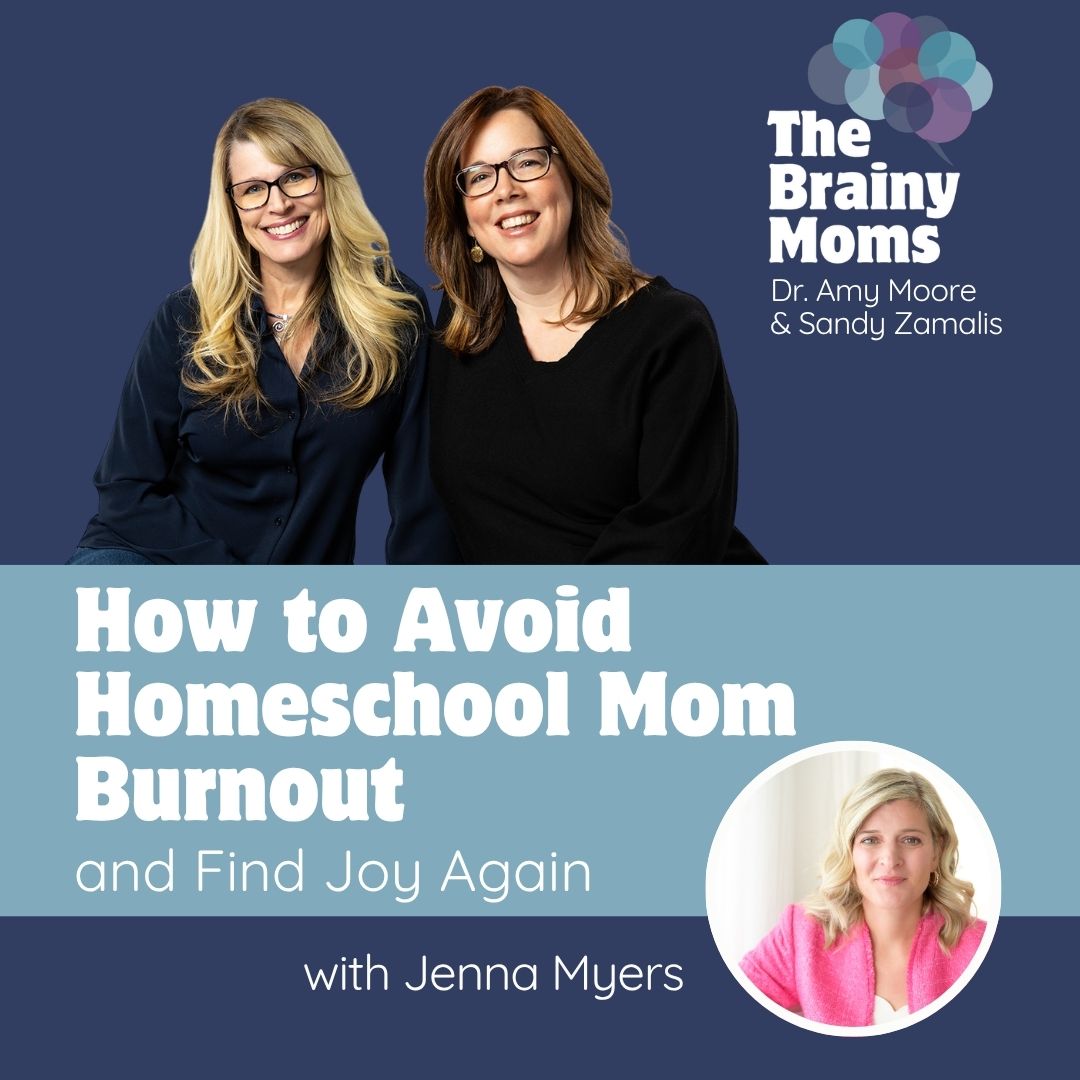
Homeschool mom burnout is real—and it doesn’t mean you’re failing or that God is calling you to quit. In this episode of The Brainy Moms Podcast, Dr. Amy and Sandy talk with former classroom teacher, veteran homeschool mom, and educational consultant Jenna Lynn Myers, author of Homeschooling with Purpose: Candid Encouragement for Homeschool Parents. Jenna has supported thousands of homeschool families and is passionate about helping worn-out moms avoid burnout by recognizing early warning signs and building life-giving rhythms at home.
You’ll hear how to spot homeschool burnout before you throw in the towel: loss of joy in your day, constant frustration, procrastinating with your phone instead of starting lessons, snapping at your kids, and feeling like everything is falling apart. Jenna shares practical ways to revisit your “why,” create white space on your calendar, and set stronger boundaries around your time so you can protect your nervous system and your children’s.
We talk about:
· Early signs of homeschool mom burnout and what to do when you wake up three days in a row dreading school.
· How to revisit and rewrite your homeschool “why” so it actually motivates you in this season.
· Slow-rolling your year, setting realistic expectations, and choosing progress over perfection in your planning.
· Creating consistent home rhythms and boundaries that support your mental health and your kids’ regulation.
· Homeschooling kids with ADHD, special needs, or mental health challenges without sacrificing academics or your own well-being.
If you’re an overwhelmed homeschool mom—exhausted, snappy, ready to quit—this conversation will give you hope and simple, actionable tools to avoid burnout and find joy again in your calling.
About Jenna Lynn Myers
Jenna is a former classroom teacher turned veteran homeschool mom with a master’s degree in education. She’s the author of the book Homeschooling with Purpose: Candid Encouragement for Homeschool Parents. It’s a book written for new, curious, and worn-out homeschool parents who need practical guidance and reassurance that they’re not alone. As the owner of The Sophisticated Teacher, an award-winning business, she has supported more than 2,000 homeschooling families through consultations, testing, evaluations, tutoring, and classes. Jenna is passionate about equipping homeschool parents to recognize and prevent burnout, build life-giving community, and confidently teach their children, including those with special needs. And she brings her experience as a mom of three boys into everything she shares. Find her at https://www.thesophisticatedteacher.com/ and on social media @thesophisticatedteacher
Free Downloads from our Sponsor, LearningRx
Download the free ebook, Unlock the Einstein Inside: Wake Up the Smart in Your Child
Download the Brain Training Game Pack
Link to our sponsor’s website: www.LearningRx.com
Listen or Subscribe to our Podcast
 Apple Podcasts
 Google Podcasts
 Pandora
 Spotify
 iHeartRadio
 TuneIn
 Stitcher
 YouTube
Watch this episode on YouTube
Read the transcript for this episode:
NOTE: This transcript was auto-generated by an AI assistant that thinks it’s smarter than we are. It’s not, but it has more free time than we do, so we gave it a low-stakes job. It probably spelled a few things wrong, but we’re okay with that. We’d rather spend our time interviewing cool guests!
Welcome And Meet Jenna Lynn Myers
Dr. Amy Moore 0:00
Before we welcome our guest, we just want to remind you that we have a free monthly newsletter. You can go to the brainymoms.com, sign up there, and you will get lots of cool free resources about homeschooling, child development, child psychology, all the cool things that we talk about on the show. We add extras in that newsletter, so don’t miss out. And now, our guest today is author and educational consultant Jenna Lynn Myers. Let me tell you a little bit about her in case you don’t know who she is yet. Jenna is a former classroom teacher turned veteran homeschool mom with a master’s degree in education. She’s the author of the book Homeschooling with Purpose: Candid Encouragement for Homeschool Parents. It’s a book written for new, curious, and worn-out homeschool parents who need practical guidance and reassurance that they’re not alone. As the owner of the sophisticated teacher, an award-winning business, she has supported more than 2,000 homeschooling families through consultations, testing, evaluations, tutoring, and classes. Jenna is passionate about equipping homeschool parents to recognize and prevent burnout, build life-giving community, and confidently teach their children, including those with special needs. And she brings her experience as a mom of three boys, hey, just like me, into everything she shares.
Burnout And The Urge To Quit
Dr. Amy Moore 1:22
This topic that you want to talk about, you want to talk about uh preventing burnout and is super timely because I just interviewed Deborah Fileta a few weeks ago. I’m not sure if you’ve read any of her work. I have. Yeah. And so we spent a lot of uh the episode talking about burnout and really like those messages that we as women send ourselves, how our spirituality bleeds into that idea that, you know, there’s gotta be something wrong if we’re experiencing burnout because we’re stepping into our calling and this is ministry what we’re doing. And yet, um, it happens to the best of us. So talk a little bit about that. Like, why is this such an important topic to you? Why did you choose to write about it? Where did you start to notice these patterns? Why is this so important?
Jenna Lynn Myers 2:20
So I’ve experienced burnout in a several ways. I was a classroom teacher, so unfortunately, I experienced it there. Then as a mother to young children, and now as a homeschool mom, I have done it again. You’d think I would learn over the years, but it just happens, right? When we um aren’t quite paying attention to our nervous system and our schedule, and we don’t have enough white space on our calendar. And I’ve watched so many other moms struggle and quit homeschooling or decide that they can’t continue on whatever path they might be on any longer because they’re burned out so clearly, they’re not meant to do it anymore. It’s just too hard. Let’s throw in the towel. God has a different purpose for me, whatever it might be. And I hate seeing that because even though something’s challenging, does not mean that we should throw in the towel. Sometimes that means we need to dig a little bit deeper and reassess and refocus. Um, so I really just want to encourage moms in particular to not throw in the towel when they are feeling overwhelmed, um, especially when in the area of homeschooling. I’m a homeschool mom now. And I mean, Monday, let me tell you, was a burnout day for us. We we could have thrown in the towel, but we didn’t because we knew that this is our calling, but we did have to refocus. And I had to look at our schedule and our life right now and say, okay, is this reflecting the vision that we made for our family? Is this reflecting the path that I do feel like God put us on? Um, so I’m just very passionate about helping others not make the mistakes that I have and recognize the signs of burnout before they get to a point where they feel like they cannot continue in the current season they’re in.
Early Burnout Signs At Home
Dr. Amy Moore 3:55
Okay, so how do you start to recognize signs of burnout? How did you personally start to realize that? But like, what should our moms be doing to kind of prevent going down that path? Or hey, when I find myself on this path, what does that look like?
Jenna Lynn Myers 4:12
I feel like one of the first things is when you’re going through the motions and you’re checking the boxes, but there’s no joy, right? And not everything we do can be joyful. Let’s be honest. Laundry isn’t always joyful. Um, cleaning up after children, not always joyful. Even some of our homeschool lessons or work tours, not always joyful. However, we shouldn’t just be clicking the boxes and just trying our best to power through the day. We want to make sure that we’re actually enjoying what we’re doing. We want to make sure that we are finding um just peace throughout our day. So if you’re finding frustration easily by checking off the things that used to bring you joy, if you’re in the middle of a homeschool lesson and you are just begrudgingly reading through all of the curriculum and you are like, I’m teaching this to my kids, but I’m not excited, and now they’re not excited. Those are signs of burnout. Those are signs of maybe we’re overdoing it, maybe I’m stretching myself too thin. Maybe we need a break, right? And so unfortunately, I learned that the hard way a few times when I just wasn’t excited for our school day. I wasn’t excited to start our day in general. I would procrastinate and do other things. I might sit on my phone, right? That’s a big one when we are not really wanting to engage in regular life or binge watching shows or just avoiding daily tasks. I think those are huge signs of burnout and a need to reassess. And another one would be being snappy. Oh, we hate doing that as a mom with kids, whether we’re homeschooling or not. It’s really easy to just be snappy about the littlest things. And sometimes our kids are snappy back, or we’re like, why is everyone in a bad mood? No one can get their shoes on. We can’t finish this math problem. The house is a mess. And if we stop, sometimes we will recognize that our tone is setting the tone for the rest of our house. So if everything feels like it’s falling apart, sometimes we have to pause and say, okay, I’m leading the house. And if everything around me is falling apart, am I in a good place to be leading right now? Do I need to take a step back and refocus? Um, and that’s a hard thing to do because you don’t want to be the problem and you’re trying your best. And so self-reflection can be a little tricky in those moments, but it’s really important.
Revisit Your Why For Motivation
Dr. Amy Moore 6:30
Yeah, I love that you bring up that one of those early signs of burnout is just not wanting to do it, right? Not having the joy, not feeling the joy. And so I was a teacher before I was a psychologist. And so I will never forget the principal of the school where I did my student teaching at the very first staff meeting that I ever attended. The principal said, if you wake up three days in a row and you don’t want to come to school, it’s time to find another career. That stuck with me for a really long time, three days in a row. But when you’re homeschooling and you wake up three days in a row, you can’t find another career, right? So you’re gonna have to find, right? So you’ve got to find a different path through that, um, through that feeling, right? You have to say to yourself, why am I feeling this way? Right. And so you talk about in your book how important it is to know your why. Talk a little bit about that.
Jenna Lynn Myers 7:28
So you can’t just wake up, I mean, you can wake up one day and say, I want to homeschool, but you’re not going to get very far. Let’s be real honest, because it takes a tremendous amount of commitment and diligence. So you have to know why you are doing what you’re doing. And that looks so different for every family. And it looks different throughout your journey as well. Um, when I started, my why was because my kids were little. I didn’t want them sitting in a classroom all day with screens because our unfortunately our county got rid of centers at that point. And so I wanted them to move. I wanted them to have outdoor time. I wanted to also be a part of those big moments. So that was a huge motivator for me at the beginning. As my kids have grown, my why has changed a lot. I want flexibility to dive deeper into their interests. We want more time as a family. My husband was overseas 75% of the time for quite a while. And during that time, we could take breaks than when he was home. So it really elevated our quality of life as a family. So there’s a wide variety of reasons. Of course, some pulled from public school due to their experiences or other needs they might have. But knowing your why and revisiting it is going to help you keep going. So I always suggest to moms when we get started is I have a series of questions in my book and then I’ll work through with clients about why you are homeschooling. Ask your kids why they want to homeschool if they are part of that decision and your spouse as well, and to reflect on that. So when we’re having a bad week, I will pull it back out myself and I will reread. Okay, this is why I’m doing it. It was a juicy of a day. We didn’t finish all the lessons we wanted. I feel a little like a failure right now. But you know what? I’m not. It was a bad day. It was a blip on the radar. And if you’re unmotivated, it’s the same thing. If you’re feeling burned out, okay, why am I doing this? Have my reasons changed? Maybe I need to adjust my vision slightly, but that reflection and knowing that will keep you going much longer.
Boundaries And Consistent Home Rhythms
Sandy Zamalis 9:21
I love that. So, Jenna, how important do you think consistency and boundaries are to this equation?
Jenna Lynn Myers 9:30
Oh my goodness, so important. And something I was, I was not good with boundaries early on in my homeschooling, and I have changed that myself. And I know a lot of homeschool moms struggle with that because people assume you’re home. Therefore, you’re available to them to do many things, right? Whether it’s people coming to your house to work on things, a family member who needs help, a friend who maybe has a child in a different situation and needs your assistance. But you can’t always be available. Your job now is to homeschool your kids. So treating it as such is really important. And creating blocks of time that protect your school is crucial. Because if you don’t, then you will become burned out because you are spread too thin, first of all, and you’re not able to complete what you actually have set out to do. So then that feeling of a failure and like you’re not doing enough will come into play. Um and consistency is the only thing that’s going to move you forward. You can pick whatever curriculum you feel is best, but if you don’t use it regularly, it doesn’t matter. Might as well be in the trash, right? So that’s I find so many clients that they’re like, well, we bought this great curriculum. And I’m like, in how many days a week are we using that? And they’re saying, well, it depends on the week. And I’m not sure, you know, it just kind of depends how things are going. And we wanted to go to the park and all these other things you can do where homeschooling is great, but if you’re not implementing what you set out to do, then you’re not going to find that progress, right? And those rhythms, the consistency, your rhythms of your everyday, and those boundaries all help your nervous system, your children’s nervous system, and they help you to not burn out as quickly, right? Um, and having that space blocked off, I also tell moms, put your phone on focus or use a brick or do not disturb, whatever you need to do. But it’s so easy in today’s world to pick up your phone, to take a picture or to check something real quick. And 20 minutes later, you’re on the phone with a friend, you’re on social media, whatever it might be, right? Um, but not having those boundaries, if you don’t set them for yourself, then it’ll be your off course and you’re just going to feel chaotic in your homeschool and you’re not going to see the progress that you set out to have for your children.
Sandy Zamalis 11:40
That’s a really great point. I love that because I was thinking in terms of like, I think one thing that I know I as a homeschool parent struggled with on the front end was reasonable expectations of how long a task should take. And so I would make these grand schedules. Right. And try plans. Yeah. Try to accomplish all these things. And it’s like, well, math took us twice the amount of time. And the writing took us four times the amount of time as it should. Writing should be a little more challenging. But is there a I think one of the things that’s really hard as a parent is like you feel like if you’re not hitting your your to-dos, like if you’re not checking off all the boxes, that’s when you start to feel that failure and burnout. Um what are some guidance you can give to parents? How how do you find those kinds of really good expectation meeting goals for your family? Um, I always said I would take like the first two weeks and just be like, all right, how long did this really take us? And then adjust. And it’s okay, give myself permission to adjust, but that’s how I did it. Do you have suggestions?
Jenna Lynn Myers 12:54
So I always say slow roll your year, first of all. You can’t do everything at once. You can’t just first day, okay, and we’re going to use this new math textbook and we’re writing this paper this week, and oh, for science, we’re watching this video, and there’s this experience. You will be done after day two, right? We can’t do everything at once. We have to ease into it. Um, and even as a classroom teacher, I had to ease into it and also set expectations throughout our day. So if our expectation is we’re going to begin most mornings, you might don’t have to have a set time. It depends on your household structure. But in my house, we start um at 8:30. We don’t have times the rest of the day, but we know we get moving together at 8:30. We meet in a room that has no distractions, we read together, we spend some time together, we talk about what our day will look like, and we move from there. But what I always tell my clients, and what I have to remind myself, is we use the curriculum as a guide, but we’re the facilitator, right? And so we sometimes need to pause, we need to dive into a math lesson if it’s gonna take a little bit longer. We need to work on writing a little bit longer because you know, they’re on a roll and we don’t want to stop. But I had a science lesson plan. That’s okay. We can push it to the next day. It’s all right. And while checking all the boxes of curriculum sound fantastic, it’s very unrealistic overall. Most curriculums are made for around 180 days, a lot of new material. But the truth of the matter is you can’t give new material every day and assume that your child will absorb it. They’re you’re gonna bring them out too, right? So it’s that balance of review and exposure, but not necessarily mastering every topic that we’re bringing up as well. And I think that’s something that everyone is they’re like, well, we were supposed to have these math problems, you know, these multiplication facts done in two months with this curriculum. And it’s taking six. Okay, then it takes six because if you don’t spend the time now, what happens later when you move on to a more challenging concept is you don’t have your base, you don’t have anything to build on, and then frustration ensues, and you end up actually spending much more time on concepts late down the road than you could have if you just paused and dug into where they currently are. I always say progress over perfection. So we’re not looking to check every box, we’re not looking to say, okay, 100% mastery for every aspect of study that we’re in. I mean, I always have felt like that’s kind of unrealistic. You might have a math child, you might have that engineering brain, but you might have that more creative side, that writer, that reader. So you also have to play into their interests a little bit. But having a good rhythm throughout our school day, having white space on our calendar so that we have margin to dig deeper if lessons are taking longer. Because if you are like, this is our window, and then we have five activities every day, you’re not going to ever be able to have the time to pause, to slow down, and to ensure your child is hitting the next benchmark, is ready to move forward. You’re just going through the motions, and that is not beneficial to anyone.
Progress Over Perfection In Planning
Dr. Amy Moore 16:01
So let’s talk a little bit about when we make the decision to homeschool because our child has special needs or because there may be some mental health issues that are happening. How do we as parents balance that desire to nurture this struggling child? Um, and I mean, I speak from experience. So, you know, one of my children we pulled out of school because they couldn’t meet his um needs. And the other we pulled out in high school because of mental health issues. But we would find ourselves giving in to, well, I don’t, you know, I don’t really feel like working on that today. I need a break. I need right. And so we would give in to that because our why was because we felt like for this child, his mental health was more important than academics. But you can’t say that every day all year. Right. So how do you have those conversations with your kids who know why, who know why you’re um homeschooling, but they’re pushing back.
Jenna Lynn Myers 17:10
Yeah, it’s so hard when you get pushback. And I understand that I have homeschooled all my kids from the beginning, but I do have an ADHD child who we have to revisit that why often. And I have a lot of clients that are struggling with this, especially the ones who have pulled out late, because a lot of the time they also maybe didn’t do a lot of work in school. So now they’re being required to do some more at home, and that can be a new challenge as well. And now mom or dad is kind of the authority in education, and that is also an adjustment. So I would say the first thing is, especially if you’re pulling your child out, to give it a moment. You can’t jump right into a curriculum the moment you pull them out. So to de-school a little bit, work on your relationship and try, especially if it’s a mental health issue, make that your focus at first. That doesn’t mean you’re solving it until and then you’re starting school, but you’re giving it a moment, right? Um, that moment can look like a couple days or a couple weeks. It can’t look like a whole year, because we need to make progress, right? Um, but something that some of my clients that we’ve done with older children is we’ve sat down and written our whys together, written our goals to. Not a goal for every subject, but two to three tangible goals that we actually go back and revisit every two months, not quarterly, not halfway through the year, but every eight weeks-ish. And we say, how are we moving towards this goal? Do we need to adjust it? Was it realistic? And we involve them in that process. Because sometimes we also bring our children home and we say, and this is the curriculum I chose, and this is how we are doing it. And we don’t give them much of a voice. And our older children do need a little bit of a voice. We need some choice. That voice can’t be, no, I’m not doing it, but hopefully we can find some common ground. And I have a lot of parents, we will write kind of a contract with their kids. We’ll say, okay, if we’re going to homeschool, these are the things that we need to accomplish. We’re going to agree on these visions, these goals, and we’re going to both sign it and we’re going to make it a priority. And we put it in a space where everyone can refer back to it. So then we’re also not having the same conversation all the time. So if you’re hitting a brick wall with one of your children not wanting to work, we say, okay, let’s go back and let’s look at what we decided. Let’s look at why we decided that. We need to and how we’re going to move forward. It’s not empty threats of, well, now you’re going back, right? Which I’m not saying any homeschool mom ever does. But we want to make sure that we’re revisiting and saying, okay, if this isn’t working, outside help is also okay. Maybe we pulled them from a situation, but maybe we do need some support and an error, whether that’s tutoring or a specialist, an online program, or another mom you’re working with. So there are ways to work around that. But to continue to have the conversation for older kids to have it in writing, to have them be a part of that vision and goal setting is really important. And again, the consistency and rhythms. If part of our problem is we’re not getting up in the morning, we’re doing everything but school, then our rhythms and our priorities need to change. And school needs to be number one at the priority list. And I always tell kids, this is your job. Your job is to learn, our job is to facilitate and to help guide you, but we take our job seriously, right? Um, and we want to be able to be um meaningful members of society and we want to feel good about ourselves. And the truth is, when kids are working towards a goal and they are making even baby steps towards that goal, they feel bad about themselves. And that intrinsic motivation rises. And so that’s why revisiting those goals, revamping them, and not making too many, not making them outlandish and celebrating small wins is really helpful in motivating the kids that maybe just school isn’t their favorite topic at the moment, right?
Special Needs Pushback And Goal Contracts
Dr. Amy Moore 20:50
Yeah, I love that because you know, I always encourage parents to make some things negotiable and some things non-negotiable. And the more negotiable things you have, the more relational equity you build and the more apt your child is to cooperate with those non-negotiables, right? But we have to be able to say, you know, school is non-negotiable, but how we meet our goals, that is negotiable. And so to be able to include them and give them that sense of autonomy and control um is part of meeting that basic psychological need, right?Jenna Lynn Myers 21:26
Absolutely.Sandy Zamalis 21:27
I totally agree. And I wonder if it would be beneficial. I love thinking about this from like like how to plan your homeschool day and you know, working with your kids to reach their goals. But also, um, I think it would be important to do that as mom too, separately. What are my goals for the year? And you know, and and am I making those priorities in my calendar? Am I saying no to things uh more to try to give myself more boundary and white space, like you suggested? Um, I think. Like when we think about that nervous system part of you, you say that statement, your nervous system runs your homeschool. Like in order to recognize burnout, we as moms also have to take time by ourselves and figure out what our goals are and whether we’re meeting them or not.Jenna Lynn Myers 22:19
Yes, I totally agree with you. It’s and it’s hard because we only have so many hours in a day. And if you’re in a stage where you have young kids who aren’t sleeping or you have kids in lots of activities and everyone needs you, right? It feels like the demands never stop. It can be hard to find that time. But like you said, finding your reason for doing things as a mom will also continue to motivate you. But saying no is also really important. It’s funny because everyone’s like, what will you do as homeschoolers? You just sit at home all day. There’s not, you’re not socializing, you’re not out. Like, what do you do? And I’m like, oh dear. If we did not say no to activities, we would never get any schoolwork done. But also, then I wouldn’t have that quiet time. I wouldn’t have that reflection time. And self-care is not taking a shower. It’s not hiding in your closet eating cookies, right? Those things are not regulating our nervous system. That sugar’s throwing you off. Stop it. But what does regulate your nervous system is having your own routine too. Aside from your kids. Okay, you have a rhythm for your school day. Do you have a rhythm for yourself? Are you maybe taking 30 minutes before bed to not be on screens, to read something you enjoy, to take a walk around your neighborhood, to sit and pet your cat and quiet, whatever it might be, right? But you need to have even small moments where you have quiet, where you can refocus yourself and just reflect on what’s going on in your day and what’s coming for the week. But having the goals of, okay, I’m going to make time for a hobby I enjoy. And maybe it can’t be what you did, you know, 10 years ago because your time’s restrict restricted or your finances are restricted, but even little hobbies, reading, doing a craft, trying a new recipe, whatever that might be, sitting in quiet on your porch, you know, that’s that can be your hobby for this season. Um, you need something for you for sure. Yeah.
Nervous System Care And Self Tracking
Sandy Zamalis 24:06
I agree. It’s it’s so interesting. It’s so interesting because um we’ve been talking um in the past um on the show. Um I I’m on my own personal health journey at the moment, and Amy is as well. We’re we’re in this constant flux of figuring out what’s going on with our autoimmune selves. And uh don’t do that. Right. You’re doing what? I have loved this season um because I’ve been able to find someone who’s been able to give me data points and things to track. And weirdly, I didn’t think that that would be so motivating to me to have data points to track, but it’s really helpful. Yeah. So, case in point, um, for my birthday, my husband got me a treadmill because um we live kind of out in the boonies. It’s not really safe to walk. Um, I’m really busy with my job. I can’t get to the gym. I’m like, I just need to create a gym. Yeah. So let’s at least start with a treadmill. Um, and then me trying to get this into my routine every day. Well, um, we were also checking like our fasting blood sugar in the morning. Well, lo and behold, when I walk at night after dinner, when I check my flat fasting sugar numbers in the morning, they’re my best numbers ever. Um, and it’s like, well, that’s an interesting data point. Yeah. When I don’t walk, up they go. So it’s super helpful to give yourself, I think, that room to trial and error and get feedback, impartial, neutral feedback that tells you, yes, this is working well for me. Like I feel more rested. Or, you know, it could just be even just having like a mindful meditation moment, but like just something, data point for yourself that you can track.
Jenna Lynn Myers 25:53
A journal, you know, reflecting on that. And to remember, things don’t happen overnight. So someone will do something for like a week and they’re like, it’s not working. I’m still stressed, I’m still waking up, like thinking about my to-do list. You have to give it several weeks, right? I always say at least seven weeks for your habit to really form, right? And so I will tell moms, I actually went through something similar in the fall because I have MCIS. And so I had to really take some things off my plate this year, um, because my autoimmune system was not happy whatsoever. And but it took a solid seven to almost nine weeks for my body to recalibrate, even though I was doing all the right things and I was taking the breaks. Your body takes time to recover too. And I think we don’t give that to ourselves as a mom. We we need to recover even sometimes from our school day. If you have had a hard school day, that’s a good day for you to take a few extra minutes. And I know you feel like it’s not always possible, but you’ll do yourself more service and your children if you do schedule in those breaks and allow for some of those times um to occur. So it keeping a journal, having your I love that you’re tracking your blood sugar. I think that’s amazing, tracking your oxygen levels, all those types of things, or even just writing down like on a calendar, like write a word describing your mood that day. And then maybe what you like, what did you do that day? Did you have those five minutes? Did you not? Just kind of this is when you can check a box, check off the calendar. Did I have my 10 minutes that day? And if you notice a pattern, then you’ll say, okay, these things are working or aren’t working. But any kind of anecdotal data is definitely helpful.
Dr. Amy Moore 27:25
Yeah.
Working While Homeschooling With Support
Dr. Amy Moore 27:26
So let’s talk a little bit about those moms who want to do all the things. And um so for example, I during the seasons that I did homeschool, I was also working full-time, which is definitely a challenge. And so I had to choose to outsource a lot of a lot of that. Um, but when you work with parents who say, I want to homeschool, but I’m also gonna be working full-time from home. What is your advice? Do you say, oh, absolutely not, don’t even try it? Or do you say, okay, let’s look at how you can balance a career and homeschooling at the same time? What does that look like? What is your advice? How do you help moms work through that?
Jenna Lynn Myers 28:10
Balance is so tricky, right? Because balance does not look like equal every day, I tell parents. I say some weeks will look like more work, my work might get a little bit more attention, and some weeks my kids might get a little bit more. And that’s okay. So balance is not always being level. Sometimes things tip up and down slightly, but we don’t want to be too out of wax. So that’s that’s something to watch for. So of course you can homeschool and work at the same time. It’s going to be a different set of challenges depending on your career. I have a lot of shift um workers, uh, clients. They are EMTs, they are nurses, whatever it might be, right? And so they will homeschool many times during the weekend, during off shifts, things like that. Homeschool doesn’t have to be nine to three. Just because the public school’s in session does not mean that’s when you have to be learning and teaching, right? So evenings are okay. And for some kids, especially older children, it’s actually a great time to dive into a book or to explore a new topic because their rhythms are a little bit different than, say, younger kids. Or for younger kids, if you wake up early with them and you can get school done or part of school, the instructional, more guided piece, right? Before work hours, that’s also helpful. So you can absolutely do both. You just have to get out of the mindset that nine to three, Monday through Friday is the only time you can do school. That is not at all the case. And we’re in 2026. We can use textbooks and do it all ourselves. We can use online classes, we can do hybrids, there are co-ops. Sync up with another working mom. What can each of you pair with? Um, you know, there’s been seasons where I’ve done that, where this season, actually, I’ve been doing science and my homeschool’s been crazy and history has fallen off the table, let me tell you. So there’s another mom I know that is her for today. She lives and breathes history and geography. God bless her. That is not my jam. So she’s taking that over for our kids for a few weeks. And I’ve done science experiments and we flop every other week. Less pressure for each of us. We can work within our schedules. So it is possible. Um, I would just say that you have to be flexible with your mindset throughout that season, right?
Sandy Zamalis 30:20
We had a friend like that. She was an art teacher, and so she did all the art stuff. Like, I guarantee and it would all it didn’t have to be a formal like art class. Like literally, our kids were friends, and if they were at her house, they were doing arts and crafts. Like that was just a part for the course. Especially when you’re not that mom. So it was like that had their art for the day. It wasn’t even uh they but they were just there to have some fun and to play. And and the same thing would happen on our end. I was more um, like you said, I was more the science experiments, like you know, we’re hatching chickens, let’s, you know, candle the eggs. Let’s I was definitely that type of mom, a homeschooling mom. So yeah, it’s just finding that community of people that can help you fill the gap. Because you you really it it is you will achieve burnout if you think you have to do all of the things. So finding finding the who, not the how, is in homeschooling is really important, just as it is in anything that we do. Yeah. And now a word from our sponsor, Learning RX. In middle school, Kevin had given up on learning because of his reading struggles. His parents had tried everything and they were losing hope until they enrolled him in the cognitive training and reading programs at Learning RX. It was hard, but he gained confidence as he strengthened his memory, attention, processing speed, visualization, reasoning, and auditory processing skills. Years later, his mother wrote to us that Kevin has graduated from college and is beginning his master’s degree. He’s a military officer and is married with his own children. He’s thriving in life, in learning, and in his career. We can’t promise your child will have the same results as Kevin, but we’d love to talk to you about our brain training programs. If your child is struggling with reading or learning, talk to the team at Learning RX to see if we might be the right fit for your child. Visit LearningRX.com slash the Brainy Moms to learn more and receive a cognitive skills assessment with a consultation for just ninety-nine dollars. That’s LearningRX.com slash the Brainy Moms. Homeschool OT is for families whose children want to learn and participate but struggle with what their days require. Things like starting work, staying regulated, writing, reading, or following through on plans. Created by occupational therapist and homeschool mom Sarah Collins, Homeschool OT helps parents understand why these challenges show up by breaking down executive functioning, sensory processing, and motor skills in real practical ways. Through the OT is in podcast, parent coaching, and targeted classes, families learn how to turn that understanding into strategies they can actually use in their homeschool day. Because homeschooling is not alone schooling. You can find support, resources, and expert guidance at homeschoolot.com.
Flexibility With Weekly Reset Planning
Sandy Zamalis 33:15
So let’s talk about those pitfalls of flexibility.Dr. Amy Moore 33:18
Because I always say if you chase three squirrels, they all get away. And so if we adopt this mindset of flexibility, which we should, by the way, there is a danger that things will not get done. They will fall through the cracks.
Jenna Lynn Myers 33:33
Yeah.
Dr. Amy Moore 33:33
Yeah, absolutely. So how do we how do we have a system of checks and balances to make sure that, yes, we can be flexible within our larger goals?
Jenna Lynn Myers 33:45
So always before you start your school year, you definitely want to look at the big picture, right? I always say do some long-term planning. That doesn’t mean planning every day, really generic, have the months lay down and say, okay, these are our general goal goals. This is what we think we’re going to cover. Probably not going to hit all of them. We understand that. That’s okay. But then each week, really having a reset day. For me, that’s Sunday nights, but for somebody else, that could be a different day. So on Sundays, I take 30 minutes, that’s all it takes, and I close the door to my office and I sit down and I say, okay, this is what we accomplished last week. These were our goals. What do we need to accomplish this week? Let’s look at our schedule. And we, I will look and be realistic about what we can get done. And if we need to be flexible in time, say, okay, but our priorities are reading with this child, math, we are still working on this unit and we need to continue to move forward. What can we drop? Okay, we were going to do this fun art lesson. I still want to do it, but this is not going to be the week to do it. Our focus really needs to be on our reading and math because we’re making good progress, progress, and we want to be consistent there, right? That’s really important. So we still want to do the fun things, but sometimes we do have to take a step back. And learning can’t always be hands-on. I know it, it’s really fun when it is, but sometimes we have to take a step back and reassess our week. So we can be flexible, but we still need to be thoughtful. I think that’s part of it. So flexibility does not mean just chasing our tail and not planning for the next day or the next week. It means, okay, our times might move. We might shift our schedule a little bit. We might say, okay, science and history are not both going to happen this week. Something’s going to happen another week, or we rotate and block schedule. But that doesn’t mean that we just say, oh, well, we got math done today or we didn’t. Oh, we checked one page or we didn’t. We need to continue to reflect, but we need to schedule that reflection honestly, especially if you’re working on your calendar. You need to have a set day or time of the week set a reminder. And your kids can be involved. If they’re older, say, okay, this is what we accomplished this week. What do you feel we need to do next week as well? Involve them in that. And if you have a spouse that’s helping you and you both are working, then hopefully you’re able to have that communication time as well so that everyone knows the goals for the week and no one else is creating extra distractions or saying, oh, well, we were being flexible this week. So we’re just going to do X instead of what we needed to accomplish. So we’re not trying to check every box again. We’re not necessarily saying we have to have a rigid schedule, right? But we do want to make sure that we’re prioritizing during that time and that we’re refocusing what we are spending on our time each week and having that reflection piece. I’ve talked about it in so many different ways. Oh, so much reflection that we need to do. Um, but having that reflection time and the time to plan out our week is really important.
Handling Critics Socialization And College
Dr. Amy Moore 36:36
So let’s talk a little bit about how to respond to naysayers when you decide that you’re gonna homeschool your kids, right? Because somebody has an opinion about something, right? Every time you decide I’m gonna homeschool my kids. And so one of the pushbacks that I hear often is well, you’re not qualified. You didn’t go to school and get a degree in education. So what makes you qualified to teach your child? How do you respond to those naysayers?
Jenna Lynn Myers 37:07
It’s so hard. Um it’s so hard anytime anyone attacks something that you’re doing for your family. Because first of all, we did not make this decision on a whim as homeschoolers, right? It was a thoughtful decision. We are doing what we know is in the best interest of our child in this season, right? So that’s something to remind yourself of when other people are asking these questions. But I tell everyone, it is not your job to convince other people that homeschooling is good. Okay. You don’t, your child is not a reflection for all homeschoolers. Your experience is not a reflection for all homeschoolers. The proof will be in the pudding, but you don’t need to prove it to them, right? They’ll see it on their own if they want to see it. Because the person asking the question has to also want to truly understand it. And unfortunately, not everybody wants to understand your why or um will be accepting of it, even if they see that it’s working for your family. So when people are naysayers or saying, oh, you’re not qualified because you weren’t a teacher and you don’t understand biology, how could you possibly teach that? I would just say, you know, we have great resources in 2026, and I don’t thankfully have to know everything. I can choose wonderful curriculum, I have a community and support system, and that’s how we’re going to move forward. And I know my child best. So while others might be qualified and academics, I also am qualified in knowing my child, how they learn, what makes them tick, what makes them frustrated, and knowing their learning style. And I can help choose things that will facilitate an engaging and rich area for them to learn. So I think also just not giving them too much lip service. I think it’s so easy to go down the rabbit hole and be like, well, but I did go to college or I went to this high school and it was great. And well, I know a lot about gardening, whatever it is, right? Whatever your reporte is, it’s so easy to want to stand and defend yourself. And just know you don’t have to. It is not your job. And while if your child’s doing great with homeschooling, it’s also always fun to be like, well, and they do know these things, or now they’re in algebra one in sixth grade, or you know, whatever it might be. But your child’s not your trophy. Their child shouldn’t be theirs. And it is not a showpiece for everyone else. It’s about following your child’s educational journey and mental health journey, right? And spiritual journey when you’re homeschooling and working together as a family. And so I think when people have things to say, like you’re not educated enough or you don’t have the right background, say, well, luckily I have resources to help me along this ride. And luckily I know my child best, so I can support them academically long term.
Sandy Zamalis 39:42
Typically, I think it’s that argument always comes from family members. I was just thinking, right? It’s not about caring.
Dr. Amy Moore 39:50
Yes, it’s a mother-in-law, a mother, your sister.
Sandy Zamalis 39:55
And it comes from worry, right? Like they they have a vested interest in your child, and so they want to make sure that um and it’s against the norm.
Jenna Lynn Myers 40:04
They’re not they don’t know what they don’t know, right? Yeah.
Sandy Zamalis 40:08
Yeah. Typically from other people, I would always get the oh, I could never.
Jenna Lynn Myers 40:13
I could never be with my kids all day. That’s a lot.
Dr. Amy Moore 40:19
So what about the socialization pushback? Right? Because we hear that all the time, right? Oh my gosh, you’re gonna isolate your children. What about socialization? What is your response to that?
Jenna Lynn Myers 40:31
I mean, honestly, I can’t even tell you how many times I’ve heard it. But when I was a classroom teacher, I taught fifth grade for 10 years in particular. And every day, we’re not here to socialize. Girls, stop talking. That was my line when I was a teacher, guys. Okay. And we did have time to socialize, but it was not during language arts and math. And hey, we’re doing a science experiment, right? So a lot of the time when people bring up socialization, um, the first thing I will say, especially if we’re in a setting, a lot of people will bring it up like we’re at a park or we’re at baseball or, you know, wherever it might be. I’m like, well, my my child’s playing with your child right now, so I think we’re okay. Sometimes I’ll just kind of pause and I’ll reflect on where we are and what we’re doing, and I’ll be like, I think we’re good. Because they might be interacting with a cashier, they might be interacting at a family event, whatever it might be. And I don’t play into it a lot, but I also say we uh homeschooling is not what it was 20 years ago, 30 years ago, right? Homeschooling is so much different now. There are co-ops everywhere, there are pods everywhere, there are micro schools, there are so many opportunities. Businesses um have really learned they can service homeschoolers as well with daytime art classes, with daytime sports practice, all types of things. So there’s a plethora of way, but socialization happens within your home too, right? So you’re with your parents, you’re with multi-age siblings, you’re learning how to be part of a family unit. You’re learning how to work with each other through hard things, and you’re learning to love the people you’re with regularly, even on those challenging days, and to accept who they are. And I think that also helps to build confidence when they are socializing in other settings because they have no problem speaking up at home, they have no problem working through conflict at home, communicating, and they have a strong family base. Well, then you’re gonna be more confident when you’re outside the home as well. I’ve noticed that a lot with homeschoolers. And you’re also not just with the same age peers all day long talking about the same exact thing. So it was so funny. One of my kids, he’s in middle school and he wanted to take physical science this year, and he’s been studying the periodic table. He just, he’s a science kid, loves it. And another friend picked them up from youth group. It’s a car full of boys, and a bunch of the boys were talking about different movies, and my son knew the movies and they were talking about that. And then school became a topic and he started talking about the periodic table, what he was learning. And they were like, Well, I didn’t knew that. And they had a whole conversation, but the dad was like, he came on when he dropped him off and he said, Your kid like facilitated a whole discussion in my car around something that I don’t even know anything about. He was just blown away, but he had confidence in it because he also gets to spend enough time with himself and his studies to know himself, right? So then he was confident in his situation. He knew the local, you know, the trendy movie and all that sort of thing, but he also had new information and he was able to ask questions that were open-ended because that’s been modeled for him. And those children were able to engage in the conversation in a different way. So I, you know, socialization is kind of an outdated argument, if I, in my opinion. Um, you know, we’re not all just in our homes all the time. Oh, though we need to be to do some studies, we need to be at home some. But there are so many other opportunities, virtually, in person. And I mean, there honestly, we have to schedule time to not be out and not be social. It is, we have had a season before where I’ve been like, oh, we’ve been, we’ve been too social. We have done too many park days. Too many field trips. We’re in three co-ops. What was I thinking? But at the time, it was fun. It was great. But we needed to reel it in a little bit. So when people ask about socialization, I also don’t know that this is a great answer, guys. But sometimes I will say to people, well, they’re not puppies. So I’m not really worried about socializing. I’m worried that they can hold a conversation, but I’m not socializing is not really the issue. I’m not saying that’s the best answer. I’m not.
Dr. Amy Moore 44:32
No, I think it’s a good, I think it’s a good point to make because especially because you’re saying, hey, this is kind of an outdated concern given all of the resources we have available for the same thing. And as a former teacher, right? Yeah.
Sandy Zamalis 44:45
As a former teacher who was embedded in that system of and probably heard that all the time. And also able to see, like, actually, I get a lot more done in my school day at home than I ever was able to get, probably done in a classroom because of the amount of just management of people.
Jenna Lynn Myers 45:03
And when you think about being able to be with mixed ages and how much you’re learning from each other, that’s so beneficial. When you’re with the same kids five days a week, the same age, you’re regurgitating a lot of the same behaviors, right? And the same thoughts. And we’re not getting a time to really figure out who we are and what our thoughts are and to dig deeper into interest and topics. And so we’re sometimes a little more conformed than ourselves. So I would rebuttal and say, well, they are socializing with different ages, but they’re also just learning themselves themselves just so much better and how they learn how to spend their time, how they best prioritize things and how they um, you know, want to execute the rest of their lives. They’re just having time to do all of that. And their executive functioning skills, I would say, can be a lot higher because they have more independence, because they are self-guided a little bit more, and there’s not constraints of waiting for other kids to speak, waiting for other kids to complete things, um, or for a lot of the disruptions that happen as well. Um, but just because you’re in a room full of people doesn’t mean you have best friends, doesn’t mean you are socialized, does not mean you can carry a conversation, and doesn’t mean you feel like you belong. I can’t tell you how many years I one year I had 36 students in my room, first of all, which was insane. Um, but I had many lonely students. 36 students, and they were lonely. They didn’t have that person, and we would have lunch bunches and we would talk about it, and I would have to help them form connections. They had been in that school the whole time and it was fifth grade, and they still felt lonely. So just because you’re surrounded by others doesn’t mean you’re getting your social and emotional needs met either.
Dr. Amy Moore 46:50
Yeah. Okay, so the last big pushback that I hear all the time is well, aren’t you worried that your child won’t get into a good school? That they can’t go to college if they’re homeschooled. What is the response to that?
Jenna Lynn Myers 47:05
Well, another outdated kind of way of thinking, right? Um, so first of all, I so I’ve graduated out so many clients, and I’ve had some go to the Naval Academy, which has been so fun to see. I’ve seen them go to Purdue and Yale and all kinds of great colleges. And I’ve seen some go the trade route and they started a business when they were in high school, and quite frankly, they’re booming. You know, I I wish I had the idea that they did. So they’re doing so well. But the big thing is just keeping transcripts for your children and making sure that you’re keeping a record. But homeschoolers are sought after by many colleges because they are known for working independently, first of all, and we need kids that can do that. They are self-motivated, they know how to complete tasks, they know how to manage their time, right? And again, they know how they best learn and study because they’ve had time to work on those exit executive functioning skills at home. And so now they are comfortable with themselves and can go into a college setting and say, okay, I know how I study for math, and I know what kind of time it takes me to complete math because I’ve already figured this out in high school, right? There’s also a lot of dual enrollment options now, especially with virtual online. Which is what we did. Yeah. And so that is really helpful in those last couple of years of homeschooling and transferring. So they already have the skills. Most of these homeschool kids are already taking college classes, at least their junior and senior year, right? Um, our local college has plenty of in-person offerings, and they’ve actually added more for homeschoolers, and they have a program where they can roll right into the four-year university in our state, you know. So I would say, I would not worry. We also are in an age where it’s not just one or two curriculums to choose from, and that’s it. We have so many great resources. There are really high-level curriculums available to utilize in your classroom. There is online learning, videos, interactive ones, self-paced ones. So you can find something that will work for your child and that will hit the benchmarks you want them to enter into a um college if that’s the route that you end up going. So I have seen the proof and the pudding myself. I have had so many clients go on to college and do great things. I have no worries. I’ve had a couple that decided college wasn’t their thing and they took homeschool to figure it out. And one is a YouTuber and he is, I mean, he’s doing great. And a couple others have, like I said, mate businesses that are very unique that I might not have thought about, and they probably wouldn’t have if they didn’t have that time, right? And some of them who have made businesses but went on to business school to fine-tune their skills, and then they’re off and running. So there’s a lot of options also in this day and age for paths. And, you know, it’s not what it was 15, 20 years ago at all, um, where everyone’s on the same exact trajectory either at this point.
Dr. Amy Moore 49:59
So really what I the reason I wanted to have that conversation is not just because these are questions that naysayers give, but because these are doubts that homeschooling moms will have sometimes. Um, and this can be doubts because it’s something they haven’t done before. So they haven’t seen the success that they can have doing it, or they could they haven’t seen the outcome yet from their child. You know, this could be a spiritual battle, right? Where they’re just hearing lies. You can’t do this, you’re not qualified, your kids won’t be socialized, they won’t get into school, right? I mean, the enemy loves to have those conversations with us when we are already doubting, can we do this? And so I wanted moms who, yes, are hearing from family members who are nasing, but are also feeling these doubts inside, right? That this shouldn’t be something that stops us. This shouldn’t be something that keeps us from doing what we have already decided is what we want for our child.
Jenna Lynn Myers 51:03
I always say to moms when they are really deep in their fear and I can see their anxiety um rising, I’m like, anxiety and fear is from the devil. That is not from God. And if you are set out on this path to homeschool, then we need to take a breath, let go, and let God right hand it over to him. If he called us to it, he will equip us through it. And so that is something that I always have them focus on as well. And there’s no perfect cookie-cutter way to send your kid to college or out into the world. You can do public school, private school, homeschool, and life is still going to happen. They’re still going to have their testimony, they’re still going to have to make some choices along the way as well. Um, homeschooling gives you the opportunity, though, to tailor their likes, to tailor their interests, and you can guide them along the way. And just think of how well equipped they will be as an individual, not even just active academically. We know we are doing our best academically, we’ve talked about the academics, but also their confidence level, their spiritual level. If they are at home and you are able to pour into them, how sound they can be when they are going off to college or out into the world, right? And so you have the opportunity to create strong family bonds and to create an atmosphere they want to also come back to and seek advice from because you’ve been guiding them and walking alongside them this whole time. You’re not just plugging in their their senior year and giving, oh, this is, yeah, that college looks great. This is what I think you should do. You’ve been walking the walk with them and you can really talk through decision, decisions, and choices, and classes and paths because you know your child so deeply and intimately through this homeschool experience. And don’t discount knowing them like that. That doesn’t mean you have a perfect relationship. That doesn’t mean all of your decisions will be easy. It just means that you have insight and a rapport that you might not have in a different situation. And what a gift that is. Even on the hard days, what a gift it is to have that closeness and to know your child in a way that honestly a lot of people never understand. That’s such a blessing, in my opinion.
Where To Find Jenna And Wrap Up
Dr. Amy Moore 53:03
Jenna, how can our followers and listeners find more from you?
Jenna Lynn Myers 53:07
So they can find me on social media. I’m at the sophisticated teacher. That is my handle on Instagram and TikTok and all the things. And um, also my website, which is just thesophisticated teacher.com. And they can also find me with my new book, Homeschooling with Purpose, which is found on Amazon and Barnes and Noble. And um, I just hope that they’ll find me and we can connect because I love encouraging moms as much as possible. I had so many porn sweet and encouraged me. So to be able to pay that forward is something that I am very excited about.
Dr. Amy Moore 53:39
Jenna Myers, thank you so much for being with us today, for sharing your wisdom and your encouragement with our listeners. I know that they’ll be blessed from all of the things that you shared today. So we really appreciate this time with you.
Jenna Lynn Myers 53:53
Thank you for having me. It’s been great.
Dr. Amy Moore 53:55
All right, let’s wrap up this show. Listeners, thank you so much for being with us today. If you love us, you can find us on social media at TheBrainy Moms. Don’t forget to sign up for our free monthly newsletter at thebrainyoms.com. That is all that we have for you today. We hope that you feel a little bit smarter after spending this hour with us. We’ll catch you next time.