
Preparing Kids to Thrive in an AI World | Wylde Scott
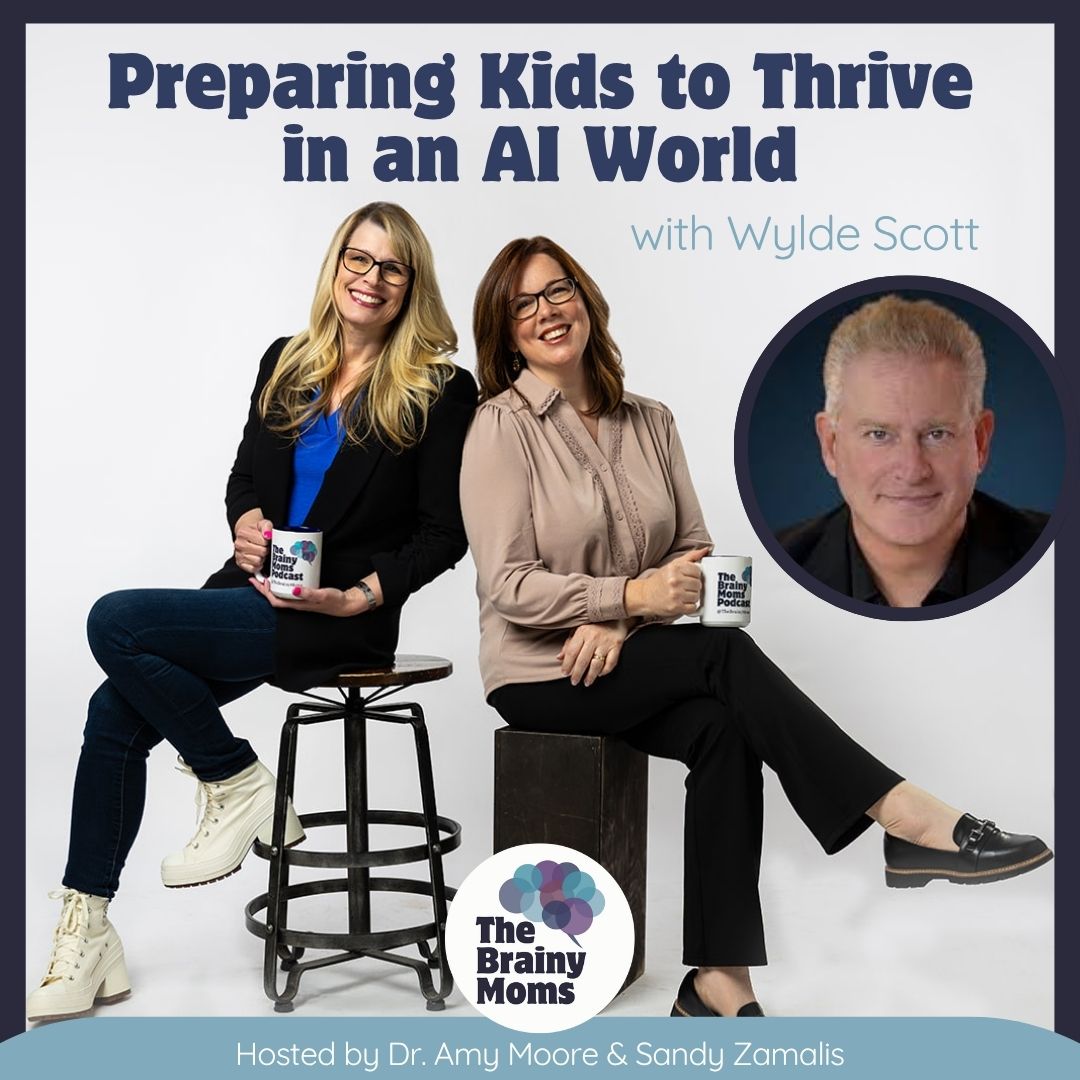
About This Episode
In an AI world, a robot can anticipate your needs, clean your house, and do your job. It sounds like science fiction until you realize how fast artificial intelligence (AI) is already reshaping the world as we know it. That speed of change forces a tough question for parents and educators: are we preparing kids to think, create, and lead when the world as we know it no longer exists?
On this episode of The Brainy Moms Podcast, Dr. Amy and Sandy have a brave conversation with author and Imagination Project founder Wylde Scott to make the case that imagination is not fluff. Instead, it is a critical and trainable skill that powers creativity, problem solving, resilience, and agency. We unpack why the industrial education model gravitates toward rote learning, standardization, and test prep, and why scaffolding can collapse when college is no longer a guaranteed bridge to stability. We also wrestle with the double edge of AI tools: they can unlock incredible creative work, but they also replace tasks that used to be someone’s job. And who is in control?
You will hear practical ideas for building “creator” habits early, especially in the five to ten window when mental frameworks stick: project based learning, safe spaces to try and fail repeatedly, and daily experiences that strengthen independence without losing human connection. We also discuss technology in classrooms, engagement problems teachers face, and why apprenticeships and mentorship may become a more direct path than the default college pipeline.
If this conversation challenges your assumptions about how fast AI is changing our world, share it with a parent or teacher, then subscribe, leave a review, and tell us what you are changing first at home or in your classroom.
About Wylde Scott
Wylde Scott is a children’s author and author of a new book for parents called Raising Dreamers: Why Imagination is the Key to Preserving Humanity in the Age of Artificial Intelligence. He is a leading voice on imagination, creativity, and human potential in the age of artificial intelligence. Through his work with children, educators and organizations, he explores how imagination shapes innovation, purpose and resilience in a rapidly changing world. Find him on IG and FB @WyldeScott and on TikTok @WyldeScott01
Free Downloads from our Sponsor, LearningRx
Download the free ebook, Unlock the Einstein Inside: Wake Up the Smart in Your Child
Download the Brain Training Game Pack
Link to our sponsor’s website: www.LearningRx.com
Listen or Subscribe to our Podcast
 Apple Podcasts
 Google Podcasts
 Pandora
 Spotify
 iHeartRadio
 TuneIn
 Stitcher
 YouTube
Watch this episode on YouTube
Read the transcript for this episode:
NOTE: This transcript was auto-generated by an AI assistant that thinks it’s smarter than we are. It’s not, but it has more free time than we do, so we gave it a low-stakes job. It probably spelled a few things wrong, but we’re okay with that. We’d rather spend our time interviewing cool guests!
Costume Banter And Authenticity
Dr. Amy Moore 0:00
Today, we’re asking a big question. In a world where artificial intelligence can answer almost anything, what does it mean to raise kids who can still dream, who can still create, who can still imagine what doesn’t yet exist? Our guest today is Wilde Scott, a children’s author and founder of the Imagination Project. He works with kids, parents, and educators and organizations to help them grow imagination and resilience. In what many are calling the age of AI. He’s also the author of Raising Dreamers: Why Imagination is the Key to Preserving Humanity in the Age of Artificial Intelligence. Our conversation today is for any parent who’s wondering how to nurture their child’s inner world while technology gets smarter and louder. We’re going to talk about why imagination matters now more than ever, how AI changes, but doesn’t erase the skills our kids need. And what you can practically do at home to raise children who are not just informed, but deeply imaginative humans. We are super excited about this conversation with Wilde Scott.
Dr. Amy Moore 0:00
Dr. Amy Moore 0:00
We expected you to show up in costume.
Wylde Scott 0:03
Man, you know it’s so funny you say that. Like I can’t tell you my crew. So, you know, I have two or three people that I work with and my wife, and this has been an endless argument about me. I actually did a couple podcasts in the in the um costume.
Sandy Zamalis 0:16
Uh-huh.
Wylde Scott 0:17
And uh I got outvoted, I will tell you that, by my own team. They were like, uh they weren’t sure the message was coming across because I was costumed and I was like, Yeah. But I will tell you, with five-year-olds, the costume brought it up.
Dr. Amy Moore 0:32
It’s a hit, I’m sure. Well, so to be honest, I’m glad you’re actually not in costume. Because I feel like our connection with you will be more authentic.
Wylde Scott 0:41
Yes.
Dr. Amy Moore 0:42
Um, but had you shown up in costume, we’d totally roll with it.
Wylde Scott 0:45
Nice. Yeah. Yeah. I I love it personally. I got talked out of it. They were like, look, we like your podcast, but I’m not sure. I’m not sure. I think the blue hat is distracting, right? From what you’re trying to talk about here.
Dr. Amy Moore 0:58
Right. Exactly.
The Mission To Restore Imagination
Dr. Amy Moore 1:00
Um, well, let’s talk about this mission that you’re on. Um, and I think you’ve just written this book, and you want parents to know how important imagination is. You want teachers to know how important imagination is. And my assumption is you want kids to know how important imagination is. And so talk a little bit about, situate it a little bit in our current state of the world and what you’re trying to do, what your message really is here.
Wylde Scott 1:28
Yeah. So for years, like part of this came out. I always in my head had a book on the imagination that was more built around my experience with children. So I spent a lot of time with children when I started writing these books. Uh, I did probably a hundred different elementary schools, a hundred different Barnes and Nobles, all kinds of fun stuff. And originally I just came up with, for example, the character Wild Scott, and you know, I really was just thinking about what would I do in front of kids if I had them for an hour, right? And um, through practice and fun and doing a lot of stuff, I started to develop this sort of routine that was all about the imagination. Like coming into these schools, like what was my message? And my message was that all possibilities exist if you believe in them, right? This is all about the imagination. Uh, through that journey, I um I created a nonprofit called the Imagination Project. And what I realized by going in and out of uh a lot of different schools is A, we had lost the art form, right? We we basically had lost a lot of creativity in play. And the ability to um, I guess what I would call train imagination. It just didn’t exist in our lexicon, right? We weren’t doing it. We very naturally um have a system that we use from the ages of zero to five just because we enjoy that period so much. We understand that their their brains are developing, we tell them fantastic stories, um, and then all of a sudden we do this weird thing where we start to rip that away at a at a pretty early age. And one of the things that I noticed in elementary schools is that stuff was happening earlier and earlier because of the context of what we all call the industrial complex, right? Like the context of test, I’m prep, test, prep, you know, this whole idea of we are preparing from the time they’re six years old for the SAT. And we just, in my opinion, we lost our minds, you know, kind of down that path. And I was experiencing all of this as I went down the path over and over again. Uh, what happened to me is last year I started to sit down and write that book about imagination and how would you train it.
Why AI Changes Everything Fast
Wylde Scott 3:34
And I’ve and I’ve done many years of research on it as a writer myself. Like I spent a lot of years trying to understand how I would improve my creativity. And the other thing that happened was I was researching schools because and education because I wanted to have some sort of intelligent foundation that matched what parents would do or teachers would do. I didn’t just want it to be my own thoughts on imagination. And at the same time, I started to uh research this whole AI thing, right? I was kind of late to the gate. I was like, what’s this whole AI thing? And the more I researched it and I understood in detail exactly what was happening and exactly what world was created, being created as we go through these motions, the more I realized, A, um, it’s not just that the old model is outdated, it is irrelevant, completely irrelevant to what will happen 10 years from now. Um, and then, you know, studying, and I and I love the fact that you guys spent a lot of time on what you call the cognitive training, right? The more I understood the brain, I did a lot of research on the brain to try and map my map my personal thoughts about how everything worked to some neuroscience, right? I was trying to create the maps, create the maps. And, you know, in that process, um just started to realize that so much of the future begins to erase a lot of what we have done and considered and thought about in terms of raising kids in the last you know century. And so it becomes irrelevant because the speed at which change comes is so fast. The predictability is not there, it’s not linear anymore. The scaffolding in education completely disappears once you remove the idea of uh getting into a college as the ultimate goal in life for a child, the entire scaffolding of the way we teach and the way we approach things begins to collapse. And so the new world that’s coming up, it has a whole different set of needs and skills for a child. And the the final connection that I made as I was going through this process was that a child who is five years old today, think about 15 years from now, their world is completely, completely different. And so what really came down to a lot of what excuse me right in this book is that if we don’t start today, you’re already pushing another gen you’re pushing another generation that will not be prepared for the world. And um the last piece of it for me was the idea of the way that the brain develops between the ages of five to ten. I started realizing when we we all have these big conversations right now. You know, anybody who cares about this stuff, you know, you’re looking at you know the Jonathan Heights of the world and you’re you’re listening to all these messaging about the damage of social media. We see it live, anxiety, depression, all these crazy things. In my opinion, um if you don’t build a fortress against these things by the time a child is 12 or 13, you’re done. Because that kid, the AI is 10 times more powerful than what we just witnessed in the past 10 years. It’s way more powerful. So if we’re not developing skill sets and mindsets and frameworks that teach these kids how to think independently outside of a device, by the time they do start picking up device, and that will be inevitable, right, for all children of the next generation. AI is here to stay, devices are here to stay. It’s all going to be a part of their life. So you can’t, you know, we can’t do the ostrich and bury them, bury your head in the ground. We have to say, what are we going to do about this? And those years from five to ten are so insanely critical in trying to create a child that has the ability to battle in some ways what they’re about to face as they begin to, you know, hit AI and, you know, and in the toughest phase of their life, teenagers. Toughest phase of their life, they’re now going to be, you know, introduced to a tool set that in you know many would consider you know evil, powerful. I mean, all these words they’ll use, but it really is just it’s the power they’re talking about, the strength of the tool set, not only to be useful, but also to be damaging, right, at the same time. So I became obsessed, as you can tell, I became obsessed with this idea that, hey, there is something we can do about this, guys. We don’t have to sit here and just pretend like it’s either, A, it’s it’s not gonna happen or it’s gonna, it’s gonna happen. And we all know school systems, big systems, everything are very slow to adapt and develop. So I’m trying to shout from the rooftops to say, guys, today is the day. We start today, and we need a brand new framework and a brand new way of thinking about this and brand new tool sets for our children to be able to thrive in that world that’s coming at them.
Ages Five To Ten Matter Most
Dr. Amy Moore 8:42
So I am one of those who um I don’t respond super well to conspiracy theories and scare tactics because I would like to just bury my head in the sand. Um, when when I read things that feel um like your book in the very beginning, I picked it up and you were talking about Gary, the AI robot, right? Who you could ask Gary to do just about anything. Gary could rub your feet, Gary will clean your house, Gary will anticipate your needs before you even know what they are. And so it scared me so much. I had to close the book. I just had to close the book. I mean, I so then I went back and um said, Why would I bury my head in the sand when there’s a message here? Right. That maybe, maybe this does need to be a neon sign to open the conversation. Um, rather than just saying, well, that’s not gonna that’s a conspiracy theory, or that’s not gonna happen in our lifetime when the reality is it’s probably gonna happen in our lifetime. So you’re being bold and brave enough to have a conversation about it and not soften that. You’re not softening that message. You’re saying, hey, pay attention. We need to talk about this. And I really respect that.
Wylde Scott 10:03
I appreciate that. Yeah. And I think um, again, I, you know, I uh what I would share with you guys is that I was not this AI knowledgeable person a year and a half ago. Like it literally was in every way just a uh as big a shock to me as you’re describing. When I started to read and understand the depths of what everybody was up to in the halls of MIT and Silicon Valley and Stanford and what everybody was really doing, um, you know, part of it is amazing, right? Part of it is like, oh my God, the things that these guys are doing. And then it becomes frightening when you apply it to the the thing, the epiphany I had in the connection was while I’m dreaming up all these wonderful things that are possible with what they’re creating, I also know I am obsessively connected to the idea of the iPhone. Okay. Because I what I will share with you is no one, when Steve Jobs created the iPhone, think about all the wonderful things he had in mind and some of the things that are productive, right? I mean, Uber is like, oh, cool. Anytime we want a car shows up, awesome. There’s nothing evil about that. That is using amazing technology to create a service that’s a that’s valuable to the general populace, right? And I would think that to us to a large extent, you know, that’s what Steve Jobs had in mind was this amazing world he was opening up for everyone. But do you think that he really even Steve Jobs thought that you would walk into a Starbucks and the entire generation is doing this? Like that wasn’t the intention, right? So the the things I would share with you on that journey that you’re talking about of moving from uh, oh my God, that sounds nutty, crazy, and 50 years out there to, oh my, we have to do something about this, is that um if you understand traditional technologies, generally what we see, it’s five years behind what’s actually happening in MIT and Stanford in those places, right? That’s the first thing. What’s even scarier is by the way, things, the iterations they used to do in tech that were two, three years are now two, three months. The iterations are so fast, the changes are so fast, right? Um, if you do what I did, which is go three levels up from being a normal person and start to really dig into and listen to and uh join conferences and all this stuff that’s going on, you really get a different picture on the speed of this transition. And that’s what was was why it became so important to me is that we are all thinking the way we normally think, right? Like we think about how we grew up. It’s a generation, right? Like every 20 years is a different generation. Our kids take 18 years to grow up. That’s done in the new world. It is frightening how fast this stuff is coming and how fast it will be here. So while we’re all conceptualizing the I robotaxis are on the street today. They’re on the think about. I’m I’m a little bit older, right? I’m in my 50s, there were no computers, there were no cell phones. Imagine us standing in the 1980s and a car drives by without anybody driving it. Right? Like, what?
unknown 13:28
Right?
Dr. Amy Moore 13:28
That’s here we’re in our 50s too, so we get that, right?
Wylde Scott 13:31
Like it’s on the road. Like it’s not it’s not the future anymore. It’s on the road. And and I will share with you guys by studying a lot of this, robots are way closer than everybody thinks. Like, literally, Elon Musk wants to produce a million a year before 2030, right? That’s not a scientific experiment, that’s mass production at scale, right? So the idea is 2030. One, two, three, four years. All right, four years. Everybody’s gonna be riding around in cars that have no driver in four years, and robots you will begin to see physically on the street in different places all over the place in four years, right? So what really started dawning on me was that a five-year-old today, when they’re in high school, will be living in a place that is unrecognizable to us in the 1980s. It is every, it’s all science fiction, fantasy, all this stuff. So the problem is if we don’t make the adjustments, we will release another generation into the world that doesn’t understand how to navigate. And and like I have uh a 23-year-old and a 25-year-old. I already feel to a certain extent we’ve done a certain disservice, right? Now, I personally try and talk to my kids. They don’t, I’m the last guy they ever listened to. I don’t know if you have that experience, right? They they like my wife way better, right? But because dad has advice all the time, right? It’s just full of advice for my daughters. And um, but I told them to do everything I thought they were supposed to do, right? I made them, they both have college degrees, you know, and then they went on to the real world. My entire attitude has changed because the rules are off. And I don’t know if you guys know a lot of, you know, the the current um age group between the ages, say, 20 and 30, with the most college degrees is also the highest unemployment rate in the country. And that’s gonna get worse. And it’s and they’re gonna start moving backwards to where they start firing. Today it’s more a lack of hiring. Pretty soon it’ll move into firing. And if you understand the tool sets, you start to really understand why they’re talking about this. Because almost everything that we are used to doing with a computer, which is what we’ve set the last 20 years of kids up for, will become doable by a machine or a robot. It will be doable. And and I work with some of these tools, and I’ll give you guys an example. Um you saw my you saw you saw my blue hat and my blue outfit. We are now animating, okay? These are dreams that I’ve had for I’ll share with you guys. I’ve been writing for 30 years. And um, Disney is my favorite thing. I don’t know if you could tell. I love children’s stuff, right? Um I’m a big Disney guy. I’m a big Sesame Street guy. Um, I love those worlds, and and Disney classics are my favorite world. And I have literally five novels I haven’t even produced yet that are all kind of a Disney classic mentality, right? And me and my team are now animating. Not one of us is an animator. No how this this is, by the way, 2026. Everything before that was me jumping in the costume and shooting stuff. We are now animating full load and doing, and we’re starting with music videos. So Suno, have you seen Suno? Do you know what that is? Yeah, we’re creating full songs in Suno. I always wanted to create songs. Always. But I did I’m not a musician. I just love kids’ songs, right? Full, beautiful songs we’re creating now in Suno, okay? Without a band, without musicians. I’ve gone into studios like three times to record songs. You know how much money we had to spend to record in studio and find the right people? And um what a you know, classic animated film costs $300 million to make. But what’s scary about that is not that’s the wonderful side, right? Look at all these wonderful things that I’m starting to do. The negative side is those are all somebody else’s job. All of those things are somebody else’s job. And that’s what our kids are facing. That’s why I’m so frightened. Our 23 and 25-year-olds, and even funnier, you guys listen to longevity, um, they’re supposed to live to 100 and something, right? So if there is this world that comes where a normal job, the mental thinking is we gotta go get a job, but if that disappears, they now have to find purpose and meaning for 80 straight years of their life. That is an entirely entirely different formula than what we’ve told them for the past 30 years.
Sandy Zamalis 18:29
Wow.
Using AI Tools Without Losing Ourselves
Sandy Zamalis 18:30
It’s an interesting discussion because because you kind of highlighted it, right? It’s two sides to the same coin. Um you need imagination to solve problems. Well, we’ve created all sorts of cool things to solve problems, which then create other problems. And now we have to use our imagination to solve that problem. And we keep on moving. And I think uh to your point, and probably uh from the beginning of your book too, when you talked about um the one robot movie that Disney made, what name has this been? Lolly Lolly. Um, or even um one of my favorite books. I don’t know if you’ve ever read it, it’s called Sophie’s World. It’s a book on philosophy. Um, but it talks about, you know, we’re all born, you know, when you pull the rabbit out of the hat, we’re all born, you know, at the top of the fur, looking around and wondering all. And then as we start to get more comfortable, we sink down into the comfort of the rabbit and don’t come out and see all the wonder that there is. And there’s always been this romanticized, I think, piece to imagination that um I I think what your argument is is that we what we really want to do is create doers and thinkers, not consumers. Does that sound like that? That’s exactly right.
Wylde Scott 19:44
What side, what side of the fence do you want your children standing on when all this comes down, right? Because there will be, of course, there will be people who are fantastic at creating something out of nothing utilizing all these wonderful tool sets, right? My the way I would describe it for you guys is percentages. I think about the percentages, right? Um, and the ideology in my brain is how many kids can we get on the creative side of the fence, right? Because if you’re just consumers, that’s the wall-e scenario, right? And what I would share when people, you know, maybe call it conspiracy theory or things like that is we already have the proof. All you have to do is look at what just happened in the last 10 years. You know, and my kids, I give an example, my kids are highly productive and effective and still addicted to their phones, right? Like, and so I worry about um what percentage of children will be able to be active participants in the world versus staring into a portal waiting on the rest of the world to tell them what to do. And I think when I talk about humanity, you know I talk about humanity a lot because I I really believe it’s all connected. Um those problems lead to a loss of human connection. That’s really what we talk about a lot when you when you listen to Jonathan Haidt and those guys. It is a loss of connection, anxiety, depression, all these, you know, terrible things we’re talking about is a loss of human connection, right? And when people are actively human connected with other human beings, they tend those all tend to be radically lowered, right? All those types of problems. And the more kids are disconnected, staring into portals and and just viewing things online, the more all these problems are gonna be evident, right, in society. And so the fear I have is we already deal with, you know, this this generation had the highest generation ever of anxiety and depression registered, right? This current we just got out of, right? Um what if that were 30%? What if that were forty percent of just a populace that is disaffected, right? Doesn’t care, is unconnected to other human beings. Those are dangerous numbers. Right. And so that’s the point for me is we can train, we can teach an entirely different way of thinking that is based in imagination, creativity, and agency. Right. Which is it’s not just that you can imagine, it’s also that, well, what do you do with it? Right. And that is the new race. The new race in life will be this um insane skill set between creativity and agency, right? Is who has the ability to do something with themselves without the external directive? Right? Without external motivation. It’s all internal. The world is your oyster, but nobody is giving you the roadmap. Who has the ability to do that? And we need to train children for that roadmap a hundred percent.
Dr. Amy Moore 22:53
Okay, so just to clarify that, what I’m hearing you say is that you are 100% on board with using tools, because tools can help us do things more affordably, more quickly, in a way that we might not have been able to reach some of the dreams that we have without new tools, right? Like you’re animating and you’re saving millions, right? That you may not have been able to spend prior. But it’s who’s in charge and who’s controlling that and who is generating the ideas. And the tool is just the vehicle for enacting those dreams and ideas. Is that what you’re saying?
Wylde Scott 23:39
It’s exactly what I’m saying. And what’s interesting is but you know, mindsets matter and mental frameworks matter, right? Um as an example, I don’t know if you saw Eric Schmidt was giving a speech late uh recently, uh, a keynote at a university, and he mentioned AI, and he was just talking about the world that’s coming. And all the students, these are high-level graduate and and undergrads, and they booed in. They all booed. The problem with that, I’ll give you the context I worry about. The problem with that is if they have that attitude, they’re done. Because another kid is gonna move right past them at blinding speed. That’s the first thing. So if you want to be a graduate in today’s society and say, I’m not touching AI, good luck with your career. I don’t I don’t know what to tell you. You’re just fighting, you’re um punching air right at that point. It’s not it’s not healthy to think that way. Um so frameworks matter because um there will be this if we don’t get it right.
Universe 25 And The Agency Trap
Wylde Scott 24:53
Have you guys heard of the Universe 25 experiments? No. Oh man, I don’t know why they should be teaching this everywhere. Um It was a social experiment from a scientist scientist in the 1960s, and he started trying to figure out basically what was happening in inner cities. Like, how do you what can we do about the violence and the things that happen in inner cities? And they were blaming things like overcrowding and you know, all and uh poverty and all these different things. And so he was trying to develop experiments that would lead to some intelligence on these matters, right? Like, what do we do about this stuff? And he started designing utopias, okay, and he started designing um these perfect rat um like resorts, right? All the food, all the water, all the space they need. And they called the universe 25 because it was the 25th time he had done it, and he was trying to perfect this version of his testing, right? And they started out, I don’t know, maybe 10 rats or whatever, and they gave them everything they need, and eventually it swelled to I don’t know, maybe 2,000 rats at some point. But within two years, the entire population died off. And they called the whole experience, uh, they came up with a term called behavioral sink. I don’t know if you’ve ever heard of that term.
Dr. Amy Moore 26:21
This was in your book, wasn’t it?
Wylde Scott 26:22
It’s in my well, no, I didn’t really write too much about it because it’s it’s so scary.
Dr. Amy Moore 26:27
Um have you written a blog about it? I feel like I just read something about this recently. But anyway, I’m sorry, I interrupted.
Wylde Scott 26:33
Yeah, I don’t know. Like um now you’re telling, now you’re making me doubt whether I put in the book. I I try to keep the book to your point, I try to keep some positivity to the book. I didn’t want it to be to be negative.
Dr. Amy Moore 26:43
Yeah.
Wylde Scott 26:43
But behavioral sync, it just all the wrong things happened that were unexpected. Meaning you you would think that with that type of environment, that there wouldn’t be violence, there wouldn’t be because nobody has everybody has everything they need, but there’s really nothing to do at that point. There’s no need to go find food, need to go find water, no need to find anything. So it starts off as a normal, you know, process where they start um breeding, they start populating. And then very soon, all of the behaviors go sideways. And so they had gangs. Think about this, gangs of rats running around picking fights with other gangs of rats. Um, they had um fights over the food, even though there was plenty of food. They had um they were incredibly violent towards each other, killing each other, all kinds of crazy things. Um there were mothers who abandoned their babies 100%, just had the baby and walked away. There were males who disengaged from society entirely and would go off to a far corner, pick a room, and they basically said groom themselves all day. And they would gain excessive amounts of weight. They would become these and they like big fat princes, right? They would just groom themselves and look pretty and wouldn’t engage with the rest of society. None of it were behavioral norms, right? And and eventually I th he had a few rats left and he shut it down. But it was frightening what they saw, but it was crazy how it did reflect to a certain extent some of the things that we see in society, right? There is no universe in my mind where a bunch of people, especially young people, standing around with nothing to do is a good thing. It is a terrible thing, right? Idle hands or the work of the devil, whatever you want to call it. And so the so the two-sided thing, Sandy, we were talking about is that everybody keeps talking about this crazy dichotomy right now. It’s like abundance and no jobs, right? Oh my God, like fantastic abundance. We can get a hamburger delivered to our doorstep four times an hour if we want to, right? You know, all this fantastic abundance. But at the same time, the possibility of nothing to do. And then you have, so you have all these people talking about universal basic income and all this crazy stuff. My advocacy is why are we waiting for all that stuff? Let’s create human beings that have agency, creativity, imagination, so that not everybody is stuck in that mindset or trap. The mindset of, hey, there’s nothing to do, so I’m going to sit around and do nothing. That is the worst outcome, in my opinion, to this potential world of abundance is a loss of agency, a loss of critical thinking, all the things that we talk about in terms of developing young human beings. And unfortunately, we haven’t designed in all our school systems all these things. They’re not designed for those things, right? They’re not designed for true critical thinking. They’re designed mostly for rote learning, right? And mastering specific tasks that they’re told they have to master, with the end goal always being the SAT. Right? The end goal is always the SAT. And it’s like all the measurements are the SAT, and all the outcomes are, you know, college, college, college, college. Well, if college doesn’t guarantee you anything, which is what’s going to happen, um, and I can give you 50 examples of kind of what’s happening in the world today around that. Um why all the need to spend 12 years of my life working toward an SAT score? What’s the point of that? And by the way, it will be too late because with the speed and agency, the people who are able to figure this out, they’re not going to go to college. The world will be too fast, too quick for you to sit in college for four years. College will become, in my opinion, a very, very narrow, specialized space, um, worse than it is today for um, you know, super brainiac scientists or whatever, you know, all these fantastic things that you might be able to do at the highest levels, um, where you want to bring people together into an environment that they can work together to try and solve things. But the vast majority of education is not really built around that, right? It’s built around some job. And that system will become irrelevant in the next 20 years.
LearningRX Sponsor Message
Sandy Zamalis 31:19
And now a word from our sponsor, Learning RX. In second grade, Isla was struggling to read despite being pulled out of class to work with a reading specialist. Progress was slow, and Isla was frustrated. She hated to read, and it was a battle to get her to pick up a book to practice reading every evening. Her Learning RX cognitive skills assessment provided insights as to why, despite consistent reading interventions, Isla struggled to read and spell. Her assessment revealed significant weaknesses in memory, auditory processing, and attention skills. See, to unlock reading ability, it is critical to address underlying deficits in cognitive skills. Isla’s Learning RX training targeted these weaknesses and her reading has taken off. At the beginning of second grade, she was reading at a kindergarten level. After brain training, she is now reading at a third grade level. Isla now loves to read and is devouring books. Your child may not achieve the same results as Isla, but the team at LearningRX would love to talk to you to see if cognitive skills training might be the next best step in your child’s reading journey. Visit Learningrx.com slash the Brainy Moms to learn more and receive a cognitive skills assessment with a consultation for just $99. That’s LearningRX.com slash the Brainy Moms.
Teaching Resilience Through Projects
Sandy Zamalis 32:39
I think so. I’ve been listening to you and um it’s fascinating because we’ve just uh come from like a bunch of homeschool conferences where we’ve talked to a lot of parents and um just in our our nature of our job, this kind of topic tends to come up a lot uh because we deal a lot with frustration tolerance and helping kids work through hard things and be able to do hard things. And I again back to that like issue of not being a consumer, not being driven by comfort. Part of I think what you’re trying to get at in that whole imagination place is a little bit of problem solving and being able to manage conflict a little bit, right? Sit in that ability to problem solve and try like a Thomas Edison, you know, you know, we’re gonna make a hundred, you know, replications of this object to see which one works the best. And we just don’t have that kind of iteration anymore because we’re used to fast and easy. So, what would be your prescription for that? Because that I think is at the core of where you’re gonna run into some trouble.
Wylde Scott 33:48
It’s basically what I would, you know, consider a flip upside down of the whole equation in terms of what education is about, right? And and I kind of really try and get into that last couple chapters of the book. Um, and part of what I want to write next is actually a lot of tool sets associated around that, right? And some of this stuff, I think, for you guys, especially in the the you know, in the the cognitive space, would be familiar with you know some of the techniques that I’m really advocating for, right? Because if you take out just math and you take out um, and and I don’t won’t take out reading because I’m I’m the biggest reading advocate in the world. Um, but if you take out kind of how we design the end goals of this and you replace it with creativity, um, imagination, resilience, adaptability, you start to come up with a totally different need in terms of what you’re doing during the day. It’s just a different set of things you’re working on. So what I’m really advocating for in that idea is that the majority of the day is dedicated to techniques, not, hey, I gotta pass a math test. But what techniques am I using to establish adaptability? Right? How am I teaching kids alternative thinking? That’s not sitting down in front of a textbook, right? And how am I teaching them creative creativity? How am I teaching them? Um, we talk a lot about, you know, some advocates, and I think just a minor part of most curriculums, is project work, right? Like when you talk about agency, the things that go through the patterns are like the definition of a North Star, right? When you think about the educational space and the psychology space, a lot we talk about motivation, right? And one of the biggest messages that I learned in talking to a lot of teachers and researching the teaching is the amount of kids that are showing up disaffected, just not interested. They are not interested at all. So, how in the world are you developing an environment where kids are not only interested, fully engaged, right? And the old formula is, you know, oh, I got this math formula, how am I going to fully? No, it’s not what type of environment are you creating daily for full engagement, right? That’s not sitting at a desk, right? It’s what are you doing every single day that makes it fun to show up in that classroom? And then in a fun environment dedicated to play and imagination and creativity, what are those exercises? What are the things that you actually are doing for four, five, six hours a day that is dedicated to these principles, right? So project work as an example, and I’m really a big advocate of understanding the difference between just take the concept of a project. We’re gonna pick a North Star, we’re gonna figure out all the tools and requirements of achieving that North Star, right? We’re going to pick a set of alternatives. How many different ways can we do this? We’re gonna use the scientific method, right? We’re gonna kind of say, hey, let’s try it. And one of the biggest things I’m an advocate for is try and failure over and over again. You get kids from the time they are five, six, seven, eight years old into the game of trying and failing and trying and failing without the emotional attachment, they become masters at that game. No one’s afraid to try. They love to try. I always say when I’m with children, the greatest thing that I ever get in my life is this. The rate I want, I want to be a part of this conversation, right? Please let me be next. So a lot of the techniques, I spent a lot of time in after-school programs as well, trying to facilitate these techniques in my mind with children live. And when you focus all your attention on that idea, those ideas, like I’m A, they have to be engaged. B, I’m creating a setting. I can pick a problem, but I’m gonna create a setting and a game, or I’m gonna create a lesson that is fully engaged in this process. It’s never gonna be sitting at a desk standing there. And then what are my guiding principles? Is it math? Well, maybe, but it’s again, what lessons do you have that are 100% designed to create resilience? Do you have a lesson plan that’s about resilience? What game, what lesson, what project are we doing that you’re trying to implement resilience in it in a children’s brain, right? And so part of what I’m talking about, the prescription is that every day we are building those types of environments, right? It is a repeated process, doesn’t matter, you know, we know the brain emotionally, all these things connect, connect, connect, connect. And the more that you can throw them into these environments and have them come out with a smile, the more all this becomes frameworks, mental, permanent mental frameworks. Hey, I’m capable, right? Hey, do you know how to pick a North Star? You you have a kid who knows how to pick a North Star, say the kid, we’re gonna pick a project today. What do you want to do? What’s your favorite thing? And what’s a project based on that, right? And the the ability to make up, pick, select a North Star, the ability to design a project around that, design, say, a scientific method to test something, make four or five choices to try and fail repeatedly and be happy about it, right? And I’m and I’m also a big believer that confidence, in my opinion, all comes from one thing and one thing only. It’s or maybe two things. It’s safety and success. Right? Confidence comes from the idea that there’s a safety zone in some way. So the safety zone for me is you know, any type of environment, I don’t care if it’s homeschooled or in a classroom, where you’re safe to do all these crazy tries and fails, right? And then the confidence really comes from successes in that environment, right? If you tried and failed and tried and failed, and then you got a few successes, you’re not afraid to try, you’re not afraid to fail, and you start to build confidence, right? And the whole idea for me is that if you’ve got, you know, 10 total years in my book from the ages of two to 10 to create solid foundations before they they hit the toughest stuff, right? How many times can you take them through these patterns so that they’re habits and so that they’re permanent frameworks for these kids? And what we don’t do is we don’t prioritize, is the way I would describe it. We don’t prioritize adaptability. We’re not prioritizing imagination, we’re not prioritizing creativity, alternative thinking, um, trial and error, scientific method, first principles thinking. We can teach all this from the time they’re five. It is simply the intention to create age-appropriate scaling. Like, hey, this is what you would do with a five-year-old to kind of have fun in an environment and still be pushing creativity and imagination. And what would you do for a six-year-old? And what would you do for a seven-year-old? And what would you do for an eight-year-old? We have all of that today based on our old goal sets, right? That’s what we do. It’s curriculum-based, right? What’s the curriculum? And everybody spends unbelievable amounts of time on curriculums based on those principles. We have an end goal, and we’re trying to do this for a five-year-old, a six-year-old, seven. How would we walk them through eight months of schooling to get them to the next level? So, in my opinion, we need to throw out all the old handbooks and start saying the main goals are based on what this child will need in the 21st century. And it’s just a different framework. It’s a different goal set than we’re doing today.
Hybrid School Models And Standards
Dr. Amy Moore 41:43
All right. So I’m 100% on board with your philosophy. 100%. I have a Reggio Amelia background in early childhood, and that’s all project uh-based discovery learning. So I’m 100% on board with everything that you just said. So, how do you integrate that into an institutionalized system that is dug in, right? The heels are dug in in not only traditional school systems, but uh regulations for homeschooling, because those regulations are set by traditional school systems, right? And so that’s almost even scarier for the homeschooling parent who says, Hey, I’m being watched. I’m being told that I have to cover the same curriculum that’s happening in the traditional school system down the street. It seems like, I mean, this has to be a systemic change and not just something that a homeschool mom in Virginia can enact independently. Yeah, this is part of and still meet those standards.
Wylde Scott 43:00
Yeah, this is part of my big advocacy right now because I will tell you that it’s already happening in, you know, the kids who live in Boston and Cambridge, right? It’s already happening in the kids who live in Silicon Valley. Those private schools are dramatically shifting their directions already. So everyone else gets left behind, which is one of the biggest things for me when I created the Imagination Project was my experiences in a lot of Title I schools and understanding the difference between what it’s like to grow up with tons of resources and tons of positive influences, and then what it’s like to grow up with no resources and not a lot of whole, not a whole lot of positive influences. It’s a it’s a doomed start, right? Or the percentages 90% like when my daughters went to school in high school, it was in I don’t know, 97% were college graduates of the high school, meaning that was the destination. But you Know you go to an inner city school, the admission rates, right? It’s the percentages that all fall apart in bad environments. So I’m advocating hardcore because yes, like I’m a diehard, I already know this because I know how the systems work. Um, you’re gonna deal with uh this guy named Salim Ismail who calls it the immune response, right? It’s an allergic response to new ideas. So we’re we know this is gonna happen. We know this is part of the equation. I had a consult I did for uh someone building a big private school, and they were asking me the same equation because we know um like they can’t even open their private school if they’re not gonna meet certain state requirements and standards, right? So they can be innovative, but they still have to meet the standards, or they can’t get licensed appropriately, right? Right now, what I’m advocating for, I talk about in the book, which is the best and brightest of the AI models. Um they focus on individual instruction and they are creating learning curves and patterns that are far outstripping um normal results, right? And they’re being used in very exclusive schools in very exclusive ways, right? So if you walk into an elementary school, like right now, I’m looking at a lot of teachers’ conferences, part of the big thing is this crazy argument between AI or no AI. And it’s they’re not really doing a good job of understanding the nuances and the complexities, right? It’s AI or no AI. And I’m not an advocate. I will tell you, like, I uh is it I think guys, is it Jeremy Horvath, the guy who just wrote the book on the Jared. Jared Horbath, right? Jared, yeah. You know, he writes this book, and it’s and I and I think and I think that his book just he the research behind it shows what we kind of all were worried about, that just throwing technology in schools, you know, is not the answer. And I’m the biggest teacher advocate on the planet. I think we fail without good teachers as a society, quite honestly. So the current thing that I’m advocating for is that if you all these schools are spending unbelievable systems are spending millions on these AI systems and all this stuff. And I’m what I’m advocating for is flip the day. Take that AI, do two strict hours of the highest form of the learning that is based on these standards and protocols. What standard am I trying to achieve? Because I I think SATs and PISAs and all that should be erased. But I agree with you, that’s not going anywhere for 10 years, right? So smart school systems are going to build a hybrid in the meantime. And the idea is stealing as much time of the day as we possibly can to reinvent the environment. And that, but if all the systems and programs that do nothing and continue will will be failing all of their children. They will be failing all of their students by not adapting. Because 10 years from now, they will come out to a world where they’re expecting, you know, I don’t need to take my SAT and I need to go get into a college, but the rest of the world is moving way past that at lightning speed, right? And I I I’ll give you an interesting analogy of what’s really going to happen. Today, when you go to MIT and you go to Stanford and you go to the brightest minds in the world, do you know what’s happening in their undergrad programs? These kids are dropping out and getting funded for $10 million companies. The capital is replacing the university environments. The reason so many of these kids, you know, used to fight to go to a place like that was because the lab was there, the other bright minds were there, all this wonderful stuff was there. And that, to a large extent, you know, would benefit a university like MIT because they became known as the greatest place on the planet for this type of innovation. And all the government funding would go to them, company funding sponsorships, everything just went in that direction. What’s happening now is they’re starting to exit out without the university. Kids are 21 years old, they’ve been in school for three years, they’re super genius bright. So they’re coming out with just a concept or an idea, and the venture capitalists are throwing, you know, $10 million at a set of three kids who are 21. I mean, it’s crazy, right? It’s happening every single day in the brightest places in the country. So if they’re not finishing school and they’re all dropping out of school because the world is too fast, what’s going to happen to the rest of the kids? Right? So that’s one analogy I think about all the time. The second one I will share with you is um I’ll share a couple things with you. And I’m not trying to, I’m just trying to say how important this change is, right? Um the idea of AI agents is the hot new topic, right? You basically create a personal assistant, it washes your dishes, right? This like the crazy, you know, what the capabilities they’re talking about, right? What’s really happening in the business space is the place that it has wrecked is coding. And we just spent the last 20 years telling all the brightest minds in the country, go be a computer science major, go be a coder. The number one field that is dropping through the floor in terms of college placement is computer sciences. That’s the craziest thought process in the world, right? Um, but the agency thing with these AI agents, what everybody’s learning how to do is one person do the work of 10, right? That’s the whole idea of this. And it will displace a large layer in the middle. But even when we talk about things like entrepreneurship, right? Like, okay, so uh there’s some people in Silicon Valley are just so disconnected from reality. They’re just like, well, everybody will start a company, right? I’m like, yeah, that’s how it works, right? We’re not even trained for that, right? Everybody just start a company because they come from a world where everybody does start a company and everybody has access to $100 million. That’s not the rest of us, right? So what happens when you have, you know, the the brightest of us are dropping out of school to start companies because that’s the new thing. They’re using all these fantastic AI tool sets. And the scary part is the next Google will not have 100,000 employees. It will have five employees at best. Because they are training this to be super systems where there’s 40 people or 40 agents doing the job of one person using 40 agents, what used to be 40 people’s job responsibilities. And so when systems um, you know, they basically this immune response, like, oh, we’re not going to do this, we’re not gonna do this, they are doing such a tremendous disservice, I will tell you, they will continue to do this for the next 10 years. To what I care about the most is A, the general populace, because we we have not been designed or taught how to operate in a world that is highly entrepreneurial and highly competitive. We are really designed to do what is told, right? We’re just told pick a path of multiple paths, but it’s the same path, right? It’s education, try and get into a great college, go do that thing that says you have some degree in a chosen field, and then come out and look for a job or a company that’s going to give you that chosen field, right? We are not designed as a populist in the general populace to think highly innovative creative thinking that is on the fly creating companies and doing this and that. The only bridge I see as a quasi-decent bridge is the fact that everybody created this creator economy, right? They call it a creator economy that we’ve all been living in. Everybody’s got podcasts, all this stuff. But I think what people don’t realize is for every one highly successful creator who makes millions of dollars online or whatever, there’s 10,000 people also trying that, right? Who have not succeeded. And the end game for me is always this idea of the general populace. How many active participants do we have that are succeeding in life? And the lower that drops, the more we lose humanity. That’s the humanity equation I keep talking about, right? So um, so I don’t have a perfect formula for what we do about these large systems. Um, but what I would advocate is a hybrid model throughout this shift, almost like a titration. We’re trying to move that bar as fast from the old school to the new school as humanly possible, and that anybody stuck in the um and trust me, I’ve talked to school, I’ve I’ve been ignored by school districts planning on this topic.
Phones In Class And Teacher Burnout
Wylde Scott 52:53
Right. Entirely my own school district where I’m at is not returning my it’s not even giving me a shot at the conversation.
Dr. Amy Moore 52:59
Because they’re entrenched in the way we’ve always done it. Yeah. Right? This is how we’ve always done it. And so change is terrifying.
Wylde Scott 53:08
Yeah.
Dr. Amy Moore 53:08
For sure.
Wylde Scott 53:09
It is terrifying. And um, but this is not what I would share is I’m sure you guys, this is not unusual. This is normal. Dramatic change frightens everybody. Um, we’re stuck in the old. I mean, you know, again, I’m not like one thing I don’t advocate for is I’m not gonna be a Ludite, right? Like I know all the dangers, but standing outside a loon factory, you know, breaking down the right, the machinery, that’s not gonna help us. It’s not gonna do anything for me. It’s it might come because people are frightened. Um, but we need to make the turn. And and you know, part of like why I’m going after parents, I’m trying to talk to parents a lot in this book, is because they need to recognize that. They need to be accountable and responsible for this idea because, again, traditionally in society, we have learned to turn over our kids with the exception of this, you know, now current homeschooling movement. But for the majority of 100 years, we turn our kids over to a system for their development and education. And so now there is this parental responsibility. But I think uh you can’t, everybody can’t be a homeschooler. It’s not gonna happen, right? And not everybody’s meant to be a homeschooler. And I don’t know if you guys saw that where I write about in the book with the analogy of a fire station. Like we all know how to put out a fire. If your kitchen’s on fire, you take a rag and you stomp it, or a grease pan, or you spray your little um fire extinguisher. We all have the basic concept now of what it is to put out a fire. But if your kid was trapped in a four-story building and the whole thing is burning down, do you think you’re equipped to be a firefighter? No, we’re not. And so the average person is also not trained to be a great teacher, right? So I’m really advocating for I think there’s a massive renaissance in the idea of teaching. A massive renaissance in the idea of the value of a teacher. Because now they can go from this person. Teaching is one of the worst professions in the world in terms of appreciation, right, for what they actually do. And anybody who spent time in a classroom with a bunch of kids, you know, for a full day, it’s not an easy job. And then the expectations are ridiculous. And then I think in many cases, in the U.S. especially, but in many cases, we took the joy out of teaching, right? For a lot of these people. It’s got one of the highest burnout rates. You know, teaching has one of the highest rates of people within five years quitting the profession entirely. It’s crazy, right? Um, I think we have an opportunity to reinvent the whole thing to the idea of what teachers, I imagine someone who signed up to be a teacher actually wanted to do, which is to be incredibly inspiring and incredibly valuable to a young person’s life. Right. And I think we have the capability of reinventing that in a way that is joyful and fun all day. And that your kids, when they walk out of the room, walk home with grins, and come back with the attitude, you know, there are kids and that will say, I don’t want to take summer vacation, right? They’re like, they’re so, and it’s usually the little ones, right? It’s not the teenagers, right? But you know what I’m saying? It’s like to be able to create those types of environments, uh, I think is benefit, a benefit to both sides of the equation, right? It’s children wanting to come to school and be engaged and super excited about what’s going to happen today, and teachers who have something to look forward to as well, right? Who want to come and share joy and experience something fantastic and fun today with a bunch of little minds that are engaged, by the way, because I can’t imagine the stories I’ve seen, I’m sure you guys have too, of the disengagement, right? Imagine walking into a class and you spent look at minimum four years of your life becoming a teacher. Many have master’s degrees now, and you you walk into classrooms and within five years, all your soul is sapped because your students are not paying attention and you can’t get through to their brains anymore because they and we all know the science, right? The science is the dopamine, the fast dopamine, the fast dopamine, the fast dopamine. And if you look into the phone, the world is crazy cool. Everybody’s got a yacht, everybody’s got a jet, right? Everybody’s in a visa all night long. And do you think that kid wants to come sit and pay attention to you on right, 18th century history?
Dr. Amy Moore 57:53
Sure, my frame rate’s not as fast at the front of the class, right? I mean, it’s the reality.
Wylde Scott 57:59
Yeah, so it’s like that’s the challenge. And so all those things are they factor into my thought process, right? Is um the devices are gonna be there. I think they should be banned. No, I I was shocked, and my my kids, like I said, in their in their elementary school, but certainly junior high, the phones started being allowed in the in the classroom. And I I was dumbfounded. I just didn’t understand. What are we doing? I don’t understand. Why are the the phones? I’m sorry. And then it just became one big excuse, right? Everything was a big excuse for everything but some discipline, some adult adulting, right? To say, no, no, no, no, no, guys. We’re not having we’re not having a cell phone in a class with 13-year-olds. It’s not happening. Right? And the tea and who you know who was primarily to blame? But the parents. The parents were like, what if I need to get a hold of my kid? Okay, I understand it, but you understand you’re you’re letting your kid, they were texting each other and videos and all while the teacher’s trying to teach. How would you expect that teacher to get through on any complicated or difficult subject if A, their lesson plan is based on standardization and conformity, and B, what’s in their hands is way more exciting.
Dr. Amy Moore 59:14
Yeah, can’t compete.
Wylde Scott 59:16
You can’t compete.
What Parents Can Do Today
Dr. Amy Moore 59:17
So what do you want to leave parents with? Like, what’s your number one tip?
Wylde Scott 59:21
I think my mind is what should they do today? Yeah, I think the number one thing I always talk about is that they have to, number one, they have to completely change their mindset. They have to accept that 10 years from now will be very different. Very, very different. And the deep question for every parent is what is our job, right? Is our job to be convenient for us, or is our job to prepare that little human being to be successful in the world? And if if your job and your belief and your love for your child says, I need to prepare this kid, then the standard equation today is not appropriate, right? So the parents have to start realizing we need to do something about it. We if you just sit for 10 years, you’re done. Number one. Number two, these things are very teachable. And hopefully you guys, like I, you know, I was watching a lot of the stuff with you guys, and you know, you talk about this cognitive training, right? The brain is so adaptable. The brain is so, we can create so many things that we want to create. It is about time, focus, and energy, right? And I say this in a lot of my talks. If you focus 10 years of your life on a golf swing, you’re gonna get pretty good at golf, right? Why? Because you just stood around all day swinging. Do you guys have any idea how much money is spent across the world on a golf swing every year? $70 billion.
Dr. Amy Moore 1:01:04
Wow.
Wylde Scott 1:01:04
Country clubs, coaches, clubs, training on a golf swing, right? So my message to all parents is this is very trainable, these skill sets. These skill sets are very trainable. And the frameworks I’m talking about, you can embed in your child in a permanent way that will set them up to be participants in the new world, right? This idea that Sandy was talking about between creators and consumers. They’re guaranteed to be consumers. They don’t have to do anything but wake up. If you want them to be active participants, you need to design little creators. Right? You need to design small children with incredible creativity and agency. And the last piece of it that I really focus on in the book that is not separate is the idea of human connection. And I believe when we talk about these classrooms, like homeschooling is great, but I also still have a hard, a hard connection to the idea that we bring people together every day. And the reason for that is we have just witnessed what happens when someone disconnects in the last 10 years. An entire generation of disconnected people staring into a portal. So the big thing for me on that topic is just once again, it requires intention. If we as parents are not active in this equation, I can guarantee the outcomes. I know what they look like. It is a child disengaged, addicted to their phones, addicted to sitting in front of a screen, receiving the world. That is the guaranteed outcome if we as parents are not actively involved in changing this pathway.
Apprenticeships Over The College Default
Sandy Zamalis 1:03:04
I wonder if an answer to your question, uh, Wilde, is bringing back apprenticeships.
Wylde Scott 1:03:10
100%. So what I didn’t talk is I’m I’m trying to get people to pay attention so much to the age group before 10, because I’m so afraid of um kids with poorly developed skills hitting the teenage years with mass technology, right? Um, but the second piece that I’m gonna write as a book is about the second phase. And what do you do? Okay, so let’s say we did a great job of up till 10 years old. Really fantastic little minds, adaptable, resilient, creative, all these fantastic things. Well, what now? Well, the old school system of college breaks down. The world is going to be too fast. So starting at 12, all training should be agency training. Right? There’s two things I think about after the age of 12, agency and morality, right? Which is that we do heavy agency. We’re trying to really focus them in on, and now we provide the tool sets. Now we open up the tool sets and say, okay, you have this amazing tool. You could do anything in the world. What do you want to do with this? And we do heavy training, training, training, training from the ages of, say, 12 to 16 on the idea of these projects or create a company or whatever it is that they want to do. Suno, create a symphony. Like imagine telling a 13-year-old create a symphony, right? But the idea of this agency training repeatedly is that you are giving them the skill sets, it’s not just theoretical, it’s a skill set on how to create things out of thin air in life. How do you use the tool sets available to you in the world to make something, to drive purpose, to drive meaning? Um, and I and I believe 100% when I talk about these things, like um when you think about the companies being created now, all the SpaceX companies, like if you were really trying to figure out what a successful career might be that wasn’t based necessarily in entrepreneurship, you would think about things like these spaceships being created. Would you work at a robotics company? What would you do? And my 100% belief, these almost all will become apprenticeships. I don’t know if you know, you guys know this, but you know, companies like SpaceX are now hiring directly out of high school. They’re skipping college. And so I believe in apprenticeships 100%. I don’t care what field it’s in, I don’t care if it’s music, right? You want to create music, you have all these wonderful skill sets, but why not intern with amazing musicians or producers or an artist, right? I mean, in the old days, when you think about the old schools of art, you would go work under masters for half your life. And then hopefully produce a piece of art that was worthy of the world, right? And so, yeah, I’m a big advocate. I think it in as is so some of my background, guys, is I’ve been in Massive companies and 30 years in different types of companies and industries. And um in many ways, that that model is also a failure, right? In about a thousand different ways. But I think that the value of apprenticeship can would have skipped 10 years for everybody in corporate America. If you had one mentor who understood what it was you wanted to learn, and they already had those skill sets, and they just spent time with you. You could have skipped college, you could have skipped 10 years of your working life and mastered it within three years, right? And so I believe in that power, and I think that will become the norm. What will become the norm is a rapid shift from childhood, which is maybe 10, 11, 12, to um full agency as a quasi-adult, you know, 16, 17 years old. And rapidly those will move into, in my opinion, a lot of internships because it will be more direct learning. I have a path, I figured out something I want to do, and I want to learn from a master, right? Someone who knows more than me is better than me. And again, it it skips this whole idea of college, you know? And I can tell you as a so I have a long history and background in finance. I don’t know how long you guys want to go, but I can tell you another story. Um so I have a long background in finance, CEO, CFO positions. And a friend of mine called me this week, uh, an old friend, she’s our age, and she created a really successful company in Miami. So someone I grew up with. And um she was struggling with the CFO position. She’s and she’s trying to recreate her company in a way that she can start elevating out, right? She’s created it, she worked hard, now she wants to create layers of people who know how to manage. But it’s very much a personal-driven business, right? She has three sons, one’s in med school, one’s a lawyer, and the youngest one says he’ll go work for mom, right? So they call me up and they start asking me about finance and paying all these fractional CFOs. And I said, Why would you do that? And she said, Because I’m struggling with the finance piece. And I said, Isn’t Nicholas in school for finance? She goes, Yeah. I go, where’s he at? She’s like, he’s got one more year. So, okay. And he wants to work for you, right? She goes, yeah. I said, I can I can teach Nicholas how to be your CFO. So I can do it on weekends. I can teach him how to do it. And she was surprised that I was saying this, right? So what do you mean? I said, what, you’re telling me he’s going to school? He doesn’t know the basics of accounting and finance? She goes, yeah, yeah, yeah. But he’s thinking about you know getting a master’s or an MBA. First time in my life, I said to a young man, don’t waste your money. Don’t do it. I said, you can. I’m not telling you what to do. I said, but you’re telling me you, and the mom’s company is very successful. And I’m like, you want to take over your mom’s company, right? Yes. Your mom’s struggling with finance, right? Yes. I said, give me six months, I’ll teach you how to CFO the whole company. And you know, it’s my time, my personal time. This is family to me, so it’s not that big of a deal. But I’m being honest when I tell them, you don’t need four years of college or an MBA. I can teach you how to do this. Right. And I just wanted to share that with you in terms of the apprenticeship conversation. Is the idea of him going to school from MBA, and I know thousands of MBAs, um, and wasting another $100,000 to do what I can teach him how to do in a few months, it made no sense to me. You know, and I think what’s gonna happen is we are all gonna see that play out a lot in the next 10 to 20 years. Where these, the old way we, and we all, I grew up at the same time you guys did. I made my kids go to college. Like for daddy, you’re gonna get a college degree. For daddy, you’re doing, I’m by the way, the first person in my gener in my family to ever have an education. So this was a personal pride thing, right? You gotta do it. Guess who paid for this? Daddy. Now I’m like, man, what did I spend all that? Did I spend all that money for? The whole world is telling me that college doesn’t matter, right? They did it for me. But it, but I don’t, I don’t sweat it because it was the way we grew up. It was the teaching that we had, the foundation of society. Everything worked in the way we were taught. This will not work 10 years from now. That’s my you know, my big message. And we have the power to work on this. We have the ability to do something about this. And I’m a big believer that you can crazily influence a kid’s mental capacity from a very early age. You can have massive influence and you can really develop incredible little human beings if you believe in that, if you believe in them, if you believe they’re capable. And I think this is a wonderful thing to a certain extent, replacing the idea of the industrial education model with the idea of developing humans. That is an incredible thing. But to Amy’s point, it’s gonna take, it’s gonna be like, you know, drinking from a fire hose, right? You’re gonna be fighting your whole life to get it. The wall’s broken down, right? We’re just gonna be trying breaking down these traditional walls. But listen, it takes people like you guys. I’m on this podcast because I really believe we we have to start talking about these things. And there will be a general consensus shift in how this all works. And, you know, hopefully I’ll I’ll I’ll gain some ground. I’ll gain some traction in this process, right?
Where To Find Wild Scott
Dr. Amy Moore 1:11:52
Well, and I think that, you know, people make change with their feet, right? They make change with their vote, but they make change with their feet. And so, you know, as the homeschool movement continues to grow, that is sending a message. That is sending a message to traditional schooling that there’s something missing or something wrong. Or, right. So whether people are, you know, moving to charter schools or private schools or homeschools or kind of hybrid schools, hybrid schools on the right. Like they’re even if they’re outsourcing their you know, different educational requirements, that’s sending a very powerful message to the entrenched institution um of traditional schooling that was created by the way to produce, you know, soldiers who followed orders. In Europe and America thought, what a great idea, right? And so maybe sometime we decide that we need a new idea uh that’s aligned with the future of our world for sure. And so I really appreciate you coming on and bringing this to our attention and scaring us a little bit because I think we need to just stop and go, whoa, let’s listen to it’s the worst part, is I want people to pay attention, right?
Wylde Scott 1:13:06
I really do want people to pay attention. But the the the message is actually positive. There’s so much we can do with this. So I hope we have we really just start really having this conversation.
unknown 1:13:16
Yeah.
Dr. Amy Moore 1:13:17
So how can our listeners find more from you?
Wylde Scott 1:13:20
Uh so uh obviously I’m hoping um they’ll think about buying the book. It’s called Raising Dreamers, and it’s on Amazon under the name Wild Scott. Um, I’m actually creating a channel called Raising Dreamers um on YouTube that is really just about the foundations of this book and having these continued conversations. Um and um if they have children, there is Wild Scott, um, a YouTube channel that’s just Wild Scott videos that is for young children. They can watch that too.
Dr. Amy Moore 1:13:51
And then how can people follow the progress of your new projects?
Wylde Scott 1:13:55
Um if they say, so I have a website, wildscott.com, www.wildscott.com, and I also have, you know, um uh it sounds like uh too many things, but I do have a thing called the Imagination Project, and it’s imaginationproject.org. And it’s a it’s a nonprofit that I specifically created, to be honest, because I I always knew that in the US we call them Title I schools, but the schools that are have the fewest resources struggle behind all of their kids, right? And the main thing that I wanted to create with the Imagination Project was to not let that specific cohort of people lose entirely because of the things we’re talking about, right? And so the Imagination Project was created for me to go into schools to inspire kids all day with imagination. And now I’ve added the idea that I want to help teachers make this transition. I want to help teachers convert their classrooms into these really wild environments where kids are having a fantastic time and they’re building the skill sets that we’re talking about.
Dr. Amy Moore 1:15:02
Wild, thank you so much for being with us today. We really appreciate you taking time out of your schedule to bless our listeners with some ideas that uh they really can chew on and um have influence over. So thank you for being with us.
Wylde Scott 1:15:17
Thank you guys. Thank you so much for giving me the time.
Dr. Amy Moore 1:15:19
All right, we’re gonna close the show. Uh so listeners, we love it that you choose to spend this hour with us every week. Uh, we hope that you feel a little bit smarter after listening to this conversation. If you want more from us, you can find us on social media at the Brainy Moms or at our website, thebrainymoms.com. And you can find Sandy on TikTok at the Brain Trainer Lady. So, look, that’s all the smart stuff we have for you today. We’re gonna catch you next time.
Top of Form
Bottom of Form