
Is it AuDHD? When ADHD and Autism Occur Together | Dr. Norrine Russell
About This Episode
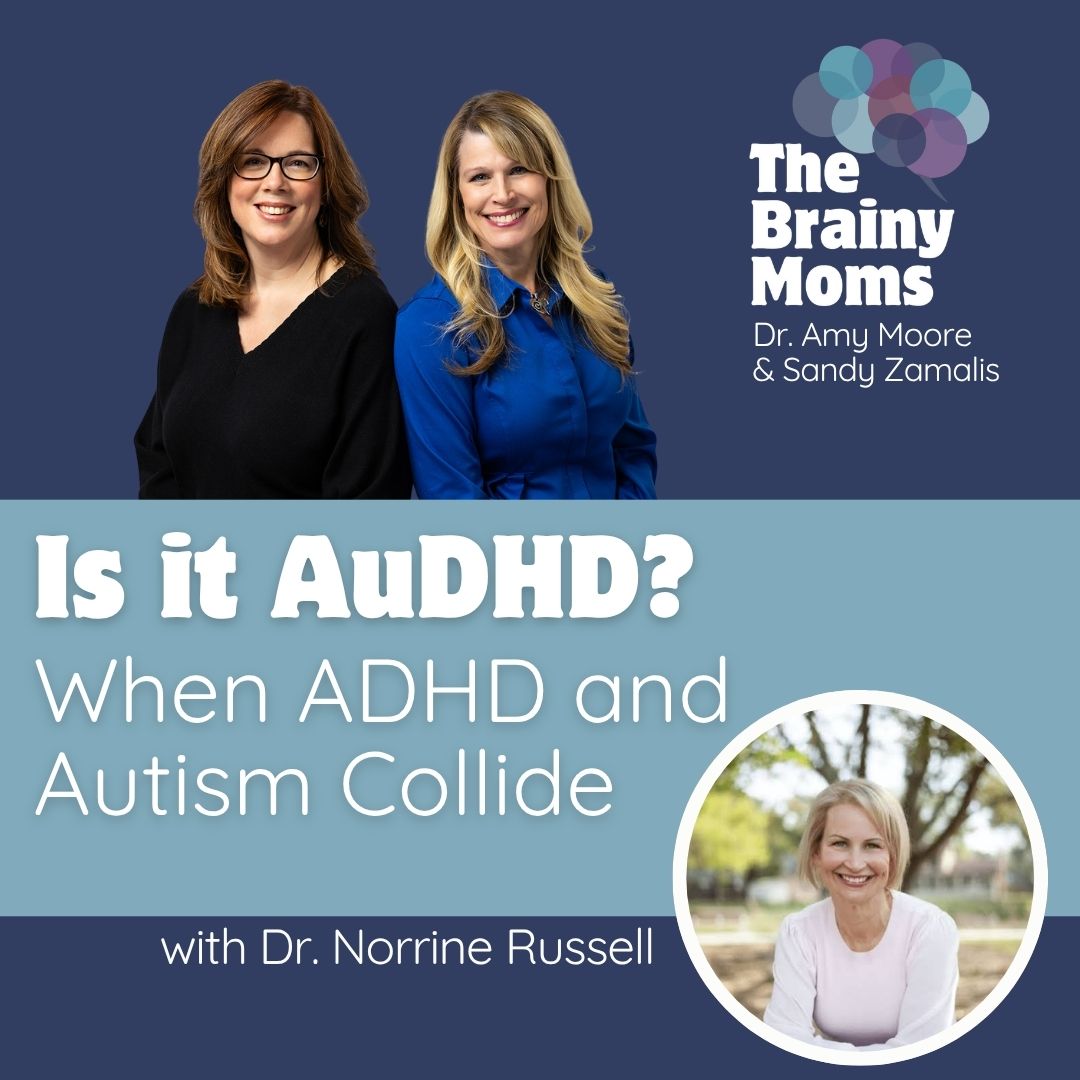
Could your child have AuDHD? If you have ever wondered whether your child’s ADHD is the whole story or whether autism is also part of the picture, this conversation is for you. On this episode of The Brainy Moms Podcast, Dr. Amy and Sandy talk with AuDHD expert Dr. Noreen Russell, founder of Russell Coaching for Students and host of ADHD, Autism, and Anxiety: Breaking Out of the Box, to unpack the growing term “AuDHD” and what ADHD and autism overlap looks like in real homes, real schools, and real nervous systems.
We dig into why “ADHD plus autism” is not just double the challenge, but often a push pull experience that can feel exponentially harder. In fact, it’s more like “ADHD times autism.” Dr. Russell shares an unforgettable metaphor: ADHD can look like a foot on the gas, autism like a foot on the brake, and AuDHD can feel like living in constant tension between the two. We talk sensory processing issues, rigidity and sameness, meltdowns versus shutdowns, and the day-to-day moments that confuse parents most, like wanting constant movement while needing everything done in a very specific way.
We also get practical about parenting strategies that actually fit this neurodivergent profile: when accommodation is the kind choice, how to watch for developmental readiness before pushing flexibility, and how to practice skills in low pressure moments so you are not “poking the bear” during high stress transitions. Finally, we cover why a comprehensive assessment can be worth it when questions linger, what signs suggest autism alongside ADHD, and why support for parents is not optional, it is essential.
Subscribe for more brain-based parenting conversations, share this with a friend who needs language for what they are seeing, and leave a review so more families can find these tools.
About Dr. Norrine Russell
Dr. Norrine is the founder of Russell Coaching for Students, a nationally recognized practice that supports complex learners, including those with ADHD, autism, anxiety, and learning differences. Through her innovative connected coaching method, since 2009, her team has helped thousands of students thrive while also guiding parents towards more calm and confidence at home and at school. Dr. Russell is the host of the podcast ADHD, Autism and Anxiety, Breaking Out of the Box, where she shines a light on the real world experiences of neurodiverse families and she offers practical, hopeful insights. She’s also the author of Asking the Right Questions Before, During, and After Your Child’s ADHD diagnosis, a trusted guide for parents navigating the diagnostic journey. With more than 20 years of experience in youth development, psychology, education, and positive parenting, Dr. Russell consults with schools nationwide, delivers professional trainings, and speaks widely on child development and neurodiversity. She’s dedicated to turning chaos into calm and is a sought-after voice for families, educators, and organizations committed to helping students grow and succeed. Find her at https://russellcoaching.com/ and her podcast at https://russellcoaching.com/podcasts
Free Downloads from our Sponsor, LearningRx
Download the free ebook, Unlock the Einstein Inside: Wake Up the Smart in Your Child
Download the Brain Training Game Pack
Link to our sponsor’s website: www.LearningRx.com
Listen or Subscribe to our Podcast
 Apple Podcasts
 Google Podcasts
 Pandora
 Spotify
 iHeartRadio
 TuneIn
 Stitcher
 YouTube
Watch this episode on YouTube
Read the transcript for this episode:
NOTE: This transcript was auto-generated by an AI assistant that thinks it’s smarter than we are. It’s not, but it has more free time than we do, so we gave it a low-stakes job. It probably spelled a few things wrong, but we’re okay with that. We’d rather spend our time interviewing cool guests!
Welcome And Guest Intro
Dr. Amy Moore 0:00
Smart Moms and Dads, welcome to another episode of the Brady Moms Podcast, brought to you today by Learning RX Brain Training Centers. I’m Dr. Amy Moore here with my co-host Sandy Zamalis. And Sandy and I would like to welcome our guest, Dr. Norrine Russell. Let me tell you a little bit about her in case you don’t know who she is yet. Dr. Norrine is the founder of Russell Coaching for Students, a nationally recognized practice that supports complex learners, including those with ADHD, autism, anxiety, and learning differences. Through her innovative connected coaching method, since 2009, her team has helped thousands of students thrive while also guiding parents towards more calm and confidence at home and at school. Dr. Russell is the host of the podcast ADHD, Autism and Anxiety, Breaking Out of the Box, where she shines a light on the real world experiences of neurodiverse families and she offers practical, hopeful insights. She’s also the author of Asking the Right Questions Before, During, and After Your Child’s ADHD diagnosis, a trusted guide for parents navigating the diagnostic journey. With more than 20 years of experience in youth development, psychology, education, and positive parenting, Dr. Russell consults with schools nationwide, delivers professional trainings, and speaks widely on child development and neurodiversity. She’s dedicated to turning chaos into calm and is a sought-after voice for families, educators, and organizations committed to helping students grow and succeed.
When Simple Fixes Take Forever
Dr. Amy Moore 1:33
an episode a few weeks ago, the guests um uh video only recorded for 29 seconds. And so I spent two days um doing the help chat. The AI bot finally had to transfer me to a human. Anyway, long story short, all of the episodes record to the cloud automatically. And so you can always access a lost recording like that out of the cloud. Why could AI bot not just say, grab the cloud version?
Dr. Norrine Russell 2:09
Right.
Dr. Amy Moore 2:10
Two days.
Dr. Norrine Russell 2:13
Two days. It’s so frustrating when there are easy solutions to things like that, and you spend all of your time chasing down the answer. The answer itself wasn’t that complicated. Exactly. That was what I find about parenting.
Dr. Amy Moore 2:30
Well, do share what you mean.
Dr. Norrine Russell 2:34
That was a great segue. That sure was. Oh my gosh. Okay, so today, I’m I’m just gonna be real here. But today, my daughter just got invisaline two days ago, and she takes after her mama in this regard. She has just a very sensitive mouth. I just do. I had an easier time having major surgery C-sections than I did having root canals and and crowns put on. So I I get it, I do. But um, she’s just at this stage where she is just mommy hungry at 16 and a half, and she wants to tell me every single thing she’s discovering about what exactly makes her mouth sore. And um, and finally this morning I was like, why don’t you go talk to dad about it? Um, he might have some good suggestions. And you know, it’s interesting because her dad is very involved in her life, they have a great relationship, but she just sat right down in the chair in her music room and and and stopped talking about it. And I was like, oh, that’s my simple solution. Go talk to dad about it. Um and yeah.
Dr. Amy Moore 3:45
Yeah. Well, and so would her dad have said just rub some dirt on it, or would he have shown some more empathy than you could in the moment?
Dr. Norrine Russell 3:58
He would have been very kind, um, but he’s much better at, perhaps sterner about, protecting his work time. Um, and so he has done an amazing job training them to not bother him while he’s working. He also did the same thing about his bathroom time. Now, I think he should teach classes to moms on how to accomplish this because I don’t really see any difference between what he did and what I did, but somehow the kids don’t bother him when he’s in the bathroom or working in his home office. But mom is fair play.
Dr. Amy Moore 4:36
Okay, so this sounds like a boundaries issue to me. Could be. Could be. Yeah. I was gonna say it sounds like sensory overload to me.
unknown 4:48
Yeah.
Dr. Norrine Russell 4:48
Well, that’s what it felt like this morning when I was like, can I actually get on and focus on doing a podcast? I feel like just sensory overload myself this morning. Um, it probably is a boundaries issue, and some of that probably comes from my own stuff about you were working for so long and you missed so much of their time when you were building the practice, and I want to be here and I do. I love and enjoy them more than anything on earth. Um, and then about once a week I just have the day, and it thankfully usually coincides with my therapy day, where I’m like, okay, mom needs a break from the momming.
Dr. Amy Moore 5:25
Imagine what that email to us would have looked like. I’m sorry, I will be unable to record with you today because my daughter is complaining about her teeth. Oh, right.
Dr. Norrine Russell 5:35
Like, yeah, no, and I didn’t want to let you down because I absolutely love, love, love your podcast and just the way you approach things. And it feels very, let’s get smarter, but let’s not give you a to-do list, you know? Um, that just really resonates for me. So no, I I pulled it together. I went and took a hot shower, which is my own like at-home therapy, and went in the bedroom where I don’t usually podcast from and locked the door. And um, I just said, I’m looking forward to doing this. So yeah. Everyone will survive the throwing up dog, the leaking roof, the daughter with the braces, the son with um the big test tomorrow. Everyone will survive for an hour. And then I’ll leave to go to therapy.
Dr. Amy Moore 6:26
Well, we’re glad that you were able to push through. I too was able to push through. I was in a neurodivergent brain tail spin this morning because I made a comment to my boss that I then regretted. And then we hung up and I went, Oh, I shouldn’t have said that. Oh, that makes me not seem humble. Oh my goodness, I don’t have a filter. I better email him back. So I email him and I’m like, hey, you know, my ADHD brain doesn’t have a filter. Right. And I said, so I didn’t mean to say that. And I’m really, I mean, and I just went on and on and on. And and he just sent me back a smiley face. So like it was uh I see you.
Dr. Norrine Russell 7:10
It’s just that’s so like simple and lays it to rest and is like, I see you, I hear you, it’s all okay. Like we don’t have to continue this conversation in words, it’s all okay. I can’t send you a heart because it’s email, but I’m sending you the smile face.
Calm Is Contagious Co-Regulation
Sandy Zamalis 7:25
It must be like the theme this week because uh we were having uh so at our Learning RX Center, um, we have a lot of neurodivergent uh students that we work with, and there’s been a couple that have been just really having a hard time. And so we had our professional development this uh meeting this week, and my theme for it was calm is contagious. How do we bring calm uh to our sessions so that our students who are struggling, um, you know, remember it’s their brain that’s struggling, it’s not them, it’s not the personal uh thing, they’re having a hard time. So, how can we make that calm contagious? And yeah, maybe it was maybe we should check. Was it a full moon this week?
unknown 8:11
I don’t know.
Dr. Norrine Russell 8:12
I feel like it was just in the universe this week. Doesn’t it? It feels like something like that. And then Sandy, do you feel I feel this tremendous responsibility? So I have 22 coaches at the practice and two part-time employees, and you know, we’re always talking about co-regulation and you know, asking the right questions and listening and all these really emotionally intense work. And then I’m like, and how do I nurture and love and take care of you? Um, and so for staff development for the next six months, we’re doing, I paired them up and we’re just doing fun challenges. Like they um got to do um would you rather cards with their partner? They’re doing um those, what are those fill-in-the-blank things where you have to put like a noun, a verb, and then it turns into a funny story. Um can’t remember what it’s called. Oh, like the mad libs? Mad libs, yes. Yeah. Um, I was like, we have to bring some lightness and joy um after, you know, the end of the school year and then starting the school year. I’m like, I just want to make sure you’re refreshing yourselves because this is hard work. Um yeah, yeah.
Sandy Zamalis 9:27
For us, it was um working with the trainers to help them because we do need to co-regulate when we work with students, but we only have them for an hour. And so we’ve got a lot of work to do. So there’s some nuance and a little bit of a dance to that co-regulation process, and we can’t let the student leave the arena. Like they need to stay in the pocket of what we’re doing and and kind of so it was more about coaching our team to to, you know, downgrade maybe um and coach through, but not, you know, abandon ship. Because I was seeing a lot of abandoned ship. I was like, no, we gotta we gotta live in this uh thing because this that’s where I don’t we don’t want that repetition that our our clients learn is that when I am dysregulated or melting down, then I just don’t have to do the thing, right? Especially if the thing wasn’t something that was monumentally difficult or hard, um just something that they needed to do for uh better strength. So it’s just kind of it’s a funny dance to kind of work through. Um and then I sort of laughed for myself because then it shows up everywhere, right? Like so this that was our work stuff, but then it was like, okay, in my day-to-day like dealing with other people in my world stuff. Like I need to take my own medicine. Calm is contagious. Calm is contagious.
unknown 10:50
All right.
Sandy Zamalis 10:50
I thought that was a brilliant theme.
Dr. Amy Moore 10:52
It is a brilliant theme. I I talk to parents all the time about how it all starts with us, right? Like you come to me because you want me to fix your child when it’s not about fixing your child. It’s about let’s pull back a little bit and uh take a look at um what those family dynamics look like. And again, like you said, how are we taking care of ourselves? And can we regulate our own emotions? Because they are contagious.
What AudiHD Means And Why
Dr. Amy Moore 11:21
So here’s what I would love to talk to you about today. We have never had a conversation in our six seasons uh with anyone on Audi HD. We have not had the conversation. And so ADHD is my area of expertise and it’s what I speak on, it’s what I my book is on ADHD. Um, but I frequently get questions like, um, hey, so I think my child might also have autism because he has sensory issues, or because, and I’ll get I’ll hear these examples and I’ll say, well, what you’re describing to me is characteristic of ADHD also. So it might not be a separate diagnosis. Um, however, um, I want to talk about that overlap. I want to talk about what that looks like, how that’s showing up, what we should do about it, how they intertwine, how they’re different. Let’s do it.
Dr. Norrine Russell 12:23
I think that’s great, and it’s so important.
Sandy Zamalis 12:28
I love that you got super excited. Yes. Yes, please. Let’s talk about this topic. That diagnosis is coming a lot around a lot more, too. Like I’m seeing it more and more, that both of those uh tandem diagnoses coming into play with what students we see.
Dr. Norrine Russell 12:45
It’s so interesting because um, so my children are 18 and 16, both have what I call the three A’s: ADHD, autism, and anxiety. Their diagnoses are the same, their temperaments are so different, their interests are so different, they are two wildly different people. Um, but even in the let’s say 13 years since my son was five, so between five and eighteen, the last 13 years, I have seen the field of autism change so dramatically. And so I think it’s very hard to keep up with, but I think as a parent, it’s also very, very confusing. So I’m excited to talk with you all and see where we want to go with that and what might be helpful.
Dr. Amy Moore 13:38
So Audi HD is a relatively new term. Um obviously that is a kind of colloquial term, not uh a DSM term. But let’s start at the beginning. Let’s talk about what that term means, where it has come from, why it’s important, what do we need to know about it bait from basics.
unknown 13:58
Yeah.
Dr. Norrine Russell 13:59
I think this is a good place to start. So when we talk about kids with ADHD, sometimes uh uh we talk about ADHD as if it’s a singular thing. And if it that’s the thing that predicts kids’ behavior, ability, temperament, everything, right? If you have ADHD, then you XYZ, or if you XYZ, then you have ADHD. And one of the things that I think we need to move in the direction of is having a more complex conversation about ADHD. Because about two-thirds of people with ADHD also have another psychiatric condition or psychological condition, whatever term you prefer. Um, and that could be a learning difference, that could be anxiety or depression, that could be autism, could be Tourette’s, but uh it is more unusual than usual that a person just has ADHD, what some people would call simple ADHD. Um and so I I think our conversation culturally and professionally needs to move from this is what ADHD is like to okay, what else is going on with the ADHD? What is this person’s ADHD? Because when you have so many other things that can go along with the ADHD, it’s very hard to make accurately the kinds of global statements that people sometimes like to make in popular culture. And for kids with ADHD, it is estimated that um 20 to 40 percent of kids with ADHD also meet the criteria for an autism diagnosis. Okay. And when you look the other way, somewhere between the low, low estimates are 50%, up to 80 to 90 percent of kids with autism have ADHD. There’s so much of a relationship there that licensed uh psychologists and licensed medical doctors didn’t used to give an ADHD diagnosis when kids were given a diagnosis of autism. It was just assumed that they had these attention regulation problems. So we have to start thinking in a more complex way about ADHD and how does it present. And yes, what are the comorbid diagnoses, but also what are the strengths of that particular child? So I think that’s the beginning is taking a look at how do these things overlap. Now, ADHD and autism have two really different symptom profiles, and I think that’s why people have come up with this term Audi HD, to start talking about the fact that there are a lot of people who are diagnosed with both, but it is really different than having just ADHD or just autism. And how how is that different?
Gas Pedal Meets Brake Pedal
Dr. Amy Moore 17:29
What does that look like? Okay, do you want a really simple metaphor? I want what our listeners will uh relate to.
Dr. Norrine Russell 17:38
Okay. Yes. Let’s start here and then we’re gonna move on from being simple. But we can think in some ways that for ADHD, it’s like having your foot on the gas all the time. It’s go, go, go, go, go. Now, immediately I’m gonna contradict myself and say some people with ADHD also have slow processing. Some people have language deficits. That’s why we always have to be looking at the broader, you know, profile. But in general, the ADHD person is hyperactive in some way, could be verbally, could be physically, um, you know, they’re impulsive. It’s go, go, go. The foot is on the gas all the time. The problem is with slowing down and with self-regulation in terms of holding back from activity. Having autism, on the other hand, is a little bit like having your foot on the brake all the time. Wait, stop. The world doesn’t make sense to me. Hold on. I need to understand that better. I’m afraid there. I don’t know what that’s going to mean. I don’t understand what’s happening around me. And so when you take this profile of Aud, what we’re looking at are people who are living in this state of constant tension between the go, go, go and the stop, stop, stop. And that is intrinsically, psychologically, such a difficult place to be in. You have conflicting cognitions, you have conflicting sensory experiences, you have conflicting physical impulses. And so I think this new phrase that is not a DSM diagnosis, but but talks about this profile is a helpful way to start having the conversations, both in the professional world and culturally. Aud is different from ADHD and different from autism, and it’s more than the two put together.
Dr. Amy Moore 19:40
So what I’m hearing you say is it’s exponentially more challenging to have both, not twice as challenging.
Dr. Norrine Russell 19:50
I think that’s a beautiful way to put it. Because of the push-pull. Yes. It’s not you’re exactly perfectly, beautifully, and this is why you’re the brainy moms um podcast. Yes, it’s not ADHD plus uh autism, it’s ADHD times autism. It’s exponentially more complicated and difficult.
Dr. Amy Moore 20:12
So that complexity has to make parenting more challenging as well.
Dr. Norrine Russell 20:19
Yes, because neither one of those things, of course, gets enough attention in terms of the parent training and the parent education that’s needed when you get that diagnosis, right? We don’t do enough. It is shocking to me when it is so clear in the literature, starting with the American Academy of Pediatrics, that parent education and training is an essential part of multimodal treatment for ADHD. And yet, most of us get maybe an hour feedback session and that’s it. And then it’s up to us. What do we choose to learn? What books do we read? What podcasts do we listen to? You know, what social media are we on? And I think, first of all, that’s a huge problem for parents, but then of course it becomes a huge challenge in the family. And so, yes, it makes parenting more difficult because now we have a parent who got probably at two different times an ADHD diagnosis and an autism diagnosis. Sometimes you get them together, but sometimes they happen sequentially. You get maybe an hour of feedback on, okay, and this is what this means, and this is what you can do. These are the recommendations, but nobody tells you what you should do or what is science based best practices. And so it becomes infinitely more complicated to figure out okay, what parenting strategies are going to work with my child that are gonna help me main connection, maintain connection, but also help me help this child develop self regulation. And executive functioning skills, what school environment is going to nurture and educate my child? And what experiences out in the world is my child going to be able to tolerate at different times in their development? And your journey as the parent of an Aud child is going to be so different from anyone else’s journey that you’re really on your own. And I think that makes it difficult. It’s first of all a very complex puzzle. And then second, you’re really on your own individual journey.
Sandy Zamalis 22:38
I really loved that gas pedal brake pedal analogy that you gave, but I’m wondering if it would be helpful if we could even give a more practical like example of what it looks like day-to-day. What might uh if you have a child that’s got both of these diagnoses, what would it look like? Because I’m assuming it’s going to look like a little bit of turmoil in that, you know, where you might approach it one way for an ADHD child, you’ll you might have to flip it on its head and approach it another way if you’re handling the autism piece of that equation. But I think I’ve I think our listeners would need like a really practical example of what this might look like at home.
Real Life AudiHD Moments
Dr. Norrine Russell 23:19
Sure. So when we look at an everyday experience for a younger child, let’s say going to the park, okay, and you know, this is healthy, this is great, we’ve got green space. But your child who’s Aud wants to do the slide 10 times in a row and might get very frustrated that she or he has to wait in line behind the other kids who also want to do the slide. So they want to do the slide over and over again to get that sensory input and because of that physical need to release some energy that comes from the hyperactivity, but it has to be done in a certain particular way, right? Each and every time, because of the rigidity, rigidity of the autism. So it might look like your five-year-old who doesn’t want to stand in line behind the other three kids, who wants to do the same slide the same way all the time, but needs that constant motion. I was actually watching some children, um, friend of mine’s children the other day, and um the boy who’s about seven wanted to be out on a walk with our dog, right? And um, he wanted to race because that’s how they walk at home. His mom lets him race up and down the block. And I said, Well, we’ve got the dog with us, so we have to walk. We can’t race with the dog because the dog is little. And he said, But I want to race. And so again, we had that kind of push-pull of the hyperactivity along with resisting kind of doing things a different way or a new way. As we get to older kids, you know, it might look, for example, you know, with chores at home, like, well, you know, yes, I’m responsible for taking the trash out, but I don’t want to take the trash out because it’s too full. I only want to take the trash out on Sunday and Thursday because those are trash nights. Yes, but the trash is full right now, and so you need to take the trash out. No, like, and so it’s a constant push-pull between the need to express that and and the attention dysregulation versus the need for sameness.
Sandy Zamalis 25:36
Does that is that a helpful example, Sandy? Oh, I think yeah, I thought that was really helpful because it gave that I could see both of those pieces and I could isolate what would be different for a child that just had a DHD and was just moving all the time versus needing it to be the same, um, but also needing that movement. So that was super helpful.
Dr. Amy Moore 25:55
So
Parenting With Accommodation Then Growth
Dr. Amy Moore 25:56
then let’s talk about how the parent needs to respond in those scenarios, right? So, I mean, the typical um, well, you can do it now or you can do it an hour from now. That’s your choice. Why does that fall flat? Why does that not work? What should we be doing instead in those scenarios?
Dr. Norrine Russell 26:18
I think the trouble, the kind of big problem that we’re wrestling with right now with autism, is that so many of us still want the primary goal to be flexibility and um not obedience really, but compliance. Um, we want to give the child choices and we want them to comply with what those choices are and choose one and do it. And, you know, I’ve seen dozens of IEPs where there’s a goal under social emotional functioning where we want to build flexibility. I just want to pull back for a minute from that, right? If rigidity, right, if the need for things to be the same is a part of the symptomology of autism, and it’s a neurodevelopmental disorder that people don’t grow out of, I think we have to be cautious about how do we push when it comes to building flexibility. And so when we come back to on a practical, everyday basis, how do we parent for the child who’s going to have a meltdown if they don’t have the same macaroni and cheese for dinner every night? And that meltdown is going to be physical and it could be destructive, right? I think sometimes the answer is we accommodate, right? We accommodate what that child needs because of the autism, and we pay really close attention to brain development as it happens. And the minute that we see that a child is capable of flexibility, we go there, right? But I think pushing the you have two choices or you’re going to time out, or you can only have this privilege when you’ve done this, if we’re talking about autism, can be a little rigid on our parts. And I’ve been that parent and I have done that, right? But when we think of it as part of the symptom profile, right, to expect our little ones with autism to learn how to be flexible through being given choices or being told they can only have a particular reward if they are flexible, I think is not paying enough attention to what is the core challenge of autism, right? The core challenge of autism is you have these rigid, scripted interests and preferences and a weakness in reciprocal social communication. And so those two things together make it really hard for a child to be flexible. And so I think sometimes you bend in the early years and you say, Yep, we can have the same cinnamon sugar toast for breakfast, lunch, and dinner. Yep, like you can read the same book over and over again at night, you know, but there’s nothing inherently wrong about accommodating that need for sameness. And then this is what makes the parenting piece so challenging. When you see the brain being ready, then how do you jump in and start to give choices? You can only do this when, but it’s when you’re seeing signs that the child is developmentally ready, when there are fewer meltdowns, when there’s less emotional reaction, when you try it this month and maybe you get some pushback, but you don’t get a meltdown. That’s when you know that the child is developmentally ready for more structure and can tolerate less sameness.
Dr. Amy Moore 30:12
What
Support For Parents Who Struggle Too
Dr. Amy Moore 30:13
about the parent who is also odd or is also ADHD or inflexible? How do we work with that inflexibility in the parent? Um I see that all the time.
Dr. Norrine Russell 30:33
Right, right. I think it’s so essential, these communities that we’re building, you know, online and virtually. And if they can happen in person in your community, great. Um, but I think the most important thing for parents in this situation, whether they are neurodiverse or not, is to have the support of other parents who know what they’re going through. They might not be on that exact same journey, but it’s really helpful to talk with other parents who have kids with ADHD andor autism. And it’s especially helpful if you can talk with other parents who are also neurodiverse. And so, you know, it’s not that there’s anything that’s going to be an easy solution that your friend across the country in Colorado is going to tell you, but I think it’s helpful, as we were talking earlier, to be heard, to have a safe place to express that your own sensory system was on overload. Your inability to listen to the same story over and over again was taxed, right? And then I I think the other thing that we tell parents is it is entirely normal and rational and reasonable to get some help with someone who is a coach or a therapist who specializes in this area. You are not crazy for needing this. No, your parents probably didn’t have a parent coach or a therapist for themselves, but that’s okay, right? We have these really unique challenges when we’re raising neurodiverse kids, and then we have to teach them how to interact with the world. And so, you know, I’d love to sit here and have a super easy answer for you. And and some of it, you know, there are those easy suggestions, you know, take time for yourself, get out of the house, you know, do the things that you love. But those aren’t always things that are feasible, especially in those younger years or when you’re in trying period. And so ultimately, I think the most important thing we can tell parents, and the most important thing we can do as professionals is to offer that time and that listening to parents. I know that’s not a quick and easy solution. I’m sorry.
Dr. Amy Moore 33:00
No, I mean, my response is usually, well, how is how is that working for you right now? Um, because that’s a pain point, right? Like a parent has already identified, hey, I don’t have the patience for this, or I really struggle with this. And so the nice thing about a 30-year-old parent is they do have more executive functioning skills than that six-year-old does. And so the fact that you’ve been able to identify this is a pain point and this is a problem, and you want to work on it is half the battle. Right. And then just if if you combine that desire and that understanding with your own coping skills and then support from others, like I’m hearing you say, um, we can get through that.
Dr. Norrine Russell 33:51
We absolutely can get through it. And I think that’s an important message too. You know, support and optimism. You know, uh we can get through this. We can. Not alone. And we might not feel like we’re going to, but we can.
Sandy Zamalis 34:10
And
Sponsor LearningRx Brain Training
Sandy Zamalis 34:11
now another success story from our sponsor, Learning RX Brain Training Centers. Here’s what Jacoby from Atlanta, Georgia said about his experience at Learning RX. I just wanted to say how thankful that I am to have been recommended Learning RX. Before now, I did not fully understand the power of cognitive training and the difference that it can make in my everyday life as a graduate student. Through their expertise, my attention to detail, processing speed, and overall academic confidence have all improved considerably. I recommend these services to both children and adults who’ve had to work extremely hard to excel thus far or are just looking for ways to improve mental sharpness. At Learning RX, we target the root cause of learning struggles, cognitive skills that need to be strengthened. Every child is different, and you or your child may or may not achieve the same results as Jacoby, but give Learning RX a call to see if brain training is the next best step for you or your child. Around the world in our centers and over Zoom, we’ve worked with more than 130,000 children and adults who struggled with thinking and learning. Visit LearningRX.com or call 1866-BrainZero One. Mention that you heard about us on the Brainy Moms podcast to get a special pricing on the cognitive skills assessment. That’s 1866-Brain01 or LearningRx.com.
Practicing Flexibility Without Meltdowns
Sandy Zamalis 35:35
It sounds like you had talked about, you know, waiting to see when your child was developmentally ready, right, to handle more complex or more flexible kinds of scenarios. But just like everything, like even with co-regulation techniques, like you’ve got to practice some of these things when they’re you’re not under pressure to actually use them. So I would imagine one of the things that is really helpful in getting that parenting coaching piece in place is figuring out how, especially for a child who has uh more of a rigid kind of um approach to the world, how do you set up scenarios in a play-like way, low pressure, where you can see if they are developmentally building those skills so that you can, you know, rely on that in a more tense or complex situation. Um, but a lot of times as adults, like we just want it to be the next week. We we want we don’t want to deal with this. So, but that takes time. It takes, you’ve got to give a lot of attempts, um, especially for uh students who are really rigid and you don’t want to poke the baby. Right. You don’t want to poke the bear.
Dr. Amy Moore 36:47
Right. I mean, that’s a scary place to that that tension of how how can I push when they’re not upset without making them upset to be past the point of no return, right?
Dr. Norrine Russell 36:59
Like I have a great story for you about this. I was just thinking about this. So my daughter is now 16, and um, she was never one who liked to talk to others. She’s my introvert baby, she’s her mama’s girl, she could live without people easily. And one of the things, unfortunately, that she struggles with is kind of self-advocacy and speaking up for what her needs are or just asking for basic information. So started really working on this a few years ago, and you know, having her talk to people in the store, like, you know, the cashier, or having her ask for something at the doctor’s office. And she would just freeze up at the time. She was 13 or 14, and she would just freeze. She didn’t have a huge emotional meltdown, but she shut down for sure. So gave it a break for a while. We revisited it, you know. Um, I remember once telling her, you know, to run into the convenience store and and pick out a donut, just purely for developmental purposes, right? Like take this dollar and go inside that store, buy yourself, pick out the donut, and go purchase it. And she just sat in the car, like passive resistance. And I was like, okay, we’re not ready yet. We’re not ready yet, but I’m gonna keep, I’m gonna keep going. Six months later, we try again. Nope, I don’t want a donut. Okay. And now, the summer she’s 16. Um, we are trying again, and I’m doing it with so much humor, mostly to crack myself up so that I don’t lose my mind. Um, I’m, you know, talking about dragging her, kicking and screaming into adulthood, but I’m like, okay, you’re gonna go check yourself in at the scoliosis doctor. She’s like, but mom, I’ve never checked myself in at this doctor’s before. And I was like, I understand you have not done this at this particular doctor’s, but we have been doing this now for a few months, and the process is always the same at every doctor’s. You’re gonna walk up there, you’re gonna sign your name, they’re gonna ask you for your ID and insurance card. So you could go to thousands of doctors and the check-in process is gonna be the same. But to her, it was very scary because it wasn’t a doctor’s office she had been to before. So she didn’t know the check-in process. And then also, she’s had a lot going on this summer: braces, scoliosis, surgery. Um, yesterday she was like, I just don’t feel like going to PT by myself. Will you come in? And I was like, this is a good example of her executive functioning and coping is just kind of low today. She’s emotionally worn out, she’s physically overstimulated from the braces, and she just needed some help. And so I went because her executive functioning capacity at that time was a little bit lower. But these are things that are hard for our kids, right? Um, the process of learning how to be an adult to go up to a doctor’s office to tell the story of what hurts in her back and hip. And she’s constantly looking at me, and I’m having to constantly say, I’m gonna let you practice telling the story. You know the story best. But it takes all of this explicit dialogue to coach her to say, you need to be the one to use the words.
Dr. Amy Moore 40:27
And it’s exhausting. Right. It takes effort on our part to be that coach rather than just answering for our child to make it easier.
Dr. Norrine Russell 40:40
Yeah. It would be so much easier to answer. But then, you know, what am I teaching her that she can’t tell her own story? That, you know, because the words are hard to find, she doesn’t have to practice. And so I just keep practicing. We have this ongoing um funny thing in in our family chat where I’m like kicking her into the hurricane of adulthood. Um, and honestly, every day I’m just coming up with something else that makes me laugh about it so I don’t cry about it because I never imagine after having an older boy who really had a pretty easy time making the transition from 16 to 17 to 18 and you know, is super competent in the world. I thought, oh, well, this is my girl. Like, aren’t girls easier at this stage? Girls are more mature, isn’t that what everyone’s told us? She’s lovely and she’s mature in a lot of ways, but she, you know, is immature in other ways. And so I had to let go of my expectations and figure out how to meet her where she was at, but how to push also, how to push in a way that didn’t create shutdown, which I think is the adolescent, you know, equivalent in many ways of the meltdown.
Sandy Zamalis 41:55
Right, because we’re trying to help them. We’ve got a bigger vision, right, of where we’re headed. And yes, they’re beautifully and wonderfully made, and but they’ve got growing up to do, right? They’ve got skills they need to build so that one day they don’t need us anymore and they’re able to function independently in the world, doing the things that they have been made to do through their talents. So, yes, I think I love that kind of uh approach because you know, I think it is hard when you have a child who struggles, like not wanting to poke the bear. Sometimes the fear of poking the bear can hinder you from doing the proper recalibrating of pushing and figuring out how to do that dance. You, you know, as the adult, have to manage that. And I think, you know, grabbing someone who has done this with other families and understands these diagnoses to help you navigate that is just so important. You can’t do it alone. You’ve got to get out of your own comfort zone, like Amy was saying.
Dr. Norrine Russell 43:01
And the other thing is, I think you can have this conversation with your child. You know, you can absolutely say, sometimes it’s hard for me to figure out when to push and when to allow you to make the choice yourself. Sometimes it’s hard for me to watch you making a choice where I would have made a different choice. Sometimes it’s hard for me to watch you learning the lessons of growing up. I want to intervene. We can absolutely have those conversations with our tweens and our teens and our young adults. And what is it like for us, especially when we’re talking about this Audile, and that one of the core symptoms is this, you know, sort of difficulty with reciprocity. I have found with my own two that being explicit about things is more helpful than. Not, you know, I’m worried about how you’re gonna feel if you make that choice. I’m worried about what your chances will be of getting into the vet tech program if you don’t study more. It’s your choice, but I just want to let you know that I’m worried and anxious today because sometimes they don’t pick up on those things intuitively. And so I find that having a lot of explicit conversations, and we really do this at the practice, my coaching practice as well with the students we work with, you know, that explicit, clear, you know, blame-free, shame-free conversation is really helpful for developing that theory of mind that people with autism, you know, just take a little bit longer to develop. Um, and Sandy, I know I’m taking the conversation back in a different direction, but I also think what you said is so powerful. And and I know sometimes you all will get into this conversation on the podcast, but our children are here for a purpose, right? And I, as a mom from my own upbringing, take that very seriously. And that for me is something that’s very helpful. I think my kids are here for a reason, and that it is my obligation to help them develop into the best people they can be. And that requires for me a constant self-regulation between helping and observing, you know, helping and observing, um, and being aware that the developmental trajectory should go from being director to manager to coach to consultant. I was about ready to give myself the gold medal of parenting when my son came out to my office a month or so ago and said, Mom, something at work is feeling weird to me. And I was just wondering if you had some time to talk about it. I was like, oh, yes, I do. I have been waiting for this moment my whole life for you to recognize I’m concerned about something, for you to identify the feelings of anxiety in your tummy, and for you to say, who’s someone I can talk to? Oh, yes, I can. Come and sit down. Um, yeah.
Dr. Amy Moore 46:13
So I love that. I love that. Yeah. Um, so
Do You Need A Full Assessment
Dr. Amy Moore 46:17
I want to back up just a little bit because I’m always asked, how important is a diagnosis? How important? So let’s say we have someone who already has either an autism diagnosis or an ADHD diagnosis, but they’re beginning to wonder, does my child actually have both? How important is that to officially identify, to, to know if you actually have this secondary? And a lot of times, if you have gone through a comprehensive diagnostic process with a clinical child psychologist, a clinical neuropsychologist, these would already be identified as comorbid. But many times um children are diagnosed by uh their family doctor or their pediatrician without a comprehensive uh neuropsych process, testing process. So, how important is it then to go back and dig in a little deeper? Oh.
Dr. Norrine Russell 47:18
This is a conversation where we could poke the bear. Um, not me personally, but so many people we like to poke the bear around here. Oh, okay. We’re not afraid of controversy. Okay, well, then I’m gonna go for it. If you have a question, if you’re concerned about something, go seek out someone who can do an official assessment process. One of the things that we know about ADHD and autism is that they are frequently diagnosed sequentially as opposed to um, you know, at the same time. And so sometimes what happens is that the ADHD is diagnosed first, a child starts to receive treatment, you know, they’re taking the proper medication, school plan is in place, parents are educated, and then there’s still something that’s kind of lingering, right? And they’re like, what is that? What is that? What is that? Yes, go back to maybe whoever did the initial diagnosis process, if it was a psychologist or a psychiatrist or a neurologist, and raise the question, right? Raise the question. One of the things I always want to tell parents is just because you go doesn’t mean you’re gonna get the diagnosis, right? You might end up with a different diagnosis. You might end up with a clinical report that says your child doesn’t meet the diagnostic criteria. We do see the concerns you’re talking about, and here’s some suggestions on how to handle it or where to go with school, right? So just because you’re going to ask the question doesn’t mean you’re going to get the diagnosis. Um, so I I am, I think, you know, as a scientist, I want to know from the person who has the most training. One of the things that I think is concerning these days is there’s so much out there that says, do you think your child has autism? Or your child probably has autism if they do these five things. The process is so much more complex than that. I just had someone on my own podcast talking about what makes a good assessment and what are the warning signs of assessment that maybe wasn’t as thorough as it needed to be. And this is something for parents to pay attention to. You want to find someone who can do a very thorough psychoeducational assessment for kids and raise all those questions and tell them all of the things that you’re observing. So I would say without a doubt, you want to know.
Sandy Zamalis 50:05
Do you think some of that comes just from the lack of education on autism in particular? Because like even in the DSM, like it’s changed in how we’re diagnosing it in the last what, 10 or whatever years. Um, there were other diagnoses, and now it’s like one, two, or three, or um, there’s tears to it.
Dr. Amy Moore 50:22
And Osbergers now, and right, and so it can have both. It’s not excluded, you know, exclusionary. So Right.
Sandy Zamalis 50:28
And we’re only thinking of autism maybe in the nonverbal sense, or someone who’s really struggling um to even function in their day-to-day um life, versus someone who’s more high functioning, um, who can mask a little bit better, but is still stuck in a lot of those same diagnostic criteria. Um so I don’t know what we can do to help that right now on the podcast, but like I think that’s probably the biggest hurdle is that most people have a vision of what autism is and they don’t really understand the depth or how big that umbrella is anymore.
Dr. Norrine Russell 51:02
Well, and I think the most helpful conversation is to say this is what autism is currently defined as in the DSM. This is what it is not defined as. Now, science is constantly evolving, right? That could look different in 10 years or 20 years, but not everyone is a little bit ADHD, not everyone is a little bit autistic. It’s not a spectrum because everyone has autism, right? There are diagnostic criteria that can be scientifically applied to make that determination. Is the assessment process 100% foolproof? No, of course not. But, you know, we have to rely on what we have now. And I think what we can do on our podcasts and in our daily work is to say, these are the criteria for ADHD, these are the criteria for autism, this is the assessment process, and these are some questions to ask, right? Because that gets rid of some of this idea of, oh, kids with ADHD are the kids who run around, you know, all the time. And people with autism are, you know, people who can’t communicate, you know, it’s so much more nuanced than that. Um, and most people with autism are verbal, right? So we have to, of course, be respectful of this entire spectrum and of people with autism who are non-verbal, but we have to also bring into awareness that there are plenty of kids who are going to need level one supports or level two supports or even level three supports who are verbal. You know, my own son is an enigma in that way. When he was diagnosed, he was diagnosed as needing level two and level three supports, but he is also gifted verbally, was reading at a college level in kindergarten, and also has a very serious mood disorder. So those things together, that profile didn’t look at all like classic autism.
Dr. Amy Moore 53:18
But it is autism.
Sandy Zamalis 53:23
Homeschool OT is for families whose children want to learn and participate, but struggle with what their days require. Things like starting work, staying regulated, writing, reading, or following through on plans. Created by occupational therapist and homeschool mom Sarah Collins, Homeschool OT helps parents understand why these challenges show up by breaking down executive functioning, sensory processing, and motor skills in real practical ways. Through the OT is in podcast, parent coaching, and targeted classes, families learn how to turn that understanding into strategies they can actually use in their homeschool day. Because homeschooling is not alone schooling. You can find support, resources, and expert guidance at homeschoolot.com.
Signs Of Autism Alongside ADHD
Dr. Amy Moore 54:10
So let’s say we have an ADHD diagnosis. What would be some behaviors or patterns that might suggest there’s actually a comorbid autism diagnosis possibility?
Dr. Norrine Russell 54:28
Sure. I think a couple of the things that parents observe are that need for sameness or rigidity. Um, you know, the coloring book has to be this way. I need to have these color crayons. I need to have the sandwich cut this way. I can only eat this food at this restaurant. That kind of need for predictable um predictability in their world, you know, that this is how it has to be, otherwise, it doesn’t make sense to me. So sameness, rigidness, things have to be lined up, things have to feel the same. I only want to wear these socks, I only want to wear these t-shirts. Um that is one category that falls under the rigid, scripted symptomology. The other symptom for autism is that lack of reciprocal social communication. So a lot of times parents get confused because their kids are like, oh, my kid is so friendly. My kid will talk to anybody, you know, my kid has no fear when it comes to people. But what you sometimes end up realizing is that your kid is talking at people, right, all the time, but your kid is not talking with people, right? And so your kid might be very friendly, goes up to every kid on the playground. Your kid might be the kid who’s, you know, not afraid of the bully or the most popular kid, but are they listening to that other child? Is the conversation mutual? And if what you’re finding is that your kid is kind of like I’ve heard some people say, the little professor or the know-it-all, or the mayor, I’m not saying any of those things indicate autism, but I’m saying if you’re not observing your child having back and forth conversation, then that’s something that I would bring up with a professional. The back and forth conversation, not just talking, right? But that’s the differentiator is okay, yes, my kid talks all the time. That’s great. That might be partly a function of their ADHD, but are they able to listen and reciprocate? Can they listen to that other person’s interest, experience, feelings that relate to it and respond back to what that person was saying, as opposed to going back to their favorite topic of ice hockey or ballet or horses or dogs or fire trucks?
Dr. Amy Moore 57:13
Very clear. Okay, good. Okay, are the sensory processing issues more explosive on the autism side than they are when they’re just associated with ADHD symptomology?
Dr. Norrine Russell 57:33
I think that that is a safe assumption to make. Um and certainly I would think when you have that Aud profile, that that’s when you’re gonna get the most significant struggles with sensory issues. Um, you know, that it’s too loud or it’s unexpected or doesn’t taste the same. Um, you know, and those things are hard for parents. I remember my own son telling me, Mom, is this ketchup? I was like, Yeah, it’s ketchup. It says ketchup. You can read that, it’s ketchup. He’s like, but is it the ketchup? I’m like, I don’t know what’s the ketchup, you know, because my taste buds can’t differentiate between whatever the major brands of ketchup are and the ones that they serve at McDonald’s or Chick-fil-A, right? Ketchup is ketchup is ketchup, right?
Sandy Zamalis 58:22
They’re not all the same though. I’m just saying.
Dr. Amy Moore 58:26
I don’t know. I hate ketchup, so I wouldn’t go.
Dr. Norrine Russell 58:30
Well, and and mostly I was so excited that we were trying a condiment for the first three years that, you know, I was like, sure, great. You know, I didn’t realize that the only way he was trying it was from the ketchup from McDonald’s. And so when we had ketchup at home that was cold, that was going to be an entire freak out. Um, but yeah, I think when you have the Audi HD, the sensory issues are going to be bigger because a lot of those sensory issues come from the unpredictability of the noise, the sound, the taste. And when you look at that through the autism lens of wait, the world doesn’t exactly make sense to me if it doesn’t operate the same all the time, then you have a more outsized reaction. The actual physical sensory part of like, this bothers me, this shirt bothers me, these shoes bother me, that can happen on either side, right? But when you add in the unpredictability with the autism, then I think you end up with a um, I want to say multiplicative, but you had exponentially stronger response.
Sandy Zamalis 59:37
Well, and I think your description there is really good because like for a sensory um sensitive uh kiddo, you know, certainly you might just like soft things, right? And so you could wear any soft shirt versus um, you know, I have one uh client that I work with who only wears the same blue shirt, the same uh black pair of shorts every day as a uniform, because that is um what his sensory um issues require. Is it’s this shirt, it’s trustworthy. Um, that’s what we’re gonna wear. And if it’s a different shirt, then you know, that’s when the meltdowns come because there we can’t trust that a different shirt is gonna to meet the need. So right, right.
Dr. Norrine Russell 1:00:25
And when we think about the theory of mind challenges that kids with autism have that maybe they don’t understand the category of shirts or shorts or shoes, right? That becomes harder. Maybe they’ve always had slip-on tennis shoes with velcro, and then you go to try to use the first pair of lace up shoes, and it’s like somehow that information was missing from their schema of shoes that shoes could be lace up as well as Velcro. And so you have the actual physical sensory discomfort of this feels different, but also the whoa, what’s happening? Are these shoes safe? Um, part from the autism side.
Dr. Amy Moore 1:01:07
Yeah. So can we ask you, how would you characterize your own brain? Oh.
Dr. Norrine Russell 1:01:18
Um, I think fairly neurotypical. I mean, as a child, I was diagnosed as gifted, um, post-menopausal. I don’t think I feel very um intellectually gifted, but I think after, you know, a good, let’s see, Ethan was diagnosed with ADHD when he was three. So that would have been 15 years ago. After spending probably the first 10 years of my kids going through lots of assessment processes and wondering, do I? Am I? Um, I don’t think I have ADHD or autism. I think I’m a sensitive person. Um I’m a busy person cognitively, but I I think I’m the neurotypical person in my household. You probably are both too young to have watched Sesame Street, but Sesame Street used to do the same thing.
Dr. Amy Moore 1:02:13
How old do you think we are? Old. We’re in our 50s. Oh, you look so wonky and gorgeous and beautiful. Our children are in their 20s and pushing 30.
Dr. Norrine Russell 1:02:27
Okay, well then you know, my friends, you know the Sesame Street vignette where they would put up the four things, right? And it would be a banana, an apple, a pear, and then a hot dog. Which of these is not like the other? Yes, that’s me in my house.
Dr. Amy Moore 1:02:45
All right. Well, that’s what my husband says in our house, that he is the only neurotypical brain in our home. And I always joke, that’s what you say. Right? Like so my husband’s a retired fighter pilot. So there’s nothing neurotypical about the fighter pilot brain, number one, right? From I mean, that’s as gifted as a brain can be.
Speaker 5 1:03:08
Yes.
Dr. Amy Moore 1:03:09
Um, but I I think it’s interesting to me when someone thinks they’re not neurodivergent. Um I love to hear those explanations.
Dr. Norrine Russell 1:03:23
Yeah. I mean, and how wide is our umbrella, you know. Sure. Absolutely. And your husband, I would think, would feel some sense of self-consciousness, like, well, yes, I’m neurodivergent, but in that way where I’m gifted, right? You know, like I could see that being a little bit awkward to navigate publicly, maybe not at home. At home, it could be very funny. Um, but you know, when you’re talking about kids struggling with ADHD and autism and adults struggling with ADHD and autism, being the gifted neurodiverse person, that just feels like a little dicey to navigate somehow. I mean sure.
Dr. Amy Moore 1:04:07
He uh he took many years to uh understand um all the nuances of of our many diagnoses in our home. Mine and our three boys. So three boys. Three boys. Yeah. And we have ADHD, Tourette syndrome, OCD, dyspraxia, dyslexia. Am I missing anything, Sandy? No, I think those are the big ones. Anxiety, yeah, the big ones.
Dr. Norrine Russell 1:04:35
Yeah.
Dr. Amy Moore 1:04:36
Yeah.
Dr. Norrine Russell 1:04:37
All things. As one of our therapists said when the kids were little, a bucket full of letters.
unknown 1:04:43
Right.
Dr. Amy Moore 1:04:44
Well, I used to say that we had a living, breathing psychology lab in our home, and I was not the psychologist running the lab, but one of the participants.
Dr. Norrine Russell 1:04:55
Isn’t it fascinating when you do have, you know, a background that should help you understand this? And my background, I’m not a clinical psychologist, right? I studied developmental psychology. And I could tell right away with my son that he was not developmentally typical. Um, but then there were so many people around me who were so loving and protective, like, oh, he’s just a boy. He’s so energetic, he’s so great. And I’m like, oh yes, he’s a boy and he’s lovable and energetic and all those things. But he is not typical. Um now, I I don’t know what he is beyond that. But as someone who studied typical development, I could tell you didn’t fit that better. Right.
Sandy Zamalis 1:05:36
I think what fascinates me uh right now in society is how many, well, to your point a little bit ago about being, you know, menopausal and you know, not knowing where you were. Um, there’s so many late diagnosed um mostly women, I think, because we tend to seek this, we like to we like this kind of stuff. So we’re gonna dive in and want to get some help. Whereas I think a And might just be like, oh, this is how I am, and I’m gonna, I’ve always been this way. Sandy wants all the data. I do. I’m a data person. Um, but I think it’s fascinating because we look at things, um, Amy and I do from a cognitive skill lens a lot of the time. And so, like Amy um would share, like through research, you know, our cognitive skills do start to decline as, you know, as we get into um, you know, 30s, 40s and beyond, we start to lose some skill, like in processing speed and those kinds of things. And then I wonder, like, well, how much of that is just a cognitive drop, right? Like we’re not able to uh accommodate or compensate or mask as well because our skills are weaker and how we’re processing that information. And so then that’s bringing on, you know, all these um late diagnosed things that were probably always there. We probably always had, you know, those, you know, that criteria we hit the mark, but we, you know, we’re all old enough that nobody talked about that when we were kids. Like they didn’t look at this stuff.
Dr. Amy Moore 1:07:03
Right. I was diagnosed in college, right? Because it was young hyperactive boys that were diagnosed with ADHD in the 70s and 80s. And so it wasn’t until, well, it wasn’t until the late 80s that I was diagnosed. So yeah.
Dr. Norrine Russell 1:07:19
I think the whole menopause thing is something that you two should explore on the podcast too. Um I’m gonna be fascinated to watch recently.
Sandy Zamalis 1:07:28
I think we threw that out, didn’t we, Amy?
Dr. Amy Moore 1:07:30
We totally are gonna do we’re we’re gonna do an entire series on uh the taboo topics um for moms for women, right? Those things that women just are afraid to ask someone else about because it’s embarrassing. Uh, we’re gonna do a whole series on that because I think that that impacts our ability to be fully present in our day-to-day interactions uh with our families. It’s part of motherhood and wifehood and personhood, right? When we have these unmentionable issues, and so we’re gonna just lay them out. And so all the things that happen with menopause to our bodies, we’re gonna talk about.
Dr. Norrine Russell 1:08:12
And you know who needs to be listening to that is women in their 30s and 40s. This is what I find myself on morning, here’s what’s coming. Well, like I wish I had known what uh you know, like, oh, menopause, your period stop. Okay, great. I mean, yeah. Uh-uh. I just I think there needs to be so much more. Oh, yeah.
Dr. Amy Moore 1:08:40
Right, right. And what about it? Works to help you. Right. Yes, right? Yeah, yeah. It doesn’t talk about that. Oh, you guys are gonna be talking about it. I’m so excited. I’m so excited. And people are gonna be like, what? What are you doing? And I’m like, this is reality for women and moms.
Sandy Zamalis 1:08:57
And so And it affects your brain. So we’re it’s totally on brand.
Dr. Norrine Russell 1:09:03
It totally affects your brain. It totally affects your brain. It it’s so on brand for you. And and being smart about how it affects your brain.
Dr. Amy Moore 1:09:16
Yes, exactly. For sure. All
Hope And Where To Find Help
Dr. Amy Moore 1:09:20
right. What do you want to leave our listeners with today about Aud? Uh, anything you didn’t get to say or anything you really want to emphasize?
Dr. Norrine Russell 1:09:31
You know, uh recently I have just been reflecting on how hard this is in those early years when you have a child who’s Aud and you’re struggling with the meltdowns, you’re struggling with, you know, reports from school, you’re struggling with do they even have a real friend? And you’re struggling with how do I make enough time to take care of this child’s needs and my other children’s needs, much less my own needs. But it can be really hard. And I would just echo, you know, our point of find support, keep looking for support, and look for the success stories. I wasn’t sure I was gonna have a success story to tell, but I do, and I’ve told it. And um, you know, my 18-year-old who never sat through an entire day of school in his life, is now a full-time college student. And this is the same 18-year-old who struggled so badly with anxiety and depression that I wasn’t sure we would be 18. Um, and here he is, happy, functional, working as a camp counselor at the camp he attended and processing this so beautifully. Well, yeah, it can be a lot sometimes, because sometimes the kids scream a lot, but you know, I’m really coping with that, he says. Okay, who knew that was possible? Who knew that was possible? Balancing two jobs, going to college full-time. So there are stories of hope and inspiration, and I would just say I would have given everything I owned to hear those stories when I was at the stage where I thought it was going to be all emotional meltdowns and looking for a school that would solve the problem.
Dr. Amy Moore 1:11:31
And so ask for help and have faith. I love that. How can our listeners find you?
Dr. Norrine Russell 1:11:40
Oh, I’m easy to find. Go to RussellCoaching.com or search for Russell Coaching or just search my name, Noreen Russell, and everything is on our website. We have a beautiful, beautiful brand new website. You should check it out. And um there’s information about our coaching services on there, of course, but our blog is on there, and the blog is really focused on practical suggestions for day-to-day how do you build executive functioning skills with your child or teen. Um, and the link to my podcast, ADHD Autism and Anxiety Breaking Out of the Box, is also on Russellcoaching.com. So just Google Russell Coaching or Noreen Russell and and you will get to me. And um you will see that on the website there’s an easy way to book a complimentary 30-minute call with me to discuss anything that you want to talk about with me, any concerns you might have, um recommendations you might be seeking, just getting support.
Dr. Amy Moore 1:12:42
So, yep. I love that.
unknown 1:12:45
Dr.
Dr. Amy Moore 1:12:46
Noreen Russell, thank you so much for taking time out of your day to bless our listeners with your knowledge and experience. This has been a fantastic conversation.
Dr. Norrine Russell 1:12:56
I can’t tell you what a gift it was to be on with the two of you after having a crazy week and settling back into what I love so much and am passionate about. So thank you both for having me and for being such great hosts.
Dr. Amy Moore 1:13:10
All right, we’re gonna close the show. Listeners, thank you for being with us today. We love it that you choose to spend an hour of your time to get a little bit smarter every week. Um, if you love us, you can find us on social media at the Brainy Moms. You can go to our website at theBrainymoms.com. You can find Sandy on TikTok at the Brain Trainer Lady. On our website, you can sign up for our free monthly newsletter that is full of lots of great tips on parenting, homeschooling, child development, child psychology, all the things that we talk about on our show that we want you to know more of. So, look, that is all the smart stuff we have for you. We’ll catch you next time.