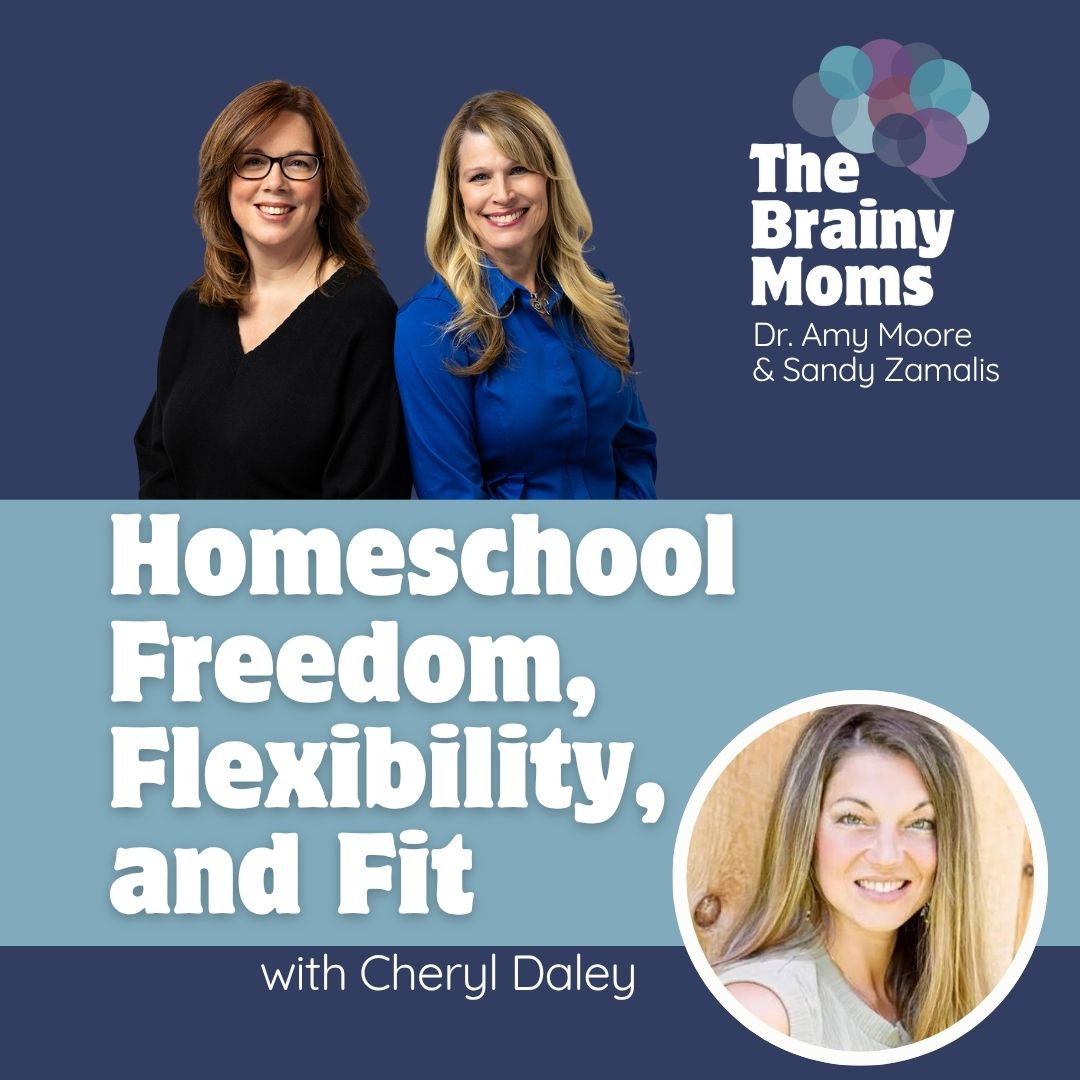
Homeschool Freedom, Flexibility, and Fit | Cheryl Daley
About This Episode
Wondering about homeschool freedom and flexibility? And how homeschooling might be a fit for your family? On this episode of The Brainy Moms Podcast, Dr. Amy and Sandy talk with Cheryl Daley, author, speaker, and host of the popular Homeschool How To podcast, to trace the exact chain of events that took her from a six-figure New York State government career to building a homeschool life rooted in freedom, relationships, and real-world learning.
Cheryl shares why she treated homeschooling like a research project, interviewing more than 120 families to test assumptions about socialization, academics, and what kids “miss” when they don’t follow a standard school track. We talk about deschooling, child-led learning, and the mindset shift from checking boxes to teaching kids how to learn. If you’ve ever worried about prom, sports, or whether you’re doing “enough,” you’ll hear practical ways families create options without copying school at home.
We also dig into reading and literacy through the lens of the science of reading: why phonics fell out of favor, how balanced literacy failed too many kids, and what structured literacy gets right. Plus, we explore the trade-offs of digital textbooks, handwriting, and online learning tools, including how “smart” programs can still be gamed when a child is focused on time instead of mastery.
If you’re curious about homeschooling, curriculum overwhelm, or how to start simply with read-alouds, nature walks, and meaningful projects, this conversation will steady your next step. Even if you’re a seasoned homeschooler, the conversation should resonate with you in validating ways. Subscribe, share this with a parent who’s on the fence, and leave a review so more families can find it.
About Cheryl Daley
Cheryl is a homeschooling mom, speaker, author, and host of the Homeschool How to Podcast. After 16 years working in New York State government, Cheryl made the bold decision to leave her six-figure career to homeschool her children. And she turned her own discernment process into a podcast, interviewing more than 120 homeschooling families to decide whether this path was right for her kids. From those conversations, Cheryl has developed a flexible, don’t replicate school-at-home philosophy that prioritizes de-schooling, relationship, and real-life learning over a rigid curriculum. She’s passionate about helping parents understand how culture and education systems shape children, often by design, and equipping families to build Christ-centered homes that guard their kids’ hearts and minds. Cheryl is also the author of So You Want to Homeschool and the children’s book Let’s Talk Emergencies, which helps families teach life-saving safety skills in kid-friendly language. Through her books, speaking, and podcast, she offers both courage and practical guidance to parents who are curious about homeschooling on the fence or already on the journey. Find her @thehomeschoolhowtopodcast and at www.thehomeschoolhowto.com
Free Downloads from our Sponsor, LearningRx
Download the free ebook, Unlock the Einstein Inside: Wake Up the Smart in Your Child
Download the Brain Training Game Pack
Link to our sponsor’s website: www.LearningRx.com
Listen or Subscribe to our Podcast
 Apple Podcasts
 Google Podcasts
 Pandora
 Spotify
 iHeartRadio
 TuneIn
 Stitcher
 YouTube
Watch this episode on YouTube
Read the transcript for this episode:
NOTE: This transcript was auto-generated by an AI assistant that thinks it’s smarter than we are. It’s not, but it has more free time than we do, so we gave it a low-stakes job. It probably spelled a few things wrong, but we’re okay with that. We’d rather spend our time interviewing cool guests!
Welcome And Meet Cheryl Daly
Dr. Amy Moore 0:00
Hi, Smart Moms and Dads. Welcome to this episode of the Brady Moms Podcast, brought to you today by Learning Rx Brain Training Centers. I’m Dr. Amy Moore here with my co-host Sandy Zamalis. And before we introduce our guest today, we just want to remind you that we have a free monthly newsletter full of tips and information related to all the topics that we cover on the show. Just go to the BradyMoms.com and sign up for free. And now, our conversation today is with Cheryl Daley. Let me tell you a little bit about her in case you don’t know who she is yet. Cheryl is a homeschooling mom, speaker, author, and host of the Homeschool How to Podcast. After 16 years working in New York State government, Cheryl made the bold decision to leave her six-figure career to homeschool her children. And she turned her own discernment process into a podcast, interviewing more than 120 homeschooling families to decide whether this path was right for her kids. From those conversations, Cheryl has developed a flexible, don’t replicate school-at-home philosophy that prioritizes de-schooling, relationship, and real-life learning over a rigid curriculum. She’s passionate about helping parents understand how culture and education systems shape children, often by design, and equipping families to build Christ-centered homes that guard their kids’ hearts and minds. Cheryl is also the author of So You Want to Homeschool and the children’s book Let’s Talk Emergencies, which helps families teach life-saving safety skills in kid-friendly language. Through her books, speaking, and podcast, she offers both courage and practical guidance to parents who are curious about homeschooling on the fence or already on the journey. We are super excited to have this conversation today with Cheryl Daley. We’re excited that you’re here with us today. Yeah, me too. And I were super interested in your unique approach to supporting homeschool families. Like when I think about, okay, you have a homeschool podcast, you have a homeschool book, what makes you different? Um I’m fascinated how you took this basically research approach. I mean, you dug in with 120 different families to see if this was right for you. I want to hear, I want to hear the story. So just share with our listeners uh your origin story for the homeschool how to podcast and and your place in this space.
The COVID Moment That Changed Everything
Cheryl Daley 2:30
Yeah. So I’m like learning right along with the people on Instagram that are probably following my account, right? Like I’m I don’t really have all of the advice, but I’m learning it. And I guess the reason being that I started that way is I’m in New York and during COVID, it was a little bit more strict here than in a lot of states. And they started masking three-year-olds in our daycare where my son was going. And it was a private daycare in a woman’s home. And she said, Yeah, I still have to follow all of the rules though, because I, you know, I do everything by the book. I report to the state. We have auditors walk in all the time. And I was like, Well, that’s ridiculous. He’s learning how to talk. I we don’t want a mask on him. And they were like, we can’t do anything about that. This is how it has to be. And I guess I don’t really like to be told this is how it has to be. Like, it’s my child. I don’t want the mask on him. That should be the final say. I am the parent. I should be the final say in that. And so I guess that was the first time it struck me that, like, when your kids are in these school systems, you are not the final say for your child. So that bothered me. My husband and I were not going to mask him anyway because he was learning to talk. He was learning speech at that time. So, and I remember the daycare lady saying to me, You might want to get a speech looked at. And I wanted to say to her, Well, take off your mask. Then maybe he can understand what you’re saying better and he can see how you’re forming the words and replicate that. But um I was like, okay, well, for sure, putting a mask on him is not going to help any sort of speech issues. So we pulled him out. I was working for the government for 16 years. So I was kind of like, all right, we’re almost halfway there. I can retire at 55 years old, maybe 60 if I do some part-time years when the kids were young. So I hadn’t had my daughter at that time yet. Um, but still retiring at 55, 60 is kind of like the state worker, government worker’s dream, right? You just like count down the days. And I guess I started thinking during COVID too, like, is this really the right way we’re supposed to be living? Because at that time everybody was home. We were working from home. And I’m like, why can’t I work from home all the time? I can get the job done. I can be with my children. Why are we living this way? Why do I why am I rushing everybody out of the house so I can go sit in a cubicle and twiddle my thumbs? And um, so I guess it was a whole whirlwind of things happening at once. And um, I met somebody that had a podcast about something completely different. And he he I said, Oh, who hired you for that? And he goes, You can just you start it. And I was like, what do you mean you start something? Because I had the public school mentality that like I couldn’t just start something of my own. And so I learned how to start a podcast. I said to my husband, I think I’m gonna interview homeschooling families because I’ve been to a couple meetups now because they were the only ones getting together. And with my son out of daycare, I thought, oh my God, he’ll never be socialized, these three, right? Like he’ll end up weird. So little did I know then. But uh, so at three years old, I was taking him to homeschooling meetups, and I was just like talking to these families. They’re like, Well, what do you do all day? And what do you mean you grow food in a garden and you have chickens? And like this was all so foreign to me. But uh I I started kind of branching that out with beginning the podcast. I just had my daughter. I was on maternity leave at this time. What better to you know spend your nights doing is editing podcast episodes while you’re waiting for your daughter to be hungry again. And um, it kind of I I figured I would do like maybe 50 states. Like, what are your rules in Montana and what are your rules in Nevada? And once I did all 50 states, like it’d be done. But everybody’s story was so different. And it turned out that I didn’t even really ask about the reporting after a while because it was more just like, wow, so what does your day look like? What does it look like with multiple kids in the house, or with an only child in the house, or if you’re working in homeschooling, or if you’re in a big city in homeschooling, or if you’re in the country in homeschooling? Uh, that took more of the role of the podcast. And I I did, you know, eventually say I kind of ran out of time in my maternity leave. I had no more leave to take with the the government work anymore. And I said, all right,
Starting A Podcast As Research
Cheryl Daley 6:40
I’m out. I’m just gonna do this. And yeah, we went in uh, I guess full full-fledged there. And it’s been really cool. My kids right now, they’re still young, four and eight. So I’m kind of like learning the how do we get him to read? How do we get this hyperactive boy to memorize phonics skills and and all that stuff? But and and I’m seeing a lot of the things I’m doing wrong too, because we have those fears like, well, grandma’s not gonna think I’m doing enough with him if he can’t read at eight or nine. And, you know, people are gonna ask questions and all of those insecurities. So I think the podcast actually helps me uh in my confidence with no, it’s okay if we’re not spending two hours a day on bookwork. Like he’s right now, he spent his whole morning helping the neighbor with her horse, and she taught him, you know, is teaching him how to ride a horse. So I don’t think without the podcast, I would have been confident that, like, yeah, go spend your morning doing that. We don’t need to sit and do our all-about reading curriculum. You know, that’s enough. Uh, so it’s been cool.
Dr. Amy Moore 7:47
Yeah, I can’t imagine making a decision based on 120 testimonials. Right. Like most people are like, hey, I have a friend who tried this, they said this restaurant was great, let’s go. Right. Uh 120 pieces of evidence, not even related, right? 120 different pieces of evidence for you to consider, right? To weigh. Was there a point where you had already made the decision? It just clicked, or did you wait until you were finished with this process to make the decision?
Cheryl Daley 8:29
You know, I was like, I I know I really want to homeschool, but I still, it was really hard for me to leave the government job because of that. You’re you’re gonna have a pension. And I didn’t even go into government work because I wanted to be a government worker, right? It was just like, I don’t know, I graduated, then I went to college, now I have loans. Uh, my parents were government workers, take a civil service exam, and I ended up doing well. I I left at six figures. I never thought I’d make six figures working for the government, you know. I mean, that that’s like kind of a little crazy. You know, not I and I know that it’s very top heavy too, but there’s a lot of, you know, people that make under that and and retire under that. So I was like going to really be set up for like retire at 55 and probably bring home $80,000 a year for the rest of my life till I die. We don’t have jobs like that anymore. It’s like, oh, you might have a 401k, invest well. It might not be there someday. Like the pension, no, it’s just there. You can do whatever you want with it. So that was huge. I was like, all right, how can we make homeschooling and working work, which you absolutely can do? But I also saw this whole disconnect as I was hanging out with these homeschooling families, like going to these meetups and making friends with the moms and, you know, just seeing the dynamic of the kids. And I’m not gonna say everything was wonderful because there were definitely kids that I was like, ooh, I don’t know, maybe we shouldn’t hang out with them, or parents that I’m like, yeah, I’m not crazy about those people. Um, but but the overall lifestyle of they woke up this morning and they got to choose what they wanted to do with this day. Like, that was crazy to me. It’s still crazy to me that like on Sunday night I can just be like, oh yeah, tomorrow’s tomorrow’s Monday. Where I spent 16 years and probably all through school, Sunday nights being like, oh my God, it’s Monday tomorrow. This sucks. Like, oh, I can’t, I don’t want to do this, you know? And it’s like to not have to live that way, it’s I like I just want to shout it from the rooftop. So, like, you don’t have to do this, people. And there are other ways to make money. Um, we’re so ingrained to think it has to be done this one way. So the 120, that was more just like, I just kept learning more about these families and all the different ways. And this morning I interviewed a woman who’s in Norway and they’re from Germany, and they had to leave Germany because homeschooling is illegal there. And now they’re road schoolers. And they, she told me about this website. I think I still have it open. Um, like for instance, this it’s called Workaway, workaway.info. And she goes, Yeah, we my family just once we we pick a month and go somewhere in the world. We don’t even have to pay for it. We go to this workaway.info, we find a place in the world that we want to go, we stay in their home, or maybe they have like um a cabin or you know, apartment on their property and they might need help with their animals, with their gardens, with some sort of work at their house, which is we just spend a month in this location, a month in that location. So right now they’re in Norway. And uh so it’s like I keep learning this stuff, these things on the every episode, and my mind is always blown. So I haven’t stopped doing the episodes yet. But but I think if anything, it’s Imore also tells me that like there’s no wrong way to homeschool either. There’s no right way and there’s no wrong
Real-Life Learning Over Seat Time
Cheryl Daley 11:44
way.
Sandy Zamalis 11:44
How did you get your husband on board?
Cheryl Daley 11:48
So he’s funny because like he’s always been the conservative, and I was always super liberal. And like, remember back in the day when like nobody really cared who was liberal or conservative? And it didn’t even mean anything because like because I was liberal, it just I felt like, oh, it’s just I want to be nice to people, and the other side must be horrible people, right? So that I think during COVID, a lot of our eyes woke, you know, opened up, and I started, you know, kind of learning about like the vaccine issue and kind of being like, oh my God, but maybe I don’t want to give my kids everything on the schedule. And I started looking into that and like, man, were they lying about things? Like they wouldn’t lie to parents, would they? And then it was like, well, are they lying in the in the education system too? And in the pharmaceutical industry and the food industry, what are they putting in our foods? And so that sort of took me to like, yeah, Chris, I don’t, I don’t think we should send them to school. Like just for the sheer fact of loan of like, what are they gonna be eating? I could send them with all organic food. They could throw it out and get the free meals there. And he was like, Yeah, don’t send them. School was a waste of time. And and I remember being like, oh my God, but they’re gonna miss the prom and they’re gonna miss football games and they’re gonna resent me and they’re gonna hate me for the rest of my life. Like, I don’t know if I can do this. And I think he just told me recently, too, he’s like, I never went to my prom. And I’m like, wait, you didn’t go to your prom. This has like literally been the whole reason I’ve been interviewing all these homeschooling families to see if these kids are gonna hate me for not having a prom. And it turns out they do have proms for homeschoolers. You can make your own prom, they can be a date to the school prom. They can attend football games at the like, it’s it was just the stuff I was worried about was so silly, but it is what we’re worried about before we dive into homeschooling. So he was totally on board. He thought school was a waste of time when he was there, and he just wanted to get out and work. He he worked on horses, he worked on tractors, he worked on cars and school. So, like to him, school was a hindrance once he got to the age where he could actually make money. And he didn’t think it really taught him anything that he needed to know. Everything was on the job, you know, hands-on learning for him.
Dr. Amy Moore 13:58
Well, I think that, you know, the political divide illustrates this.
Why Standards Miss Real Learning
Dr. Amy Moore 14:03
But we tend to think in terms of dichotomies, right? Either or like you’re either a homeschooler or
Leaving A Six-Figure Career
Dr. Amy Moore 14:10
you’re a traditional schooler, um, you’re gonna get to go to prom or you’re not gonna get to go to prom. Like there’s so much nuance and there’s so much both and um in the homeschool world that when you realize that it’s this aha moment that you can basically curate the life that you want for your kids. Uh and yourself.
Cheryl Daley 14:31
And yourself. Like I never knew starting a podcast was something. Like they busy us so much in school that you actually don’t have the time to be bored to figure out what you might enjoy when you’re older.
Dr. Amy Moore 14:44
Yeah.
Sandy Zamalis 14:45
I was listening to some influencer to uh today, this morning, there was a video that popped up that was uh it was a teacher railing against the homeschoolers and um how much they, you know, don’t care about their child’s education. And I was like, where do you get because and I think it stems from not sticking to this state standard plan. Like, so if you’re not on this track, then you clearly you don’t care about your child’s education. And I was thinking to myself, I don’t know a homeschool family that doesn’t care a hundred percent about their child’s education and their trajectory. And just because they’re not following this list of things that we feel the need to check off to make sure we’re educated, that that does not mean that a parent doesn’t care.
Cheryl Daley 15:40
And what do you remember now that you learned back then that really helped you get to where you are today? Like, was it that chapter on the Aztecs, Incas, and Mayans that I don’t really remember even where they were? I’ve learned more about that now, homeschooling my kids than I ever did back then. It wasn’t interesting, it wasn’t relevant to my life. You know, um, now that I’m homeschooling, I’m like, did you know the Erie Canal is like right outside our door? People dug that by hand. Tell me more. Where did they come from? How did they do it? Like, what were they doing this for? How did it change New York and America? And it’s literally in our backyard. I have driven over the Hudson River and past the Erie Canal for 42 years. Not one teacher in school ever taught us about it. And it’s in our backyard. I mean, to me, that’s like, and it’s so interesting. Even the Revolutionary War took place right in our backyard here. Never learned anything other than this is what you learn in the textbook, and the kids in New York are learning the same thing as the kids in Texas and Montana and Oregon. But to us, you know, it could have been really interesting because it’s right there, just like something, you know, the Dust Bowl might have been super cool for someone else to learn. Um, but uh it to me, it’s like there are so many more interesting ways to learn things than through that dry textbook, too. So when they say you don’t care about your kids’ education because they’re you’re not sticking to the standards, well be your kids, if it’s not relevant to them, they’re not gonna remember anyway. But if you can teach something that’s relevant to them, like, yeah, let’s go check out where they started the Erie Canal and like see where they dug and how did they do it and watch a video on it and read a book about it. Um, take, you know, take a trip. Let’s drive the Erie Canal from one end to the other and see how long it took us to drive, and then think about them walking it with like they had like donkeys or something pulling, you know, the boats in parts. And it’s there’s just so history and everything in the world is so cool. And I feel like school makes finds the most boring way to teach it and makes kids sit through that.
Dr. Amy Moore 17:55
Yeah, I was taking this marine biology class in college, and my school was right on the ocean. And so we were in the water, you know, pulling barnacles off of the dock pylons. We were on a boat looking at the striations in the sand, you know, on the cliff side where the water had kind of washed that away in the erosion. And me, we were standing on the beach watching the loggerhead sea turtles create their nests. And I just remember thinking, I will remember every single detail of everything that I’m learning right now because I’m immersed in it. And so how cool would it be for our kids to remember every single detail because they’ve been immersed in it? And what better way to make that happen than when your mom or dad can curate those experiences?
Cheryl Daley 18:49
Yeah. And I think we are we feel that every kid has to learn the exact same things. Like just like you were saying, Sandy, that you know, oh, they don’t care about their kids because they’re not on the state, you know, timeline of what they should know. But I mean, there’s so much that they’re not teaching kids in school to. So it’s like who decides what they should know and what they shouldn’t? There might be something more important to like a child growing up in a big family on a farm in New York that maybe a kid in a different state doesn’t need to know or doesn’t care about. So it’s like where and I know exactly where it came from. Okay, from the Rockefellers, starting the Board of Education in the early 1900s to make sure everybody was on the same playing field and that they played it off like we want everyone to have the same opportunities, and that’s all well and good. But everybody’s different and everyone’s gonna have different interests and different things that they like in life and don’t like. And um, you know, when you can really like lean into what the kids like, like I know, you know, we talked about that when you were on my podcast, Dr. Amy’s um, you know, seeing what let your son up and kind of like, oh, that’s the way that you want to go, you know, in the direction, then maybe you don’t have to sit there and learn all of the pre-calc and all that other stuff that they might not might not be relevant to them.
LearningRx Sponsor Break
Sandy Zamalis 20:10
And now a word from our sponsor, Learning RX. In middle school, Kevin had given up on learning because of his reading struggles. His parents had tried everything and they were losing hope until they enrolled him in the cognitive training and reading programs at Learning RX. It was hard, but he gained confidence as he strengthened his memory, attention, processing speed, visualization, reasoning, and auditory processing skills. Years later, his mother wrote to us that Kevin has graduated from college and is beginning his master’s degree. He’s a military officer and is married with his own children. He’s thriving in life, in learning, and in his career. We can’t promise your child will have the same results as Kevin, but we love to talk to you about our brain training programs. If your child is struggling with reading or learning, talk to the team at Learning RX to see if we might be the right fit for your child. Visit LearningRx.com slash the Brainy Moms to learn more and receive a cognitive skills assessment with a consultation for just ninety-nine dollars. That’s LearningRX.com slash the brainy moms.
Dr. Amy Moore 21:18
Yeah. Um oh go ahead, Sydney. Oh, go ahead. No, you go ahead.
Analysis Paralysis And Teaching Reading
Sandy Zamalis 21:39
You know, moms and probably dads too in the mix where you’re just kind of working through. I guess my question to you is how do you not get into analysis paralysis at some point with all of this data coming into you and figuring out, well, which way do I go or what do I do? Um, because not every I I was definitely a just Jump in or just I we’ll figure it out. We’ll just jump in and go. Um, when I started to homeschool my kids. But my husband probably would have preferred I did it your way. Like had a plan. Or at least not maybe not had a plan, but like, you know, made sure that there was enough data points that there would be some success. Did you ever feel that paralysis of, yeah, I do all the time.
Cheryl Daley 22:24
I mean, I I’m right now in the middle of making like a five-part series of reels for Instagram on like all the attempts at me trying to teach my hyperactive son how to read. But then I had Dr. Amy on last week and she was like, Yeah, it’s not the curriculum.
Prom Fears And Getting Your Spouse On Board
Cheryl Daley 22:40
Your kid either wasn’t ready or has a like a skill gap or a content gap, and you gotta figure out which one it is. So um then it’s like, okay, if we didn’t need any of those curriculums, we could have just waited until you were probably cognitively ready and interested in learning to read. And then it would have come like that. But as long as you are reading to them. Uh and you know, I’ve I’ve heard that a lot of times too from most homeschool parents will say it does not matter what age your child learns to read, if there is no um like skill gap, if there’s not a dyslexia or you know, um, then they’re just their brain, it takes a little bit longer for some kids to have those synapses connect and learn, but we still get, I think, uh insecure in ourselves as parents, as their primary educator. So yeah, I think that I like I have so much information. I know that this child-led learning is a real thing, and we’ve seen now that there are kids that graduated, you know, as unschoolers, quote unquote, where you sort of just let them take the lead and what they’re interested in, and then you move forward with that. And I don’t know that I can be that loosey-goosey with it because I am like a little like type A, and you know, I don’t want to be blamed if he’s still living in my basement at 30 years old. But um I but I think I do think like the overwhelm of like knowledge stuff can be detrimental for sure. It might have been easier if we just went into it like, all right, everybody likes the good and the beautiful, let’s just get that. And we just went with it. And I didn’t feel like, but a different one might be better, but a different one might be more fun, a different curriculum might be easier, you know. But I think at the same time too, it probably if he’s gonna learn to like read solidly at age nine, like that’s just gonna be what no matter what curriculum I have or not. So yeah, I definitely feel the overwhelm, and I’m sure most parents do, especially the parents that weren’t homeschooled themselves, like if they went to public school, you know, I hear more confidence in the parents that were homeschooled themselves. That, you know, it’s just, you know, we get up, we do our chores, we read a book together, read a couple books, we we have the family time, the meals, do a little bookwork for an hour or two, and then go do our activities. And, you know, I’m like, yeah, that sounds good to me. And then something else pops up, and I’m like, oh, ukulele, you should take that. So yeah, he’s probably gonna resent me. All this that I’m doing for him, he’s still gonna grow up and be like, oh my gosh, I’m loving it.
Sandy Zamalis 25:29
I promise it won’t happen. It won’t happen at all. My kids loved, I mean, there was a time maybe uh when my kids did end up going into public school later on. And I know we had conversations where they were just like, Mom, you know, you made it too hard. Because at that point I was starting to worry that I was missing things, right? And I wanted to make sure they had what they needed for the next stage. But now as grown-ups, they they yeah, they they think they had the best childhood.
Cheryl Daley 25:56
So oh good.
Sandy Zamalis 25:57
It’ll all turn around.
Cheryl Daley 25:59
Yeah. And he oh, he loves it. He doesn’t want to go to school. He likes his freedom.
Dr. Amy Moore 26:04
Right. Well, I think when you are adapting your approach to what fits your child, why would they want to give that up?
unknown 26:14
Yeah.
Dr. Amy Moore 26:15
Right. Like why? I mean, that’s that’s what makes you passionate about learning new things. You know, I so I was a licensed teacher and a curriculum specialist before I was a psychologist, and I think we talked about that. And um it’s funny, you would think that my instinct would have been to try to recreate a traditional school environment in my home when we pulled Evan out for high school, and that was the last thing on my mind. Oh I literally said, I know what my kid needs, and it’s not that.
Cheryl Daley 26:56
Yeah.
Dr. Amy Moore 26:57
Right. And so I like I define it as unschooling. Um, the reality is he, you know, he did college courses at the same time, but I was giving him credit for symphony participation and you know, youth ministry and running the coffee bar at church and all these cool things that you do as an unschooler, right? But he was also taking college classes. So I feel like you call yourself a traditional eclectic unschooler. So I kind of feel like, is that similar to what I did? Maybe I should add another adjective when I describe to people unschooling my old my youngest. I don’t know.
Cheryl Daley 27:36
Yeah, I don’t even I feel like we all ebb and flow with, you know, on on the little scale of the traditional, like, you’re gonna sit down and do, oh, what is that one that was like the only curriculum in the a becca?
Dr. Amy Moore 27:51
Right.
Cheryl Daley 27:52
Sit down and do your a becca, right? To the unschooling approach. And and yeah, there are days where I’m like, we gotta sit down with this workbook. You you’ve gotta learn like when an O and an A are next to each other. What that what sound that makes? Um, and I’m learning like as I’m like, wait, what? I never I don’t remember learning that in school. When do you think when do they bring about phonics?
Sandy Zamalis 28:17
I think it uh phonics has been around for a long time. Um and I don’t know the year dates. Amy probably knows them better than me, but it ebbs and flows, like
The Science Of Reading And Phonics Swings
Sandy Zamalis 28:25
it goes in and out of favor.
Dr. Amy Moore 28:26
Well, right. They like that’s what we taught in the 50s, 60s, 70s, and then in the 80s, that whole language camp decided we were boring children with phonics. So let’s just immerse them in print-rich environments and read to them and they’ll learn by osmosis, basically. That is not the term they used, but that is what happened. And then um, once we were graduating kids that were illiterate and the No Child Left Behind committee came on and said, okay, we got to go back to Duphonics, but we’re not gonna just do phonics, we’re just gonna sprinkle a little bit in to that whole language approach. And they called it balanced literacy. And then the next time the nation’s report card came out, and we still only have 30% of American children who can read uh at a fluent uh level, they said, okay, we’re gonna swing the pendulum back. And so that’s when we looked at all of the research, the neuroscience research, the psychology research, the education research on how the brain learns to read. And that’s when we finally had this consensus on the science of reading and that a structured literacy approach was the only way to make that happen. And so that’s when we said, all right, we’ve gotta do all phonics. Like that is that has to be our primary focus, or we’re gonna keep graduating kids that don’t know how to read. So luckily, um we have seen that shift. But like what you and I talked about, you know, the problem is they’re not addressing brain deficits at the same time. So, were you talking about when was phonics introduced, or when in a child’s education do we introduce it?
Cheryl Daley 30:09
No, exactly what you explained, because I would have been in school all through the 90s, and I definitely don’t ever remember them teaching me phonics skills. The only time I ever heard the word phonics was that commercial on TV. Hooked on phonics hooked on phonics called 1-800 phonics. And I was like, oh, that must be for the dumb people, you know. But meanwhile, here I’m not learning any of it. That’s why I’m not sure. Right. Yeah. Yeah. I don’t uh as there, as the curriculum is teaching my son this stuff, I’m like, oh, well, that’s nifty. I didn’t know that that, you know, that’s why that did that, or you know, these little tricks. So yeah, I grew up in the era of the no phonics. Yeah.
Dr. Amy Moore 30:59
Well, I I went through my teacher education program in that era. Right. So it it that was in the, you know, late 80s, early 90s. And so I didn’t learn how to teach phonics until well into my career.
unknown 31:16
Wow.
Dr. Amy Moore 31:17
So came out of that with a teacher license, not knowing that.
Cheryl Daley 31:22
But isn’t that case in point right there? You didn’t learn it in school, but on the job, you learned that you had to teach phonics. So you just learn how to do what your new job, you know, was asking of you to do. So why do we need this whole like 12 plus four more years plus sometimes more for every job, right? And I don’t, you know, as we I think a big part about what makes us scared to homeschool as well is like like we don’t take enough time to think about what our goals are for our kids. Like we just assume, oh, they’re they’re gonna be in kindergarten, we have to enroll them. We don’t think about why. What is what do we want for our child? Do we want them to, you know, be an entrepreneur, have their own business, um, do we want them to travel the world, be bilingual? We want them to have a homestead and like live off the land. And obviously their goals will change with that, but we just kind of like all follow suit of this cookie-cutter education without even thinking about why we do it. And when you think about the education system today, and particularly the college system, I think people’s eyes are sort of waking up to like, wait, maybe we all don’t need college. And and I think it’ll be going back to the way that it used to be, that certain jobs require it and and people will go that need those degrees. But it really somewhere along the line, and I’m sure by design, they were like, everybody’s gotta go to college. And and like, what is happening to all that money that’s getting siphoned into the college system? Is it is it going back to the students? Cause I don’t know. Um call me crazy, but I feel like there is these billions of dollars. And then you know, they talked about the college loan and college loan forgiveness. And what does that even mean? We’re taking out $300,000 worth of loans, say, to go to school for if you’re getting a master’s degree, six years. And if if like to the best of my knowledge, what I have been told is that when you take out that loan, the money goes to the school. Like the school’s paid. The bank is the one that’s not paid, right? So if you don’t pay off your loan, your $300,000, plus really probably six to nine hundred thousand because of the interest that accumulates over the 20 years that you have it. If you don’t pay back that half million dollars, the bank is the one that doesn’t have like your the university has it already. You’ve paid them. So that’s an interesting concept too to think about. Like, what are they doing with all of this money when a lot of times like they’re not carrying textbooks anymore? The you have the computer, the laptop. Like, uh, what’s going on? It’s a good question. What is going on? And then we’re bailing out the banks again. It’s just a cycle. It’s a cycle. We gotta break it, we gotta stop the cycle.
Sandy Zamalis 34:12
Well, I think to your point, yeah, it’s it we’re it’s about teaching our kids how to learn, not what to learn, right? So if we put it in that box or frame, um, that I think you know, to your point, Cheryl, is what we’re missing in our typical education trajectory is our kids are just part of the assembly line versus, you know, a part of the learning process where they get to enjoy that learning, they get to be immersed in it, like Amy was sharing, or you get to, you know, learn about something cool in your backyard that you maybe never noticed before. Because it’s those kinds of things you need those hooks in order for the brain to learn those things anyway. And, you know, textbooks had their place for sure in time. And
Paper, Screens, And Memory Anchors
Sandy Zamalis 35:00
I don’t know, there’s a whole argument to be made that technology’s influence in education. Um, I don’t know that it’s helped us in that immersion type. I mean, yeah, it’s cool. You could maybe, you know, go someplace you’ve never been before via the internet, but it’s not helping you process, you know, basic learning skills as efficiently or effectively as, you know, more hands-on multimodal approaches would.
Dr. Amy Moore 35:28
Well, and there is some research to suggest that the digital textbooks are impeding uh memory for the information because we anchor information based on its location on the page. And as we recall it, we can we can recall, okay, that information was about midway through the book, halfway down the page, it had this image next to it. That I mean, that part of our memory is part of recall. And when we have a digital textbook where it’s just a constant scroll of pages, we don’t have that visual anchor to recall that piece of information. So it does make um rote memorization much more difficult.
Cheryl Daley 36:20
That’s so interesting. I’ve never thought about that before, but it’s so true because I’ll be listening to say a podcast or an audio book. And you know, if you like pick up later, but you weren’t really sure exactly where you picked up. And when you hear them say a line that you, oh, I remember them saying that. And I was about two minutes from the house when they said it. You know, I was I remember I was driving by the neighbors at that point, so I’m almost to the part I need to get to. Like that’s sort of the same kind of thing.
Dr. Amy Moore 36:49
Oh, that’s so funny. Yeah, infir stories or novels, you know, like audiobooks, that’s one thing. But when you’re reading to learn something, especially when it’s technical information or more difficult concepts, like a lot of the things that you’re learning with a college textbook, um, sometimes having that paper book and that ability to make notes in it or highlight it or stick your sticky note in it, like those are all memory anchors. And so I I believe we’re doing kids a disservice by not having that as an option for those difficult courses.
Cheryl Daley 37:28
Do colleges not have textbooks anymore?
Sandy Zamalis 37:33
They do. I think a lot of them are available online, though, just like anything else. Um and again, so you’re having cheaper, the digital version is cheaper. Right. Okay. Oh wow. Yeah, no, you’re totally right. Uh we didn’t get us on a tirade about note-taking because right?
Dr. Amy Moore 37:50
Like if you don’t put it in your handwriting, you don’t encode it in your memory the same way you do as when you type it. And so For sure.
Cheryl Daley 37:59
Yes, absolutely. No, I believe.
Sandy Zamalis 38:01
Can you tell we love to talk about this stuff, Cheryl?
Cheryl Daley 38:04
No, but it’s so great. And and and it’s important because people need to realize why the kids are coming out with lower literacy rates. And, you know, they it can be tied to something tangible here. They need something tangible in their hands.
Sandy Zamalis 38:18
Well, and I think, you know, there there are some studies showing that’s why homeschool kids have a little bit of an advantage in a lot of different areas because they are doing some of these, like in terms of like getting into college, those kind of statistics. Um, even hiring, I think there’s been some, I’ve heard some reports about um homeschool kids just being more desirable because they’ve got more ability to be flexible, they think a little bit more on their feet. If they’ve had that kind of environment that they’ve grown up in, you can spot them. You’re like, you know, they’re not afraid to jump in. Um, they don’t have to be fed everything or handheld in every single um learning task. They’re able to kind of problem solve.
Cheryl Daley 39:03
Yeah, and it’s funny because as as you know, you’re saying this, I I’m I kind of like kicking myself for giving my son the last reading program that I gave him, even though it was a good reading program, but it was called um reading horizons, but it was online. And it looked like they put it online like back in the 80s. Like this was like the first online program. It wasn’t high-tech or anything like that, but I let him do it because we do butt heads. And I was like, all right, he’s having a problem learning from me. And one of my podcast guests was like, I don’t know, all my kids have learned from this reading horizons. I’m barely even a part of it. I just tell them to sit there for 20 minutes a day, and they do it and they all know how to read, and we’re good. So I was like, all right, let’s give this a try. And I I like the program, it was phonics-based. Um, and I would give him sort of the authority to like when in the day he’s gonna do his 20 minutes on it, and he would set his little timer. And what I noticed, and and this is moving forward into the AI world because I think this is exactly it’s the good part and the bad part about the AI education that I think will be coming down the line is that, you know, when your kid masters something, it moves them along. And when they haven’t, it circles back so that they can either learn it in a different way or just repeat it over again. So that’s all well and good. I understand that in a lot of ways that’s that’s great. For him, though, he was like, I just have to sit here for 20 minutes. Like it doesn’t matter if I answer these things right or not. When 20 minutes is up, I can go ride my four-wheeler. So he would do the thing, but like not actually read it. You know, and I’d be walking by and I’m like, Are you reading that? Yep, yep, mom, I got it, I got it. And it’d be like, oh, you got two right out of four, two right out of five. So it was just circling him back like the whole year. So eventually I like called the company. I’m like, is there something wrong with our program? Like, my son is not graduating from this first grade level. And it’s been like a year and a half. They’re like, oh yeah, if they don’t get it right, they just repeat it. So he just keeps repeating the same stuff. And I’m like, all right, we’re gonna go back to paper and do this the right way. But I, you know, ooh, sorry. I like to tell people that because yeah, I I this is something I learned and I knew it should be a physical book, but I was like, you know, maybe, maybe for some personalities it’s better. I’ll I’ll I’ll let them try this. But that’s what didn’t work for us with that one, even though it was a great program. And I think you can get their program in a book as well. We were just cheating. But yeah, I definitely saw that that was a little detrimental to him, but maybe you learned something.
When Online Programs Backfire
Dr. Amy Moore 41:41
So um, as you have kind of created your own philosophy of what homeschooling should look like, right? Like you looked at all of these different success stories, and I’m I’m sure you heard about failures too, I assume. Um where have you landed? Like what is what is your kind of lens through which you approach homeschooling? And if somebody came to you and said, I’m considering homeschooling my child, what’s your advice? What would you say?
Cheryl Daley 42:17
So I think the lens that I’m looking through, and again, I think I’m still learning, or maybe it’s just that all of us as parents, as homeschoolers, you know, we are always gonna be evolving because our kids, what whatever season they’re in, you know, we’re gonna try to accommodate. But I also find that if you make their life too easy, like that’s not good either, right? Struggle makes us better people. Um, so I try to give myself grace. And when I do things like spend a year and a half circling around a first grade online curriculum, um, you know, that like, hey, that’s okay. I learned from it. It wasn’t a complete waste of time. Like he learned something about it. Now we’re gonna sit down and do this together. We’re gonna have fun doing that too. Um, so I’ve definitely learned to like give yourself a little bit of grace. You’re not gonna do everything 100% right because there is no 100% right. And I think you had a similar takeaway when you came on my podcast. Like, there is no perfect homeschool mom. There’s no perfect mom, right, in the world. So stop thinking in those terms of like, am I failing them? Am I not? I think failing, failing your child means that you don’t give them any attention and you don’t care about their needs at all. So if you’re homeschooling them, chances are you care about them in some way, okay? Because you’re thinking, let’s take this bold leap and step outside of the norm and try to figure out a different way to do this, if it could be better. So right there, I think you’re not failing your kids. Um, like you said before, Sandy, like teaching them how to learn, how to be good learners, that’s the number one thing right there. Right. So if I can make kids who are confident to talk to adults, Are confident to search out information, are um, you know, instead of like can read by age eight, do they love stories? Do they love hearing stories? Whether someone’s telling them a story, do they love me reading to them? You know, that’s sort of what we should be striving to cultivate versus we can check a box, reading done, age eight, got it, I’m successful. No, it’s we read together every day, and maybe my son or my daughter is 10 and they still don’t read on their own, but I read to them every day. That’s success in my mind. Um, and I think a lot of homeschoolers would agree with that. I think if someone came to me, which you know often they do, I want to homeschool, but where do I even begin? I’m not confident in this. I would say, which is part of my free guide for your first 30 days of homeschooling, like, first, don’t even think about curriculum. That’s like not, it’s something you you can take the whole year off of curriculum. Deschool yourself. Um, so don’t worry about any of the curriculum. I would say go to hslda.org and learn your homeschooling laws in your state. Uh, you can go right onto that website and click the state that you’re in. And then I think if you just scroll down a little bit, um, it might say like my laws in my state or guidelines in my state. And that’ll tell you exactly what you have to do to maintain, you know, proper reporting requirements. So write that down by hand, because then you’ll remember it better. And and just, you know, become confident in what you actually have to do because it’s really not. I’m in New York, which is one of the most strict states, and it’s like not any different than I used to have to fill out for my employees. So, like when I was in government work. Like, okay, guys, for the next year, this is what I, this is what our goals are. We want to get you to be able to, you know, answer phones and not have any complaints. Um and then every quarter, you just tell the school what you did. Did they succeed? Did they improve
A Practical Homeschool Starting Plan
Cheryl Daley 45:55
at all? What should they improve on next? Is literally all I did as a supervisor in the government. So you can handle it, guys. So it’s really, you know, it’s different every state. Some states you don’t even have to report. Some states, you know, they they I I I know Connecticut just had a law saying that they’re like, need you need their approval before you can homeschool. So we do have to be on the lookout, make sure none of these laws creep into the other states. But um that might be that might be the strictest thing. And even then, there’s probably nuance to that too. It probably might be more of a like headliner to get you to read the headline. But I would say read to your kids every day. Read aloud Revival has fantastic book lists. If you’re someone like me, I went to public school, my parents never read to me, I don’t remember teachers ever reading to me. So there was a book here and there by the librarian, I think. But so I I started homeschooling and people would talk about literature, literature, read your kids literature. I’ll be like I don’t, are you talking about books? I don’t, what is literature? So I rely on the parents who have done this before me, like Sarah McKenzie from Read Aloud Revival. She has fantastic book lists, and I go on. You can pick like the season that you’re in. Okay, it’s springtime. Let’s all these books about spring, and my kids are these ages. These are the books that they would love. And they do love them, and I love them too. And um, so I would say just and then nature, walks, and games, like The Poppet, or we love skipbo, or you know, board games, card games, any sort of games. Just so just go out, explore where you live. Like you don’t have to travel that far. You can travel local parks, local mountains, local trails, local ponds, local, you know, historical places, where you live, museums. Like all of that is out there. And I feel like I never went to go visit any of it when I was a kid because I was too busy with school and and whatever other activities they put you in. Um, so like just take a year to explore that. Don’t worry about the curriculum, play games together and read together. And that’s it. That sounded like a lot though.
Dr. Amy Moore 48:07
No, I think listening, right? Parents could relate to something in that list, right? They could get inspired by something from that list. And so speaking about inspired, um, as you did all of these interviews, was there something that stood out to you that gave you this eureka or this aha moment where you said, yes, I’m gonna try that? That sounds amazing.
Cheryl Daley 48:37
You know, there are different people, like I love talking to the road schoolers and world schoolers and like hearing how they do it. And I guess in my mind, I’m like, oh, that’s what we’ll do one day. Like, I would love to get an RV and you know, if I can get my husband to retire early and drive across the country and stay at different, you know, places and just really see the world. And I’ve I’ve even had people that listen to my podcast, that world school, pull into my backyard basically, like, hey, can we come meet you? My husband’s like, Oh, you’re gonna get killed one of these days. But um, but you know, I think I’m inspired by so many, and even like the the people that you know, Sarah McKenzie with Read Aloud Revival, and she was on the show. Um, just like, oh, I can I can order the books from your book list and they come right to your library for free. I can go on an app, order books that she has recommended, somebody smarter than me, and they come to the library and it’s all free. You just go and you pick up it’s like free curriculum. Um, that was sort of an aha moment. Like, this just happens and nobody’s like shouting this from the rooftop. This is so crazy. And oh, like I had I had Dr. Peter Gray on who wrote Free to Learn, and his son, the whole reason he got into writing that book was because his son was like, I’m done with school. I don’t want to be told what to do anymore. And he was nervous that this sort of unschooling approach or childhood learning was going to fail his son. So he went in and researched how what is the outcome like of kids who did this that actually just like go to this um, what was that school called? It escapes my mind, but somewhere in the States, they go to this school all day where they’re really not told what to do at all. They might have a project that they have to do, but they’re not like guided on it. It is sort of self-guided, and they can ask for help, of course, but they’re not told like this is due by this time, and this is what you have to do, and these are the steps. They figured it out on their own, and they spend the rest of the day maybe bringing in their guitar or writing poetry or bringing in their pain. And he was nervous that that wasn’t gonna work. And then lo and behold, he now advocates that you are free to learn, you do not have to be con like bound by the confines of the school. So I guess there’s a lot of of little ones throughout the way, and I just hope I remember them as my kids get older.
Sandy Zamalis 50:59
What I love about you, Cheryl, is um you have a sense of wonder still about this whole journey. Like you’re just like in amazement. I give and I think that’s like addictive. I it’s no wonder that you’ve had such a following because yeah, everyone just wants to say, what what are you gonna figure out next? You’re on a journey and we just want to go along with you.
Cheryl Daley 51:21
I think I feel like I’ve just been like trapped in a hole for you know 38 years until I started homeschooling. And it was like, you want to know was a big aha moment for me, and you kind of mentioned it before. Um, I think Dr. Amy, you we were mentioning, oh, maybe it was you, Sandy, that like things that are going on outside that you might be missing, right? Last spring, a bird made a nest, you know, the the robins made a nest outside my daughter’s window. And we watched this whole process from the birds making the nest to laying the eggs, to sitting on the eggs, to the babies hatching, to bringing the babies their food, to the babies
Wonder, Nature Journals, And Closing
Cheryl Daley 52:00
flying away. So this whole process was like three weeks long. I had my kids like make a little journal, and you know, they just kind of drew a picture of each each day something bigger, you know, that happened. Oh, the eggs are here today. Okay, that’s day eight, and they just kind of draw a nest with some eggs in it. So they journaled this whole process. And I’m like, man, if I were in my cubicle and they were in daycare right now, we would have missed this whole thing. So I’m like, what else goes on in this crazy house here that we just miss when we’re we’re all out, you know, for our whole lives. It it’s not so that really inspired me too. And that was just in my own home.
Dr. Amy Moore 52:40
Yeah, that’s the whole foundation of the Regio Amelia approach to learning, right? That the curriculum emerges from the environment, from the children’s interests. And so it was funny. My mom ran a Regio Amelia inspired day school. And um, I would that was my first teaching job. And so everything was project learning. And um, there was always a spider project happening because there were always spider webs somewhere outside, right? And so the same exact process that you were just describing is what we would do with our class. And anyway, uh, long story short, the other day, um, my mom says from the dining room, hey, we could do a spider project. I was there because I was like, what in the world? I didn’t know what to do. What are you talking about, mom? And she’s like, There’s a spider outside the window, right? Like her mind automatically went there, right? Like, let’s investigate. Oh like it’s a lifelong curiosity, you know, for what happens in our world.
Cheryl Daley 53:44
So And for so long I was like, yeah, that’s not me though, because like I didn’t grow up that way. I don’t even know. Like that sounds overwhelming to be one of those people, but it happens naturally and gradually, so you’re not overwhelmed. You know, one day you learn how to make sourdough bread.
Sandy Zamalis 54:00
The next day you have to a lot of it’s inspired by our kids, right? Because it’s through their eyes that we’re being pulled into these things to remind us of what’s going on. Exactly. Yeah, exactly.
Dr. Amy Moore 54:15
Well, Cheryl, for the few people that might not know where to find you, please share with our listeners uh where you are.
Cheryl Daley 54:22
Yeah, I’m at the homeschoolhowto.com and on Instagram mostly at the homeschoolhowto podcast and Facebook as well, same the homeschool how-to podcast. Yeah. So I kind of try to document what I can, what I’m learning, what I’ve learned, what I mess up on, and a lot of anti-government stuff.
Dr. Amy Moore 54:42
Well, thank you so much for spending this hour with us and blessing our listeners with your insights and your experience and you know what you’ve learned uh throughout your journey. Um, it’s been fun talking to you.
Cheryl Daley 54:56
Oh, thank you so much for having me on.
Dr. Amy Moore 54:59
Listeners, we love it that you choose to spend this hour with us every week. If you want more from us, you can find us on social media at the Brainy Moms. You can go to our website, theBrainymoms.com. Be sure to sign up for our free monthly newsletter. You can find Sandy on TikTok at TheBrainTrainer Lady. That is all the smart stuff we have for you today. We will catch you next time.